

The invisible tripwire: Why first-year compliance errors cost millions
When regulators fine an online casino, the headline rarely mentions that the operator was only six months old. Yet in 2024-2025, most seven-figure penalties in iGaming occurred within the first 18 months of launch. New brands enter the market with an innovative front end, generous bonuses, and slick onboarding—but their Know-Your-Customer (KYC) and Anti-Money-Laundering (AML) processes are still a patchwork of spreadsheets, outsourced vendors, and last-minute decisions.
If you are about to launch or have just opened your digital doors, use this checklist of the ten most common errors to avoid an expensive lesson. For each mistake we include an actionable fix, plus a note on how an all-in-one platform like Spinlab handles the heavy lifting.
1. Treating KYC as a single checkpoint
The mistake: Many startups verify players at registration and then store the documents in a static folder. Ongoing checks—such as changes in credit card BIN country or sudden VIP-level wagering—are skipped.
Why it matters: Criminals often pass the initial screen, then launder funds by gradually increasing bets or withdrawing via alternative methods weeks later.
The fix:
- Implement continuous risk scoring that is recalculated every time the player deposits, withdraws, or changes profile details.
- Adopt dynamic triggers. Example: a user who goes from €50 to €5 000 weekly wagers should automatically move from “standard” to “enhanced due diligence.”
How Spinlab helps: The platform’s real-time analytics engine recalculates risk scores on every wallet event and can auto-lock withdrawals until additional documents are approved.
2. Relying on manual document review only
The mistake: Small compliance teams believe that a pair of human eyes is more accurate than automated verification. During busy periods (e.g., Saturday night sports), backlogs explode.
Why it matters: Slow KYC is the top driver of player churn in regulated markets. It also creates a vulnerability window where fraudulent accounts can transact before being checked.
The fix:
- Combine automated OCR and biometric liveness with manual review for edge cases.
- Set SLAs: 90 % of standard KYC files should be resolved within two minutes.
How Spinlab helps: Out-of-the-box integrations with Sumsub and Onfido provide sub-60-second checks, while suspicious or unreadable documents are escalated to the back-office queue.
3. Skipping geographic risk scoring for gray markets
The mistake: Accepting players from “tolerated” jurisdictions without assigning them a higher AML score.
Why it matters: FATF listed countries carry an increased risk of terrorism financing. Regulators expect operators to apply enhanced controls or exit the market altogether.
The fix:
- Maintain an updated risk matrix keyed to ISO country codes.
- Automatically request proof of address for medium-risk geos and source-of-funds for high-risk geos.
How Spinlab helps: The compliance module fetches updated FATF and EU lists daily and adjusts your workflow without code changes.
4. Ignoring crypto-specific red flags
The mistake: Treating a €1 000 USDT deposit the same way as a €1 000 Visa deposit.
Why it matters: Blockchain transactions can originate from mixers or sanctioned addresses, exposing you to secondary liability.
The fix:
- Screen deposit addresses with a blockchain analytics provider such as Chainalysis.
- Enforce lower thresholds for source-of-wealth checks when crypto is used.
How Spinlab helps: Built-in crypto onramp tools automatically reject deposits linked to high-risk clusters and flag medium-risk ones for review.
5. Performing AML monitoring in weekly batches
The mistake: Exporting CSVs every Friday for manual pattern analysis.
Why it matters: By the time anomalies are spotted, illicit funds may have left your ecosystem.
The fix:
- Deploy real-time transaction monitoring with rule-based alerts (unusually high velocity, rapid in-out movement, usage of multiple payment methods).
How Spinlab helps: A streaming data pipeline feeds every wallet event into a rules engine that can auto-suspend accounts within seconds of a breach.
6. Mixing marketing and compliance data
The mistake: Shared databases allow the CRM team to view sensitive documents or alter risk scores for VIP retention.
Why it matters: Data-protection regulators view this as a breach of privacy. It also opens the door to internal fraud.
The fix:
- Enforce strict role-based access controls.
- Maintain immutable audit logs.
How Spinlab helps: Separate micro-services for CRM and KYC mean that marketing sees only anonymized spend tiers, not passport scans.
7. Forgetting the paperwork: Policy documents and version control
The mistake: Policies live in Google Docs with no change history or board approval dates.
Why it matters: During an audit, regulators require proof that procedures are documented, approved, and regularly updated.
The fix:
- Use a version-controlled repository (e.g., Git or Confluence) with formal sign-off workflows.
- Review at least twice a year or after any regulatory update.
How Spinlab helps: Compliance templates cover KYC, AML, fair-gaming, and data-protection policies; each update triggers a task for key stakeholders inside the admin panel.
8. Lacking a structured SAR/STR workflow
The mistake: Suspicious Activity Reports (SAR) or Suspicious Transaction Reports (STR) are drafted ad-hoc and submitted by email.
Why it matters: Missed or late filings lead to immediate fines—sometimes larger than money-laundering proceeds.
The fix:
- Embed SAR/STR generation directly in the case-management tool.
- Pre-populate forms with wallet data and timestamps to avoid typos.
How Spinlab helps: With one click, analysts can export a regulator-ready XML or PDF that matches MGA, UKGC, or Curaçao standards.
9. Applying the same due diligence to high rollers and casuals
The mistake: A flat €2 000 annual affordability threshold means VIPs can deposit six-figure sums before enhanced checks trigger.
Why it matters: High-rollers account for the majority of AML enforcement cases; operators must verify income sources proportionally.
The fix:
- Introduce progressive tiers (e.g., €2 000, €10 000, €50 000 lifetime net deposits).
- Request bank statements, business ownership documents, or tax returns at higher tiers.
How Spinlab helps: The bonus engine and VIP manager are integrated with risk tiers, enabling automatic benefit suspension until documents are approved.
10. Choosing a fragmented tech stack
The mistake: Piecing together separate wallet, KYC, payment gateway, and CRM solutions without unified logs.
Why it matters: Data gaps create blind spots that criminals exploit and auditors penalize.
The fix:
- Opt for a single platform or at least a vendor-neutral data lake where every action is logged once.
- Use open APIs to avoid vendor lock-in while keeping observability centralized.
How Spinlab helps: Its modular but natively integrated platform offers wallet, payments, game aggregation, and compliance in the same back office, cutting integration time and audit complexity.
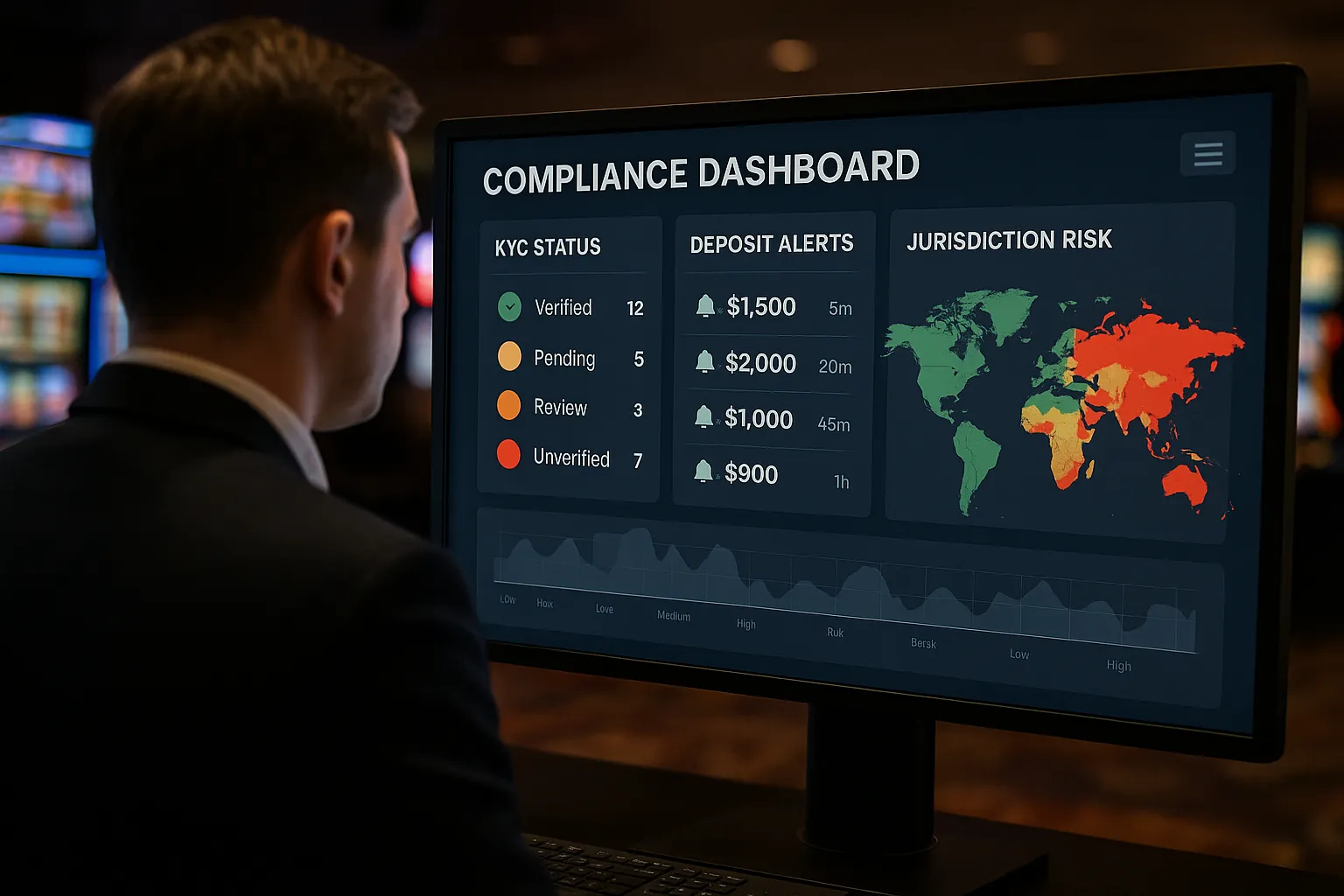
Quick compliance health check
If you are unsure where you stand, run this 30-minute self-audit:
- Latency test: How long does the average KYC approval take between 6 pm and midnight on Saturdays?
- Coverage test: What percentage of your active players have undergone enhanced due diligence in the past quarter?
- Data integrity test: Can you retrieve a complete activity log for one random player in under five minutes?
- Crypto test: Do you screen wallet addresses against OFAC or EU sanctions lists before accepting deposits?
- Policy test: When was your AML policy last approved by senior management?
If two or more answers are negative or unknown, your operation is exposed.
Staying compliant without slowing growth
Regulators worldwide—from the UK Gambling Commission to Ontario’s AGCO—are tightening controls. Yet compliance does not have to be a brake on acquisition. Modern platforms automate the heavy lifting so your team can focus on player experience.
Spinlab’s turnkey casino solution bundles:
- Automated KYC and liveness checks
- Real-time AML rule engine
- Crypto and fiat payment orchestration
- Jurisdiction-specific reporting templates
All within a Shopify-like interface that new staff can master in hours.
Ready to see it in action? Book a live demo and discover how you can launch—and scale—your casino with compliance baked in from day one.
Further reading
- FATF Guidance for a Risk-Based Approach to Virtual Assets (2024)
- UK Gambling Commission AML Guidelines, updated January 2025
- Malta Gaming Authority, Player Funds Protection Directive
Игровые автоматы — являются одни из самых известные развлечения в казино.
https://a.balenciager.ru/34wxZZEdnyTH/
На нашем веб-сайте можно отыскать массу практичной материалов.
https://online-festival.ru/detail/3725-massovyy-nalet-bolee-400-dronov-obrushilis-na-stolitsu-sredi-postradavshikh-grazhdane-inostrannykh-gosudarstv.html
Осознанный гемблинг — это комплекс мер, предназначенный на укрепление контроля по отношению к финансовыми расходами и предотвращение рисков.
https://protivbed.ru/full-article/vypuskniki-rvsn-ot-katapulty-k-mezhdunarodnoy-arene-1213/
Осознанный гемблинг — это метод, направленный на поддержание баланса над финансовыми расходами и предотвращение зависимости.
https://relax.malemoda.ru/Lpr7Mv4lAM2I/
A generic medication is a medication that contains the same active ingredient as the original product.
This type of product is designed to be equivalent the original medication in dosage form, safety, and efficacy.
When the patent on the brand-name product runs out, other companies can produce and sell generic alternatives at a lower cost.
suhagra dose
A generic version is a pharmaceutical product that contains the identical active ingredient as the original product.
It is designed to match the reference medication in dosage form, safety, and effectiveness.
When the intellectual property rights on the brand-name product runs out, other pharmaceutical firms can produce and distribute generic alternatives at a lower cost.
does baking soda help erectile dysfunction
Web-based games give enthusiasts the fantastic method to unite and explore with people worldwide.
https://links.podium24.ru/iRrYn2ODbmQb/
Транспортная логистика выполняют важнейшую задачу в хозяйстве любой страны.
Такие перевозки гарантируют непрерывное снабжение торговых точек и производств всеми необходимыми товарами.
Надёжная доставка даёт возможность уменьшать время и расходы на перемещение продукции, что улучшает прибыльность компаний.
Следовательно, грузоперевозки представляют собой критическим компонентом современной рыночной среды.
https://perevozimgruz.by/
Ежегодный осмотр автомобиля считается важной процедурой для сохранения надёжности машины.
В ходе проверки обнаруживаются потенциальные поломки, что способны вызвать серьёзных поломок на пути.
Своевременное посещение техосмотра дает возможность избежать серьёзных вложений на дорогостоящий восстановление в будущем.
Также исправный автомобиль гарантирует спокойствие вашу и пассажиров в движении.
техосмотр для ОСАГО СП