

Real-time offers are only “personalized” if they arrive while the player still cares.
In online casino funnels, the highest-intent moments are short: a failed deposit, a big win, a near-bust bankroll, the second session after registration, the first time a player opens the VIP page, the first time they land on a live casino lobby. If your segmentation updates every 15 minutes (or every night), you are effectively making decisions after the moment has passed.
Real-time segmentation is the ability to reclassify a player and trigger the next best action in under 1 second, based on what just happened (payment, gameplay, KYC, device risk, session behavior), not what happened last week.
This post breaks down what “under 1 second” really means in practice, which segments are worth building first, and the architecture patterns iGaming teams use to deliver offers safely (with compliance and responsible gambling guardrails).
What “real-time segmentation” actually means
Most casino CRM stacks have “segments,” but they are often batch labels:
- “VIP” based on last-30-day NGR
- “Churn risk” based on last login
- “Crypto player” based on last deposit rail
Those segments are useful, but they are not designed to react inside an active session.
Real-time segmentation is different in three ways:
1) It is event-driven, not schedule-driven
A segment changes because an event happens:
DEPOSIT_DECLINEDKYC_STEP_COMPLETEDGAME_LAUNCHSESSION_IDLE_90SWITHDRAWAL_REQUESTED
2) It is computed on a low-latency “hot path”
The segment decision sits in the same path as player experience, not in the reporting layer. You are optimizing P95/P99 latency, not just correctness.
3) It is connected to an action, not just a dashboard
A segment label that cannot trigger an action is just analytics. Real-time segmentation becomes valuable when it automatically triggers:
- an in-lobby banner
- a bonus or free spins offer
- a safer-gambling check-in prompt
- a cashier rail suggestion (fiat vs crypto, or an alternative payment method)
- an affiliate or VIP routing decision (where allowed)
The 1-second offer loop (and why teams miss it)
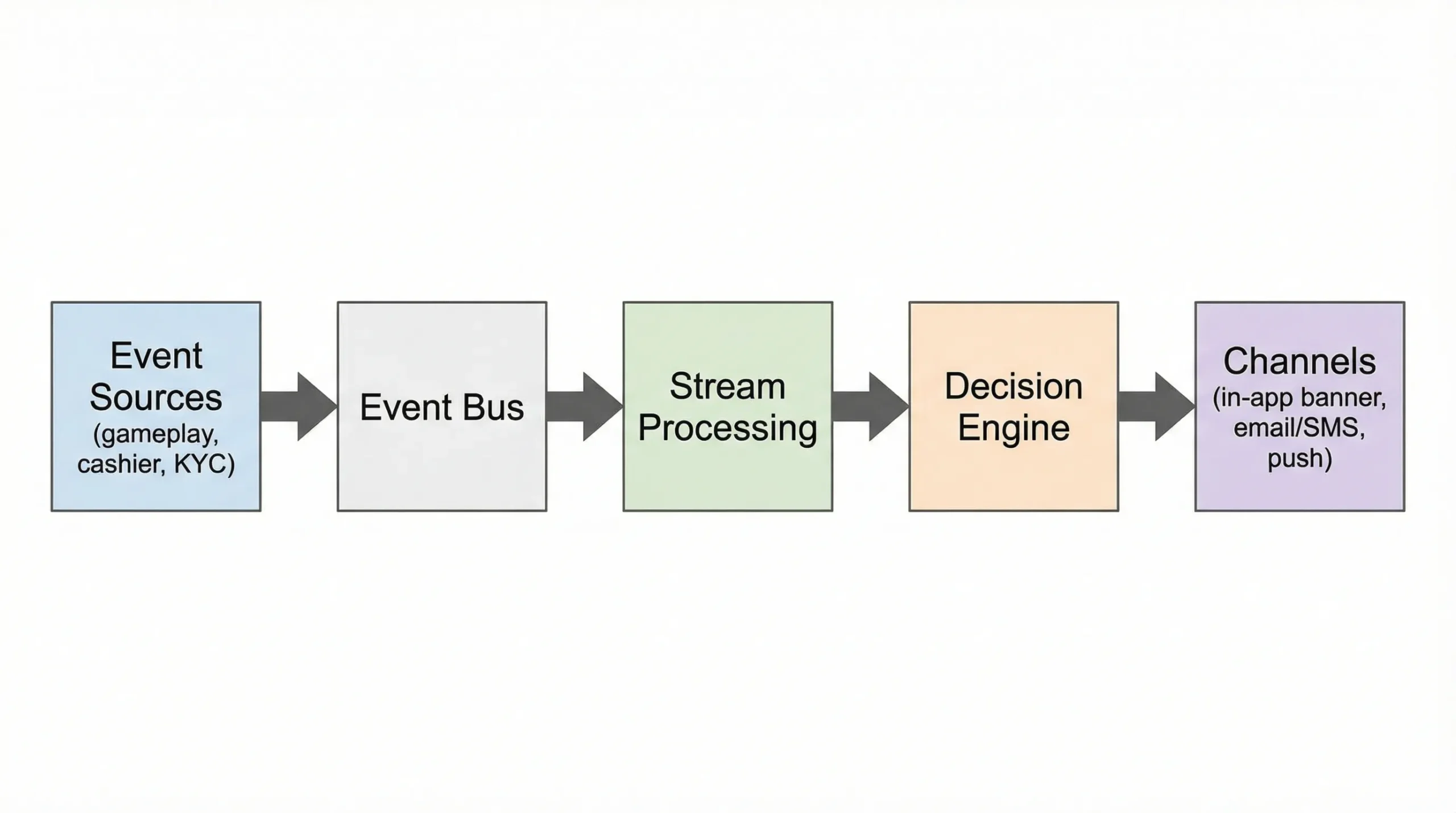
To trigger an offer in under 1 second, you need to treat the flow as a latency budget.
From the moment an event occurs (player action) to the moment the offer is visible (player UI), several systems have to do their work.
| Stage | What happens | Typical pitfalls | Practical target (P95) |
|---|---|---|---|
| Event capture | Frontend or backend emits event | Client-only events get lost, clocks drift | 50–100 ms |
| Ingestion | Event hits your bus/queue | Too many topics, oversized payloads | 50–150 ms |
| Stream compute | Rules/features updated | Joins on slow stores, heavy JSON parsing | 100–250 ms |
| Decision | “Should we trigger?” evaluated | Rule explosions, non-deterministic identity | 50–150 ms |
| Delivery | WebSocket/push/in-app render | Mobile backgrounding, retry storms | 150–300 ms |
You can hit “under 1 second” without exotic technology, but only if you keep the hot path deliberately small:
- minimal event payloads
- precomputed features where possible
- fast state stores for current session facts
- strict guardrails on what a rule is allowed to do
 UK Gambling Commission (consumer protection expectations) and the FATF (risk-based AML principles). These are not implementation specs, but they shape what “safe” systems look like.
Where a modular iGaming platform helps (and what to look for)
Building sub-second segmentation is doable, but it is rarely “just a CRM project.” It touches the casino’s core stack:
- event streaming from gameplay and cashier
- a bonus engine that can apply offers without brittle third-party calls
- fraud prevention and KYC/AML gates that can make eligibility decisions in real time
- an admin panel where ops can change rules safely
- analytics that let you verify incrementality
Spinlab Studio positions its modular iGaming platform to cover these building blocks, including real-time analytics, an affiliate and bonus engine, fraud prevention, KYC/AML compliance, crypto and fiat payments, and open API integration. If your goal is to ship real-time segmentation quickly, the main advantage of an all-in-one platform is reducing the number of cross-vendor hops in the hot path.
If you are evaluating approaches, a practical question to ask any casino software provider is:
“Show me the end-to-end latency from cashier event to visible offer, including P95 and P99, and show me how eligibility and audit logs are enforced.”
The takeaway
Real-time segmentation is not about creating more segments. It is about building a fast, auditable decision loop that reacts to player intent and risk while the session is still live.
If you can consistently trigger the right offer (or the right safeguard) in under 1 second, you unlock a different operating model:
- fewer generic bonuses
- higher conversion during high-friction moments
- faster fraud and RG interventions
- cleaner experimentation with measurable incrementality
If you are designing this system now, start with a strict latency budget, one conversion use case, one risk use case, and instrumentation that proves both speed and profit.
If you want to see what this looks like on a modular white label casino platform, explore Spinlab Studio and review how your current stack handles real-time analytics, bonus execution, compliance gating, and low-latency delivery.