

Category pages are the money pages of casino SEO.
They sit between “homepage awareness” and “game page intent”, and they’re usually the first pages that:
- Target high-volume queries like “new slots”, “live casino games”, or “Hacksaw slots”.
- Funnel players into a curated game list where they can actually start playing.
- Shape how Google crawls and understands your whole lobby.
But most casino category pages fail in predictable ways: thin text, duplicated filter URLs, slow game grids, and no clear conversion path.
This guide shows how to build category pages in a casino CMS that rank consistently and convert cleanly, without turning your site into a bloated, unmanageable SEO project.
What “category pages” mean in an online casino
In iGaming, “category pages” are typically lobby-style pages that list games and help users browse by intent. Common examples:
- Provider categories: Pragmatic Play, Hacksaw Gaming
- Format categories: slots, live casino, crash games
- Freshness categories: new releases, trending
- Mechanics categories: buy bonus, megaways-style, jackpot
- Player intent categories: low volatility, high volatility, high RTP
They are different from:
- Individual game pages (deep intent, usually long-tail)
- Acquisition landing pages (single offer or campaign)
A good category page does two jobs at once:
- SEO job: earn rankings for a cluster of related queries.
- Product job: make browsing fast and decisive, leading to play, registration, and first deposit.
Step 1: Build a taxonomy that matches demand (and avoids index bloat)
Your first SEO decision is not “how much text do we write?” It’s which categories deserve their own indexable page.
If you create a category for every possible filter combination, you end up with thousands of near-duplicates that:
- Compete with each other (cannibalization)
- Waste crawl budget
- Trigger duplicate content signals
A practical approach is to separate indexable categories from UX-only filters.
A simple category model that scales
Use this mental model:
- Tier 1 (indexable): high demand, stable meaning, unique content potential
- Tier 2 (indexable selectively): seasonal or niche, worth it only if you can keep it fresh
- Filters (noindex): combinatorial browsing helpers
Here’s a quick mapping you can use with your SEO and product teams:
| Page type | Example | Typical SEO intent | Conversion goal |
|---|---|---|---|
| Tier 1 category | /slots/ |
Broad, high volume | Get users into the slot grid fast |
| Tier 1 provider | /providers/hacksaw-gaming/ |
Brand and “best of” | Start a session on recognizable titles |
| Tier 2 freshness | /slots/new/ |
Time-sensitive | Capture “new” demand and route to latest releases |
| Tier 2 mechanic | /slots/buy-bonus/ |
Feature-led | Help users find a specific play style |
| Filter URL | ?volatility=high&rtp=96 |
Usually long-tail | Browsing, not ranking |
If you need inspiration for freshness-driven planning, align category strategy with your release workflow. Spinlab’s guide on slot release calendars is a strong framework for building “new” pages that stay current.
Step 2: Get the technical SEO right (especially filters and pagination)
Casino category pages are prone to technical SEO issues because they behave like ecommerce collections: lots of items, lots of sorting, lots of filters.
Control faceted navigation before it controls you
Filters are great for users, but dangerous for SEO if every combination becomes crawlable and indexable.
Your baseline policy should be:
- Keep one clean, canonical URL per indexable category.
- Let filters exist for UX, but prevent indexing of filter combinations.
How you implement this depends on your stack, but common patterns include:
rel=canonicalfrom filtered URLs back to the core categorymeta robots="noindex,follow"on filtered variants- Blocking specific parameter patterns in robots.txt only if you understand the crawl implications
Google’s SEO documentation has long recommended controlling faceted navigation to avoid duplication and crawl traps. Start with Google Search Central guidance on crawling and URL parameters.
Pagination beats infinite scroll (unless you implement both)
Game grids are heavy, and casinos love infinite scroll. The SEO risk is that infinite scroll can hide content from crawlers if you do not provide a paginated, crawlable path.
Best practice:
- Provide paginated URLs (for example,
?page=2) that are crawlable. - Use infinite scroll as a UX layer on top, not as the only navigation.
Also ensure each paginated page has:
- A self-referencing canonical (or a canonical strategy you intentionally choose)
- Unique title tags if your CMS supports it (even simple “Page 2” handling helps avoid duplicates)
Core Web Vitals and heavy lobbies
Category pages often become your slowest templates: thumbnails, dynamic sorting, personalization widgets, trackers.
Speed matters for conversion, and it can matter for visibility as well. If you want a casino-specific performance playbook, see Core Web Vitals for casino sites in 2026.
Step 3: Use a category page template built for ranking and decision-making
Most casino category pages either look like:
- A pure game grid with zero context (bad for SEO)
- A long SEO essay above the games (bad for conversion)
You want a hybrid template that keeps the grid dominant, but still sends strong relevance signals.
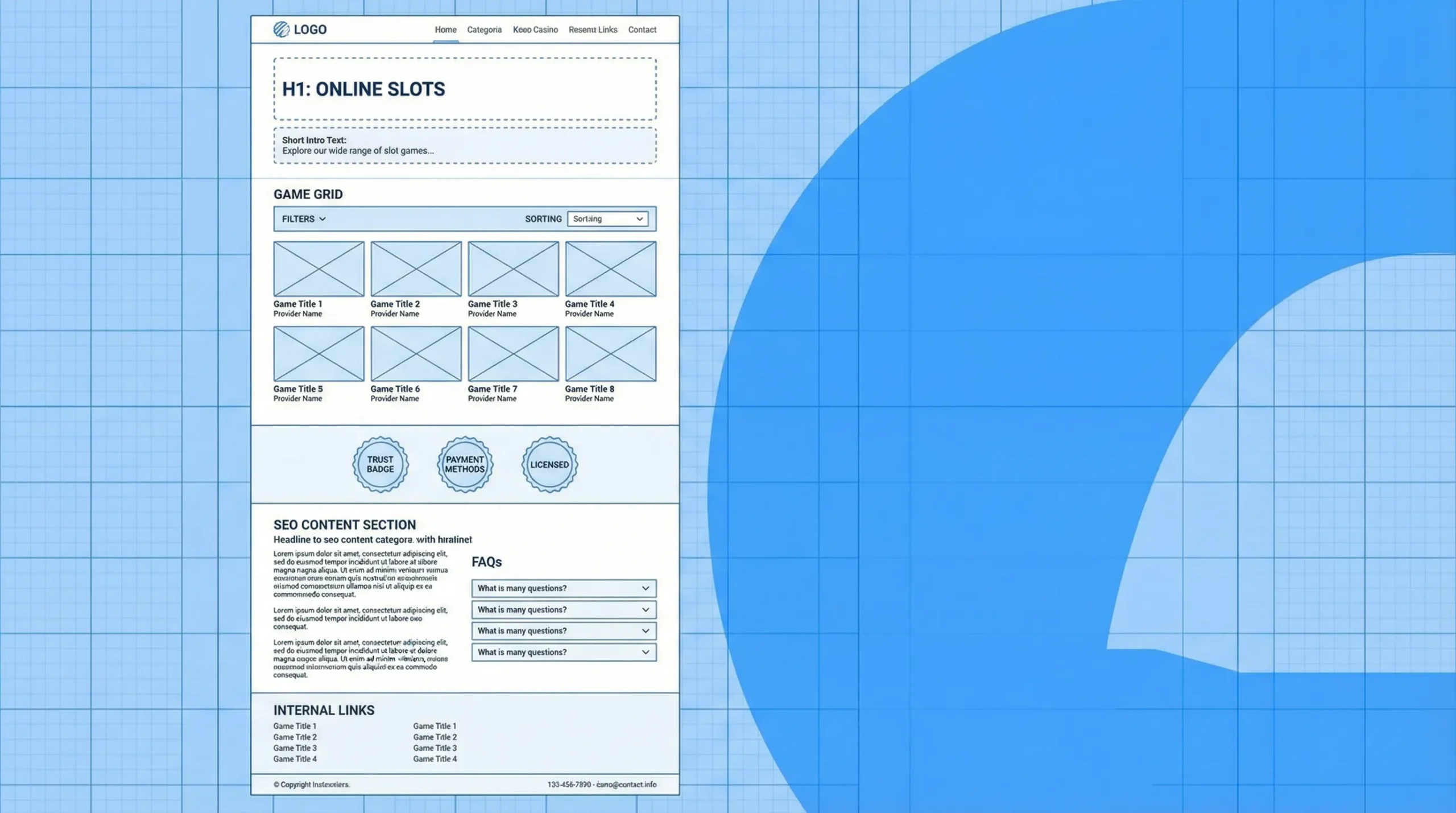
Recommended layout (practical and repeatable)
Above the fold (conversion-first):
- H1 that matches the category intent (example: “New Slot Games”)
- 1 to 2 sentence intro that sets expectations (freshness, provider, mechanics)
- Fast-loading grid with clear “Play” and “Demo” (if offered) actions
- Trust modules appropriate to your licensing and compliance requirements
Below the fold (SEO and depth):
- 250 to 500 words of unique content answering: what is this category, who it’s for, what’s special here
- A short “How to choose” section (helps long-tail queries)
- FAQ block (can rank and improves snippet coverage)
- Internal links to related categories and top games
The key is that the page must still feel like a lobby, not a blog post.
Step 4: Make category content genuinely unique (without rewriting everything)
The fastest way to create thin content is to reuse the same paragraph across 40 categories.
Instead, treat category content like structured data inside your CMS.
A practical system is to create fields such as:
category_intro_short(1 to 2 sentences)category_body(main content)faq_items(question and answer pairs)featured_games(manual or rules-based)related_categories
If you’re using Spinlab’s platform, this is where structured CMS fields matter. Their article on metafields for casino CMS explains how typed fields help you keep pages consistent, fast, and editorially manageable.
What “unique” actually means for casino categories
Your goal is not to write poetry. Your goal is to provide information that differs by category, such as:
- How this category differs from adjacent ones (“New slots” vs “Trending slots”)
- Provider-specific identity (math style, volatility tendencies, signature mechanics)
- Practical selection guidance (who should play what)
- Jurisdiction notes when relevant (availability varies)
You can also make the game grid itself more unique with:
- Curated ordering (not default alphabetical)
- Category-specific tiles (“New this week”, “High volatility picks”)
Step 5: Internal linking that drives rankings and session depth
Category pages are ideal internal linking hubs because they sit mid-funnel.
A clean internal linking system usually includes:
- Breadcrumbs (great for UX and SEO)
- “Related categories” links (horizontal discovery)
- Links to top game pages (vertical depth)
Google supports breadcrumb structured data via BreadcrumbList schema. Even if rich results are not guaranteed for gambling queries, breadcrumbs still help crawlers understand hierarchy.
Avoid internal linking mistakes that casinos repeat
- Linking only from the header menu (too shallow)
- Creating a “mega list” of every category on every page (looks spammy, dilutes value)
- Using the same anchor text everywhere (“click here”, “games”)
Instead, link intentionally:
- From provider pages to “new releases” pages
- From “new slots” to provider categories for studios you add content for
- From format categories to conversion-focused pages (payments, promos) when appropriate
Step 6: Conversion elements that belong on category pages
A ranking category page that doesn’t convert is just expensive hosting.
Here are conversion levers that typically improve outcomes without harming SEO.
Game discovery UX that reduces bounce
- Default sort that matches intent (example: “New” on a new releases page)
- Fast filter interactions (no full page reloads if you can avoid it)
- Sticky filter bar on mobile
- Clear “Play now” primary action
Trust and friction control
Category visitors often haven’t committed yet. You can reduce friction by making key expectations obvious:
- Supported payment types (crypto and fiat, where applicable)
- KYC expectations and timing (avoid “surprise KYC” later)
- Responsible gambling cues and links
If you want a broader conversion template, Spinlab’s anatomy of a high-performing casino landing page complements category optimization well. Landing pages pull traffic in, category pages turn browsing into play.
Step 7: Measurement that ties SEO to revenue
Category SEO should be evaluated like a product funnel, not like a content vanity metric.
SEO KPIs (visibility)
- Index coverage for category URLs (Search Console)
- Query groups per category (brand, “best”, “new”, “provider”)
- CTR by category template (title and snippet quality)
- Crawl stats and parameter crawl frequency
Conversion KPIs (money)
- Category page to game launch rate
- Game launch to registration rate
- Registration to first-time depositor rate
- Time to first session (especially mobile)
If your analytics stack supports it, instrument events such as:
CATEGORY_VIEWFILTER_APPLIEDGAME_TILE_CLICKGAME_LAUNCH
Then you can compare categories like products: which page brings in qualified intent and which page just attracts tourists.
A 10-page “category sprint” you can run in one week
If you want a practical execution plan, optimize 10 priority categories first (not your entire taxonomy).
Day 1: Select winners
Pick 10 categories based on:
- Existing impressions with low CTR
- Existing rankings in positions 6 to 20 (quick wins)
- Highest revenue potential (providers or formats that monetize well)
Day 2 to 3: Fix tech blockers
- Decide indexation rules for filters
- Ensure crawlable pagination exists
- Validate canonicals
Day 4 to 5: Upgrade templates
- Add structured content blocks (intro, body, FAQ)
- Add related categories
- Improve internal links to top games
Day 6 to 7: Track and iterate
- Add event tracking
- QA on mobile performance
- Submit updated URLs for re-crawl
Frequently Asked Questions
How much text should a casino category page have for SEO? Enough to make the page meaningfully distinct, typically 250 to 500 words below the fold plus a short intro. Avoid pushing the game grid down.
Should we index filter combinations like “high volatility Pragmatic slots”? Usually no. Filter combinations explode into duplicates and compete with your main categories. If a combination has clear, consistent search demand, promote it to a dedicated Tier 2 category with its own URL and content.
Is infinite scroll bad for casino SEO? Not inherently, but it becomes a problem if crawlers cannot access the full game list via paginated URLs. Provide crawlable pagination and use infinite scroll as a UX enhancement.
What structured data helps category pages? Breadcrumbs are the safest and most broadly useful. ItemList can help in some contexts, but implement cautiously and only if the markup accurately reflects what users see.
How do we stop duplicate content across provider pages and “new slots” pages? Make the intent different. Provider pages should explain the studio identity and highlight top titles. “New slots” should focus on freshness, release timing, and what’s new this week or month.
Build category pages faster with a CMS designed for iGaming
If your current stack makes category SEO painful (developer bottlenecks, slow templates, messy filter URLs), you’re not alone. Category pages are where casino CMS limitations show up first.
Spinlab is an all-in-one, modular iGaming platform for launching and scaling online casinos, with a CMS-style workflow that’s built to be flexible (more like a Shopify-style operating experience than a custom dev project). With integrated game aggregation, payments (crypto and fiat), compliance tooling, and real-time analytics, your team can treat categories as revenue funnels, not static pages.
Explore the platform at spinlab.studio or book a walkthrough to see how your lobby taxonomy, templates, and indexation rules can be implemented cleanly.