

Licensing teams rarely reject a casino because the business idea is bad. They reject it (or delay it for months) because the operator cannot prove control: control of funds, control of player risk, control of game integrity, control of suppliers, and control of security.
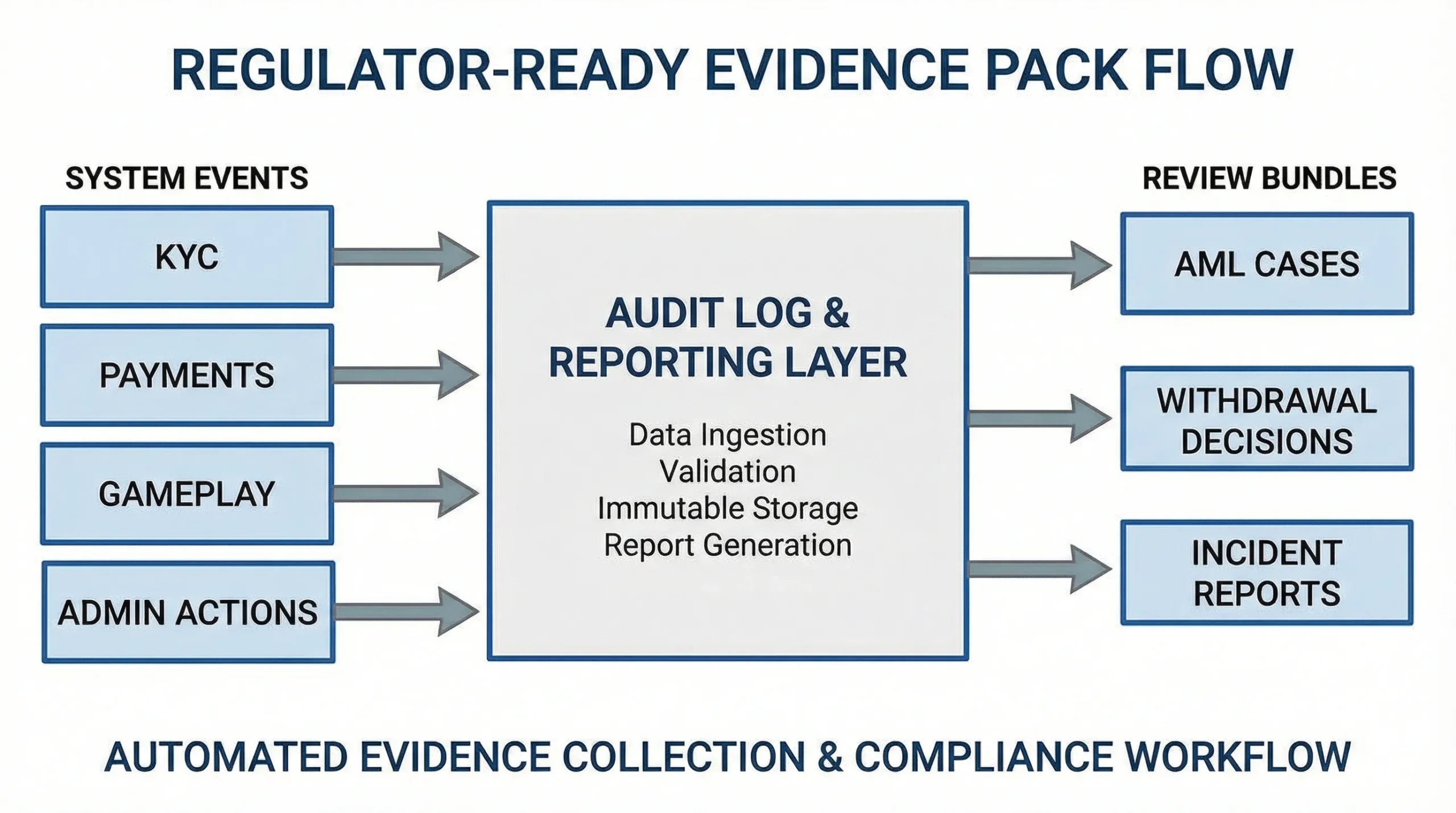
Think of your application as a product demo for regulators. Every promise in your policies has to map to a system behavior, and every system behavior has to produce evidence you can export on request.
Below is a practical casino licensing checklist focused on what your technology must prove, how reviewers typically validate it, and which artifacts you should prepare before you submit.
How regulators “test” your platform (even before go-live)
Most licensing reviews follow the same pattern, regardless of jurisdiction:
- Document review: policies, procedures, and controls (AML program, RG controls, security, complaints, payments, change management).
- Technical evidence review: screenshots, logs, audit trails, reports, vendor certificates, and data exports.
- Fit-for-purpose assessment: can you enforce rules consistently by jurisdiction, player segment, and payment rail.
- Ongoing supervision readiness: can you respond to information requests quickly, with complete and tamper-evident records.
A good mental model is “control objectives.” Your tech does not need to be fancy, but it must be demonstrably correct, auditable, and operationally maintainable.
Checklist area 1: Identity, KYC, and AML must be enforceable and measurable
A licensing team wants to see that KYC and AML are not a slide deck. They are gated workflows backed by monitoring, case management, and audit logs.
For AML principles, many regulators align expectations with FATF guidance and local implementing rules. You do not need to quote FATF in your application, but your controls should look like you could.
What your tech must prove
1) You can uniquely identify a player and link all activity to that identity. That includes sign-up, logins, deposits, wagers, bonuses, withdrawals, and support actions.
2) KYC gating is enforceable by state, not by human memory. Reviewers look for clear transitions like unverified, pending, verified, failed, enhanced due diligence (EDD), blocked.
3) AML monitoring is continuous, not periodic. They will ask how you detect structuring, rapid in-out patterns, multi-accounting, and suspicious payment behavior.
Evidence you should be able to export
| Control you claim | What reviewers ask | Evidence your platform should produce |
|---|---|---|
| KYC before withdrawal (or before certain thresholds) | “Show me the rule, and show me it was enforced.” | Configuration snapshot of the rule, user timeline showing KYC status changes, blocked withdrawal logs |
| Sanctions and PEP screening | “How often is screening run, and how are hits handled?” | Screening timestamps, hit disposition records, escalation notes, immutable audit log |
| Risk-based monitoring | “What triggers a review, and how do you prevent alert fatigue?” | Alert rules or risk score model description, alert queue metrics, case outcomes, tuning history |
| SAR/STR workflow readiness | “Who can file, who approves, and how do you preserve evidence?” | Role-based access control (RBAC) list, case export bundle, evidence retention policy |
Checklist area 2: Payments and player funds must be auditable end-to-end
Payments are where licensing, financial crime, and player protection collide. Your platform must show that money movement is traceable, reversible (when appropriate), reconciled, and correctly authorized.
This is especially scrutinized for:
- Multi-rail cashiers (cards, APMs, bank transfer, crypto)
- Multi-currency wallets
- Fast withdrawals and instant payout promises
- Bonus interactions (bonus-to-cash conversion, wagering requirements)
What your tech must prove
1) A ledger exists and is authoritative. Whether you call it a ledger, subledger, or wallet journal, regulators expect a complete record of balances and movements, not “whatever the PSP report says.”
2) You can reconcile deposits and withdrawals. This means you can match internal ledger entries to PSP/gateway reports and bank or custodial account statements, with an exception workflow.
3) Funds access is controlled. The reviewer will want to understand who can approve withdrawals, who can override risk blocks, and how you prevent insider abuse.
4) Chargebacks, reversals, and failed payouts are handled predictably. Your system should not create negative balances silently, nor should it allow further withdrawals while a dispute is open (depending on your policy).
Evidence you should be able to export
| Payment topic | Typical reviewer question | Good proof |
|---|---|---|
| Funds flow map | “Draw the path of a deposit from player to operator.” | Funds flow diagram, merchant IDs, custodial wallet structure (if crypto), settlement schedule |
| Ledger correctness | “How do you prevent double credits?” | Idempotency strategy, transaction IDs, duplicate detection logs, ledger invariants |
| Withdrawal controls | “What stops risky withdrawals?” | Rule config (velocity, KYC status, AML risk score), manual review queue audit trail |
| Reconciliation | “What happens when reports do not match?” | Daily reconciliation report, exception queue SLAs, historical mismatch resolution |
If you support crypto, be prepared to show how you screen wallet risk, enforce travel-rule related requirements where applicable, and maintain custody controls. Your licensing counsel will advise what applies in your target jurisdictions, but your platform still needs the underlying event trail.
Checklist area 3: Game integrity must be provable by version, not by vendor reputation
“Games come from reputable studios” is not a control. A licensing review typically wants to see that you:
- Only launch approved game versions for each jurisdiction
- Can disable games quickly if a certificate expires or a market changes
- Preserve enough telemetry to investigate disputes
What your tech must prove
1) You can enforce jurisdictional game availability. This includes not only the lobby, but also deep links and game-launch endpoints.
2) You can produce a game version history. If a studio updates a game, you need to show what changed, when it was deployed, and where it was enabled.
3) Game sessions are traceable. For player complaints, you should be able to reconstruct session facts (timestamps, bets, wins, disconnections, rollbacks).
Evidence you should be able to export
- A game catalog export including studio, game ID, jurisdiction flags, RTP metadata (where applicable), and enabled status
- Certification references (as provided by your suppliers) and internal mapping to game versions
- Dispute investigation bundle for a session (wallet movements, game round IDs, error logs)
Checklist area 4: Responsible gambling controls must be enforceable, logged, and hard to bypass
Most operators can list responsible gambling (RG) features. Licensing teams care about enforcement, auditability, and marketing suppression.
What your tech must prove
1) Limits and exclusions are enforced centrally. Deposit limits, loss limits, session limits, time-outs, and self-exclusion must apply across devices and channels.
2) You can prevent circumvention. If a self-excluded player tries to register again, you need a strategy (identity matching, device signals, payment instrument checks) that is consistent with your privacy posture.
3) You can prove you stopped marketing to excluded players. This is a common audit request.
Evidence you should be able to export
| RG control | What reviewers validate | Proof artifacts |
|---|---|---|
| Player-set limits | “Can players set them, and can staff bypass them?” | Player UI screenshots, backoffice permission matrix, limit change logs |
| Self-exclusion | “Show the enforcement point.” | Self-exclusion status in identity record, blocked login/deposit events |
| Reality checks | “Are they timed and unskippable as required?” | Event logs showing delivery and acknowledgement, configuration snapshots |
| Marketing suppression | “How do you stop promos to excluded players?” | Segment exclusion rules, campaign export with suppression flags, audit log |
If your team uses AI to draft RG copy, terms, or policy summaries, treat it like any other compliance content: run originality and consistency checks, for example using AI text detection checks, then have legal and compliance sign off on the final wording.
Checklist area 5: Security must map to known standards and produce audit-ready logs
You do not need to be “enterprise” to be licensable, but you do need a credible security program. Reviewers often recognize the shape of common frameworks such as NIST Cybersecurity Framework and web app guidance like the OWASP Application Security Verification Standard (ASVS).
What your tech must prove
1) Access control is least-privilege and reviewable. This matters most in backoffice tools: payments, withdrawals, KYC overrides, bonus issuance, account changes.
2) Security events are logged and monitored. Failed logins, privilege changes, high-risk admin actions, cashier anomalies, and fraud signals should be searchable.
3) Data protection is engineered, not promised. Encryption in transit, encryption at rest where appropriate, secrets management, and retention rules for sensitive data.
4) Vulnerability management exists. Patching cadence, dependency scanning, penetration tests (internal or external), and incident response playbooks.
Evidence you should be able to export
- RBAC matrix for backoffice roles (who can do what)
- Audit log samples showing immutable entries for admin actions
- Security monitoring overview (alert types, on-call process, incident severity definitions)
- Pen test executive summary and remediation tracker (as applicable)
Checklist area 6: Operational resilience and change management must be demonstrable
Licensing is not only “are you safe,” it is also “will you stay safe while you change.” This is where many early-stage operators struggle, especially when launching fast.
What your tech must prove
1) You can deploy changes without breaking money movement. Wallet, cashier, and bonus code should have controlled rollout processes.
2) You have backup and recovery targets. Reviewers may ask for RPO/RTO targets and proof you tested restores.
3) You can handle peak load and third-party outages. Game providers, KYC vendors, and PSPs will fail sometimes. Your platform needs graceful degradation.
Evidence you should be able to export
| Resilience topic | Reviewer question | Proof |
|---|---|---|
| Change management | “How do you approve, test, and roll back changes?” | Release workflow, staging environment description, rollback runbooks |
| Disaster recovery | “When did you last test recovery?” | DR test report, restore logs, outcome notes |
| Vendor outages | “What happens if KYC or a PSP is down?” | Fallback flows, status pages, incident postmortems |
Checklist area 7: Reporting, record retention, and audit response must be fast
A licensing approval is not the finish line. You are building an operation that must answer requests like:
- Provide a list of withdrawals over a threshold in a date range
- Export all actions taken on a player account
- Show every admin user who changed risk rules in the last 90 days
- Provide evidence for a disputed transaction
What your tech must prove
1) You can produce complete exports without engineering heroics. If your only way to answer regulator questions is “ask the data team,” expect delays and risk.
2) Logs are retained, searchable, and protected from tampering. Your retention policy should be realistic for dispute windows and regulatory expectations.
3) Metrics are defined consistently. Terms like GGR, NGR, active player, approval rate, time-to-paid, and fraud loss should not change meaning between dashboards.
The “Licensing Evidence Pack”: what to assemble before you submit
Treat this as a deliverable, not an afterthought. If you can compile the pack in a week, you are usually in good shape. If it takes a quarter, your controls are probably not operationalized.
| Evidence pack section | Contents | Owner |
|---|---|---|
| System architecture | High-level diagram, data flows, vendor list, environments | CTO / Engineering |
| Controls mapping | Policy statements mapped to enforcement points | Compliance + Product |
| AML/KYC | Workflow description, monitoring approach, sample case export | Compliance / Risk |
| Payments | Funds flow map, ledger model, reconciliation process, withdrawal controls | Finance + Payments |
| RG | Limits, exclusion flows, marketing suppression proof | Compliance + CRM |
| Security | RBAC, audit logs, incident response plan, vuln management | Security / DevOps |
| Reporting | Sample regulatory exports, retention schedules | Ops + Data |
Where a modular iGaming platform can reduce licensing friction
If you are building from scratch, the licensing checklist becomes a long engineering roadmap. A modular platform can compress timelines by giving you pre-built primitives that are already designed for auditability.
For example, Spinlab Studio positions its platform as an all-in-one, modular iGaming stack with components that commonly appear in licensing evidence packs, including:
- Crypto and fiat payment support, including crypto onramp solutions and multi-currency handling
- Integrated KYC and AML compliance flows
- Advanced fraud prevention
- Game aggregation and original games (including custom-designed titles)
- Real-time analytics and a customizable backoffice admin panel
- Open API integration for connecting third-party systems
If you are comparing vendors, ask them to walk through your evidence pack live: not just feature slides, but the actual exports, logs, and configuration snapshots you would hand to a regulator.
A final self-check before you apply
A strong licensing application is not the one with the longest policy PDFs. It is the one where you can point to a requirement and say:
- Here is the rule (configuration)
- Here is where it is enforced (workflow and enforcement point)
- Here is the proof it ran (audit log and report)
- Here is how we detect failures (monitoring and alerts)
- Here is how we correct issues (case management and incident process)
If you can do that for KYC, AML monitoring, withdrawals, self-exclusion, game availability, and admin actions, you are no longer “preparing for licensing.” You are operating like a license holder already.