

A casino can be “crypto-ready” in the cashier and still run a fragile treasury behind the scenes. In 2026, that gap gets expensive fast, stablecoin volumes are higher, instant rails make payout expectations tighter, and regulators expect audit-grade controls across both fiat and on-chain flows.
A crypto-ready casino treasury is not a wallet integration. It is an operating model, a set of accounts (bank, PSP, wallets), a controls framework, and a ledger discipline that lets you:
- Pay players quickly without over-exposing hot wallets
- Prove where funds are at any moment (and why)
- Survive chargebacks, volatility, sanctions events, and provider outages
- Close books cleanly (daily, not monthly)
This guide breaks down how to design that treasury in 2026, from architecture to controls to platform requirements.
1) Define “treasury” for an online casino (not just “funds”)
Casino treasury sits at the intersection of three realities:
- Player experience: time-to-credit deposits, time-to-paid withdrawals, and trust.
- Risk and compliance: KYC/AML, sanctions, Travel Rule where applicable, fraud prevention, and responsible gaming constraints.
- Finance and operations: cash conversion cycle, float sizing, reconciliation, and audit trails.
A useful rule: if your team cannot explain a balance difference within one business day, you do not have a treasury, you have a pile of accounts.
The minimum components you need
A production-grade treasury typically includes:
- Ledger of record: the system that defines the “truth” of balances and movements.
- Settlement sources: PSP reports, bank statements, on-chain transaction data.
- Wallet and bank topology: where funds live by rail, asset, and risk tier.
- Policies: who can move what, when, with what approvals.
- Monitoring: liquidity, anomalies, and operational SLAs.
2) Map your funds topology (fiat + PSP + on-chain) before you pick tools
Most treasury failures come from mixing up “where the money is” with “what the ledger says.” Start with a topology diagram and a clear separation between:
- Player balances (liability)
- Operational float (working capital)
- Revenue (house funds)
Here is a practical mapping you can adapt.
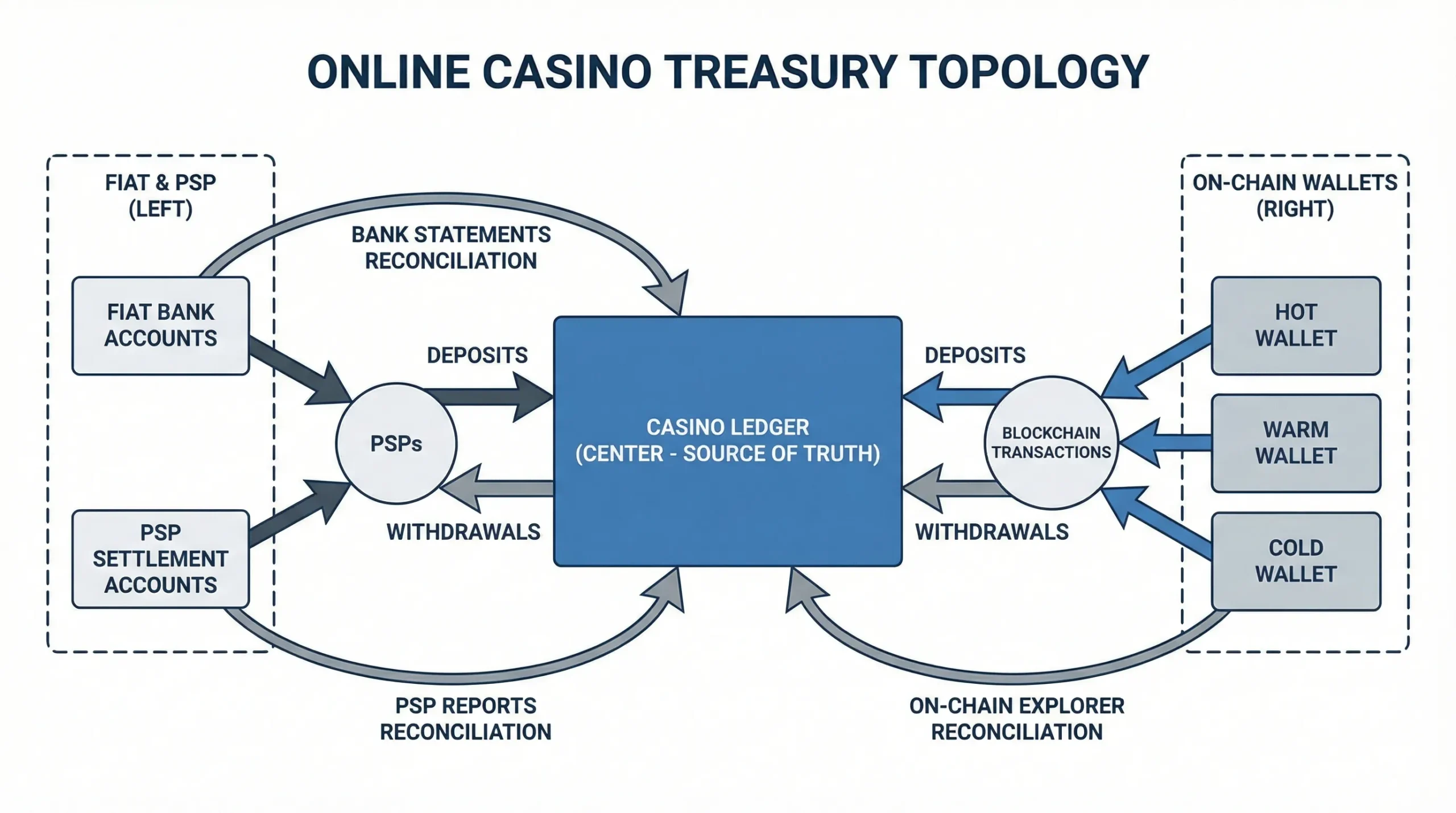
A “source-of-truth” table that prevents confusion
| Layer | What it represents | What you use it for | Common mistake |
|---|---|---|---|
| Casino ledger | Canonical balances and movements | Player balance, limits, accounting entries | Treating PSP or wallet balances as truth |
| PSP settlement accounts | What your providers owe you (or you owe them) | Funding planning, dispute tracking | Reconciling only monthly, missing drift |
| Bank accounts | Fiat cash position | Payroll, vendor pay, fiat liquidity | Not separating operational cash and player funds |
| On-chain wallets | Crypto liquidity and custody | Crypto payouts, internal transfers | Over-funding hot wallets “for convenience” |
If your platform cannot export clean ledger events (deposits, withdrawals, reversals, fees, FX, bonuses, adjustments) you will feel it in every close.
3) Choose an asset strategy that matches your liabilities (stablecoins first, speculation last)
By 2026, most “crypto-ready” casinos end up with crypto liabilities that behave like fiat (players want predictable value, fast cashout, low surprise). That pushes many operators toward stablecoin-centric treasury design, even if they still accept volatile assets.
A pragmatic asset strategy starts with two questions:
- What are you promising players at withdrawal time? Same asset, same value, or “equivalent” value?
- What exposure are you willing to hold intraday and overnight?
A simple allocation model to start with
| Treasury bucket | Primary goal | Typical instruments | Key control |
|---|---|---|---|
| Payout float | Fast withdrawals | Fiat, stablecoins | Minimum payout coverage ratio |
| Operating float | Pay vendors, cover fees | Fiat | Weekly cash forecast and limits |
| Risk buffer | Absorb chargebacks, fraud losses, FX moves | Fiat, stablecoins | Stress-tested reserve policy |
| Strategic inventory (optional) | Marketing or ecosystem bets | Volatile crypto | Board-approved risk limits |
If you operate in regions touched by the EU, stablecoin treatment can be affected by MiCA. Use the regulation itself as a design input, not an afterthought (see Regulation (EU) 2023/1114 (MiCA) on EUR-Lex).
4) Design wallet tiers and custody like a bank would (because regulators and auditors will)
Hot wallets are for speed, not storage. Your treasury should treat private-key risk as a first-class threat.
A wallet-tier model that scales
| Tier | Purpose | Target balance | Typical security posture |
|---|---|---|---|
| Hot | Automated payouts | Hours to 1 to 2 days of expected payouts | Tight policy engine, monitoring, limited signing rights |
| Warm | Refill hot wallet, batching | Days to 1 to 2 weeks | Strong approvals, restricted access, scheduled transfers |
| Cold | Long-term storage, reserves | Majority of holdings | Highest security, minimal connectivity, strict governance |
The nuance for iGaming is that payout SLAs are a growth lever. If you want “instant” payouts, you must pre-fund a hot tier, but you can still keep risk controlled with limits, velocity rules, and step-up approvals.
Governance controls operators routinely miss
- Segregation of duties: the person who approves a payout policy should not be the person who can deploy wallet code.
- Transaction policy-as-code: every on-chain transfer should have a reason code and rule path.
- Key lifecycle management: rotation, revocation, recovery drills, and documented ceremonies.
- Vendor and custodian risk: KYB, SOC reports where available, incident history, and clear liability boundaries.
For Travel Rule, where applicable to your flows and jurisdictions, align early with the FATF baseline expectations (see FATF Recommendation 16).
5) Engineer liquidity for withdrawals, not for deposits
Operators often obsess over deposit conversion and then treat payouts as a backoffice queue. In crypto-forward markets, that is backwards. Payouts are where trust is won.
The core payout liquidity problem
You must decide how you cover payouts across:
- Rail (card, APM, bank, on-chain)
- Asset (fiat, stablecoin, volatile)
- Network (L1, L2, multiple chains)
- Risk tier (auto-pay vs review)
A workable approach is to define payout tiers and fund them accordingly.
| Payout tier | Eligibility | Funding requirement | Operational goal |
|---|---|---|---|
| Instant / auto-pay | Low risk, verified, clean history | Hot wallet pre-funded | Seconds to minutes |
| Fast | Medium risk or new behavior | Hot wallet plus step-up checks | Minutes to hours |
| Manual / enhanced review | High risk signals | Warm wallet access with approvals | Same day with clear comms |
Add a refill policy: if hot wallet drops below a threshold, trigger a warm-to-hot transfer, but only within limits and with monitoring.
6) Make reconciliation a daily product, not a monthly accounting task
Treasury “breaks” quietly, then breaks loudly. The quiet phase is reconciliation drift.
In a crypto-ready casino, you are reconciling three domains every day:
- Ledger vs PSP reports (fiat and APMs)
- Ledger vs bank statements (availability vs settlement timing)
- Ledger vs on-chain events (confirmations, fees, internal transfers)
If you want a deeper framework for three-way matching, build around a deterministic ID strategy (payment intent IDs, idempotency keys, on-chain tx hashes) and exception queues.
A daily close checklist that prevents “end-of-month panic”
| Check | Output | Owner |
|---|---|---|
| Deposit completeness | Missing credit report by rail | Payments ops |
| Withdrawal completeness | Stuck / pending / failed by reason | Risk + support |
| On-chain confirmations | Unconfirmed tx list, fee anomalies | Treasury ops |
| Fee and FX accuracy | Fee ledger tie-out, FX drift | Finance |
| Exception queue SLA | Aged exceptions and root causes | Ops lead |
This is also where real-time analytics becomes a treasury tool, not just a marketing dashboard. The faster you spot drift, the less it costs.
7) Treat compliance as a treasury constraint (because it is)
In 2026, crypto treasury design must assume tighter requirements around:
- KYC and AML: identity assurance, risk scoring, and ongoing monitoring.
- Sanctions: screening for counterparties and wallet risk where required.
- Travel Rule: data exchange expectations for certain VASP-to-VASP transfers, depending on jurisdictions.
- Recordkeeping: audit logs, change logs, approvals, and evidence exports.
A practical way to implement this is to ensure every movement has:
- A who (actor and approvals)
- A why (reason code)
- A what (asset, amount, fees)
- A where (destination, rail, chain)
- A proof (PSP reference, bank reference, tx hash)
8) Build documentation like you are producing a high-stakes live event
Many treasury incidents are not “bugs,” they are coordination failures. The fix is operational design: runbooks, playbooks, and clear ownership.
If you need a mental model, borrow from production disciplines where timing, roles, and contingency plans are everything. Even outside iGaming, teams like Stories by DJ build trust by orchestrating complex, time-sensitive workflows with clear expectations, checklists, and real-world contingency planning. Your treasury deserves the same level of intentionality.
The minimum runbooks to write
- Hot wallet drain scenario: detection, freeze rules, comms, refill path.
- PSP outage: routing changes, player messaging, settlement expectations.
- Chain congestion: fee policy, asset switching, L2 fallback where supported.
- Chargeback spike: thresholds, representment evidence, velocity rule tightening.
9) What to demand from a platform (so treasury is not duct-taped together)
If you are building on a white label casino platform or modular iGaming platform, treasury quality is mostly a platform capability question. Ask for proof of:
- A unified ledger that supports fiat and crypto movements with idempotency and audit logs
- Crypto and fiat payment support, plus a crypto onramp if you target mixed cohorts
- Custodial wallet support (if you run custody), with configurable policies and safe operational access
- KYC and AML workflows integrated into payments and withdrawals (not bolted on)
- Fraud prevention signals that can gate auto-pay versus review
- Real-time analytics for liquidity, exceptions, and payout SLAs
- Open APIs so finance and risk can export evidence and integrate downstream systems
Spinlab Studio is built around this consolidated approach, an all-in-one modular iGaming platform with crypto-ready payments, compliance tooling (KYC and AML), fraud prevention, game aggregation, and a customizable backoffice. If you are optimizing for speed-to-launch and operational simplicity, it is also positioned as a cost-effective white label option with a Shopify-like interface for day-to-day management.
If you want to see what “treasury-ready” looks like in an integrated stack, start at spinlab.studio and map your current accounts, rails, and policies against the requirements above.
10) A practical 30-day implementation plan (focused on controls and cashflow)
You can make meaningful treasury progress in a month if you sequence correctly.
Week 1: Inventory and policy
- List every account and wallet, who controls it, and what it is used for.
- Define payout tiers (instant, fast, manual) and the eligibility rules.
- Set hot/warm/cold target balances and refill thresholds.
Week 2: Ledger and reconciliation discipline
- Standardize identifiers (payment intent ID, withdrawal ID, tx hash, PSP reference).
- Implement daily close reports and an exception queue.
- Define SLAs and owners for exception resolution.
Week 3: Compliance gating and audit evidence
- Ensure KYC status and risk score can gate withdrawals.
- Document approvals and exportable audit logs for key actions.
- Add sanctions and Travel Rule decision points where required for your markets.
Week 4: Stress tests and monitoring
- Simulate PSP outage, chain congestion, and hot wallet depletion.
- Set monitoring thresholds for payout backlog, hot wallet utilization, and drift.
- Publish runbooks and run at least one tabletop incident drill.
A crypto-ready casino treasury in 2026 is not about holding crypto, it is about controlling it. When you get the topology, policies, and evidence right, faster payouts become a safe product feature, not a recurring operational gamble.