

Your first affiliate payout is a high-risk moment for a new online casino. Until you’ve paid, fraudsters are still “testing” your controls. The second you pay, you signal that your program is profitable to attack, and the same playbook gets scaled.
This guide shows how to detect affiliate fraud before your first payout using a practical pre-payout checklist, a simple risk scoring model, and a payout policy that does not punish legitimate partners.
What “affiliate fraud” looks like before the first payout
Most operators think of affiliate fraud as “fake signups.” In practice, pre-payout fraud is broader: it’s any affiliate-driven activity that produces trackable conversions, but low or negative value after costs, disputes, and compliance exposure.
Common patterns in the first 7 to 30 days:
- Bot or farmed registrations that inflate “leads” and sometimes push micro-deposits to qualify for CPA.
- Incent traffic (cashback groups, reward apps, “deposit reimbursement” schemes) that looks legitimate in GA, but collapses on retention and chargebacks.
- Geo and jurisdiction spoofing where traffic originates from restricted markets while appearing allowed at click time.
- Brand bidding and unauthorized creatives that capture your own demand or break ad rules, then claim CPA credit.
- Bonus abuse sourced by affiliates (multi-accounting, payment instrument reuse, promo leakage), often disguised as “high activation.”
- Payment abuse loops (friendly fraud risk) where deposit behavior correlates with later disputes.
The key takeaway: you cannot detect this reliably from affiliate clicks alone. You need to join attribution data with identity, payments, gameplay, KYC outcomes, and (later) dispute signals.
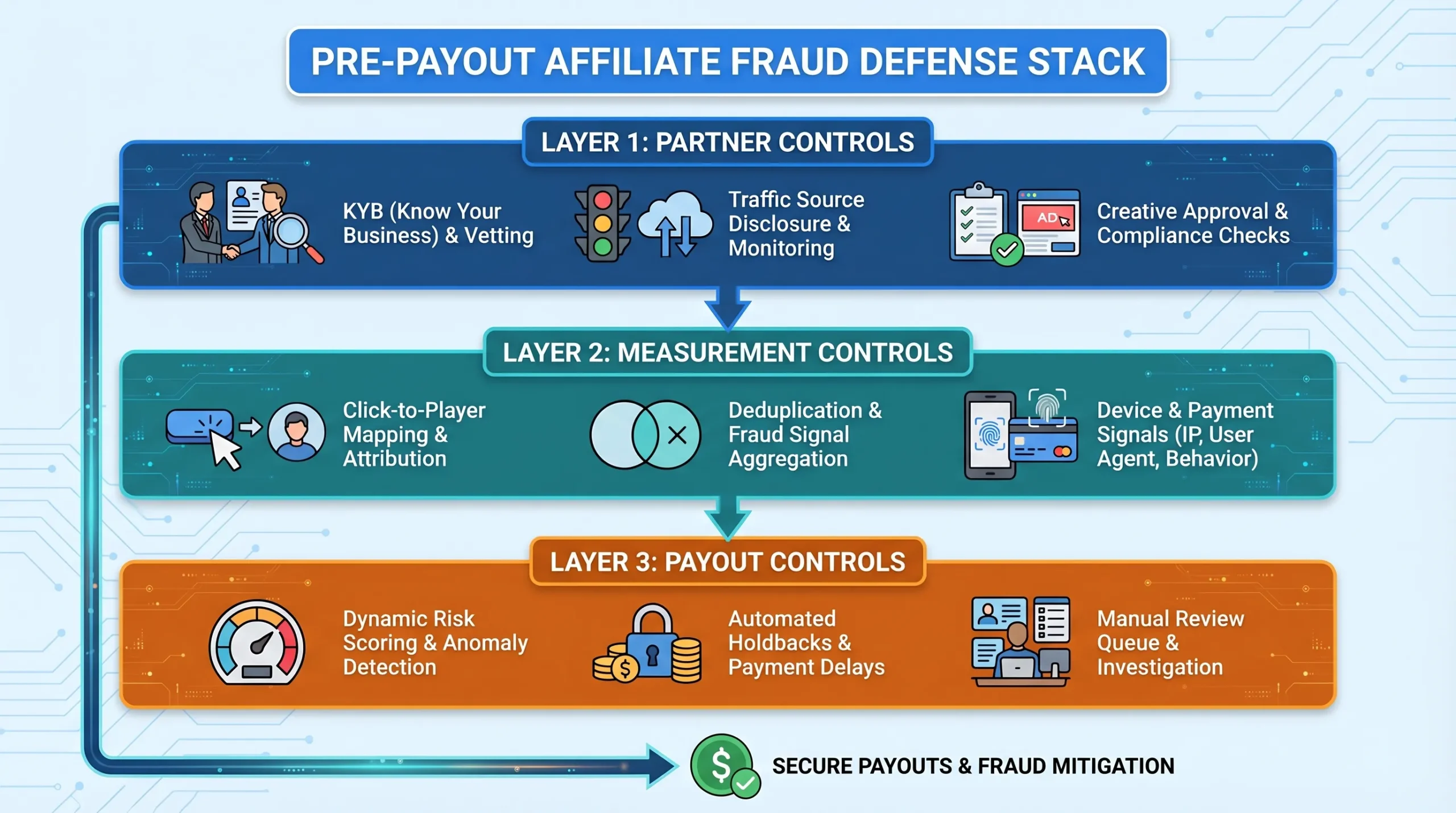
The pre-payout control stack (3 layers)
You want three layers that work together. If one layer fails, the other two still reduce losses.
-
Partner controls (who you let in, what they’re allowed to do)
-
Measurement controls (what you track, how you dedupe, how you attribute)
-
Payout controls (when you pay, what you hold back, what triggers manual review)
Step 1: Make fraud measurable in your tracking setup
Before you can “detect,” you must be able to prove which affiliate drove which player, and whether that player is unique.
Minimum instrumentation to have before you approve first payouts:
- Required subIDs (siteID, campaignID, creativeID) passed end-to-end.
- Click ID persistence from click to registration, and from registration to first deposit.
- Server-to-server postbacks for key events (REG, KYC_PASS, FTD, WAGERED_X, WITHDRAWAL_REQUESTED).
- Dedupe rules documented and enforced (for example, “only one CPA per person per X days” is meaningless if your system cannot resolve identity).
- Immutable audit logs for attribution changes (who edited what, when).
If you are building on an all-in-one iGaming platform, it’s much easier when affiliate tracking, payments, KYC/AML, fraud prevention, and analytics are already connected, because you are not stitching evidence across five vendors and three dashboards.
Step 2: Vet the affiliate like a payments partner (fast KYB)
Treat “new affiliates” as third parties that can create regulatory, financial, and brand risk.
A lightweight KYB process that still catches most bad actors:
- Ownership and payout identity: legal entity or individual, UBO if relevant, payout method ownership consistency.
- Traffic source disclosure: SEO, PPC, social, streaming, email, push, communities. “Mixed” is not an answer.
- Market and language focus: which countries, which languages, which devices.
- Examples of placements: top pages, channels, ad accounts (screenshots), creative samples.
- Compliance acceptance: written acceptance of your restricted geos, ad rules, and creative requirements.
If an affiliate cannot or will not provide basic evidence, do not “test them anyway.” Fraudsters optimize for operators who skip KYB.
Step 3: Run a pre-payout checklist (12 high-signal checks)
Below are the checks that catch the majority of “first payout” fraud. They are designed to work even when you have small sample sizes.
| Check | What you’re looking for | Data you need | Typical action before payout |
|---|---|---|---|
| 1) Source consistency | Claimed source (SEO/PPC/social) matches referrers and landing patterns | Referrer, landing URL, campaign params | Ask for clarification, limit to approved placements |
| 2) Geo alignment | Click geo, IP geo, KYC country, and payment country are coherent | IP geo, KYC metadata, BIN/country, device locale | Hold payout if mismatched or restricted |
| 3) Registration velocity | Bursts (many signups in minutes) or uniform timing | REG timestamps, IP ranges, device graph | Flag, throttle, add bot checks |
| 4) Device uniqueness | Many accounts sharing devices or near-identical fingerprints | Device fingerprint, user agent, entropy score | Treat as multi-accounting, deny CPA |
| 5) Payment instrument reuse | Same card, bank account, wallet address, or onramp identity across “different” players | Tokenized payment IDs, wallet addresses, onramp identifiers | Block and investigate cohort |
| 6) KYC pass rate by affiliate | Unusually low pass rate or suspiciously perfect pass rate | KYC outcomes, retry counts, verification time | Step-up review for outliers |
| 7) Time to first deposit | Extremely short times (seconds) at scale can indicate automation | Click to REG, REG to FTD timestamps | Require more evidence, cap CPA |
| 8) Deposit sizing distribution | Many deposits at minimum threshold to qualify CPA | Deposit amounts, method mix | Switch to quality milestones |
| 9) Bonus attachment rate | Nearly all users taking the same promo, or promo stacking | Bonus redemptions, promo codes, wagering | Enforce stricter bonus rules |
| 10) Wagering profile | Minimal wagering, instant low-risk play, or no session depth | Wager events, game mix, session length | Require NGR-based qualification |
| 11) Early withdrawal behavior | Withdrawals requested immediately after qualifying actions | Withdrawal events, reason codes, AML flags | Hold withdrawals and affiliate payout |
| 12) Dispute exposure proxy | Rails and cohorts correlated with later chargebacks or reversals | Payment method, risk score, historical dispute rate | Apply holdback and rolling reserve |
How to interpret the signals without overreacting
One red flag rarely proves fraud. Fraud happens when multiple domains correlate:
- Attribution anomalies + device reuse
- Payment reuse + bonus-heavy behavior
- Geo mismatch + KYC failure patterns
If you only look at affiliate dashboards, you’ll miss the cross-domain correlation that actually predicts loss.
Step 4: Use a simple risk score to decide payout (not gut feel)
You do not need a complex ML model to avoid your first bad payout. You need consistent decisioning.
A pragmatic scoring approach:
- Assign points for each verified issue (for example, geo mismatch, payment reuse, device reuse, abnormal velocity).
- Subtract points for trust signals (transparent placements, stable cohort retention, clean KYC outcomes, consistent payment behavior).
- Use the score to route payouts into three lanes.
| Lane | What it means | Payout rule | What you do next |
|---|---|---|---|
| Green | Normal variance, no strong fraud indicators | Pay on standard terms | Keep monitoring weekly |
| Amber | Mixed signals, needs confirmation | Pay partially or apply holdback | Request evidence, sample players, tighten caps |
| Red | Strong indicators of fraud or compliance breach | Do not pay until investigated | Freeze, investigate cohort, terminate if confirmed |
Recommended “new affiliate” payout policy (operator-friendly)
A good policy protects you without making legitimate affiliates feel like you are inventing reasons not to pay.
Common, defensible mechanisms:
- Delayed first payout (for example, pay in the next cycle after minimum maturation).
- Rolling reserve or holdback on new partners (release after clean performance).
- Quality milestones for CPA qualification (example concepts: KYC passed, first wagered amount, minimum NGR, minimum retention window).
Important: write these rules into your affiliate terms so the decision is not arbitrary.
Step 5: Build an “evidence pack” you can review in 60 minutes
When you suspect fraud before the first payout, speed matters. You want a repeatable packet that makes the decision obvious.
Your 60-minute investigation packet should include:
- Affiliate overview: declared sources, markets, placements, contact history.
- Cohort snapshot (by affiliate and by campaign): REG, KYC pass, FTD, wagering depth, withdrawal requests.
- Top 20 player timelines: click time, registration, KYC attempts, deposit method, wagering, withdrawal attempt.
- Uniqueness check: device graph overlap, payment token overlap, shared wallet addresses, repeated IP blocks.
- Compliance proof: which creatives were used, where they were placed, and whether they meet your rules.
If you cannot assemble this quickly, your program is forced into one of two bad options: pay blind, or delay everything and anger good partners.
Step 6: Lock down creatives to reduce “compliance fraud”
Not all affiliate fraud is purely financial. Some partners “convert” by running creatives that expose you to compliance and brand risk (missing 18+ messaging, misleading bonus claims, restricted geo targeting).
Two practical controls:
- Pre-approved creative library: affiliates may only use assets you provide or explicitly approve.
- Creative fingerprinting: store hashes or IDs for every approved banner/video so you can detect unapproved variants.
If you need to produce compliant video variations quickly (different languages, bonus disclaimers, duration formats), using a standardized template set can keep affiliates from improvising. Many teams use packs like these video templates for everyday projects to generate consistent, policy-compliant motion assets without rebuilding from scratch each time.
Step 7: Automate alerts so “first payout” is not a manual fire drill
Once you have the checks, you want automation that routes exceptions into a backoffice queue.
High-leverage automations:
- Affiliate anomaly alerts: spikes in REG without FTD, spikes in FTD at minimum amount, or sudden shifts in geo.
- Uniqueness enforcement: auto-flag CPA claims where payment or device overlaps are detected.
- Risk-based payout gating: if the affiliate score crosses a threshold, payouts are paused automatically pending review.
This is where an integrated platform approach matters. If affiliate tracking, payments, KYC/AML, and fraud tooling live in one modular system, you can trigger rules off real-time events (and keep an auditable decision trail) instead of exporting CSVs across tools.
A quick “before you pay” decision checklist
Use this as your final gate on day one:
- You can trace each CPA claim to a unique player with consistent click and event logs.
- KYC outcomes for that affiliate are within expected bounds (not extreme).
- No meaningful device or payment instrument reuse is present.
- Geo, language, and payment country signals match your allowed markets.
- Wagering behavior indicates real play, not qualification-only behavior.
- Your payout policy (holdbacks, milestones, reserves) is documented and accepted.
If any of these fail, the correct move is usually not “never pay,” it is “pause, request evidence, and pay once clean.”
Frequently Asked Questions
What is affiliate fraud in online casinos? Affiliate fraud is any affiliate-driven activity that generates tracked conversions (registrations, FTDs, CPA milestones) but relies on bots, misrepresentation, multi-accounting, bonus abuse, or compliance violations that create negative value.
How long should I wait before paying a new affiliate? Long enough for your key risk signals to mature (KYC outcomes, early withdrawal behavior, and payment risk proxies). Many operators use a delayed first payout and then move trusted affiliates to standard cycles.
What is the strongest signal of affiliate fraud before payout? Cross-domain reuse. Device overlap across accounts and payment instrument reuse are often stronger indicators than click metrics or CTR.
Should KYC be required before an affiliate conversion counts? For CPA-style payouts, requiring KYC (or at least KYC pass) as part of the qualification criteria can reduce paid fraud. The trade-off is that it may lower affiliate volume, so it should be communicated clearly.
Does crypto make affiliate fraud easier or harder? Both. Crypto reduces traditional chargebacks, but introduces wallet reuse, on-chain laundering patterns, and faster cashout attempts. You still need identity, wallet risk, and behavioral controls.
Build your affiliate program on a platform that can prove value (not just clicks)
If you’re launching or scaling a white label casino, affiliate fraud is easiest to stop when your affiliate engine, payments (crypto and fiat), KYC/AML, fraud prevention, and real-time analytics share one data layer.
Spinlab Studio is an all-in-one modular iGaming platform designed for fast onboarding and global growth, with built-in affiliate and bonus tooling, compliance support, and fraud controls.
Explore the platform at spinlab.studio and request a walkthrough to see how pre-payout risk checks and payout governance can be operationalized end-to-end.