

Fast growth in online casino operations rarely fails because a team lacks ideas. It fails because the platform cannot turn those ideas into reliable, compliant, revenue-producing workflows quickly enough.
A strong casino platform should help you move from launch to optimization without rebuilding the core stack every time you add a market, payment method, game provider, affiliate campaign, or compliance rule. The question is not just whether a vendor has an attractive lobby. The real question is whether the platform can support growth pressure without creating operational drag.
For founders, operators, and product teams evaluating iGaming software, the best choice is usually the platform that shortens time to revenue, protects the money layer, gives non-technical teams control, and keeps compliance visible as volume increases.
Start With Your Growth Model, Not the Feature List
Most platform comparisons begin with a checklist: games, payments, KYC, bonuses, analytics, backoffice, APIs. Those matter, but they are not the starting point.
The starting point is your growth model. A casino that plans to acquire crypto-native players through influencers needs different payment flows, wallet controls, and fraud signals than a multi-market fiat operator scaling through affiliates and localized SEO. A slots-first brand needs fast lobby iteration and strong game aggregation. A live casino brand needs streaming reliability, content contracts, and high-trust payouts.
Before speaking to vendors, define the operating model in plain terms:
- Which markets will you launch first?
- Which payment methods are essential on day one?
- Which games will drive acquisition and retention?
- How much will your team rely on affiliates, bonuses, VIP, or original games?
- What compliance evidence must you produce for licensing, banks, PSPs, and audits?
- How often will non-technical teams need to change promotions, pages, segments, or payment rules?
Once those answers are clear, it becomes easier to separate a platform that looks complete from one that can actually scale your business.
Evaluate the Three Speeds That Drive Casino Growth
Fast growth depends on three types of speed. If a platform is weak in any one of them, the bottleneck eventually shows up in revenue, support tickets, compliance workload, or engineering cost.
| Growth speed | What it means | Platform capabilities to inspect |
|---|---|---|
| Launch speed | How quickly you can go from brand concept to compliant real-money operation | White-label setup, game aggregation, payment setup, KYC/AML workflows, backoffice readiness |
| Iteration speed | How quickly teams can test offers, layouts, lobbies, and campaigns | No-code or low-code admin, bonus engine, affiliate tools, analytics, CMS, open APIs |
| Scaling speed | How well the system handles more players, markets, currencies, providers, and risk | Ledger design, cloud architecture, fraud controls, multi-currency support, compliance automation, real-time analytics |
Many casino software providers can help you launch a basic site. Fewer can help you keep shipping after launch without turning every growth idea into a technical project.
Make Payments and Wallets the First Hard Test
For a fast-growth casino, the cashier is not a support feature. It is one of the highest-leverage parts of the business.
Deposits affect first-time depositor conversion. Withdrawals affect trust and retention. Payment failures create support load. Ledger mistakes create audit, reconciliation, and player-balance risk. Crypto deposits and stablecoin payouts add another layer of custody, chain monitoring, and AML review.
A growth-ready casino platform should support both fiat and crypto payment flows without treating them as separate products stitched together after the fact. Look for a unified cashier, multi-currency wallet support, clear ledger logic, payment gateway integrations, reconciliation tooling, and risk-based controls that can respond differently to low-risk and high-risk users.
The vendor demo should not stop at successful deposits. Ask to see failed deposits, pending states, chargebacks, reversed transactions, crypto confirmations, withdrawal holds, bonus credits, and reconciliation views. Growth creates edge cases. Your platform should make those edge cases observable and manageable.
Do Not Treat Game Aggregation as a Static Catalog
A large game catalog is useful, but it is not enough. Fast-growing operators need game aggregation that supports launch velocity, content testing, localization, and profitability.
At a minimum, the platform should make it easy to connect slot games, live casino games, crash games, table games, and region-specific content from multiple providers. But the bigger growth advantage comes from operational control: metadata, category pages, provider-level reporting, jurisdictional content blocking, game launch performance, and bonus compatibility.
The best game aggregator setup lets your team answer practical questions quickly. Which slots are converting new players? Which live games retain high-value users? Which providers have latency or outage issues? Which titles should be promoted in a localized lobby? Which games should be excluded from certain bonus campaigns or jurisdictions?
If your platform only gives you a flat list of games, it will be harder to turn content into a growth engine.
Give Operators a Backoffice They Can Actually Use
Fast growth is not only about the player-facing experience. It is also about how quickly the internal team can operate.
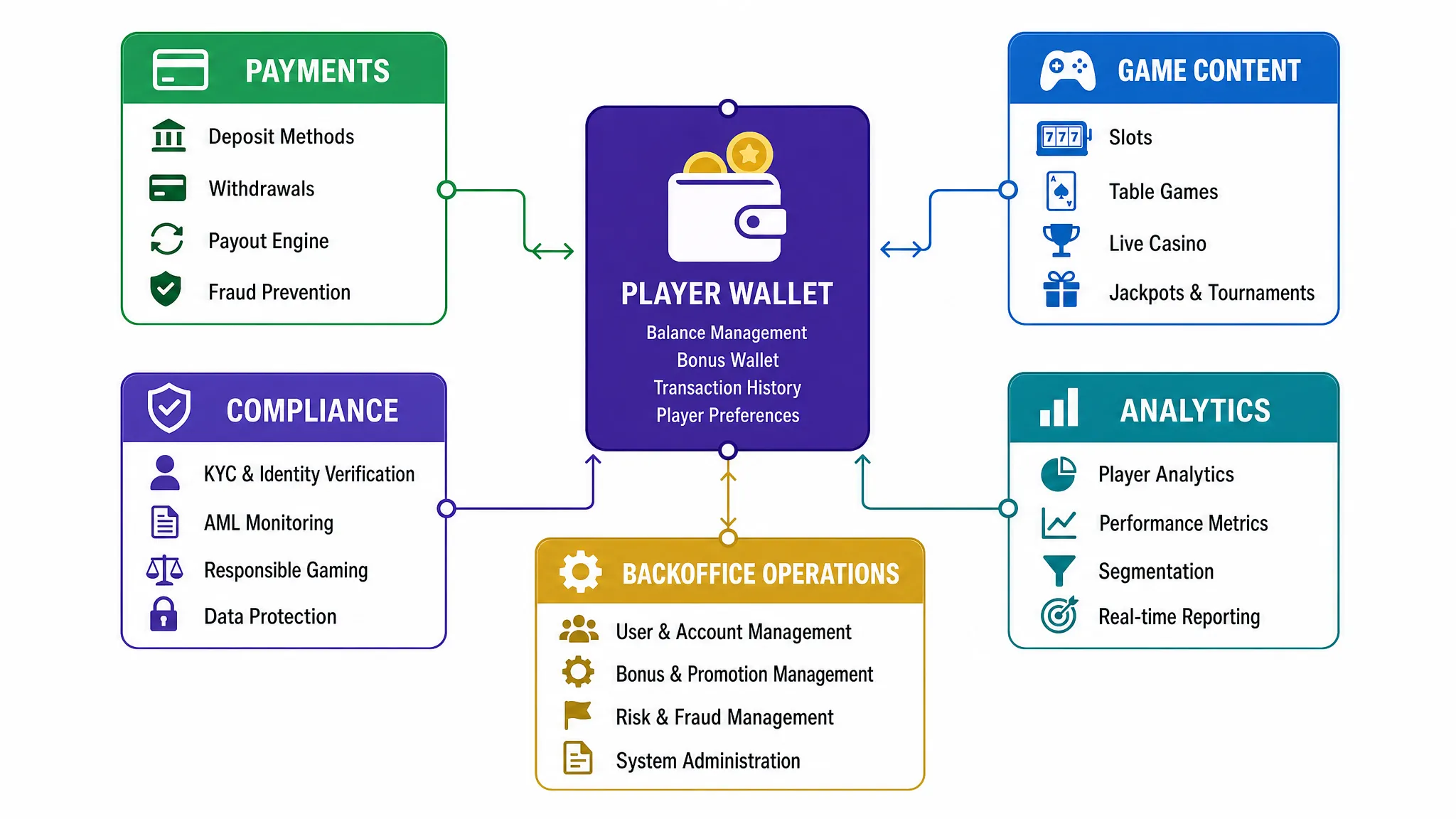
A strong backoffice should let operations, payments, compliance, CRM, affiliate, and support teams do their jobs without waiting for developers. That means player timelines, role-based permissions, clear case queues, bonus controls, affiliate reporting, payment visibility, KYC status, fraud flags, and real-time metrics should be accessible from a unified admin panel.
This is where a Shopify-like operating experience matters. Casino teams need the ability to configure, launch, pause, and review workflows without digging through disconnected vendor dashboards. When tools are fragmented, simple questions become slow: why was this withdrawal held, which bonus did this player receive, which affiliate sent this traffic, and what risk signals were triggered?
A platform that is easy to run can become a major cost advantage because it reduces dependency on custom engineering and manual coordination.
Use Analytics as a Growth Control System
Real-time analytics should do more than display revenue charts. In a fast-growth casino, analytics should connect events to action.
You want visibility into the full player journey: registration, KYC, first deposit, first spin, game preferences, bonus usage, payment failures, withdrawals, support interactions, churn risk, and VIP potential. More importantly, those signals should feed decisions. A player who abandons a deposit needs a different response than a player who hits a KYC pending state or a player who shows signs of bonus abuse.
A good way to evaluate this is to run a scenario-based vendor exercise. Instead of watching a polished sales presentation, ask the vendor to walk through a simulated growth week: traffic spike, new affiliate campaign, payment decline issue, suspicious bonus pattern, and a high-value player segment that needs retention. This mirrors the logic behind experiential business simulation, where teams learn more by testing decisions in realistic scenarios than by reviewing static theory.
The platform should make these scenarios visible through dashboards, event logs, segmentation, alerts, and backoffice workflows. If the vendor cannot show how data moves from event to decision, your growth team will likely depend on spreadsheets and manual work later.
Check Compliance Before You Check Cosmetic Customization
Design flexibility matters, but compliance flexibility matters more. As casinos grow, they face more scrutiny from regulators, PSPs, banks, game providers, affiliates, and auditors.
Your platform should support KYC, AML, fraud prevention, responsible gambling controls, geo-rules, audit logs, role permissions, data exports, and case management from the beginning. These controls should not be bolted on after the brand starts scaling.
For crypto-ready casinos, this includes wallet risk monitoring, transaction screening, Travel Rule readiness where applicable, custody controls, withdrawal policies, and evidence-grade transaction histories. For fiat casinos, it includes chargeback evidence, 3DS behavior, PSP routing, bank reconciliation, and payment method governance.
Fast growth without compliance discipline is fragile growth. If your platform cannot prove what happened, who approved it, which rule triggered, and how funds moved, the business will struggle when volume increases.
Demand Open APIs Without Accepting Vendor Chaos
Open APIs are essential for growth, especially if you plan to integrate external CRMs, custom frontends, payment partners, data warehouses, affiliate systems, or original games. But the phrase open API can mean very different things.
Ask vendors to show API documentation, webhook catalogs, sandbox access, authentication methods, rate limits, idempotency patterns, versioning policy, and example payloads for wallets, payments, games, bonuses, KYC, analytics, and player identity.
The goal is not to build everything yourself. The goal is optionality. A modular all-in-one platform gives you integrated speed at launch, while open APIs give you room to customize and extend later.
This balance matters for fast growth. Fully custom platforms can slow you down before product-market fit. Closed white-label platforms can trap you after product-market fit. The stronger middle path is a configurable platform with integrated core modules and clean extension points.
Understand the Real Cost of Speed
The cheapest platform on paper is not always the lowest-cost platform in practice. But high cost is not a guarantee of quality either. What matters is total cost of growth.
A platform can become expensive if every change requires paid development, if payment integrations are slow, if game provider fees are opaque, if analytics require external tooling, or if compliance workflows create manual headcount. On the other hand, a cost-efficient platform with integrated modules can let a lean team launch, test, and scale with fewer vendors.
| Cost area | What to verify | Why it affects growth |
|---|---|---|
| Setup and onboarding | What is included in launch configuration, training, and support | Hidden setup work delays time to revenue |
| Games and aggregation | Provider fees, rev-share, minimums, premium content surcharges | Content margins affect profitability at scale |
| Payments | Gateway fees, crypto onramp costs, withdrawal fees, reconciliation workload | Cashier economics shape player LTV |
| Compliance | KYC checks, AML monitoring, manual review tools, audit exports | Compliance cost rises with player volume |
| Customization | Theme changes, pages, campaigns, APIs, original games | Slow customization reduces experimentation speed |
| Operations | Backoffice usability, support tooling, analytics, fraud queues | Manual work limits scaling efficiency |
During procurement, model at least 12 to 24 months of costs. Include launch cost, monthly platform fees, revenue share, provider fees, payment fees, KYC cost, support effort, custom work, and expected headcount. Growth platforms should reduce operational complexity, not just move costs into hidden line items.
Run a Practical Vendor Bake-Off
A vendor bake-off should test real workflows, not just features. Give each shortlisted casino platform the same scenarios and score the outcomes.
Use these scenarios as a baseline:
- Launch a new localized lobby with selected slot games, payment methods, language, and currency.
- Configure a first-deposit bonus with wagering rules, game exclusions, fraud limits, and reporting.
- Process a fiat deposit, a crypto deposit, a failed payment, a withdrawal hold, and a refund or reversal.
- Review a player with KYC issues, AML signals, bonus abuse suspicion, and support history.
- Build a segment of high-intent players and trigger a retention campaign.
- Export evidence for payments, gameplay, KYC, and bonus activity.
The strongest vendor will not simply say yes to each requirement. It will show the workflow clearly, explain the data trail, and identify where configuration ends and custom work begins.
Use a Weighted Scorecard for Final Selection
Not every platform requirement deserves the same weight. A new operator should usually overweight payments, compliance, backoffice usability, and launch support. A scaling operator may place more weight on APIs, analytics, multi-brand management, cost controls, and data portability.
Here is a simple evaluation model:
| Category | Suggested weight | What a high score looks like |
|---|---|---|
| Payments and wallet | 20% | Fiat and crypto support, multi-currency wallet, reliable ledger, reconciliation, onramps |
| Compliance and fraud | 20% | KYC/AML, risk workflows, responsible gambling controls, audit-grade logs |
| Game aggregation | 15% | Broad content access, fast launches, metadata, jurisdiction controls, provider reporting |
| Backoffice UX | 15% | Non-technical teams can manage players, bonuses, affiliates, payments, and cases |
| Analytics and activation | 10% | Real-time dashboards, event tracking, segmentation, campaign triggers |
| APIs and extensibility | 10% | Documented APIs, webhooks, sandbox, versioning, integration flexibility |
| Commercial fit | 10% | Transparent pricing, low hidden costs, scalable support, clear contract terms |
This type of scorecard keeps the decision grounded. It also prevents teams from overvaluing cosmetic demos while underweighting the systems that protect growth.
Where Spinlab Fits for Growth-Focused Operators
Spinlab Studio is built for operators that want a modular, all-in-one iGaming platform without the complexity of assembling every core system from scratch. The platform is designed to support online casino launches with crypto and fiat payments, game aggregation, real-time analytics, KYC and AML compliance, fraud prevention, mobile-optimized casino experiences, affiliate and bonus tooling, customizable backoffice controls, multi-currency support, open API integration, crypto onramp solutions, merchant custodial wallets, and the option to create custom original games.
For teams that want a cost-efficient white-label casino path, Spinlab also emphasizes a Shopify-like user experience so operators can manage more of the business from one connected admin environment. That combination is especially useful when speed matters, but the team still needs serious controls around money movement, compliance, and growth operations.
The right platform should help you launch quickly, then keep improving without forcing a rebuild. That is the standard fast-growth operators should use when comparing vendors.
Frequently Asked Questions
What is the most important factor when choosing a casino platform for fast growth? The most important factor is operational scalability. A platform should let you launch, process payments, manage compliance, add games, run promotions, and monitor risk without creating manual bottlenecks every time volume increases.
Is a white-label casino platform better than a custom build for fast growth? For most early and mid-stage operators, a white-label or modular white-label platform is faster and less risky than a full custom build. Custom builds can make sense later when the operator has proven demand, strong engineering capacity, and very specific product needs.
Should a fast-growth casino support both crypto and fiat payments? In many markets, yes. A hybrid cashier gives players more choice and helps operators route deposits through the most effective rails. The platform must also support proper ledgering, reconciliation, fraud controls, and KYC/AML workflows for both payment types.
How do I know if a casino platform can really scale? Ask the vendor to demonstrate high-volume workflows, failed payment handling, game provider issues, fraud reviews, bonus abuse cases, audit exports, and real-time analytics. Real scenarios reveal more than feature lists.
What platform features help non-technical casino teams move faster? A usable backoffice, configurable bonus engine, affiliate tools, game management, payment visibility, player timelines, analytics dashboards, and role-based workflows all help operators move faster without constant developer support.
Choose a Platform That Grows With the Business
Fast casino growth comes from removing friction across the entire operating model: launch, payments, compliance, games, analytics, campaigns, and support.
If you are evaluating casino software, do not choose based only on the lobby preview. Test the money flows, inspect the admin tools, pressure-test compliance, review the APIs, and model the total cost of growth.
To see how a modular, crypto-ready white-label casino platform can support fast launch and scalable operations, explore Spinlab Studio and compare it against your own growth scorecard.
Finally a site that understands what regular players need. The loyalty rewards stack up nicely and I never feel ignored between spins. I tested the live chat twice and both times I got a proper answer from a real person. Safe, straightforward, and genuinely fun. gamervip
Downloaded the app yesterday and it totally changed how I play on the go. No lag at all and the notifications keep me updated on new tournaments. The welcome package felt genuinely fair with reasonable playthrough terms. If you want a stress free mobile gaming setup this is definitely worth trying out. phpfamousapp
Honestly this place has a fantastic energy and the game selection keeps getting better every month. It feels like playing with buddies who actually have your back. I love how easy it is to jump in and enjoy the ride. monkey77word
Loving the integration with Maya, it makes deposits and withdrawals so fast and seamless. luckyplayphmaya is the way to go for convenience.
Finally found a site that doesn’t lag during peak hours. The interface is super intuitive and getting started was a breeze. Check out megawin777login if you want a smooth experience.
I was struggling to find a stable login link until I found this. Now I can access my account without any issues. Thanks to hura500login for the help.
Best Jili games I have found online so far. The bonuses are generous and the local payment methods make everything so much easier. Always trust phbetjili for the best action.
Best experience I’ve had this month. The community is great and the wins are consistent. You can’t go wrong with jljl555com for your daily gaming.