

Lean casino teams can move faster than large operators, but only when the platform removes operational drag. If every payment change needs a developer, every bonus needs QA, and every KYC exception lives in a different vendor dashboard, a small team quickly becomes a support queue instead of a growth engine.
The best casino platform features for lean teams are not simply the longest feature list. They are the tools that help a founder, operator, marketer, and compliance lead run the business with fewer handoffs, fewer vendors, and fewer fragile spreadsheets.
For a lean iGaming team, the platform should feel less like an enterprise implementation project and more like a control center: launch a market, manage players, publish games, monitor risk, optimize deposits, and understand performance without constantly waiting on engineering.
What makes a casino platform lean-team friendly?
A feature is useful for lean teams only if it reduces work in a measurable way. A platform may advertise hundreds of integrations, but that does not help if your team still has to reconcile five reports manually or ask support to change every promotion.
Lean-team friendly casino software usually has four qualities:
- It centralizes high-frequency workflows in one backoffice.
- It gives operators safe controls without requiring code changes.
- It connects payments, compliance, games, and analytics around the same player and wallet data.
- It keeps advanced flexibility available through APIs, but does not force small teams to build everything from scratch.
This is the same operational logic that has reshaped other industries. For example, an all-in-one direct mail platform can bring data, design, automation, postal workflows, and reporting under one login, reducing the coordination burden for agencies and brands. Casino operators need the same kind of consolidation across payment gateway, game aggregation, compliance, and growth tooling.
1. A backoffice your operators can actually use
For lean teams, backoffice UX is not a nice-to-have. It determines how quickly the business can react. If every admin action is buried in technical menus, operators become dependent on developers for routine work.
A strong white label casino platform should give non-technical users clear, permissioned workflows for the most common tasks: updating content, reviewing players, checking payments, managing bonuses, exporting reports, and escalating suspicious activity.
The backoffice should also make every sensitive action auditable. If an admin changes a player status, adjusts a bonus rule, approves a withdrawal, or blocks a payment method in a jurisdiction, the platform should record who did it, when it happened, and why.
For lean teams, the best backoffice features are preview, permissions, audit logs, and reversibility. These reduce mistakes while allowing the team to move quickly.
2. A unified cashier for fiat, crypto, and local payments
Payments are often where lean casino teams lose the most time. A fragmented setup creates support tickets, reconciliation gaps, player frustration, and fraud exposure.
A modern online casino platform should support both crypto and fiat payments through a unified cashier and wallet model. The goal is not simply to display more payment logos. The goal is to make deposits, withdrawals, provider statuses, player balances, fees, and reconciliation visible through one operational layer.
For crypto-ready operators, this also means thinking beyond wallet-to-wallet transfers. A crypto onramp can help players who want to deposit with fiat but participate in crypto rails. Multi-currency support helps global teams avoid building separate wallet logic for every market.
The key features to demand are payment intents, idempotent ledger posting, clear deposit statuses, withdrawal review queues, PSP health visibility, multi-currency balances, and fraud-aware routing. These are the controls that prevent a small team from drowning in edge cases.
3. Built-in KYC, AML, and fraud prevention workflows
Lean teams cannot afford compliance as a separate manual department. KYC, AML, fraud prevention, and player risk workflows need to be part of the platform from day one.
That does not mean every player should face maximum friction at registration. A good platform supports risk-based checks, so low-risk users move smoothly while higher-risk cases trigger step-up verification, review, or restrictions.
Look for workflows that connect identity, payments, device signals, behavior, bonuses, and withdrawals. Fraud rarely appears in a single data point. It appears as a pattern across accounts, deposits, gameplay, promotions, and payout behavior.
For a lean team, the platform should surface those patterns automatically and route them into clear queues. Operators should see why a case was flagged, what evidence is available, what action is recommended, and what audit trail will be retained.
4. Game aggregation that reduces content operations
Game aggregation is often sold as access to a huge library of slot games, live casino games, table games, and specialty titles. Access matters, but lean teams need more than volume.
The operational question is: how quickly can your team launch, organize, test, promote, and remove games without breaking the lobby or violating jurisdictional rules?
A useful game aggregator should normalize game metadata, support market-specific availability, expose provider performance, and make lobby curation easy. If your team wants to feature a new provider, test a seasonal category, or hide games in restricted markets, the process should not require a custom development sprint.
The strongest platforms connect aggregation to analytics and bonuses. That lets operators see which games drive first deposits, which categories retain new players, and which titles should be promoted or deprioritized.
Lean-team feature scorecard
Use this table when comparing casino software providers. The best answer is not always the platform with the most modules. It is the platform that proves the workflow in a live demo.
| Feature area | Why lean teams need it | Demo proof to request |
|---|---|---|
| Backoffice admin | Reduces developer dependency | Change a bonus, review a player, export an audit log |
| Fiat and crypto cashier | Reduces payment support and reconciliation work | Run a deposit, a failed payment, and a withdrawal review |
| KYC, AML, fraud tools | Keeps compliance scalable | Show a flagged player case with evidence and action history |
| Game aggregation | Speeds content launches | Add games to a lobby and restrict them by market |
| Real-time analytics | Replaces spreadsheet-based decisions | Filter FTDs, payment failures, NGR, and bonus cost by source |
| Bonus and affiliate engine | Lets marketing move without code | Create an offer with eligibility, limits, and tracking |
| Open APIs | Preserves flexibility as the team scales | Show API docs, webhook events, and sandbox behavior |
5. Real-time analytics that point to action
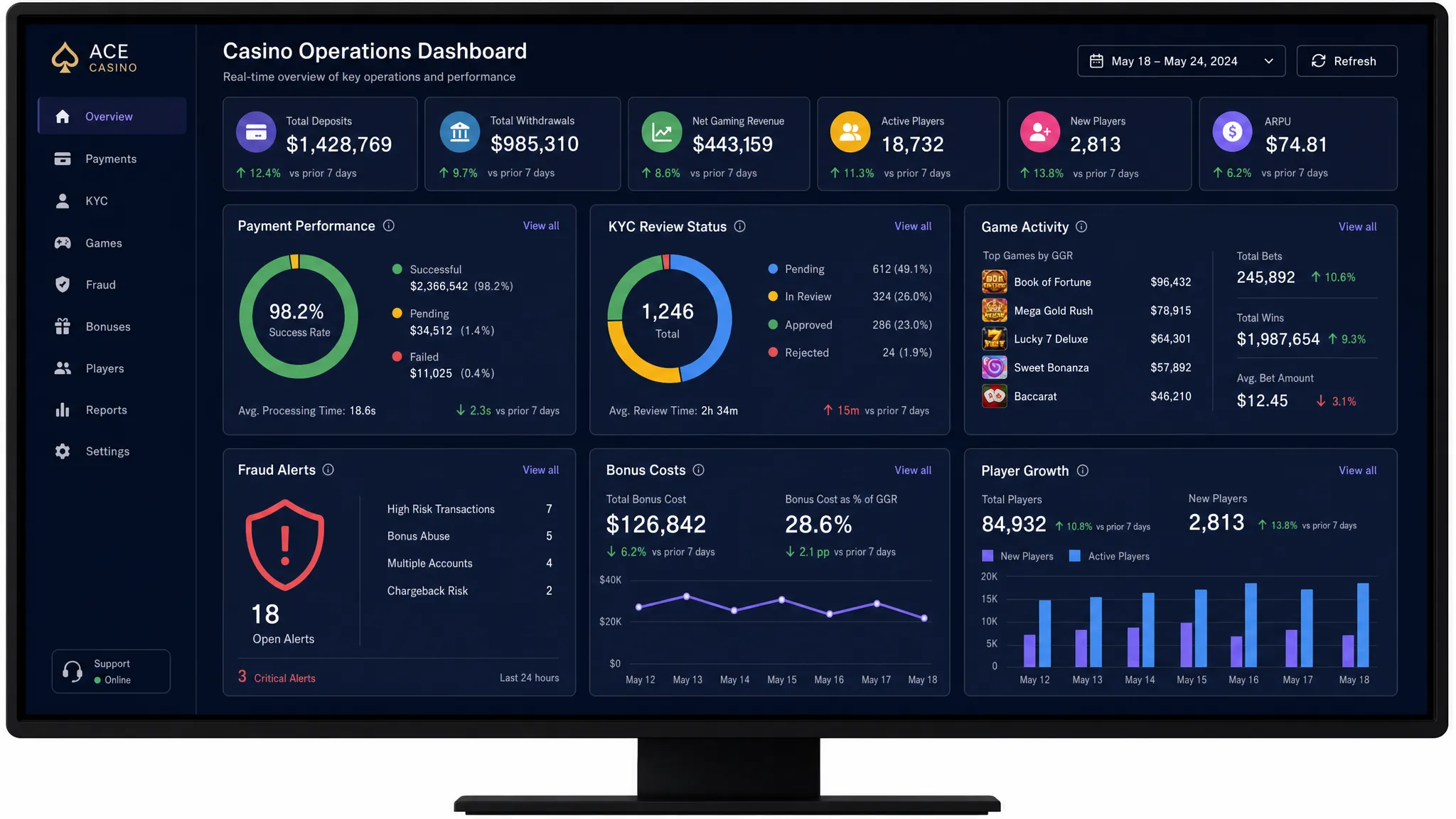
Dashboards are only useful if they help a small team decide what to do next. Lean teams do not need dozens of vanity charts. They need real-time signals tied to revenue, risk, and player experience.
At minimum, your casino platform should make these metrics visible without manual exports:
- Registration completion and first-time deposit conversion by traffic source.
- Deposit approval rate, abandonment, and failure reason by payment method.
- Game launches, game errors, and lobby engagement by provider.
- Bonus cost, wagering progress, abuse signals, and net gaming revenue impact.
- Withdrawal queues, manual review rates, and time-to-paid by rail.
Real-time analytics are especially important for lean teams because problems compound quickly. If a PSP route fails, a game provider slows down, or a bonus attracts abuse, the team needs to know within minutes, not after next week’s report.
6. Bonus and affiliate tools with guardrails
Bonuses and affiliates can accelerate growth, but they can also create financial leakage if the rules are too loose. A lean team needs marketing tools that are fast enough for experimentation and controlled enough for compliance and fraud prevention.
The best casino bonus engine should let operators define eligibility, wagering requirements, expiration, max bet rules, game contribution, cashout limits, and campaign budgets. These controls should be visible in the backoffice, not hidden in code.
Affiliate management should connect acquisition source, player value, fraud signals, and payout logic. Without that connection, lean teams often overpay for traffic that looks good at registration but performs poorly after deposit, KYC, chargebacks, or bonus abuse.
A good platform helps the team answer practical questions: which partners bring verified depositors, which offers are profitable, which campaigns generate risky behavior, and which segments deserve retention spend.
7. Mobile-first player experience by default
Most new casino brands cannot afford to redesign the entire frontend after launch. The platform should already be mobile-optimized across the high-value journey: landing page, registration, cashier, KYC, lobby, game launch, support, and withdrawals.
For lean teams, mobile-first design saves both acquisition budget and support capacity. If a deposit form is confusing, a KYC upload fails on mobile, or the lobby loads slowly on low-end devices, the operator pays twice: once in lost conversion and again in support tickets.
Look for fast templates, responsive lobbies, clear cashier states, mobile-friendly document capture, and lightweight personalization. Customization should be possible, but the default experience should already be commercially usable.
This is where a Shopify-like casino operations model becomes valuable. Small teams should be able to configure themes, content, banners, categories, offers, and payment visibility without waiting for frontend releases every time.
8. Modular architecture with open APIs
Lean does not mean limited. A team may start with a white label casino platform, then add a custom CRM, BI warehouse, affiliate network, game studio, or treasury workflow later.
Open API integration allows the platform to grow with the business. The important distinction is that APIs should expand flexibility, not compensate for missing core workflows. If the vendor says everything is possible through the API but basic bonus, cashier, and compliance tasks require custom engineering, the team is not buying leverage.
Ask for API documentation, webhook catalogs, sandbox access, versioning policies, authentication details, rate limits, and example payloads for wallet, player, payment, KYC, bonus, affiliate, and game events.
A modular all-in-one model is often the best fit for lean operators. It gives the team integrated core systems from day one while keeping the door open for custom growth later.
9. Custom game capability only when it supports a strategy
Casino original games can help a brand stand out, but they should not distract a lean team from launch basics. Aggregated content is usually the fastest way to validate acquisition, payments, retention, and compliance operations.
Once the brand has data, custom-designed original games can become a strategic asset. They may support influencer campaigns, VIP retention, crypto-native mechanics, or a unique brand identity. The platform feature to look for is not just custom game development. It is the ability to integrate original games into the same wallet, analytics, compliance, and bonus systems as aggregated content.
That keeps originality from becoming an operational island.
10. Transparent cost structure and fast onboarding
Lean teams care about cost, but the cheapest-looking option is not always the least expensive. The true cost of casino software includes platform fees, integrations, game provider costs, payment fees, KYC checks, support time, developer dependency, compliance remediation, and lost conversion from poor UX.
A platform built for lean teams should make onboarding predictable. The vendor should explain which modules are included, which services are extra, who handles each launch task, and what evidence is required before going live.
Fast onboarding matters most when it is paired with control. A demo casino that launches quickly but cannot pass payment, KYC, AML, game, and reporting checks is not a real operating platform.
A practical vendor demo script for lean teams
Before signing with any casino software provider, ask the vendor to perform real workflows in front of your team. Do not settle for slideware.
Ask them to show:
- A new player registering, depositing, passing or failing KYC, launching a game, and requesting a withdrawal.
- A payment failure with reason codes and the support view a player would see.
- A bonus campaign created by a non-technical admin with eligibility and abuse controls.
- A game lobby update with market restrictions and mobile preview.
- A flagged fraud or AML case with evidence, status, and audit history.
- A real-time dashboard showing FTD, payment, game, bonus, affiliate, and risk metrics.
If the vendor cannot complete these workflows smoothly in a demo, your lean team will probably struggle to run them under live traffic.
Frequently Asked Questions
What casino platform feature matters most for a lean team? The most important feature is an integrated backoffice connected to payments, wallet, KYC, AML, fraud, games, bonuses, affiliates, and analytics. Without that operational center, the team wastes time switching between tools and reconciling inconsistent data.
Can a small team launch an online casino without developers? Yes, if it uses a white label casino platform with configurable workflows, a usable admin panel, integrated payment gateway, game aggregation, and compliance tools. Developers may still be useful for advanced customization, but they should not be required for everyday operations.
Should lean teams choose modular or all-in-one casino software? Many lean teams benefit from a modular all-in-one platform. It reduces vendor sprawl at launch while preserving flexibility through APIs and optional modules as the brand grows.
Is crypto support necessary from day one? Not for every market, but crypto-ready architecture is increasingly useful. Even if you begin with fiat, support for crypto deposits, stablecoins, onramps, and multi-currency wallets can make expansion easier later.
How do lean teams avoid outgrowing their first platform? Choose software with strong core workflows, open APIs, reliable analytics, scalable payment architecture, and clear data ownership. Avoid platforms that are easy to launch but hard to customize, integrate, or audit later.
Build a lean casino operation without stitching tools together
Lean teams do not need more dashboards, more vendor calls, or more manual reconciliation. They need a casino platform that turns high-risk, high-frequency workflows into repeatable operations.
Spinlab Studio is designed as a modular, Shopify-like iGaming platform for operators who want to build, launch, and scale without assembling a fragmented stack. It brings crypto and fiat payments, game aggregation, KYC and AML workflows, fraud prevention, real-time analytics, affiliate and bonus tooling, multi-currency support, open APIs, customizable backoffice controls, and optional original games into one flexible platform.
If you are evaluating a white label casino platform for a lean team, start with the workflows that consume the most time: deposits, withdrawals, compliance reviews, bonus setup, game launches, and reporting. Then choose the platform that makes those workflows simple, visible, and auditable.
Explore Spinlab Studio to see how a lean team can launch faster and operate with more control.