

A Shopify-like casino operation sounds simple: choose a theme, connect payments, add products, launch campaigns, and optimize from a clean admin panel. In iGaming, the idea is similar, but the stakes are higher. You are not selling T-shirts. You are operating a regulated real-money entertainment business with payments, player identity, fraud prevention, game content, bonuses, affiliates, and responsible operational controls all working together.
The opportunity is that modern whitelabel iGaming software has made casino operations much more accessible. A founder no longer needs to build every wallet, lobby, cashier, compliance workflow, or game integration from scratch. With the right modular platform, a lean team can launch and manage a brand in a way that feels closer to running an e-commerce store than running a software company.
That does not mean the business is easy. It means your team can spend less time coordinating developers and more time on what actually grows the brand: positioning, acquisition, retention, payment performance, game selection, player trust, and margin.
What “Shopify-like” Really Means for an Online Casino
In e-commerce, Shopify works because it abstracts away technical complexity. Merchants can manage products, storefront design, payments, inventory, discounts, apps, and analytics from one operational layer. A Shopify-like casino operation applies the same principle to an online casino, but with casino-specific modules.
Instead of manually connecting dozens of vendors and building custom internal tools, operators use a centralized backoffice to manage the main parts of the business. The goal is not to remove expertise. The goal is to make daily operations manageable without waiting on developers for every promotion, payment change, content update, or reporting request.
A practical Shopify-like casino setup typically includes:
- A mobile-optimized casino frontend and lobby
- Game aggregation for slots, live casino games, crash games, table games, or casino original games
- Fiat and crypto payment support
- Wallets, multi-currency balances, and crypto onramp options
- KYC, AML, fraud prevention, and risk workflows
- Bonus, campaign, and affiliate management
- A customizable backoffice admin panel
- Real-time analytics for product, payment, and player performance
- Open API access for integrations where needed
The important distinction is that “easy to operate” should never mean “light on controls.” Real-money gaming requires clear processes for compliance, security, responsible operations, payment reconciliation, and player support. The Shopify-like model works best when those controls are built into the platform instead of scattered across disconnected spreadsheets and vendor dashboards.
Start With the Operating Model, Not the Website
Many first-time casino founders start with the visual brand: logo, color palette, homepage, and game lobby. Those matter, but they are not the operating model.
Before choosing software or designing the frontend, define how the business will actually run. Which markets will you target? Which licenses or legal frameworks apply? Which payment methods do players expect? Will your brand focus on crypto-native players, casual slot players, live casino fans, VIPs, stream-driven traffic, or a niche community? Your operating model should answer these questions before you configure the platform.
A Shopify-like casino operation is strongest when every module supports the same commercial strategy. A crypto-first brand, for example, needs fast wallet flows, multi-currency support, crypto onramps, strong fraud prevention, and clear player education around deposits and withdrawals. A slot-first brand needs a powerful game aggregator, lobby personalization, bonus flexibility, and analytics that show which providers, games, and campaigns drive retention.
If you are still choosing the foundation, Spinlab’s guide on how to choose a casino platform for fast growth is a useful next step because it frames platform selection around growth constraints rather than surface-level features.
Map the Casino Stack to Familiar E-Commerce Functions
The easiest way to understand a Shopify-like casino operation is to compare it to an online store. The categories are different, but the operating logic is familiar: present content, accept payments, manage users, run campaigns, track performance, and improve conversion.
| E-commerce function | Casino operation equivalent | Why it matters |
|---|---|---|
| Product catalog | Game lobby and game aggregator | Determines what players can discover and play |
| Checkout | Cashier, wallets, deposits, withdrawals | Directly affects conversion and trust |
| Discount codes | Bonuses, free spins, rakeback, promos | Drives acquisition and retention when controlled properly |
| Customer accounts | Player profiles, KYC, limits, risk flags | Supports identity, compliance, and safer operations |
| App store | APIs, providers, payment tools, CRM integrations | Lets the operator extend the platform without rebuilding |
| Analytics dashboard | Real-time reporting across players, games, payments, and campaigns | Shows what is working and where margin is leaking |
| Admin panel | Casino backoffice | Gives the team day-to-day operational control |
This is why the backoffice experience matters so much. A casino may have a beautiful frontend, but if the team cannot quickly update promotions, review player activity, monitor cashier issues, adjust game placement, or read performance data, the operation becomes slow and expensive.
Choose a Modular Whitelabel Casino Platform
A Shopify-like operation depends on modularity. You want the core platform to handle the heavy infrastructure while still allowing you to configure the brand, content, payments, games, and workflows around your audience.
A whitelabel casino platform can reduce the need for a large technical team because many core systems are already packaged together. That may include the player account system, game aggregation, cashier, compliance tools, bonus engine, affiliate engine, admin panel, analytics, and APIs. The more unified these modules are, the fewer operational gaps your team has to bridge manually.
The key is to avoid confusing “turnkey” with “generic.” A turnkey casino solution should accelerate launch, but it should still let you differentiate. Your brand needs its own positioning, game mix, promotions, payment experience, VIP logic, content, and acquisition funnel. A platform should give you operational speed without locking you into a copy-paste casino.
Spinlab is built around this modular, all-in-one approach, with support for crypto and fiat payments, game aggregation, real-time analytics, compliance workflows, fraud prevention, affiliate and bonus management, open API integration, and a customizable backoffice. For founders who want the operational feel of Shopify without building an iGaming stack from scratch, that combination is the core advantage.
Build the Frontend Around Speed and Trust
Your casino frontend is not just a design layer. It is the first operational test your player experiences. If the lobby is slow, the cashier is confusing, or the mobile experience feels unstable, players will not wait for your support team to explain what went wrong.
A Shopify-like casino should be mobile-first from the start. The player journey should feel fast across landing page, registration, KYC prompts, deposit, game launch, bonus activation, and withdrawal. Every extra step creates friction. Every unclear message increases support tickets.
Trust signals also matter. Players should understand which payment methods are available, how account verification works, where to find terms for promotions, and how to contact support. In crypto-ready casino operations, clarity is even more important because players may be moving between fiat, crypto, onramps, and multi-currency balances.
For a deeper technical and UX angle, Spinlab’s article on how to build a mobile casino that loads fast explains why speed must be designed across the whole player journey, not just the homepage.
Connect Payments Before You Scale Marketing
In online casino operations, payments are not a backend detail. They are part of the product. Deposit approval rates, withdrawal speed, supported currencies, payment limits, fraud controls, and cashier clarity all influence revenue.
A Shopify-like casino operation should make payment management visible to operators. The team needs to understand which methods are converting, where deposits fail, how long withdrawals take, what currencies players prefer, and how risk checks affect the experience.
For many modern operators, this means supporting both fiat and crypto rails. Crypto-ready infrastructure can help brands serve players who prefer digital assets, while crypto onramp solutions can reduce friction for users who enter from fiat. Merchant custodial wallets may also be part of the operational setup for safekeeping funds, depending on the platform structure and regulatory context.
The mistake is to launch aggressive acquisition before the cashier is reliable. Paid traffic, affiliates, influencers, and bonus campaigns can create volume quickly, but if deposits fail or withdrawals create confusion, that volume becomes churn, complaints, and reputational risk.
Curate Games Like a Product Catalog
A game aggregator gives your casino access to content, but access is not the same as merchandising. Shopify merchants do not just upload every product randomly. They organize categories, highlight bestsellers, test collections, and promote products based on customer behavior. Casino operators should treat the game lobby the same way.
Your game mix should reflect your audience. A crypto-native brand might emphasize crash games, instant-win formats, original games, and high-volatility slots. A mainstream casino may prioritize familiar slot games, live casino games, roulette, blackjack, and themed seasonal campaigns. If your audience follows provider trends, you may need a lobby strategy for new game drops, including popular categories such as new Pragmatic slots or new Hacksaw slots where relevant to your market and provider access.
The operator’s job is to turn the game aggregator into a player experience. That means managing categories, featuring new releases, removing clutter, testing lobby order, and tracking performance. Real-time analytics should show not only which games are played, but which games retain players, support bonus strategy, and contribute to sustainable margin.
Make the Backoffice Your Daily Control Room
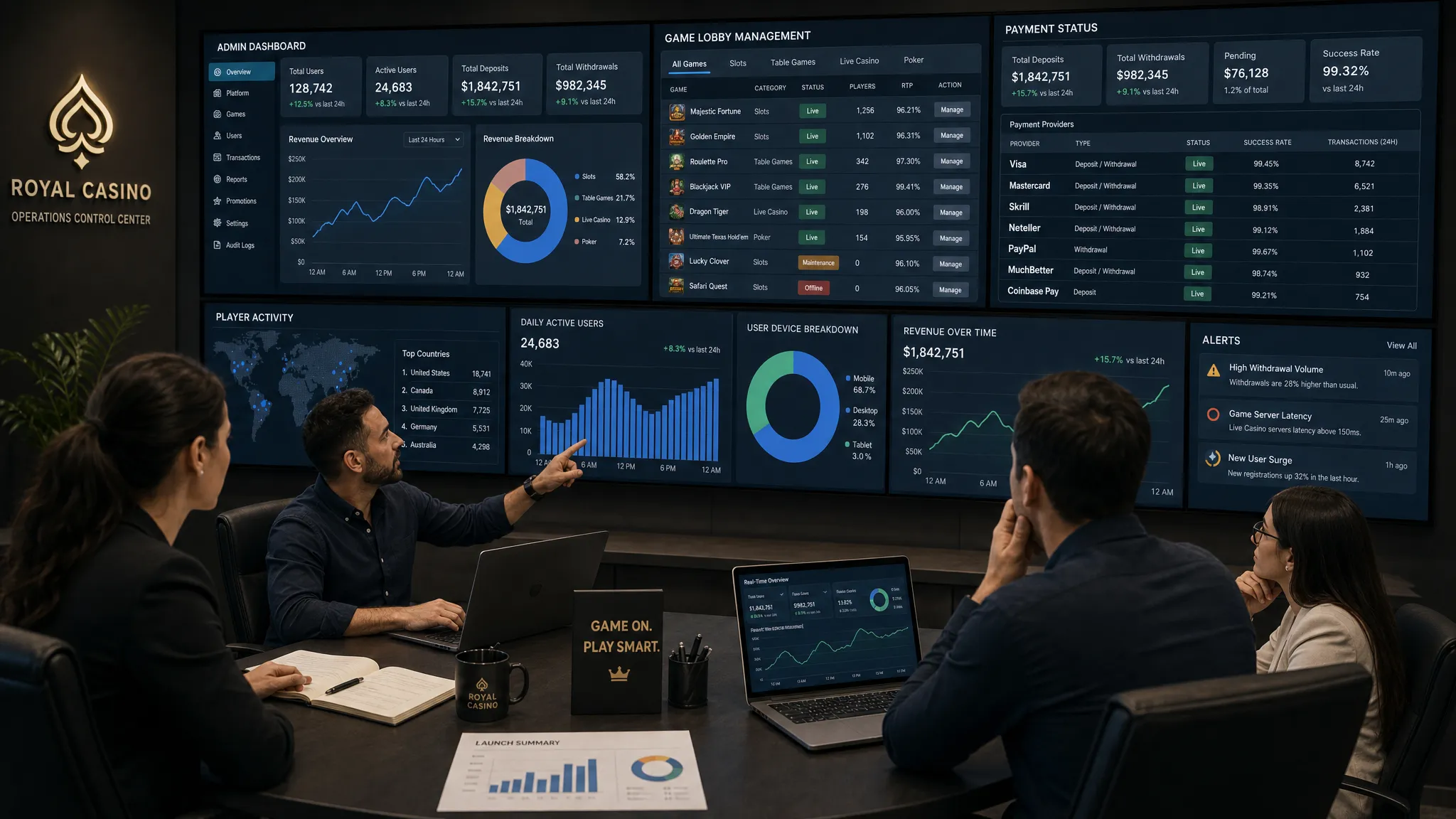
The backoffice is where the Shopify-like promise either succeeds or fails. If your team has to ask developers to create every bonus, update every page, check every payment issue, or export every report, you do not have a modern operation. You have a dependency chain.
A strong casino backoffice should help operators manage the business in real time. That includes player accounts, bonuses, affiliate activity, game visibility, payments, risk reviews, reporting, and content controls. It should also support different roles, so marketing, support, finance, and risk teams can each work with the tools they need.
For lean teams, this is especially important. A founder might begin with a small operations group where one person handles marketing, another manages support, and a third oversees payments and risk. The platform must give that team enough control to run daily workflows without building an internal tool for every task.
This is also where Spinlab’s Shopify-like interface philosophy matters. A clean admin experience can reduce training time, lower operational errors, and help non-technical teams move faster. If you want to explore the no-developer angle in more detail, Spinlab has a dedicated guide to running a brand with no developers.
Build Acquisition Around the Platform’s Operational Strengths
A Shopify-like casino operation should not rely only on software. The platform gives you leverage, but growth still comes from distribution, positioning, and trust.
Start with a focused acquisition model. Trying every channel at once usually creates messy data and inconsistent player quality. Instead, choose the channels that match your audience and your operational strengths. Affiliate marketing can work well if your bonus engine, tracking, and payout processes are organized. Content and SEO can work if your brand has a clear niche. Influencer and community campaigns can work if your onboarding and cashier flows are ready for spikes in traffic.
Creative quality also matters more than many operators expect. Casino brands compete in crowded feeds, affiliate pages, livestreams, and search results. A sharp launch video, founder story, or promotional brand film can help explain what makes the casino different. If you need polished brand assets outside the platform itself, working with specialists in cinematic business promo video production can be useful for campaigns, launch pages, and investor-facing materials.
The platform should then help you measure what happens after traffic arrives. Which affiliates send players who deposit? Which campaigns create bonus abuse? Which landing pages convert on mobile? Which payment methods perform best by segment? A Shopify-like operation is not just easy to launch. It is easier to learn from.
Treat Compliance as an Operating System
Compliance should not be a checklist you complete once before launch. It should be part of the daily operating system of the casino.
Depending on your target markets and licensing model, your operation may need KYC checks, AML monitoring, sanctions screening, age verification, suspicious activity workflows, transaction monitoring, player limits, promotional terms, and recordkeeping. The exact requirements vary by jurisdiction, so operators should work with qualified legal and compliance advisors before going live.
From an operational perspective, the platform should make compliance workflows manageable. Support and risk teams need clear visibility into player status, documents, flags, payment activity, and account restrictions. Marketing teams need to understand what they can and cannot promote. Finance teams need reliable records for reconciliation.
The best Shopify-like casino operations do not treat compliance as the enemy of growth. They treat it as the guardrail that lets growth continue without constant emergencies.
Use Analytics to Run Weekly Optimization Loops
Real-time analytics are only valuable if the team uses them to make decisions. A Shopify-like casino should create a weekly rhythm around performance, similar to how strong e-commerce teams review conversion, customer acquisition cost, average order value, retention, and refund rates.
For an online casino, your weekly operating review might include:
- Registration to first deposit conversion
- Deposit success rate by payment method and currency
- Withdrawal volume and processing time
- Active players by game category and provider
- Bonus cost, bonus abuse indicators, and post-bonus retention
- Affiliate quality by first-time deposits and longer-term value
- Mobile load speed, game launch failures, and support tickets
- KYC approval rates and reasons for drop-off
The purpose is not to drown the team in dashboards. The purpose is to identify the next operational constraint. If traffic is high but deposits are low, fix the cashier. If deposits are strong but retention is weak, review game mix, onboarding, and bonus structure. If affiliates drive signups but poor player quality, adjust partner terms and tracking.
A modular platform makes these loops easier because the operator can act on insights without rebuilding the stack.
Launch Small, Then Expand Deliberately
One of the biggest advantages of a Shopify-like model is that it supports staged growth. You do not need to launch with every market, every game provider, every payment method, every bonus type, and every integration on day one.
A smarter path is to launch with the smallest complete operation that can attract real players, process payments reliably, support compliance workflows, and generate useful data. Then expand based on evidence. Add providers when players show demand. Add payment methods when deposit data supports it. Add affiliates when tracking and bonus controls are ready. Add original games when they support your brand identity and retention strategy.
This approach reduces waste. It also protects the team from complexity too early. Many casino operations do not fail because they lack features. They fail because the team cannot manage the features they launched with.
The Practical Blueprint
If you are building a Shopify-like casino operation, think in systems rather than isolated tasks. The goal is to create an operation where the frontend, cashier, games, compliance, marketing, support, and analytics reinforce each other.
A practical build sequence looks like this:
- Define the market and operating model: Choose your target audience, jurisdictions, payment needs, content strategy, and compliance requirements before choosing features.
- Select a modular whitelabel platform: Prioritize game aggregation, payments, wallets, KYC, AML, fraud prevention, bonus tools, affiliate management, analytics, APIs, and backoffice usability.
- Configure the brand and player journey: Build a mobile-first lobby, simple registration flow, clear cashier, transparent bonus terms, and trustworthy support paths.
- Connect and test payments: Validate fiat and crypto flows, multi-currency behavior, deposit success, withdrawal operations, reconciliation, and risk controls.
- Curate the game catalog: Organize categories, feature the right providers, test game placement, and use analytics to improve the lobby.
- Set up growth systems: Prepare affiliate tracking, bonus campaigns, CRM workflows, landing pages, and creative assets before scaling traffic.
- Operationalize compliance: Build daily workflows for KYC, AML, fraud reviews, player restrictions, documentation, and internal escalation.
- Launch with a feedback loop: Review performance weekly, fix the biggest bottleneck, and expand only when the operation can support more volume.
This is the difference between launching a casino website and building a casino operation. The website is only the storefront. The operation is the system behind it.
Frequently Asked Questions
Can you really run an online casino without developers? Yes, a modern whitelabel casino platform can reduce day-to-day developer dependency by giving operators control over games, payments, bonuses, affiliates, and reporting through a backoffice. You may still need technical support for advanced integrations, custom work, or unusual requirements.
What makes a casino platform “Shopify-like”? It means the platform simplifies complex infrastructure into an admin experience that non-technical teams can use. In iGaming, that usually includes game aggregation, payment management, compliance workflows, bonus tools, affiliate tools, analytics, and configurable frontend controls.
Is a Shopify-like casino operation compliant by default? No. Software can support compliance through KYC, AML, fraud prevention, player records, and operational workflows, but legal requirements depend on your markets, license, business model, and local rules. Always get qualified legal and compliance guidance.
Should a new casino support crypto from launch? It depends on the audience. If your brand targets crypto-native players, crypto payments, multi-currency support, onramp options, and secure wallet operations may be central. If your audience is more traditional, fiat payment performance may matter more at the beginning.
What should be launched first: more games or more payment methods? Prioritize the bottleneck that affects conversion and trust most. A strong game catalog matters, but if players cannot deposit or withdraw smoothly, more games will not fix the operation. Use analytics to decide what to expand next.
Build the Operation, Not Just the Casino Site
A Shopify-like casino operation is about control. It gives a lean team the ability to launch, manage, measure, and improve an online casino without turning every operational change into a development project.
That requires the right foundation: modular whitelabel iGaming software, a reliable cashier, game aggregation, crypto and fiat support, compliance workflows, fraud prevention, real-time analytics, and a backoffice your team can actually use.
Spinlab is designed for operators who want that all-in-one foundation with a Shopify-like experience, flexible modules, fast onboarding, and cost-efficient whitelabel casino software. If your goal is to build a casino brand that can launch lean and scale intelligently, start with the operation you want to run every day, then choose the platform that makes it possible.