

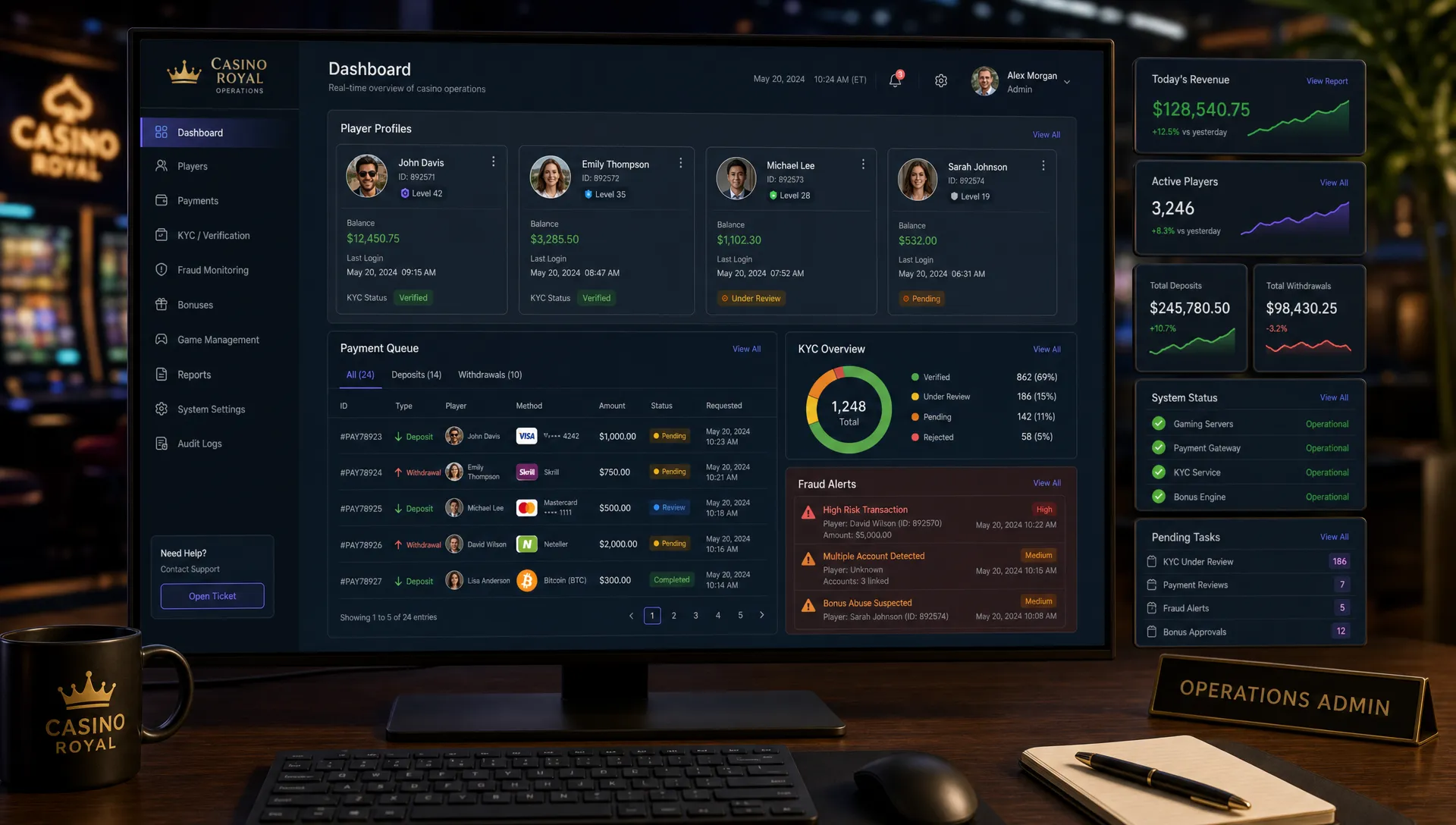
A casino admin panel should feel like a control room, not a maze of tabs. Every daily task, checking a withdrawal, reviewing a KYC document, adjusting a bonus, disabling a suspicious account, or confirming game availability, should take fewer clicks than the operator expects.
That matters because admin time compounds. A task that takes three extra minutes does not sound expensive until it happens 80 times per day across payments, support, compliance, fraud, affiliates, and content operations. For lean online casino teams, the right admin panel is not just a convenience. It is the difference between scaling smoothly and hiring people to compensate for poor software.
Below are the casino admin panel features that save time every day, with practical examples of how they reduce repetitive work without weakening control, compliance, or player experience.
Why the admin panel is where casino operations are won or lost
Players see the cashier, lobby, bonuses, slot games, live casino games, and account screens. Operators live in the admin panel. If that panel is slow, fragmented, or confusing, the entire business becomes harder to run.
A good casino admin panel centralizes the work behind the scenes: player management, payment review, KYC and AML checks, fraud monitoring, game configuration, bonus setup, affiliate tracking, reporting, and permissions. A weak one forces the team to switch tools, export spreadsheets, ask developers for basic changes, and rely on manual notes.
This is especially important for a white label casino platform or turnkey casino solution, where operators expect speed. The promise is not only a faster launch. It is a simpler operating model after launch.
If you are evaluating platform usability at a broader level, Spinlab’s guide on what makes a casino platform easy to run is a useful companion. This article focuses specifically on daily admin panel features that reduce hands-on workload.
The daily time-saver checklist
The best admin panels do not simply offer more features. They make common decisions faster and safer. The table below summarizes what to look for.
| Daily admin need | Time-saving feature | Why it matters |
|---|---|---|
| Find player context quickly | Unified player profile | Reduces tab switching across wallet, KYC, bonuses, payments, and activity |
| Review withdrawals | Payment queue with risk signals | Helps teams prioritize approvals and investigate exceptions faster |
| Manage documents | KYC and AML workflow | Keeps verification tasks organized and auditable |
| Spot abuse | Fraud alerts and case notes | Turns scattered signals into actionable reviews |
| Launch campaigns | Bonus and affiliate engine | Lets marketers configure offers without developer tickets |
| Update game lobby | Game aggregation controls | Makes it easier to manage providers, categories, and availability |
| Track business health | Real-time analytics dashboard | Helps operators catch issues before they become revenue leaks |
| Protect access | Role permissions and audit logs | Supports accountability without blocking daily work |
The goal is simple: fewer manual checks, fewer copy-paste tasks, fewer support escalations, and fewer cases where only one person knows how something works.
Unified player profiles that eliminate tab switching
The player profile is the most important screen in a casino admin panel. Support agents, payment teams, VIP managers, compliance reviewers, and fraud analysts all need fast access to the same account context, but they do not need it presented in the same way.
A time-saving player profile should show the essentials in one place: account status, balances, deposits, withdrawals, bonus activity, KYC state, risk flags, recent logins, device or IP signals, support notes, and responsible gambling limits where applicable. The value is not only visibility. It is speed of diagnosis.
For example, if a player asks why a withdrawal is delayed, the agent should not need to open five systems. The profile should show whether the delay is caused by a pending document, bonus wagering, payment processor review, AML escalation, or a manual risk hold.
The best admin panels also include a player timeline. A timeline helps staff see the sequence of events, such as registration, first deposit, bonus claim, big win, withdrawal request, KYC upload, and support contact. This saves time because operators can understand the story of an account rather than inspecting disconnected records.
Smart queues for KYC, AML, withdrawals, and support
Queues are where operational design becomes visible. If every task arrives in the same generic list, the team wastes time sorting work manually. A strong casino admin panel creates structured queues for different workflows.
KYC tasks should be filterable by document type, age of request, jurisdiction, risk level, and player segment. Withdrawal queues should show amount, payment method, currency, account age, risk indicators, and whether required checks are complete. Support queues should highlight VIP status, unresolved payment issues, and recent account changes.
This type of workflow supports a risk-based approach. Global AML guidance from the Financial Action Task Force emphasizes customer due diligence and ongoing monitoring based on risk. In practice, that means operators need admin tools that help teams prioritize the right cases, not just process everything in chronological order.
A useful admin panel also makes handoffs easier. A payment analyst should be able to leave structured notes for compliance. A compliance reviewer should be able to escalate a case with context. A support agent should be able to see that a player has already been reviewed, rather than asking the same questions again.
Payment and wallet tools that reduce manual reconciliation
Payments are one of the biggest sources of daily admin work for an online casino. Deposits, withdrawals, chargebacks, failed transactions, currency conversion, processor routing, crypto confirmations, and wallet balances all create operational friction.
A time-saving admin panel should give teams clear visibility into payment status, wallet movements, transaction references, player balances, and processor responses. For crypto-ready operations, it should also help staff understand on-chain and off-chain activity without requiring every agent to become a blockchain specialist.
The most useful payment features include searchable transaction histories, filters by method or currency, clear withdrawal states, manual review flags, refund or reversal controls where supported, and exportable reports for finance. Multi-currency support is especially important when a platform serves players across different markets.
Crypto onramp support and merchant custodial wallets can also reduce friction when they are integrated properly. The key admin benefit is having fiat and crypto activity visible within the same operational environment, instead of splitting finance work across disconnected dashboards.
Fraud prevention features that turn signals into decisions
Fraud prevention is not only about blocking bad actors. It is about helping staff make better decisions quickly. A casino admin panel should surface suspicious behavior in context, not bury it in raw logs.
Useful fraud prevention features include alerts for duplicate accounts, unusual deposit patterns, bonus abuse indicators, suspicious withdrawal behavior, device changes, mismatched account data, and risky login activity. The exact rules depend on the market and operator policy, but the admin experience should be consistent: show the signal, show why it matters, and give the reviewer the next available action.
Case management is a major time-saver here. If a suspicious player is reviewed multiple times, the team should see previous decisions, notes, documents, and outcomes. Without case history, every reviewer starts from zero, which wastes time and increases inconsistency.
Bonus and affiliate controls that reduce marketing dependency on developers
Bonuses are powerful, but they can create a lot of admin work when the setup process is rigid. If every promotion requires developer support, campaign velocity slows down and simple adjustments become expensive.
A practical bonus engine should let authorized staff configure common campaign rules from the admin panel. This can include deposit bonuses, free spins, cashback-style offers, wagering requirements, eligibility rules, time windows, player segments, and maximum reward limits. The exact structure depends on the platform and jurisdiction, but the principle is the same: marketing should be able to launch controlled campaigns without editing code.
Affiliate tools save time in a similar way. Operators need to track referrals, campaign performance, commission logic, player quality, and fraud indicators. When affiliate data is connected to player behavior and payment activity, teams can identify valuable partners faster and investigate suspicious traffic with less manual work.
The best admin panels also make bonus troubleshooting easy. If a player says a bonus did not apply, support should be able to see eligibility, claim status, wagering progress, expiration, and restrictions without escalating the ticket.
Game management that keeps the lobby fresh without chaos
Game aggregation is a core part of modern iGaming platform operations. Operators want access to a broad mix of slot games, live casino games, table games, and casino original games. But adding more content should not make the admin workload explode.
A time-saving game management area should allow teams to search, categorize, enable, disable, and reorder games from one place. Filters by provider, volatility, type, market availability, device support, popularity, and launch date can help content teams manage a large catalog without relying on spreadsheets.
This is especially useful when working with multiple game providers or launching custom original games. The admin panel should make it clear which games are active, which markets they are available in, and how they appear in the lobby.
A strong setup also protects operators from mistakes. For example, permissions can prevent unauthorized staff from changing provider settings, while preview modes can help teams check lobby placement before publishing updates.
Real-time analytics that answer operational questions fast
A real-time analytics dashboard saves time because it reduces the number of questions that require manual reports. Operators should be able to answer core questions at a glance: Are deposits working? Are withdrawals delayed? Which games are driving activity? Which bonuses are being abused? Which affiliates are sending profitable players? Where did conversion drop today?
Dashboards are most useful when they combine business metrics with operational alerts. Revenue, deposits, withdrawals, registrations, first-time deposit rate, active players, game performance, bonus cost, and payment approval rates are all useful, but they become more powerful when connected to workflows.
For example, if deposit approval drops for a specific payment method, the admin panel should make the issue visible quickly. If a bonus campaign has a much higher cost than expected, the marketing team should see it before the promotion drains margin.
Saved views are another daily time-saver. A CEO, payments lead, compliance reviewer, and affiliate manager should not need the same dashboard. Role-based saved views let each person start the day with the metrics that matter to them.
Role-based permissions and audit logs that prevent rework
Fast admin work still needs control. In online gambling, one wrong permission can create payment risk, compliance risk, or bonus abuse risk. Role-based access control helps teams move quickly without giving everyone full power.
A well-designed admin panel should let operators assign permissions by role, such as support, payments, compliance, fraud, marketing, affiliate manager, finance, and super admin. Sensitive actions, like changing payment settings, approving large withdrawals, editing bonus rules, or closing accounts, should be limited to authorized users.
Audit logs are equally important. They show who changed what, when it happened, and sometimes why the change was made. This saves time during internal reviews because the team does not need to reconstruct decisions from chat messages or memory.
Approvals can also reduce mistakes. For example, a junior team member may prepare a bonus campaign, while a senior manager approves it before launch. The workflow stays fast, but high-impact changes still get a second set of eyes.
Bulk actions, templates, and open APIs
Many admin panels are tolerable for one action and painful for one hundred. Bulk actions solve that problem. If the team needs to tag a player segment, export payment data, update game categories, apply responsible limits, or send a campaign to a defined audience, the panel should support controlled bulk operations.
Templates are another underrated time-saver. Common support notes, bonus configurations, report views, KYC request messages, and affiliate campaign structures can be reused instead of recreated. This improves consistency and shortens training time for new staff.
Open API integration matters when operators need to connect external tools. Even a strong all-in-one admin panel may need to interact with CRM systems, BI tools, payment providers, identity verification vendors, or custom reporting layers. The best setup gives operators flexibility without forcing daily teams to rely on developers for every small operational need.
Admin UX details that compound over time
Small UX details can save surprising amounts of time. Fast search, persistent filters, clear status labels, keyboard-friendly workflows, useful error messages, and responsive design all reduce friction during repetitive tasks.
Good casino backoffice UX also means avoiding clutter. The panel should not show every possible field to every user. A support agent needs fast account context. A compliance analyst needs evidence and risk data. A finance manager needs transaction accuracy. A marketer needs campaign controls and performance.
This is why role-centered design matters. If you want a deeper look at how admin tools should be designed around actual operator workflows, see Spinlab’s article on casino backoffice UX.
For small teams, UX is even more important because one person may handle multiple roles in a day. In the morning, they may review withdrawals. At noon, they may update a campaign. In the afternoon, they may check affiliate performance. A clear admin panel helps them switch contexts without losing accuracy.
What small teams should prioritize first
Not every operator needs to optimize every admin workflow on day one. The right priority depends on team size, market complexity, payment mix, and growth stage.
| Operator stage | Highest-value admin features | Reason to prioritize |
|---|---|---|
| Pre-launch or early launch | Player profiles, payments, KYC, permissions | These workflows affect trust, compliance, and first revenue |
| Growing single brand | Bonus engine, fraud alerts, analytics, affiliate tools | Growth increases campaign volume and abuse risk |
| Multi-market operator | Multi-currency payments, localized compliance workflows, advanced reporting | Complexity rises as markets and payment methods expand |
| Multi-brand operator | Unified dashboards, brand-level permissions, shared reporting | Central oversight saves management time |
Small teams should be especially careful about admin panels that look powerful in demos but require constant workarounds. A practical way to evaluate this is to test common daily workflows before committing. For a more detailed evaluation framework, use the casino backoffice checklist for small ops teams.
Red flags in a casino admin panel
A casino admin panel may have many modules and still waste time. Watch for these warning signs during vendor evaluation:
- Important data is split across unrelated screens with no unified player view.
- Withdrawal review requires manual checks in external spreadsheets.
- KYC and AML tasks cannot be filtered, assigned, or escalated clearly.
- Bonus setup depends on developer tickets for basic campaigns.
- Game management requires provider-by-provider manual updates.
- Reports are delayed, limited, or difficult to export.
- Permissions are too broad, making it hard to separate duties.
- Audit logs are incomplete or difficult to search.
- The interface feels slow when handling real operational volume.
The best test is not whether the platform has a feature list. It is whether a trained team member can complete common tasks quickly, safely, and consistently.
Frequently Asked Questions
What is a casino admin panel? A casino admin panel is the operational interface used to manage an online casino. It typically includes player management, payments, KYC and AML workflows, fraud controls, bonuses, affiliate tools, game management, analytics, permissions, and reporting.
Which casino admin panel features save the most time daily? The biggest time-savers are unified player profiles, structured payment and KYC queues, fraud alerts with case notes, bonus configuration tools, game aggregation controls, real-time analytics, role-based permissions, audit logs, and bulk actions.
Why does admin panel UX matter for an iGaming platform? Admin UX matters because casino teams repeat the same tasks many times per day. Clear screens, fast search, filters, saved views, and role-based workflows reduce errors, shorten training, and help small teams operate with less manual effort.
How does a crypto-ready admin panel reduce work? A crypto-ready admin panel can reduce work by showing crypto and fiat payment activity in one place, making transaction status easier to understand, supporting multi-currency operations, and reducing the need to reconcile data across separate tools.
Should a white label casino platform include a customizable backoffice? Yes. A customizable backoffice helps operators adapt workflows, permissions, reporting, bonuses, and payment processes to their business model. This is especially valuable as the casino grows or expands into new markets.
Build daily efficiency into your casino operations
The best casino admin panel does not make your team work around the software. It gives them a clear, fast, and controlled way to run the business every day.
Spinlab offers an all-in-one, modular iGaming platform for building, launching, and scaling online casinos, with features such as crypto and fiat payment support, game aggregation, KYC and AML compliance tooling, fraud prevention, real-time analytics, affiliate and bonus controls, open API integration, multi-currency support, and a customizable backoffice admin panel.
If you want a Shopify-like experience for launching and managing a whitelabel casino with fewer operational bottlenecks, explore Spinlab and see how a flexible admin panel can help your team save time from day one.