

In an online casino, API rate limiting is not just an uptime control. It is a money control.
The same endpoint that accepts a harmless profile update is very different from one that creates a deposit session, credits a wallet, initiates a withdrawal, calls a crypto onramp, or retries a payout. If those money-movement flows are left with generic traffic limits, a burst of duplicate clicks, bot traffic, provider latency, or malicious automation can create real financial exposure.
Good casino API rate limiting answers a more precise question: how much financial action should one player, device, IP, payment instrument, merchant account, provider route, or internal service be allowed to trigger in a given time window before the platform slows down, queues, verifies, or blocks the request?
For iGaming operators, the goal is not to block high-value players or add friction everywhere. The goal is to protect deposits, withdrawals, wallets, bonus conversion, and crypto flows while keeping trusted transactions fast.
Why money-movement APIs need special limits
Most API rate limiting guides focus on availability. That matters, especially for an online gambling platform with peak traffic during weekends, sports finals, new slot launches, or bonus campaigns. But money-movement APIs have additional risks.
A normal burst against a content endpoint might increase infrastructure cost. A burst against a wallet credit endpoint can create duplicate credits. A burst against a withdrawal endpoint can overload manual review queues or exploit a timing gap between balance checks and payout execution. A burst against a payment gateway adapter can trigger provider-side bans, lower approval rates, or cause status desynchronization.
This is why casino API rate limiting should be designed with financial state in mind. It should protect three things at once: platform capacity, payment provider relationships, and ledger integrity.
The security community treats unrestricted API resource consumption as a core API risk. OWASP API Security Top 10 API4:2023 specifically calls out APIs that do not restrict resource consumption such as CPU, memory, storage, emails, SMS, or third-party service calls. In iGaming, the third-party service calls often include payment processors, KYC vendors, AML screening tools, crypto onramps, and game providers, so the financial impact can be immediate.
Start by mapping the money flow, not the endpoint list
A common mistake is to apply one global limit per IP or one generic limit per API key. That may stop simple abuse, but it rarely protects casino money flows properly.
Instead, map each financial journey from the first player action to the final ledger state. A deposit journey might include session creation, payment method selection, provider authorization, webhook receipt, wallet credit, bonus calculation, and notification. A withdrawal journey might include balance lock, risk scoring, KYC checks, approval routing, payout submission, provider confirmation, and ledger settlement.
Once you map the journey, you can decide where limits should block, where they should queue, and where they should trigger step-up verification.
| Money flow | Common API activity | Risk if unbounded | Better limiting dimension |
|---|---|---|---|
| Deposit initiation | Create payment session, select route, redirect player | Provider throttling, duplicate attempts, approval-rate damage | Player, payment instrument, device, provider route |
| Deposit status polling | Check payment status after redirect or app switch | Provider API exhaustion, stale status races | Payment session, player, provider adapter |
| Payment webhooks | Receive deposit or payout callbacks | Callback floods, replay attempts, delayed credits | Provider identity, event signature, transaction ID |
| Wallet credit or debit | Move funds after game, payment, or bonus event | Double credit, negative balance, race conditions | Wallet, transaction key, currency, internal service |
| Withdrawal creation | Player requests payout | Review queue flooding, bonus abuse, AML risk | Player, wallet, payment instrument, risk tier |
| Payout submission | Send withdrawal to payment provider | Provider bans, duplicate payouts, liquidity strain | Provider route, merchant account, currency |
| Crypto onramp | Create quote, order, address, or settlement event | Quote abuse, stale FX, repeated identity checks | Player, wallet, asset, quote ID, onramp provider |
| Bonus conversion | Convert bonus value to cashable funds | Promotional abuse, wagering loopholes | Player, campaign, wallet, bonus state |
This table is not a final policy. It is a design tool. Each operator will set thresholds based on traffic, jurisdiction, provider contracts, fraud patterns, and responsible-gambling requirements.
Use multiple rate limit keys, not just IP addresses
IP-based limits are useful, but they are weak on their own. Mobile networks, VPNs, office Wi-Fi, and shared residential connections can make many legitimate players appear behind one IP. At the same time, bot operators can rotate IPs easily.
Money-movement flows need multi-dimensional limits. A deposit API might combine limits for player ID, device fingerprint, payment instrument hash, IP subnet, provider route, and casino brand. A withdrawal API might add wallet ID, verified identity, currency, payout method, and risk tier.
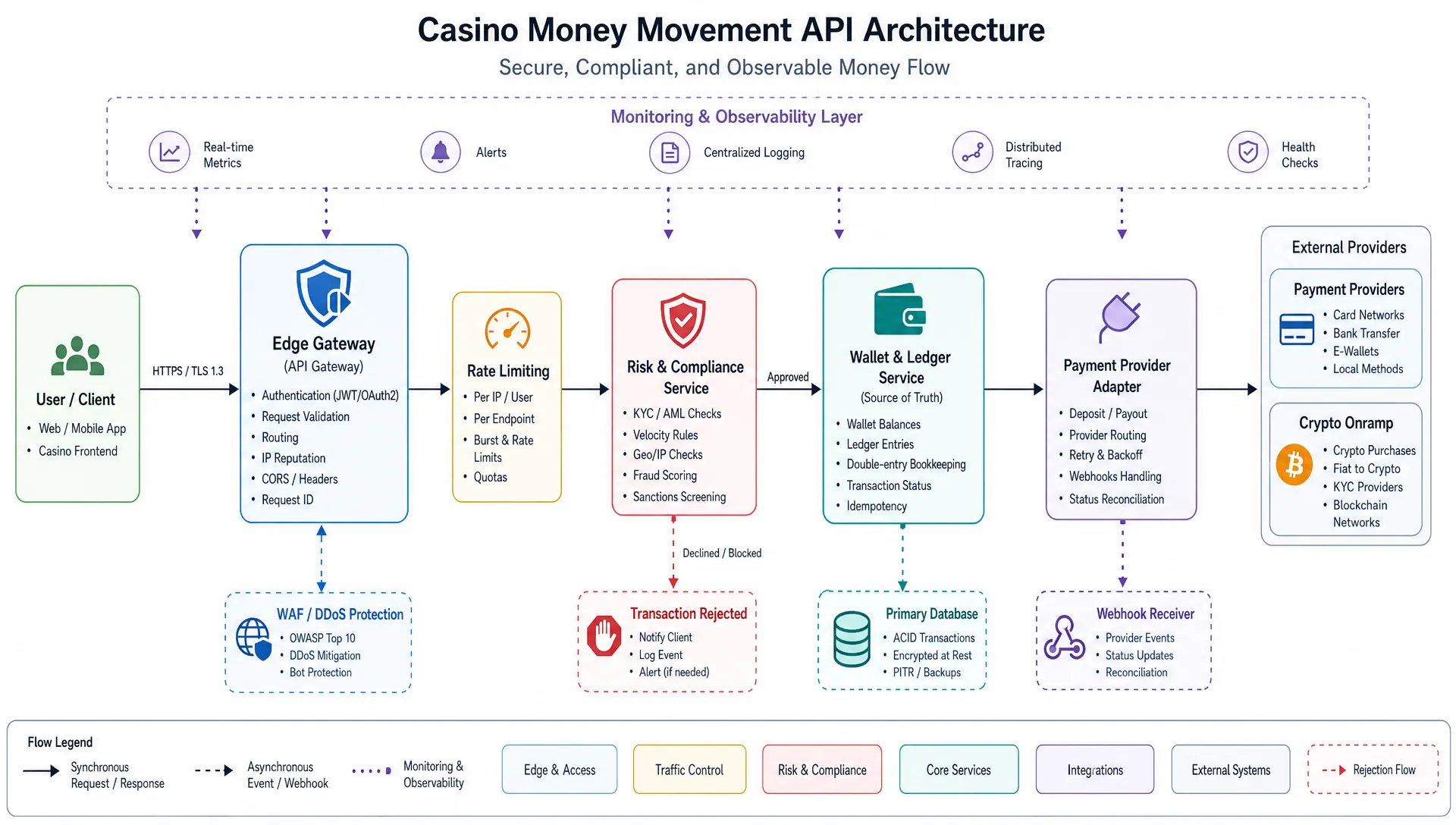
The most effective approach is usually layered. The edge gateway enforces coarse limits to stop obvious floods. The application layer enforces player and account logic. The wallet or ledger layer enforces strict transaction safety. The provider adapter protects downstream payment and KYC vendors from overload.
Risk tiers are especially important. A verified, long-standing player with a consistent deposit history should not be treated the same as a newly created account using a new device, a new card, a VPN, and an unusual deposit pattern. The limit can be higher for trusted flows and lower for unverified or anomalous flows.
Choose rate limiting algorithms by financial risk
No single rate limiting algorithm fits every casino API. Token buckets are great for smoothing bursts. Sliding windows are better when accuracy matters. Concurrency caps protect slow downstream services. Queues help prevent traffic spikes from turning into provider failures.
The key is to match the algorithm to the failure mode.
| Method | Best use in casino APIs | Watch out for |
|---|---|---|
| Token bucket | Allow normal bursts for low-risk reads and UI calls | Can allow too much financial action if bucket size is too large |
| Sliding window | Enforce accurate limits for deposits, withdrawals, and KYC attempts | More storage and compute than fixed windows |
| Fixed window | Simple protection for non-critical endpoints | Boundary bursts can slip through at window edges |
| Leaky bucket or queue | Smooth provider calls to payment gateways and crypto onramps | Queues need expiry, cancellation, and clear player messaging |
| Concurrency cap | Protect slow provider adapters, payout processors, and KYC vendors | Can create backlogs if not paired with circuit breakers |
| Circuit breaker | Stop calling a failing provider before failures cascade | Requires safe fallback routes and good observability |
| Ledger serialization | Prevent simultaneous writes to the same wallet or transaction | Must be designed for performance and deadlock avoidance |
The ledger layer deserves special attention. Rate limiting can reduce pressure, but it cannot replace atomic wallet operations, transaction constraints, and idempotent processing. If two withdrawal requests pass the gateway at the same time, the wallet must still prevent double spending.
Deposit APIs: protect approval rates without blocking good players
Deposit traffic can spike for healthy reasons. A new campaign launches. A popular streamer promotes a slot. A major sporting event begins. Players rush to top up before a live casino session. Rate limits that are too strict can damage revenue and frustrate legitimate players.
At the same time, unbounded deposit attempts can harm approval rates. Repeated failed authorization attempts, rapid payment method switching, and excessive provider polling can trigger fraud models at payment processors. If the payment gateway sees a casino as noisy or abusive, the operator may face more declines even for legitimate deposits.
This is where rate limiting should work alongside routing. A strong casino payment orchestration strategy can route transactions to the right provider, while rate limits prevent any one player, route, or provider adapter from being overwhelmed.
For deposits, good policies usually separate four actions. Creating a payment session should be limited per player and device. Submitting payment details should be limited per instrument and risk tier. Polling payment status should use backoff and session-level caps. Receiving provider webhooks should prioritize verification, replay protection, and deduplication rather than naive IP throttling.
Do not rate limit deposit webhooks the same way you rate limit public player requests. A legitimate provider may retry callbacks during network instability. If the platform drops those callbacks too aggressively, it can create delayed credits, support tickets, and reconciliation work. A safer pattern is to authenticate webhooks, deduplicate by provider event ID, accept quickly, and process asynchronously.
Withdrawal APIs: slow risky velocity, not legitimate payouts
Withdrawals are where rate limiting becomes most sensitive. Players expect fast payouts, and excessive friction can damage trust. But withdrawal APIs also concentrate fraud, account takeover, bonus abuse, AML risk, and payment-rail risk.
A good withdrawal limit does not simply reject every request after a threshold. It can move the request into a safer state. For example, a normal payout can continue automatically, while unusual velocity can trigger additional review, identity step-up, a cooling period, or a temporary hold based on risk.
This is closely related to payout decisioning. If you are defining when to approve, pause, or investigate a withdrawal, Spinlab’s guide on casino withdrawal holds covers how operators can balance player experience with fraud, AML, and payment-rail risk.
Useful withdrawal limit keys include player ID, wallet ID, payout instrument, currency, country, KYC level, and recent account changes. A withdrawal request following a password reset, device change, or new payout method should face different limits than a routine payout to a previously verified method.
Operators should also separate withdrawal creation from payout execution. A player-facing request can be accepted and placed in pending status, while the payout execution service applies stricter provider, liquidity, and risk controls. This keeps the user experience clear without forcing the most sensitive system to process every burst immediately.
Rate limiting and idempotency must work together
Rate limiting reduces how often a request can be made. Idempotency controls what happens when the same request is made more than once. In casino payments, you need both.
Imagine a player taps the deposit button twice because the app feels slow. Rate limiting might stop the third or fourth attempt, but it may not stop the second if it happens inside the allowed burst. Idempotency ensures the same deposit intent does not create two independent credits.
The same applies to withdrawals, wallet credits from game sessions, bonus releases, and provider webhook retries. Every financial write should have a stable idempotency key, a transaction reference, and a deduplication policy. If you want a deeper treatment of this topic, the Spinlab article on idempotency for casino payments explains how to prevent duplicate credits in online casino payment flows.
A practical design is to treat rate limiting as the outer guardrail and idempotency as the inner guardrail. The gateway slows abusive or accidental bursts. The application checks business rules. The ledger enforces uniqueness and atomicity. The reconciliation process confirms that provider state and wallet state match.
Crypto-ready casinos need extra controls
Crypto-ready casino platforms add more money-movement surfaces. Onramp quotes can be abused. Asset prices can move while a player is completing a payment. Blockchain withdrawal attempts may involve network fees, address validation, travel-rule workflows, or custody controls. Custodial wallet operations may include internal transfers, sweeps, and hot wallet liquidity management.
Rate limits for crypto onramps should account for quote expiry and asset volatility. A player should not be able to request unlimited quotes across many assets and payment methods if each quote triggers a vendor call. Quote creation can be limited per player, asset, fiat currency, and provider, while quote acceptance should be tied to a specific quote ID and expiry timestamp.
Crypto withdrawal limits should distinguish between request creation, risk approval, transaction signing, and broadcast. The signing and broadcast stages are more sensitive than the initial request. They should be protected by strict concurrency controls, custody policies, and operational monitoring.
For multi-currency operators, rate limiting should also consider currency-specific liquidity. A sudden spike in withdrawals for one asset or fiat currency may be normal after a promotion, or it may indicate coordinated abuse. Either way, platform limits should give finance and risk teams enough time to respond before liquidity is drained.
Return the right response when a limit is hit
A rate limit is not only a backend event. It becomes part of the player experience.
For public APIs, the standard response is HTTP 429 Too Many Requests, defined in RFC 6585. Modern APIs can also expose structured rate limit information using fields described in RFC 9333, such as remaining quota and reset timing.
In casino money flows, the message should be clear but not overly revealing. A player can be told that the platform needs a short wait before another deposit attempt, or that a withdrawal is pending review. The response should not reveal internal fraud rules, exact risk thresholds, or provider-specific weaknesses.
Money-movement requests should also avoid ambiguous failures. If a deposit request was accepted, return a stable payment session. If a withdrawal request was queued, return a pending state. If a retry is safe after a delay, provide a retry time. Ambiguity causes players to repeat actions, which creates the exact burst pattern the limit was supposed to prevent.
Monitor limits as financial controls
Rate limits should not be configured once and forgotten. They need dashboards, alerting, and regular review by engineering, payments, fraud, and compliance teams.
The most useful metrics connect traffic to financial outcomes. A generic 429 count is not enough. Operators should know which endpoint was limited, which provider route was protected, how much transaction value was affected, how many trusted players were slowed, and whether fraud or duplicate-processing incidents decreased.
| Metric | Why it matters |
|---|---|
| 429 rate by endpoint and risk tier | Shows whether limits are affecting risky or trusted traffic |
| Limited transaction value | Measures financial impact, not just request volume |
| Provider adapter queue depth | Reveals downstream payment or KYC pressure |
| Deposit approval rate after throttling | Confirms limits are not harming legitimate payments |
| Withdrawal pending time | Detects when safety controls are hurting payout experience |
| Duplicate transaction attempts | Shows where idempotency and UX need improvement |
| Webhook replay count | Helps detect provider retries, replay attacks, or network issues |
| Limit override frequency | Identifies rules that are too strict or operationally noisy |
Review these metrics after promotions, payment provider changes, new market launches, and major product releases. A limit that works for one region, currency, or payment method may be wrong for another.
A practical implementation checklist
Before launching or revising casino API rate limiting, align product, engineering, payments, risk, and compliance around the same policy. Rate limits should be documented as financial controls, not hidden inside gateway configuration.
A strong baseline includes:
- Separate limits for public player APIs, internal wallet APIs, provider adapters, and webhooks.
- Multi-dimensional keys such as player, device, payment instrument, wallet, provider, currency, and risk tier.
- Sliding-window or equivalent accuracy for high-risk money-movement endpoints.
- Queueing, circuit breakers, and backoff for payment gateway, KYC, AML, and crypto onramp calls.
- Idempotency keys and ledger-level uniqueness for every financial write.
- Clear pending, rejected, retryable, and review states for player-facing flows.
- Dashboards that connect throttling to approval rates, payout speed, fraud signals, and reconciliation outcomes.
The checklist is intentionally cross-functional. Engineers can implement the controls, but payments and risk teams need to help define acceptable velocity, legitimate burst patterns, and escalation rules.
Frequently Asked Questions
What is casino API rate limiting? Casino API rate limiting controls how often players, devices, services, or providers can call specific casino APIs. For money-movement flows, it protects deposits, withdrawals, wallets, bonuses, and crypto transactions from abuse, overload, and duplicate processing.
Should casino operators use the same rate limit for every endpoint? No. A login attempt, game catalog request, deposit session, wallet debit, and withdrawal request have very different risk profiles. Money-movement endpoints need stricter and more context-aware limits than ordinary read-only APIs.
Can rate limiting prevent double credits by itself? No. Rate limiting reduces duplicate attempts, but double-credit prevention also requires idempotency, transaction uniqueness, atomic wallet operations, and reconciliation between provider and ledger states.
How should casino platforms handle payment provider webhooks? Webhooks should be authenticated, verified, deduplicated, and processed asynchronously. Operators should avoid naive throttling that drops legitimate provider retries, because that can cause delayed credits or payout reconciliation issues.
Do crypto casino flows need different limits? Yes. Crypto onramp quotes, custody operations, wallet sweeps, and blockchain withdrawals introduce volatility, network fees, address risk, and liquidity considerations. Limits should account for asset, currency, provider, quote expiry, and custody stage.
Build safer money-movement flows with Spinlab
Casino API rate limiting works best when it is part of the platform architecture, not an afterthought added after fraud, duplicate payments, or provider pressure appears.
Spinlab offers a modular iGaming platform for building, launching, and scaling online casinos with crypto and fiat payment support, game aggregation, real-time analytics, fraud prevention, KYC and AML compliance, multi-currency support, crypto onramp solutions, and customizable backoffice controls.
If you are building a white label casino platform or modernizing an existing online casino, Spinlab can help you design money-movement flows that are fast for trusted players and safer under pressure.