

In a modern online casino, the riskiest failures often come from outside your team. A payment gateway can freeze settlements, a KYC provider can create onboarding gaps, a game aggregator can introduce faulty content and an affiliate partner can send traffic that looks profitable until chargebacks arrive.
Casino vendor risk management is the operating discipline that keeps those dependencies visible, controlled and recoverable. It is not just procurement paperwork. For iGaming operators, vendor risk touches player funds, identity data, game integrity, regulatory exposure, uptime and brand trust.
The practical goal is simple: know which vendors can hurt the business, prove they meet your standards before integration, monitor them after launch and keep an exit path ready before you need it.
What casino vendor risk management includes
A casino vendor is any external business that supports your platform, player experience, compliance obligations or revenue operations. In a simple online business, vendor risk might focus on data privacy and service reliability. In an iGaming platform, the scope is wider because vendors can influence real-money movement, player eligibility, bonus abuse, AML monitoring and the fairness of games.
A useful framework starts by grouping vendors by the risk they can create.
| Vendor group | Common examples | Primary risks | Evidence to request |
|---|---|---|---|
| Payment and crypto partners | PSPs, acquirers, crypto onramps, custodial wallets | Settlement failure, chargebacks, sanctions exposure, fund custody gaps | Licensing status, PCI scope, reconciliation files, settlement terms, AML controls |
| Identity and compliance providers | KYC, AML screening, fraud scoring, responsible gambling tools | False approvals, rejected legitimate players, missing audit trails, regulatory breaches | Control descriptions, data sources, SLAs, model governance, retention policy |
| Game and content vendors | Game studios, live casino suppliers, RNG providers, game aggregators | Uncertified games, wrong RTP settings, downtime, content restricted in a market | Game certificates, jurisdiction lists, release notes, incident procedures |
| Affiliates and marketing partners | Affiliate networks, media buyers, SEO partners, streamers | Fraudulent traffic, misleading promotion, brand damage, bonus abuse | KYB checks, traffic sources, compliance policies, contract terms |
| Infrastructure and data vendors | Cloud, CDN, analytics, messaging, CRM | Data exposure, outages, unauthorized access, availability failure | Security certifications, access model, data processing terms, incident history |
| Professional services | Developers, consultants, design agencies | Privileged access misuse, poor code quality, unmanaged subcontractors | Access scope, references, security practices, confidentiality terms |
This map gives your team a shared language. Without it, all vendors look similar during onboarding, then suddenly become very different during an incident.
Step 1: Build one vendor inventory
You cannot manage vendor risk through scattered spreadsheets, inbox threads and Slack messages. Start with one vendor register owned by compliance, risk, security or operations. The owner can vary by company size, but the inventory should be treated as a live operational asset.
A practical vendor inventory should include:
- Legal entity name, trading name and country of incorporation
- Vendor category, product owner and internal business owner
- Services provided and casino systems touched
- Data accessed, including player PII, payment data, gameplay data or affiliate data
- Markets and licenses affected by the vendor
- Contract start date, renewal date and termination notice period
- Integration method, such as API, SFTP, iframe, SDK or admin access
- Risk tier, last review date, open issues and exit plan status
The most common failure at this stage is assigning ownership to procurement only. Procurement can manage contract workflow, but the person accountable for the vendor should understand how the service affects players, funds, compliance or uptime.
Step 2: Tier vendors by real casino impact
Not every vendor deserves the same level of review. A design contractor with no production access is not the same as a payment gateway holding settlements or a game aggregator controlling your live casino games and slot games catalog.
Tiering keeps the process fast without becoming careless. If your team already scores operational threats, connect vendor tiering to your broader casino risk matrix so vendor reviews use the same likelihood and impact logic as the rest of the business.
| Tier | Typical vendors | Why it matters | Minimum review |
|---|---|---|---|
| Tier 1: Critical | Core platform, payment gateway, KYC and AML providers, custodial wallet, game aggregator | Failure can stop deposits, withdrawals, onboarding, gameplay or regulatory reporting | Full due diligence, executive approval, contract risk review, quarterly monitoring, exit plan |
| Tier 2: High | Major game studios, affiliate networks, analytics, CRM, CDN, fraud tools | Failure can disrupt revenue, expose data or create compliance gaps | Security and compliance review, business owner approval, semiannual monitoring |
| Tier 3: Standard | Content tools, email services, noncritical marketing software | Failure creates limited operational impact | Basic due diligence, annual review, standard contract controls |
| Tier 4: Low | Vendors with no player data, no production access and low brand exposure | Failure is inconvenient but contained | Basic identity check, owner approval, simple termination path |
Tiering should change when the relationship changes. If a marketing vendor later receives access to player segments or a data export, its risk tier should increase before the integration goes live.
Step 3: Run risk-based due diligence before onboarding
Due diligence should answer one question: can this vendor safely perform the role you are about to give it? A generic 100-question checklist creates fatigue and still misses casino-specific risk. Better due diligence is targeted by category, tier and jurisdiction.
Business legitimacy and ownership
Start with the legal basics. Confirm the vendor's registered entity, beneficial ownership where appropriate, sanctions exposure, operating history and authority to provide the service in your target markets. For PSPs, affiliates and other revenue-facing partners, a fast but structured KYB process prevents avoidable settlement and reputation problems. Spinlab has a deeper guide on vetting PSPs and affiliates through KYB if this is a current bottleneck.
For affiliates, business legitimacy also includes promotional conduct. The partner should be able to explain traffic sources, ad review processes, restricted claims and how they handle sub-affiliates. Weak affiliate governance can create regulatory exposure even when the technical platform is secure.
Security and data protection
Security review should follow the access level. A vendor with API access to player profiles needs stronger evidence than a vendor that supplies public creative assets. Ask for security certifications where available, penetration test summaries, data processing terms, subprocessor lists, access control policies and incident response procedures.
NIST SP 800-161 Rev. 1 is a useful reference for cyber supply chain risk because it frames third-party risk as governance, acquisition, monitoring and response rather than a one-time questionnaire. Casino operators do not need to copy every control, but the structure is helpful for building a repeatable review process.
Your review should also define data boundaries. Which player fields does the vendor receive? Is data encrypted in transit and at rest? Who can access production data? How quickly can access be revoked? Where is data hosted? These answers matter for privacy compliance and for incident containment.
Payments, custody and crypto
Payment vendors need a deeper review because they touch deposits, withdrawals, reversals, settlement, chargebacks and reconciliation. For card processing, PCI DSS includes requirements for managing service provider relationships that can affect cardholder data. Operators should understand which party stores, processes or transmits sensitive payment data and what evidence supports that responsibility split.
For crypto-ready operations, the review should also cover wallet custody, private key controls, onramp partners, transaction monitoring, sanctions screening and how fiat conversion is handled. If a vendor touches player funds, you need clarity on who holds funds, where they are held, how reconciliations work and what happens during a freeze, dispute or withdrawal backlog.
A payments review should not stop at vendor claims. Reconciliation, cashier routing, decline codes and ledger integrity need operational testing. If you are formalizing this area, use a dedicated process like this guide on auditing a casino payments stack alongside your vendor review.
Game and content integrity
Game vendors should be reviewed for certification, jurisdiction availability, release management and configuration control. This is especially relevant when an operator adds new studios, live casino games, new Pragmatic slots, new Hacksaw slots or custom casino original games through a game aggregator.
Request the certificates required for your operating markets, game version details, RTP configuration rules, prohibited territories and the vendor's process for handling defective games. You should also know how quickly a game can be disabled if there is a payout issue, math error, regulatory restriction or supplier outage.
Step 4: Put risk controls into the contract
Due diligence without contract controls is just research. The contract should turn vendor promises into enforceable operating standards, especially for Tier 1 and Tier 2 vendors.
| Contract control | What it should cover | Risk reduced |
|---|---|---|
| Clear scope and responsibility split | Who operates each control, owns each data flow and responds to each failure | Gaps between operator and vendor obligations |
| Service levels | Availability, support response, incident escalation and maintenance windows | Uncontrolled downtime and weak escalation |
| Data processing terms | Data categories, retention, deletion, hosting location, subprocessors and audit rights | Privacy violations and data sprawl |
| Security obligations | Access controls, encryption, vulnerability handling and breach notification timelines | Data exposure and delayed response |
| Compliance change notice | Notice if licensing, certification, ownership or material controls change | Hidden regulatory or business risk |
| Settlement and reconciliation rights | Reporting files, reserve terms, dispute process and fund release conditions | Cash flow surprises and accounting gaps |
| Exit assistance | Data return, transition support, access revocation and reasonable migration help | Vendor lock-in during a crisis |
For critical vendors, legal review should involve the operational owner, not only lawyers. The operational owner knows whether the SLA is actually useful, whether the support path fits casino hours and whether the reporting files match finance needs.
Step 5: Control the integration, not just the vendor
Many vendor failures happen after approval because integration controls are weak. A trustworthy vendor can still create risk if API keys are shared, webhook events are not verified or admin access is too broad.
For API-based casino vendors, set a technical baseline before production access:
- Use separate credentials for sandbox, staging and production
- Apply least-privilege access for APIs, dashboards and backoffice accounts
- Require signed callbacks or webhooks for payment, bonus and gameplay events
- Log vendor actions in systems that affect funds, identity or gameplay
- Add rate limits, allowlists and alerting for abnormal API behavior
- Test failure modes, including timeout, duplicate callback, partial approval and delayed settlement
Technical access should match the business purpose. A game provider serving content does not automatically need access to player PII. An affiliate platform does not need withdrawal history unless there is a defined compliance or commercial reason. Every additional field creates more privacy, security and breach response work.
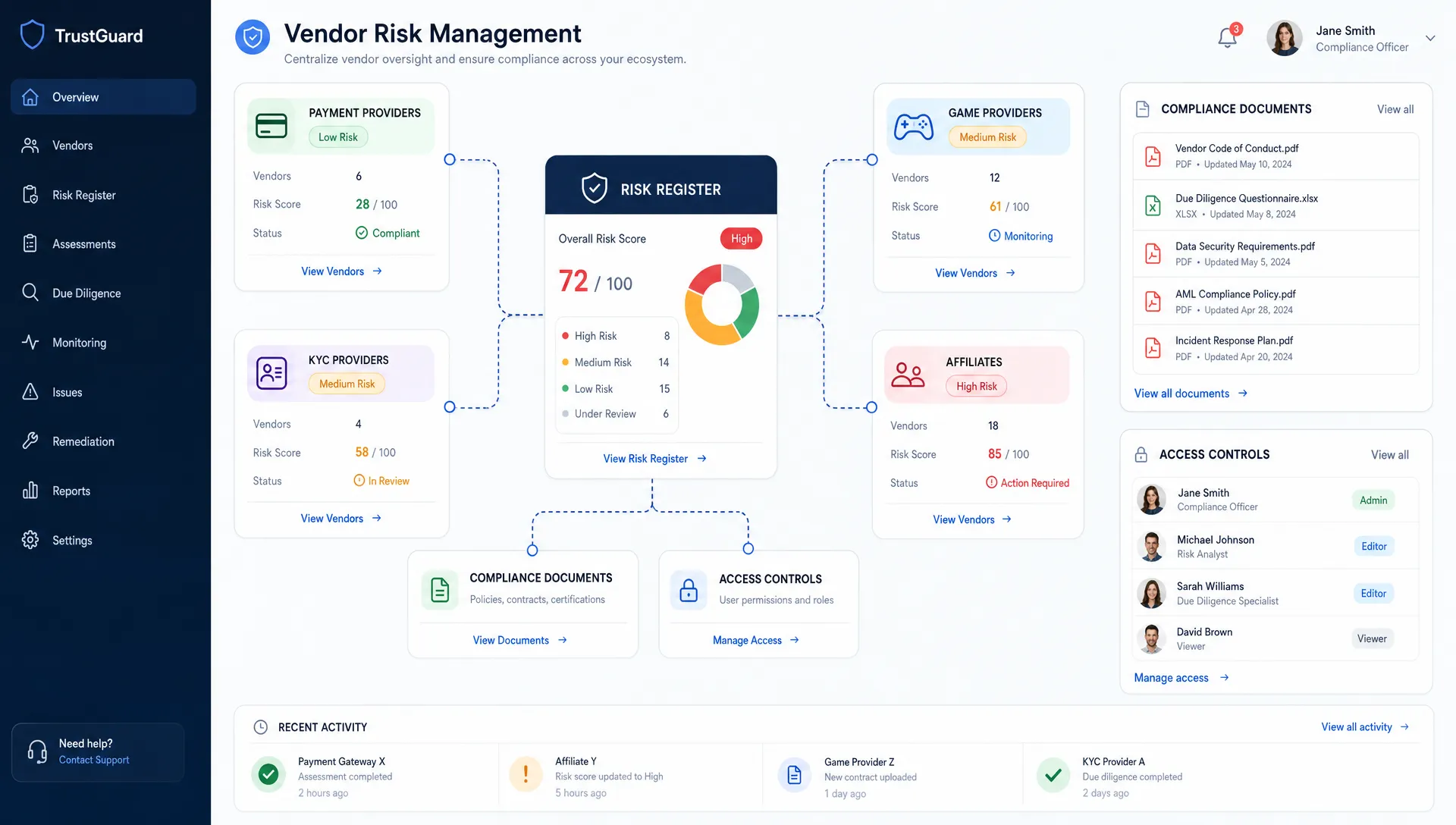
Step 6: Monitor vendors after launch
Vendor approval expires in practice even when the contract does not. Ownership changes, product changes, new subprocessors appear, payment corridors become unstable and fraud patterns shift. Ongoing monitoring turns vendor risk management from a launch checklist into a control system.
The cadence should follow the tier. Critical vendors usually need monthly operational review and quarterly risk review. Standard vendors may only need annual confirmation unless there is a material change.
| Monitoring signal | What to watch | Suggested cadence |
|---|---|---|
| Availability | Outages, degraded response time, failed callbacks, maintenance quality | Weekly or monthly for Tier 1 |
| Payment performance | Approval rates, withdrawal delays, chargebacks, settlement differences | Weekly for payment vendors |
| Compliance performance | KYC pass rates, false positives, screening misses, audit trail completeness | Monthly or quarterly |
| Game content changes | New titles, removed titles, certificate updates, restricted markets | Every release cycle |
| Affiliate quality | Fraud rates, bonus abuse, complaint volume, misleading promotions | Monthly for active partners |
| Security posture | New vulnerabilities, access changes, subprocessor changes, incident notices | Quarterly for critical vendors |
Monitoring should produce actions, not just reports. If a PSP's approval rate drops in one region, update routing. If an affiliate sends high-risk traffic, reduce caps or suspend campaigns. If a game vendor delays certificates for a market, block launch until the evidence is complete.
Step 7: Prepare incident and exit playbooks
A vendor exit plan is not a sign that the relationship is failing. It is basic resilience. The worst time to learn how to remove a payment provider, game supplier or compliance vendor is during a regulator inquiry or player withdrawal spike.
Create playbooks for the scenarios most likely to hurt your casino:
- PSP outage, settlement delay or account freeze
- KYC provider downtime during a campaign launch
- Game provider error affecting payouts or player balances
- Affiliate fraud spike with bonus abuse and chargebacks
- Data breach involving a vendor system or shared export
- Crypto onramp disruption affecting deposits or withdrawals
Each playbook should name the internal owner, vendor contact, decision authority, player communication path, technical rollback steps, reporting requirements and evidence to preserve. For vendors that touch player funds or regulated data, include finance, compliance, legal and customer support in the tabletop test.
Your exit folder should contain contract termination terms, credential locations, data export steps, fallback vendor options, open invoices, settlement reports and a checklist for revoking access. This can feel excessive until the day it saves your launch calendar or withdrawal queue.
A 30-day rollout plan for casino vendor risk management
New operators do not need a perfect enterprise program on day one. They need a clear system that covers the vendors most likely to create real damage.
| Timeline | Focus | Output |
|---|---|---|
| Days 1 to 5 | Build the inventory | One vendor register with owners, categories, access and contract dates |
| Days 6 to 10 | Tier the vendor base | Critical, high, standard and low-risk classifications |
| Days 11 to 15 | Review critical vendors | Evidence gaps for platform, payments, KYC, AML, wallet and game aggregation partners |
| Days 16 to 20 | Fix contract and access gaps | Priority amendments, revoked access, stronger API controls and updated SLAs |
| Days 21 to 25 | Create monitoring scorecards | Metrics for uptime, payments, compliance, fraud, content and security |
| Days 26 to 30 | Test one incident playbook | A tabletop exercise for PSP outage, KYC downtime or game provider failure |
This first version will not catch everything. It will, however, give the operator visibility, accountability and a way to make better vendor decisions before issues reach players.
Common mistakes to avoid
The first mistake is treating vendor risk as a document collection exercise. Certificates, policies and questionnaires are useful, but they do not prove that a vendor is safe for your exact use case. Evidence has to connect to the integration, data flows, markets and operational role.
The second mistake is reviewing vendors only before launch. A vendor that was safe at onboarding can become risky after a product change, ownership change, incident, new subprocessor or expansion into a new market.
The third mistake is ignoring concentration risk. If one provider controls your cashier, KYC, fraud scoring and wallet custody, the operational impact of a failure is much larger than a normal vendor review may suggest. All-in-one platforms can reduce integration complexity, but operators still need to understand where critical dependencies sit and how they are monitored.
The fourth mistake is giving commercial teams full control over affiliate and marketing vendors without compliance review. In casino, traffic quality is a risk signal. Misleading ads, prohibited markets and incentive abuse can create regulatory and financial problems long after the campaign looks profitable.
Frequently Asked Questions
What is casino vendor risk management? Casino vendor risk management is the process of identifying, assessing, contracting, monitoring and offboarding third-party vendors that support an online casino. It covers business, compliance, security, payment, game integrity, operational and reputational risk.
Which casino vendors should be reviewed first? Start with vendors that affect deposits, withdrawals, KYC, AML, player funds, game availability, player data and regulatory reporting. Payment gateways, crypto onramps, custodial wallet providers, KYC vendors, AML tools, game aggregators and core platform providers usually belong in the first review wave.
How often should casino vendors be reviewed? Critical vendors should be monitored continuously through operational metrics and formally reviewed at least quarterly. High-risk vendors can be reviewed semiannually. Standard vendors are often reviewed annually unless their access, ownership, service scope or regulatory relevance changes.
What evidence should a game provider or game aggregator provide? Operators should request applicable game certificates, jurisdiction availability, RTP configuration rules, release notes, incident procedures and a process for disabling content quickly. The exact evidence depends on your market, license conditions and game type.
How does vendor risk management apply to a white label casino platform? A white label casino platform can reduce the number of direct integrations an operator manages, but it does not remove vendor risk. Operators should still understand which critical services are included, how payments and compliance are handled, what data is processed and how incidents are escalated.
Build a vendor-safe casino stack from day one
Casino vendor risk management works best when it is built into the platform operating model, not added after launch. The fewer disconnected systems you have to stitch together, the easier it becomes to control access, monitor payments, review game content and maintain compliance evidence.
Spinlab offers an all-in-one, modular iGaming platform for building, launching and scaling online casinos. The platform brings together crypto and fiat payment support, game aggregation, KYC and AML compliance, fraud prevention, real-time analytics, a customizable backoffice admin panel and open API integration.
If you want a more operator-friendly route to a white label casino platform, with a Shopify-like setup experience and fewer vendor seams to manage from day one, Spinlab can help you launch with a stronger operational foundation.