

The Rise of AI-Powered Croupiers
When Evolution Gaming launched its first HD roulette studio in 2013, few imagined that just a decade later we would be debating whether human dealers are still needed at the felt. Yet rapid advances in generative AI, real-time 3-D rendering, and low-latency video delivery have put “AI dealers” on every iGaming CTO’s roadmap for 2025-2027.
In this article we dissect the technology stack behind virtual dealers, measure how close it comes to replicating (or surpassing) a flesh-and-blood host, and explore the operational trade-offs for operators running live casino games on modern iGaming platforms such as Spinlab’s Fullhouse.
What Do We Mean by an “AI Dealer”?
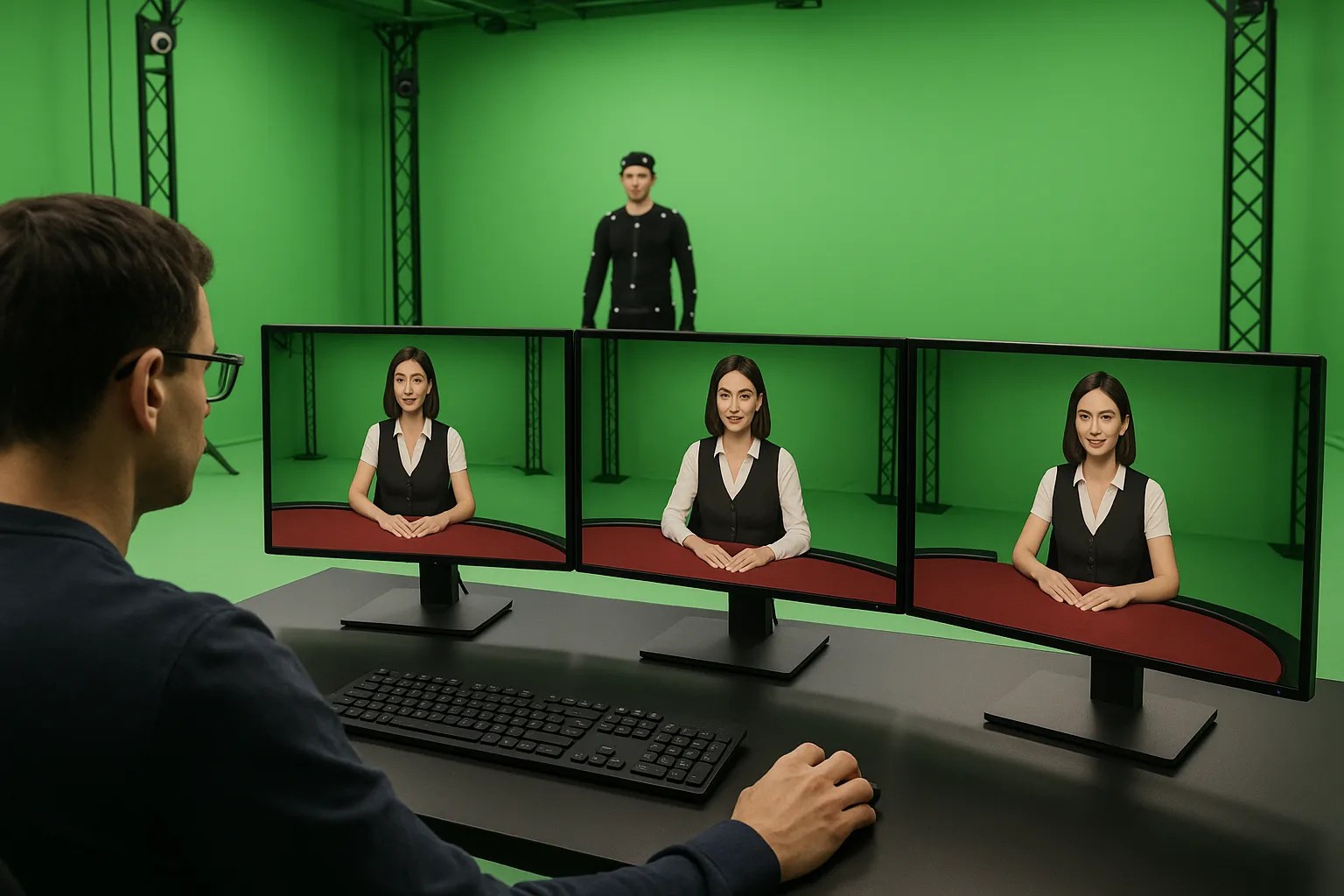
An AI dealer is more than a 3-D avatar. A production-ready system blends four technology layers:
- Real-Time 3-D Character Engine: Usually Unreal or Unity, capable of 60 fps rendering in the cloud.
- Generative Animation Models: Skeleton-driven models that map speech and game events to body language and facial expressions.
- LLM-Based Conversation Layer: Fine-tuned large language models (LLMs) that parse chat input, generate context-aware responses, and control dealer actions.
- Voice Cloning + TTS: Neural text-to-speech that produces natural, localized audio with <150 ms latency.
Combine these layers with a provably fair RNG or a physical wheel under computer vision, and you get a fully automated live table with zero human staffing costs.
Latency: The Silent Deal-Breaker
Live casino users expect sub-2-second glass-to-glass latency. That figure leaves little room for heavy model inference. Vendors pursuing AI dealers have tried three main approaches:
| Approach | Typical Latency | Pros | Cons |
|---|---|---|---|
| Local Edge Rendering | 400-600 ms | Best fidelity, lips match speech | High capex, not yet web-scale |
| Cloud GPU Rendering + WebRTC | 600-900 ms | Elastic scaling, cheaper | Bandwidth spikes, jitter risks |
| Client-Side WebGL + Server Commands | 300-500 ms | Minimal bandwidth, no GPU rental | Device fragmentation, exploits |
The emerging pattern is hybrid: lightweight animation commands over WebRTC, with optional fallback to server-side rendered video for low-end devices. Spinlab’s open API can ingest either stream type, allowing operators to A/B test deployments without swapping cashier or bonus logic.
Human Experience vs Machine Consistency
-
Authenticity
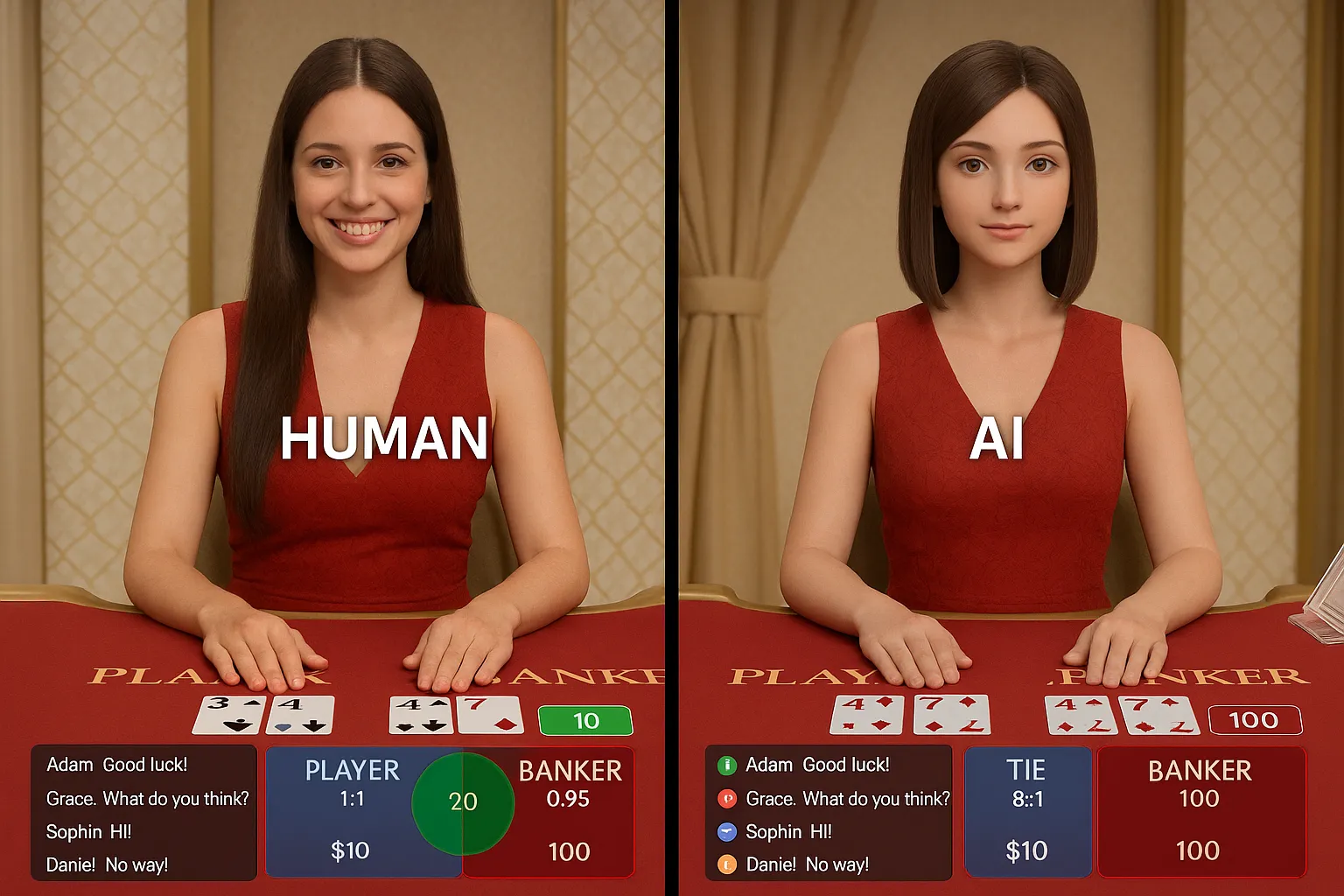
- Humans: Micro-expressions and imperfections feel genuine, especially to VIPs.
- AI: Synthetic quirks can be inserted, but players may spot repetition after extended sessions.
-
Throughput
- Humans: Standard blackjack pace is 60-70 hands per hour.
- AI: Can push 90-120 by eliminating shuffles and side chatter, raising theoretical RTP revenue.
-
Cost Structure
- Humans: Dealer + pit boss + studio overhead ≈ $35-50 per operating hour in regulated markets (source: UKGC Cost Study, 2024).
- AI: Cloud GPU + bandwidth ≈ $6-10 per hour at current spot rates (AWS G5 xlarge). Break-even often occurs at just 30 concurrent players.
-
Regulation & Trust
- Malta, Isle of Man, and Kahnawake have issued provisional guidance permitting AI dealers as long as RNGs are certified and conversation logs are stored for 90 days.
- The UKGC, meanwhile, still requires a human “controller” on shift. Spinlab customers use a blended model: AI runs the table but a single floor manager oversees eight rooms.
Under the Hood: Architecture Blueprint
Below is a simplified diagram of how operators integrate AI tables into a modular iGaming platform. While each vendor tweaks the stack, the data flow remains similar.
- Player Session (browser or mobile app)
- Secure WebRTC or HLS stream + chat socket
- Spinlab Platform
- Wallet & cashier (fiat + crypto on-ramp)
- Bonus, loyalty, and affiliate hooks
- Compliance layer (KYC, AML, session limits)
- AI Dealer Engine (micro-service cluster)
- LLM Inference API
- Animation Controller
- Physics / RNG module
- Monitoring & Analytics
- Real-time anomaly detection (fraud, collusion)
- QoS metrics into Spinlab’s real-time dashboard
Because Fullhouse uses an event-driven architecture (Kafka + gRPC), game events produced by the AI engine appear in the same ledger as Pragmatic or Evolution tables, simplifying reporting and responsible gaming limits.
Key Technical Hurdles Still Unsolved
-
Multilingual Voice Fidelity
Current TTS engines excel in English, Spanish, and Mandarin. Thai or Arabic intonation remains robotic. Operators targeting emerging markets must budget for additional voice fine-tuning. -
Player Abuse Filtering
LLMs can misbehave if provoked. Integrating a robust moderation layer (e.g., AWS Comprehend + custom regex) is essential to mute slurs or doxing in chat. -
Edge Device Variability
While 80 % of European players have devices supporting VP9 or AV1, Africa and parts of LatAm still rely on H.264 baseline. Adaptive bitrate ladders push CDN costs up to 40 % of OPEX unless optimized. -
Legal Personhood
If an AI dealer makes a payout error, who is liable? Existing T&Cs typically assign liability to the operator, but regulators may demand clearer audit trails. Spinlab’s immutable event logs can aid post-incident forensics.
Economic Impact: Scenario Modeling
Let’s model a single roulette table with a 4 % house edge and 60 % gross margin after payment fees.
| Metric | Human Dealer Table | AI Dealer Table |
|---|---|---|
| Operating Hours/Day | 16 | 24 |
| Max Concurrent Players | 7 | 25 |
| Average Stake | $3 | $2.50 |
| Daily GGR | $1,344 | $2,400 |
| OPEX (staff vs GPU/CDN) | $550 | $250 |
| Net Profit/Day | $794 | $2,150 |
Even with lower stakes, AI unlocks higher seat density and full 24-hour coverage, tripling daily net. Of course, these gains assume traffic and marketing budgets can fill the extra capacity.
Implementation Roadmap for Operators
-
Phase 1 — Proof of Concept (1-2 months)
Integrate demo AI roulette via Spinlab’s open API, capped at 100 CCUs. Measure churn and NPS. -
Phase 2 — Gradual Rollout (3-6 months)
Add blackjack and baccarat. Localize voice packs, connect to loyalty engine, and split test against human tables. -
Phase 3 — Full Automation (6-12 months)
Shift overnight shifts entirely to AI. Reassign human dealers to VIP streaming events, increasing differentiation rather than redundancy.
Remember: you do not need to rebuild cashier or CRM logic. A modular platform abstracts payment gateways, real-time analytics, and AML checks so you can swap game engines without touching core wallet code.
Will Players Accept a Bot Behind the Wheel?
• Early Adopters: Crypto players and Esports bettors display the highest acceptance of virtual hosts, according to a 2025 YouGov survey (n = 2,300).
• Mainstream Audience: Skeptical but open if the presentation looks AAA-quality and RTP is provably fair.
• VIP / High-Rollers: Still demand concierge-level human interaction. AI dealers therefore complement rather than replace premium lounges.
For operators, the short-term sweet spot is offering AI tables during low traffic hours, thereby extending studio uptime without diluting premium human streams.
Frequently Asked Questions (FAQ)
Are AI dealer games legal in regulated markets? Yes, provided the underlying RNG or physical device is certified, chat logs are archived, and a human supervisor can intervene. Always check jurisdiction-specific guidance.
Do AI tables require different integration work than live streams? No. With Spinlab’s iGaming platform you ingest the stream URL and event webhooks exactly like a standard live casino feed.
Will AI dealers eliminate human jobs? Partial automation will reduce overnight and low-margin tables, but demand for premium, branded live streams is growing. Expect role shifts rather than complete displacement.
Can AI dealers handle side bets and advanced features? Absolutely. Because the engine is software-based, it can expose any bet type defined in the game math file, and update odds in real time.
What happens if the AI malfunctions mid-game? Spinlab’s failover logic automatically pauses betting, refunds unsettled wagers, and switches players to a standby table while an operator investigates.
Ready to experiment with AI-powered live casino content on a platform built for rapid iteration? Book a 30-minute tech demo with the Spinlab team and see how quickly you can spin up your first virtual dealer table.