

Crypto faucet bonuses have become a go-to tactic for crypto-friendly casinos that want to seed wallets, showcase blockchain payouts, and build buzz on social media. But do these micro-airdrops actually convert into paying customers, or do they merely attract serial hunters who never deposit a cent? Below we dive into the data, risks, and best practices so operators can decide whether faucets deserve a place in their acquisition mix.
What Exactly Is a Crypto Faucet Promotion?
A faucet is a time-gated reward that credits a tiny amount of cryptocurrency (often between US$0.10 and US$3) to any user who completes a simple task such as account registration, CAPTCHAs, or daily log-ins. The practice comes from early Bitcoin marketing, when Gavin Andresen’s 2010 faucet gave away 5 BTC per claim to jump-start mainstream adoption.
In iGaming, faucets typically appear as:
- “Claim 500 satoshis every 15 minutes” widgets on the cashier page.
- A daily Wheel of Fortune that pays out fractions of SOL or ETH.
- Micro-tasks (follow the brand on X, verify email, etc.) that release small ICP or USDT amounts.
Players can then use the credited coins to try slot spins or table games. Any converted winnings may be subject to wagering requirements before a cash out is possible.
Why Operators Experiment With Faucets
| Objective | How a Faucet Supports It | KPI to Monitor |
|---|---|---|
| Lower onboarding friction | No initial payment card or wallet top-up needed | Wallet creations / unique new accounts |
| Showcase instant blockchain payouts | Demonstrates 1-3 second on-chain transfers | Time-to-first-withdrawal |
| Cost-effective brand awareness | Users share screenshots of free crypto on social | Cost per viral share / referral |
| Collect KYC data gradually | Email + phone captured before higher limits | KYC completion rate |
| Test new RNG or crash games | Free balance lets players sample unfamiliar content | Game trial-to-deposit conversion |
According to the 2024 Chainalysis “Crypto Gambling Adoption” report, faucet-driven sign-ups spiked 31 % year-on-year among mid-tier offshore casinos targeting LATAM and Southeast Asia. Operators cite a CPA as low as US$0.48 for faucet users, compared to US$45-US$70 for typical paid affiliate traffic.
The Downside: Freebie Hunters, Multi-Accounting, and Drained Liquidity
Low CPA looks great until you realize the cohort may never move beyond faucet value. Key pitfalls include:
- Multi-account abuse. Bonus hunters leverage VPNs, disposable emails, and proxy wallets to farm faucet claims 24⁄7. Without device fingerprinting and on-chain clustering, one individual can mimic hundreds of users.
- Skewed analytics. Free spins funded by faucet drips can inflate daily active user (DAU) metrics, making retention dashboards look rosier than revenue warrants. Linking Spinlab’s real-time analytics (see “Real-Time Analytics in iGaming” for deeper metrics) to net cash flow is essential.
- Liquidity bleed on micro-withdrawals. Even if each claim is small, thousands of HODL-minded players cashing out can rack up blockchain fees that the operator must subsidize.
- Regulatory scrutiny. Some jurisdictions see faucets as “inducements to gamble” and may limit the maximum value per claim or demand enhanced AML checks for cumulative rewards.
A 2025 survey of 37 crypto casinos by research firm YieldSec showed just 10 % of faucet claimants made a deposit within 30 days. Even worse, half of depositors added less than US$25—hardly high-value play.
Data-Driven Analysis: Faucet vs Traditional First-Deposit Bonus
| Cohort (2024 sample) | Cost per Acquired User | 30-Day First Deposit Rate | Avg First Deposit (USD) | Net Gaming Revenue / User (30 days) |
|---|---|---|---|---|
| Faucet Claimants | $0.62 | 9.8 % | $23 | $4.10 |
| 100 % Match Deposit Bonus | $55 (affiliate fee) | 41.3 % | $96 | $26.40 |
| No-Bonus Organic Traffic | $0 | 27.6 % | $74 | $19.70 |
The data confirms faucets are outstanding at driving quantity but weak at delivering quality. Unless you can recoup value through upselling, the economics rarely beat a well-optimized match bonus.
How to Improve Faucet ROI Instead of Scrapping the Idea
-
Progressive Unlocks
Allow a first claim without KYC, but require ID verification once lifetime faucet earnings hit a set threshold (e.g., US$10). This weeds out bots and mass farmers. -
Rolling Wager Requirements
Instead of a flat 3× play-through, tie wagering to cumulative faucet receipts. Players who claim more must also wager more before a withdrawal. -
Segmentation by Wallet Age
Cross-reference on-chain addresses against block explorers. New wallets (0-6 months) may be genuine retail users, while aged wallets with endless faucet transactions often indicate grinders. -
Hybrid Incentives
Convert faucet balance into a ticket for freeroll tournaments. Winners receive real bankroll, while losers cost you only notional credit. -
Crypto Onramp Upsell
Display a one-click top-up dialogue after the faucet claim, powered by in-house or partner onramps. Operators running on Spinlab’s crypto onramp can auto-fill the same wallet address, reducing UX friction.
Practical Implementation Checklist
| Component | Minimum Viable Approach | Spinlab Platform Capability |
|---|---|---|
| Faucet timer | Simple cron job releasing balance every X minutes | Built-in bonus engine supports cooldown rules |
| Abuse mitigation | Proxy IP blocklist, SMS verification | Advanced fraud module with device fingerprinting |
| Real-time performance tracking | Manual CSV exports each week | Live dashboards integrate faucet tag and funnel events |
| Crypto liquidity management | Hot wallet topped up manually | Custodial merchant wallets with daily auto-rebalancing |
| Compliance | Record email and IP | KYC & AML workflows triggered on defined thresholds |
A modular platform is critical because refining faucet logic is an iterative process. You will likely A/B test throttles, wager multipliers, and upsells for months before landing on profitable settings.
Success Story: From Faucet Farming to 22 % Deposit Conversion
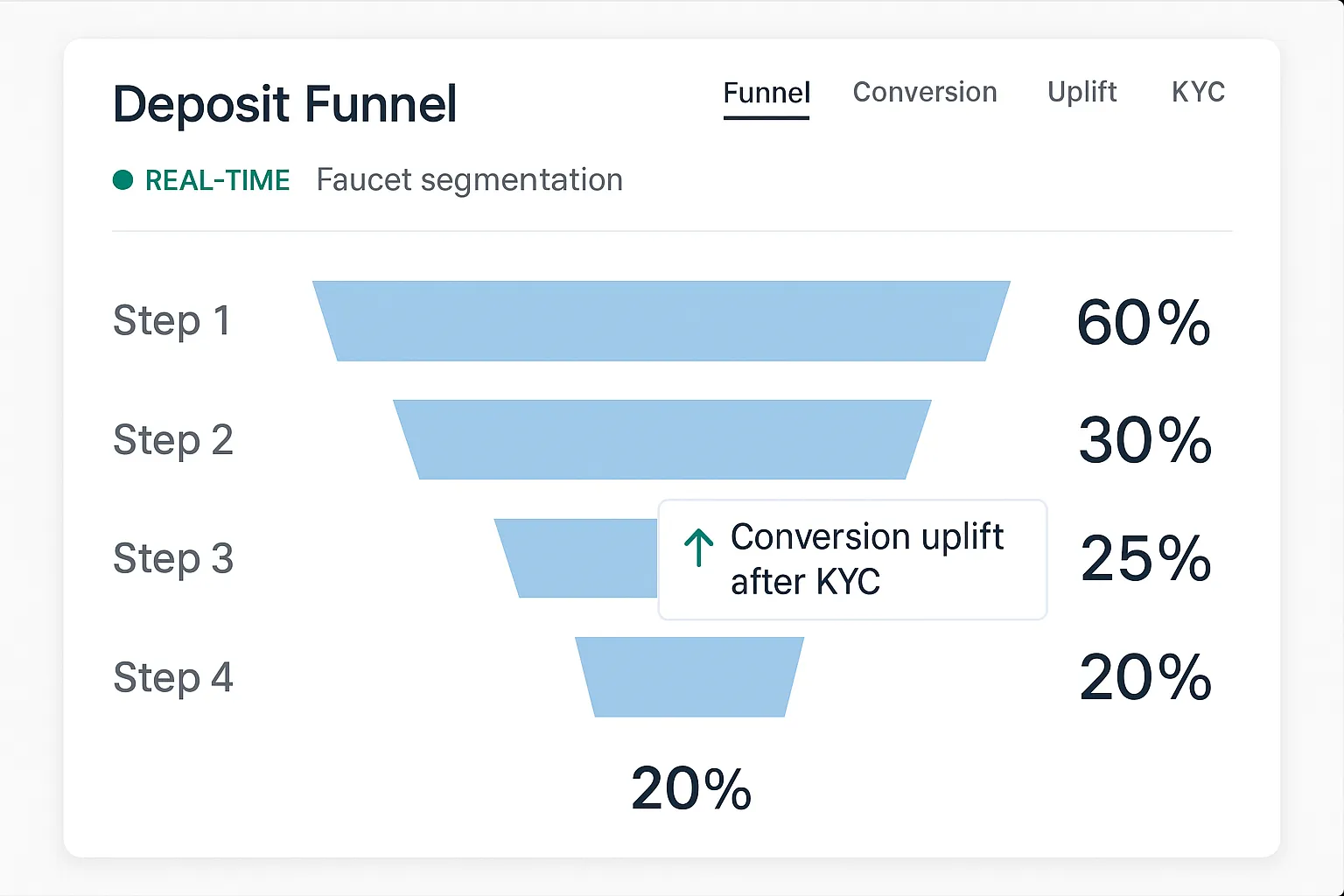
A mid-size Curacao-licensed operator (name withheld) integrated a BTC faucet while migrating to Spinlab’s white label casino platform in Q1 2024. Initial metrics mirrored the industry average: 11 % faucet-to-deposit conversion. By adding device fingerprinting, escalating KYC, and embedding a one-click USDT onramp pop-up after each third claim, they achieved:
- 186 % reduction in duplicate accounts within six weeks.
- Deposit conversion up to 22 % by month three.
- Net gaming revenue from faucet users equal to 71 % of match-bonus users, at one-tenth the acquisition cost.
The lesson is clear: tech stack and data discipline determine whether faucets are a leaky bucket or a low-cost growth engine.
When a Faucet Probably Isn’t Worth It
- You operate in a strictly regulated market (e.g., UKGC) where “no deposit bonuses” face tight caps or outright bans.
- Your games portfolio is slots-only and RTP above 97 %. Free spins from faucet funds can become a predictable grind for advantage players.
- Your cashier lacks micro-fee chains like Solana or Polygon. Paying $1.50 in gas to send a $0.50 faucet withdrawal is irrational.
In these cases, focus on alternative top-of-funnel tactics such as play-for-fun demos or loyalty quests instead.
Integrating Faucets Into a Broader Bonus Strategy
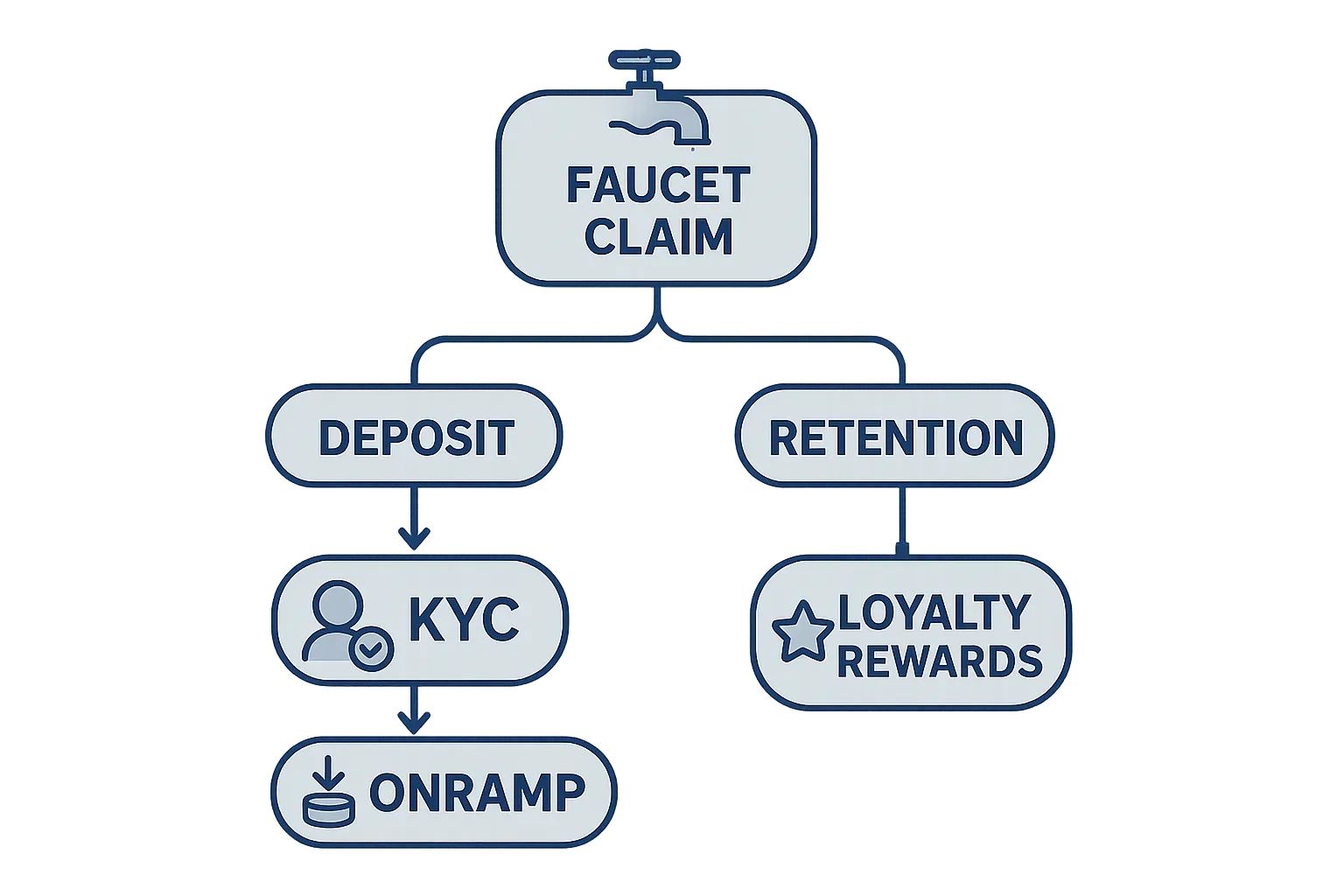
Remember the faucet should be only the first step of a lifecycle journey:
- Faucet Claim – Generate account and wallet.
- Guided Game Mission – Bet 50× faucet amount on new pragmatic slots; award XP points.
- First Deposit Match – Scale from 50 % to 100 % based on player tier.
- Retention Offers – Target crypto depositors with weekend rakeback, leveraging the real-time segmentation features covered in our article on “Crypto vs Fiat: Which Payment Gateway Drives Higher Player Lifetime Value?”.
By stacking incentives, you condition users to move from passive collectors into active bankroll managers.
Final Verdict: Depositors or Freebie Hunters?
Crypto faucet promotions do skew toward freebie hunters—but that doesn’t make them useless. With the right guardrails, they can seed thousands of wallets for pennies, giving you a first-party audience that is cheaper to upsell than any affiliate list.
Operators who succeed treat faucet data with the same rigor as high-roller analytics: deduplicate, segment, and iterate. A platform like Spinlab’s all-in-one iGaming stack supplies the fraud detection, bonus logic, and real-time dashboards needed to separate the signal from the noise.
If you are willing to invest in that discipline, faucets can sit beside traditional deposit bonuses as a high-volume, low-cost acquisition lever. If not, expect to fund a never-ending parade of faucet farmers draining your hot wallet.
For a deeper look at the analytics toolbox that makes this possible, explore our post on “Real-Time Analytics in iGaming: Turning Live Data into Bigger Profits.”