

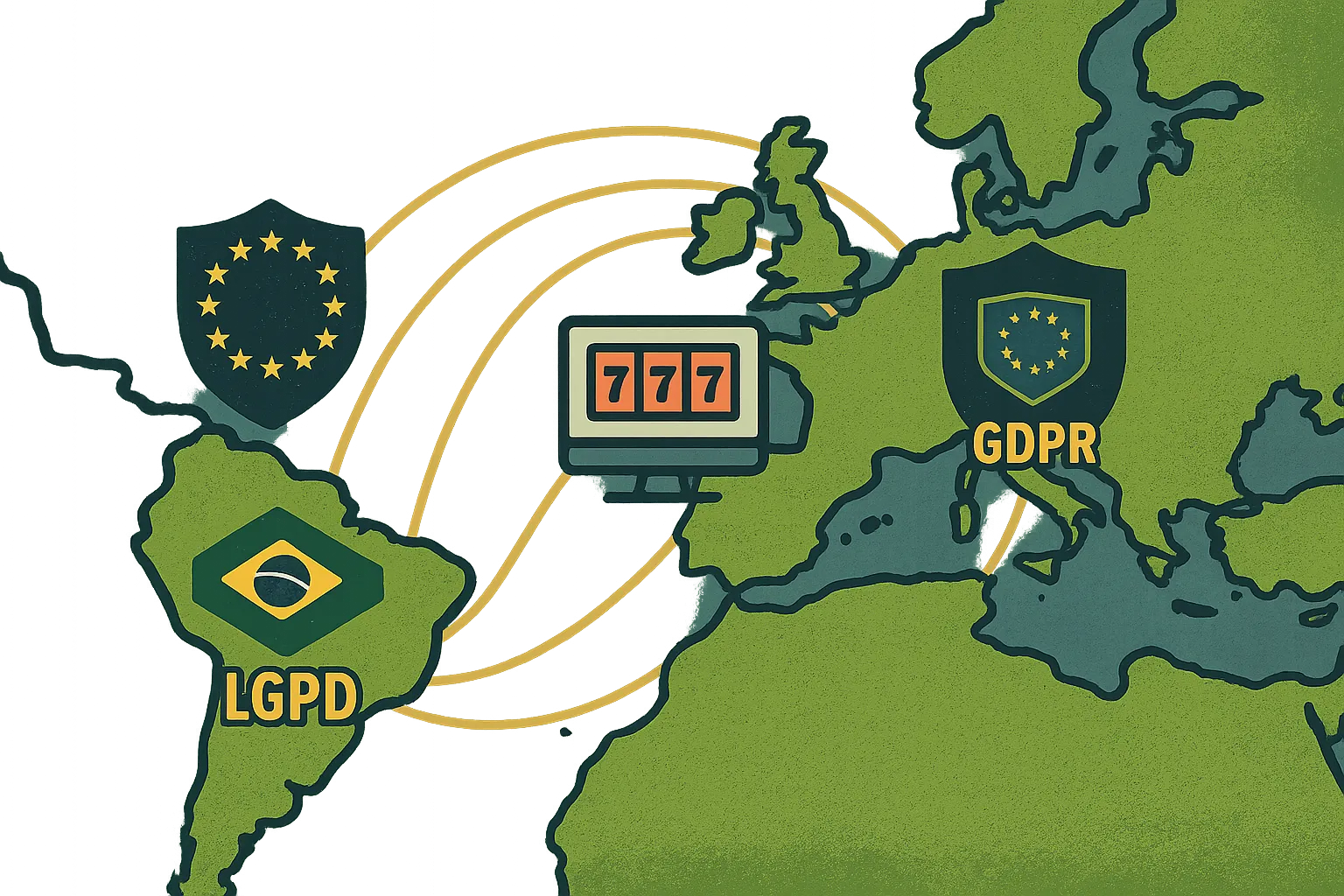
Online casinos have never been more global. A single Friday campaign can pull traffic from Berlin, São Paulo, and beyond—all within the same hour. That reach is great for revenue, but it also brings two heavyweight data-protection laws into the operator’s cross-hairs: Europe’s General Data Protection Regulation (GDPR) and Brazil’s Lei Geral de Proteção de Dados (LGPD). Get the rules wrong and fines can swallow an entire quarter’s net gaming revenue; get them right and you unlock seamless onboarding, higher lifetime value, and expansion into the world’s fifth-largest iGaming market.
This guide unpacks the practical differences between GDPR and LGPD, highlights the grey areas unique to online gambling, and offers an actionable compliance blueprint that every transatlantic casino should bookmark for 2025.
Why GDPR and LGPD Matter More to Casinos Than Most Industries
- Heavy KYC and AML workloads generate sensitive identity documents, biometrics, and financial records.
- Continuous telemetry—bet history, device fingerprints, geolocation—is classified as personal or even sensitive data.
- High-volume marketing (bonuses, VIP segmentation) relies on predictive profiling, a regulated activity under both regimes.
- Real-time fraud prevention often triggers automated decisions that affect players’ legal rights.
PwC estimates that gambling operators pay the highest median GDPR fine per megabyte breached compared with 14 other consumer sectors (2024 European Enforcement Report). Meanwhile, Brazil’s National Data Protection Authority (ANPD) handed its first LGPD-specific penalty to a fintech in March 2025—proof the regulator is warming up.
GDPR vs LGPD at a Glance
| Requirement | GDPR (EU) | LGPD (Brazil) | Key Take-away for Casinos |
|---|---|---|---|
| Maximum fine | 4 % of global annual turnover or €20 m (whichever higher) | 2 % of Brazilian revenue, capped at 50 m BRL (~€9 m) | EU fines can dwarf LGPD, but dual exposure is possible |
| Territorial scope | Any data subject in the EEA | Any data subject in Brazil or data collected in Brazil | Marketing to Brazilian expats in Portugal? GDPR and LGPD apply |
| Lawful bases | 6 bases (consent, contract, legitimate interest, etc.) | 10 bases (mirrors GDPR plus credit protection, health research) | Slightly more flexibility in Brazil, but consent still king for marketing |
| Data Protection Officer | Mandatory for large-scale processing of special categories | Mandatory when processing large, sensitive data or monitoring | Most mid-size casinos need a DPO for both regimes |
| Breach notification | To authority within 72 h | “In a reasonable time” (ANPD guidance: as soon as possible) | Use GDPR’s 72 h timer globally to stay safe |
| Automated decisions / profiling | Subject may request human review | Similar right to contest | Build a manual override for auto-VIP demotions |
| Data transfer out of jurisdiction | Standard Contractual Clauses, adequacy, BCRs | Similar mechanisms; ANPD adequacy list pending | Use modular contracts that cite both SCCs and LGPD-equivalent clauses |
5 Risk Hotspots Unique to iGaming
-
Cross-border payment routing
Fiat deposits might hit a PSP in Frankfurt while crypto onramps settle via São Paulo. Each hop is a potential compliance tripwire. -
Real-time game telemetry
Game events fed to an analytics engine can equal “automated profiling.” A player classification change (e.g., problem-gambling flag) has human-rights implications under GDPR Article 22 and LGPD Article 20. -
Affiliate sub-processors
Affiliates often collect email or device IDs before passing traffic. If contracts lack data-processing addenda, the casino remains liable. -
Shared player wallets
Running a single wallet across .eu and .br domains counts as persistent cross-border transfer and triggers adequacy rules. -
Live-dealer streaming
Face-recognition to detect collusion or bonus abuse falls under “biometric data”—a sensitive category in both laws.
For deeper coverage of risk mapping, see our guide “Building a Risk Matrix: Prioritizing Threats in Online Casinos.”
Building a Unified Compliance Framework
Operating separate GDPR and LGPD playbooks is a recipe for duplicate tech debt and errors. Instead, high-growth casinos adopt a single framework with jurisdictional toggles.
1. Data Mapping and Classification
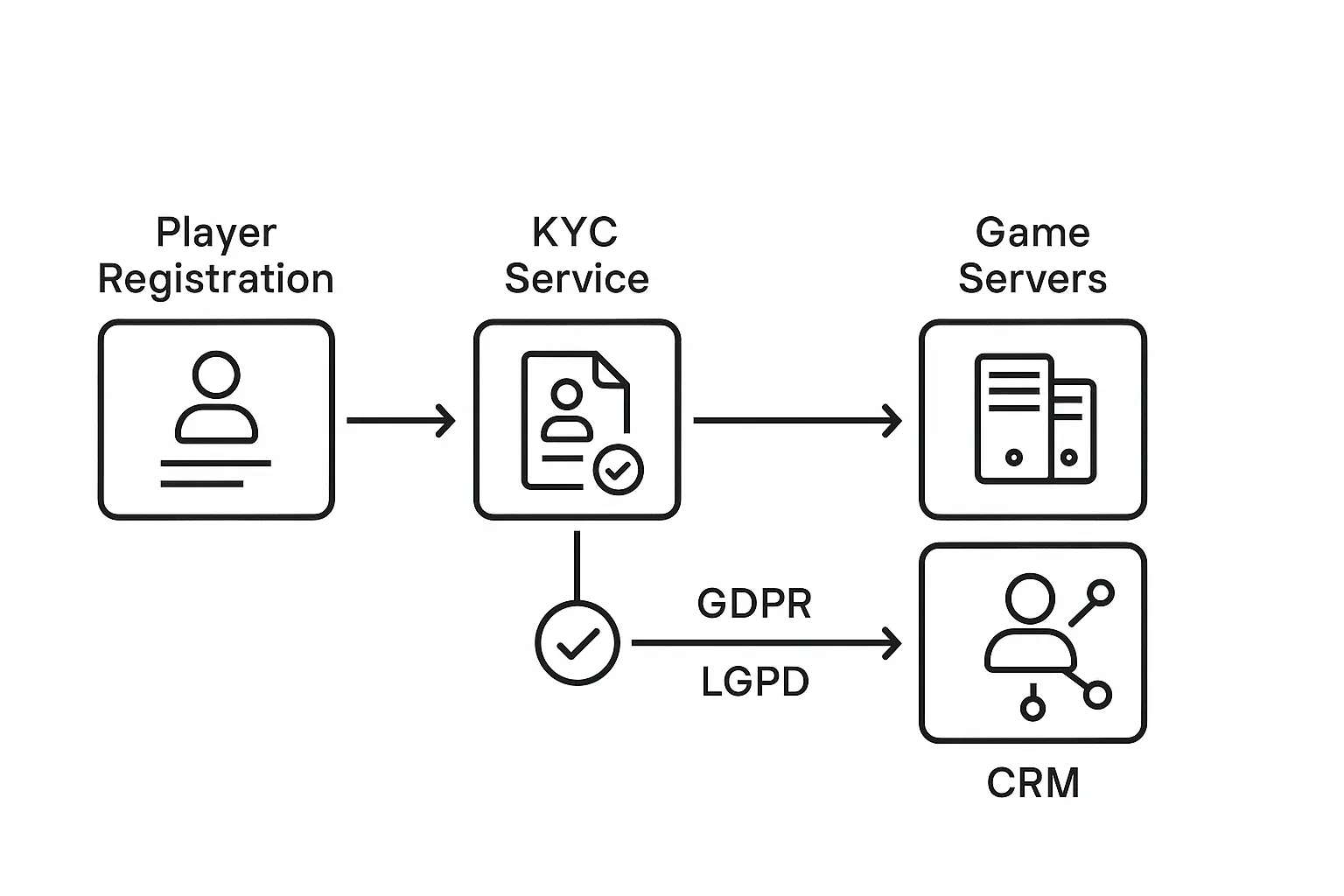
- Catalogue all data points by source: registration, KYC, gameplay, payments, CRM, support.
- Tag each element with sensitivity (PII, financial, biometric, behavioural) and retention policy.
- Document data flow diagrams—Spinlab’s backoffice auto-generates these for platform traffic and third-party calls.
2. Consent and Preference Management
GDPR requires granular, opt-in consent for marketing; LGPD allows implied consent in some contexts but ANPD prefers explicit opt-in. Best practice:
- Single banner that geotargets wording based on IP and accepts unambiguous action (Accept/Decline buttons).
- One consent ledger holding timestamp, locale, version, user ID.
- API hooks so affiliates can sync proof-of-consent on first redirect.
3. Data Subject Request (DSR) Workflow
Both regimes grant rights to access, correction, portability, deletion, and review of automated decisions.
Implementation tips:
- Embed a “Privacy Centre” inside the player wallet.
- Token-based self-serve requests slash support costs.
- Use signed webhooks to trigger erasure in downstream systems (marketing cloud, game servers).
4. Breach Response Playbook
- Maintain pre-written authority notification templates in English and Portuguese.
- Use a 24h internal escalation, 48h containment, 60h final assessment to meet GDPR’s 72h rule.
- Log every step in an immutable audit trail—Spinlab’s Fraud Shield module can be extended for this purpose.
5. Vendor and Affiliate Contracts
- Append GDPR/LGPD schedule with processing purpose, retention, breach duties.
- Enforce right-to-audit clauses for real-money gaming data.
- Make SCC + LGPD Model Clauses part of your standard MSA; don’t rely on partners to supply them.
Case Study: One Wallet, Two Continents
A mid-tier operator running under a Malta licence launched a .com.br mirror site to capture Brazilian traffic. Using Spinlab’s multi-currency cashier, the team wanted a single ledger so EU players could keep balances when travelling.
Challenges:
- Cross-border transfers each time the ledger synced.
- EU KYC docs mirrored to Brazilian servers for latency reasons.
- VIP segmentation triggered automated bonus emails.
Fixes implemented in four sprints:
- Added regional data sharding—EU docs stay in Frankfurt; hashes only stored in São Paulo edge cache.
- Activated Spinlab’s geo-aware consent banner that swaps language and lawful basis logic.
- Inserted Standard Contractual Clauses plus ANPD draft clauses into PSP and email-service contracts.
- Deployed an override button in the VIP algorithm; contested decisions route to a human host within 12 hours.
Result: Expansion hit KPI targets without a single data-protection complaint, and time-to-wallet-sync stayed below 110 ms round-trip.
Compliance Features You Can Toggle in Spinlab
Spinlab’s modular iGaming platform was built with GDPR in mind and extended for LGPD during our LATAM launch wave. Key features operators can enable in the admin panel:
- Consent Ledger – Immutable, exportable JSON logs for each preference toggle.
- Right-to-Be-Forgotten API – Cascades deletion to game providers and CRM systems; average latency 800 ms.
- Data Residency Controls – Choose AWS EU-Central, AWS S. America, or hybrid.
- Encryption-at-Rest – AES-256 with separate KMS keys per jurisdiction.
- Automated DPIA Templates – Pre-filled risk and mitigation fields for 20 common casino processes.
No need to rebuild from scratch—just flip the relevant switches. For deeper technical specs, see our post “8 Signs Your Casino Tech Stack Is Stunting Growth—and How to Fix It.”
10-Point Launch Checklist
- Appoint a single DPO covering EU and Brazil.
- Map data flows and classify sensitivity levels.
- Implement geo-aware consent and cookie banners.
- Add GDPR + LGPD clauses to all affiliate and vendor contracts.
- Deploy automated DSR portal inside account area.
- Configure 72h breach alert playbook.
- Localise privacy policy in PT-BR and EN-US; include lawful bases.
- Activate encryption-at-rest and regional sharding.
- Run a tabletop breach drill every six months.
- Document ongoing monitoring in ESG or compliance reports.
For payment-card data, dovetail this list with the guidance in “PCI DSS for iGaming: A Plain-English Compliance Guide for 2025.”
Frequently Asked Questions
Do I need separate privacy policies for EU and Brazilian players? You can maintain one global policy if it clearly flags jurisdiction-specific rights and lawful bases, and is offered in both English and Brazilian Portuguese.
Are crypto wallets considered personal data? Yes. Even though public keys are pseudonymous, they are personal data when linked to an account that can identify a player.
What happens if I ignore LGPD but don’t have a physical presence in Brazil? If you market to or process data from players located in Brazil, LGPD still applies. The ANPD can request cooperation through international mechanisms and ad networks may cut you off.
Can I use legitimate interest for bonus-offer emails? Under GDPR, legitimate interest for direct marketing is possible but risky; explicit opt-in is safer. Under LGPD, consent or legitimate interest backed by a clear balancing test can work, but regulators favour consent for gambling.
How quickly must I honour a deletion request? Neither law sets a hard deadline, but 30 days is typical. Many operators aim for 14 days to minimise regulator queries.
Ready to Simplify GDPR and LGPD Compliance?
Spinlab’s crypto-ready, modular platform makes cross-border data governance as easy as toggling a switch. Book a 30-minute compliance walkthrough to see how our Consent Ledger, Right-to-Be-Forgotten API, and geo-aware sharding can de-risk your expansion into Europe and Brazil—without slowing time-to-market.
Schedule your demo now at spinlab.studio/contact and launch globally with confidence.