

Player engagement in iGaming rises and falls on thin, often invisible lines. Nudge players at the right moment and you create a micro-burst of excitement that keeps them spinning. Ping them one time too many and you trigger the silent churn that marketing dashboards rarely catch until it is too late. In other words, great push notifications live or die on timing.
This article lays out practical, data-backed timing rules that help online casinos maximise in-game push performance without inducing player fatigue. The guidelines are drawn from Spinlab customer benchmarks (Q1-Q3 2025), external engagement studies, and hundreds of A/B tests across mobile and web casinos.
Why Timing Matters More Than Copy
Copy, creatives and offers certainly influence click-through rate (CTR), but timing shapes the entire opportunity window. A 2024 Braze study found that notifications sent within five minutes of a behaviour trigger delivered 7.2× higher conversion than the same message fired 60 minutes later. Yet overly aggressive cadences backfire: Localytics reports that 46 % of app users disable push when they receive more than eight messages per week.
The iGaming vertical amplifies these dynamics because:
- Session lengths are short and event-driven.
- Many players juggle multiple casino apps and browser tabs.
- Gambling regulation and responsible-gaming rules impose time-of-day and frequency caps.
Finding the sweet spot is therefore non-negotiable.
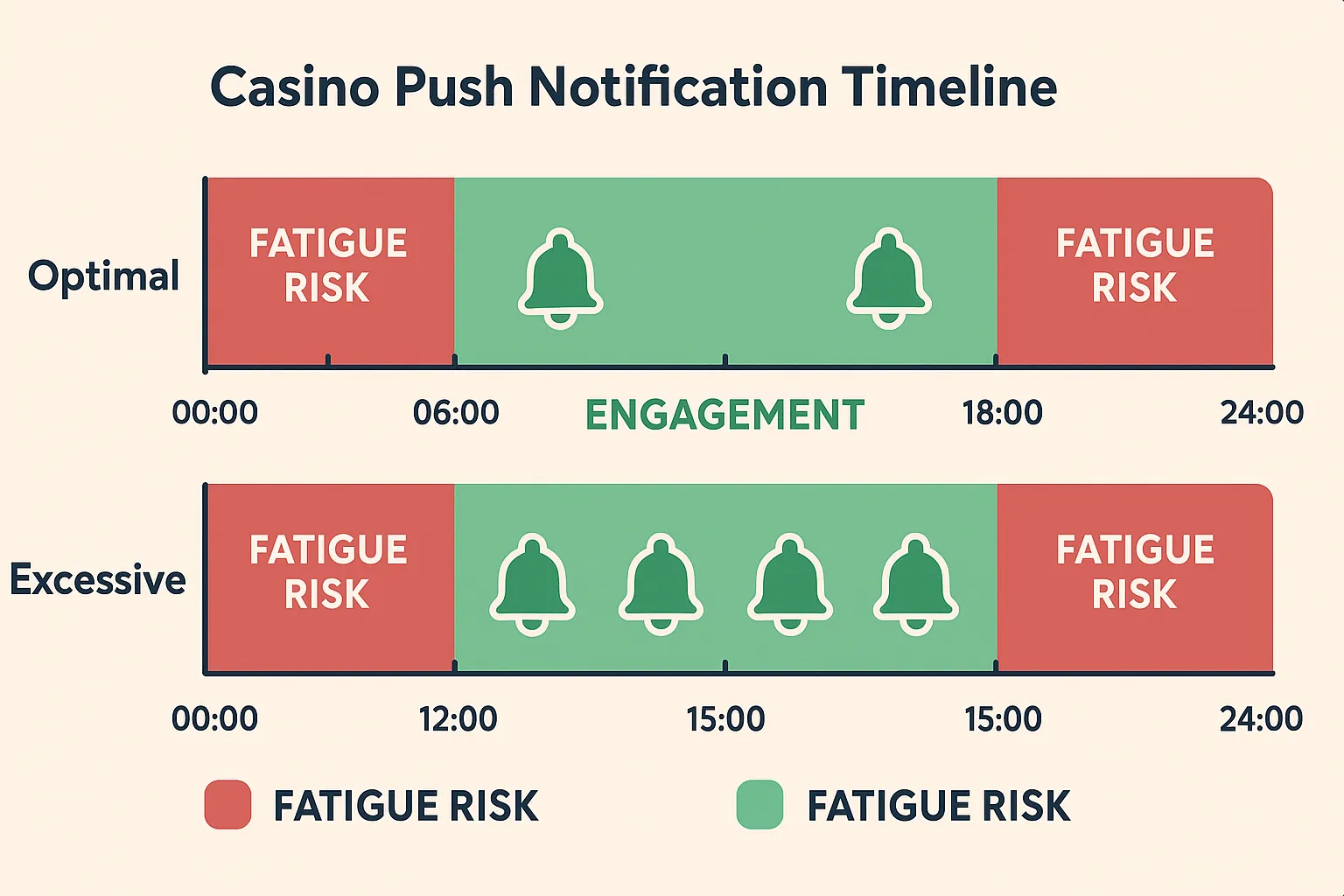
Defining Player Fatigue
Player fatigue happens when notification frequency or poor timing produces one (or more) of the following reactions:
- Manual push opt-out.
- Silent mode or OS-level notification muting.
- Shorter sessions and faster log-outs after a notification is received.
- Increased churn within seven days of the last push.
Spinlab’s aggregated platform data shows that once weekly push opt-outs exceed 1.8 % of your active base, LTV begins to decline linearly. The mission is to stay below that threshold.
Core Timing Rules That Prevent Fatigue
The table below summarises proven timing rules. Each rule assumes you already segment players by lifecycle stage and local time zone.
| Rule | Recommended Setting | Why It Works | Danger If Ignored |
|---|---|---|---|
| Session-Aware Triggers | Fire within 0-90 s after significant in-session events (big win, achievement unlock) | Leverages peak dopamine and keeps context | Firing later feels random; perceived as spam |
| Cool-Down Window | Minimum 15 m between any two pushes to the same player | Gives breathing room; reduces cognitive overload | Multi-push barrage triggers opt-out |
| Daily Frequency Cap | 3 pushes per 24 h for engaged players; 1 for casual | Mirrors typical micro-session counts | Above 4 pushes drives 12 % higher opt-out |
| Quiet Hours | No pushes 00:00–08:00 local unless session is live | Respects sleep patterns and RG regs | Night-time pings cause 2× higher uninstall risk |
| Loss-Run Buffer | Withhold promotional pushes for 30 m after a net-loss streak (>20× bet) | Prevents perceived predatory behaviour | Regulators may flag “chasing” cues |
| Win Celebration Delay | Trigger win messages 4-6 s after end of animation | Reinforces thrill without overlap | Instant overlap cuts click-through by 18 % |
How to Implement These Rules in Spinlab
- Event Stream Hook-Up – Use Spinlab’s real-time event bus to capture bet outcomes, level-ups, and cashier events.
- Condition Engine – Create rule sets in the no-code Push Studio: e.g.,
if event=big_win and last_push>90000ms then send. - Dynamic Caps – Leverage the
daily_capparameter tied to user segment metadata. - Local Time Resolver – The platform attaches an IANA time zone to each profile, enabling accurate quiet-hour checks.
- Regulatory Flags – Spinlab’s Responsible Gaming API automatically suppresses pushes to self-excluded or cool-off players.
Event-Driven vs Scheduled Pushes
A common mistake is batching promotional pushes at fixed times (“every day at 6 pm”). While easy, this ignores live context. Benchmarks across 22 Spinlab operators show:
- Event-driven pushes average 28 % CTR.
- Scheduled pushes average 7 % CTR.
The delta widens when offers are high-stakes (e.g., reload bonuses). A hybrid model works best:
- Event-driven for contextual moments.
- Scheduled reminders for expiring promos, but only if the cap has not been hit.
Segment-Specific Timing Nuances
-
New Registrants (D0-D7)
- Prime onboarding window. Up to 2 context-rich pushes per day perform well.
- Avoid sending before first deposit; focus on trust cues and quick-win games.
-
First-Time Depositors
- Reinforce deposit success instantly (<5 s) with a confirmation push to reduce anxiety.
- Offer a same-session bonus only if session length >4 m; else wait until next login.
-
VIP / High-Value Players
- Wider frequency tolerance (up to 5 daily pushes) but stricter quiet hours (personal preference surveys help).
- Use loss-run buffer aggressively to avoid RG investigations.
-
Dormant 30-Day Players
- Best reactivation times are Friday 17:00-21:00 local based on 2025 return rate data.
- Limit to 1 push per week for four weeks; then pause 60 days.
Measuring Fatigue in Real Time
Spinlab’s analytics dashboard ships with a pre-built Fatigue Tracker widget. If you run a different stack, replicate these metrics:
- Push opt-out rate (weekly cohort).
- Silent notification delivery errors (iOS Focus, Android DND).
- Session length delta pre vs post push.
- Churn within seven days of last push.
Set automated alerts when:
- Opt-outs >1.8 %.
- Average session length drops >12 % within 24 h of a campaign.
Compliance and Responsible Gaming Considerations
Regulators increasingly scrutinise push practices. Recent UKGC guidance (May 2025) warns against “undue urgency cues” during loss streaks. Implement guardrails:
- Loss-Run Detection – Real-time bet feed identifies prolonged negative streaks.
- Self-Exclusion Sync – Instant suppression of all marketing pushes.
- Time-of-Day Curfew – Auto-disable promotional pushes in jurisdictions with ad hour restrictions (e.g., Spain 01:00-05:00).
Failing these checks can jeopardise licences and trigger hefty fines.
Future-Proofing: AI-Optimised Send-Time Personalisation
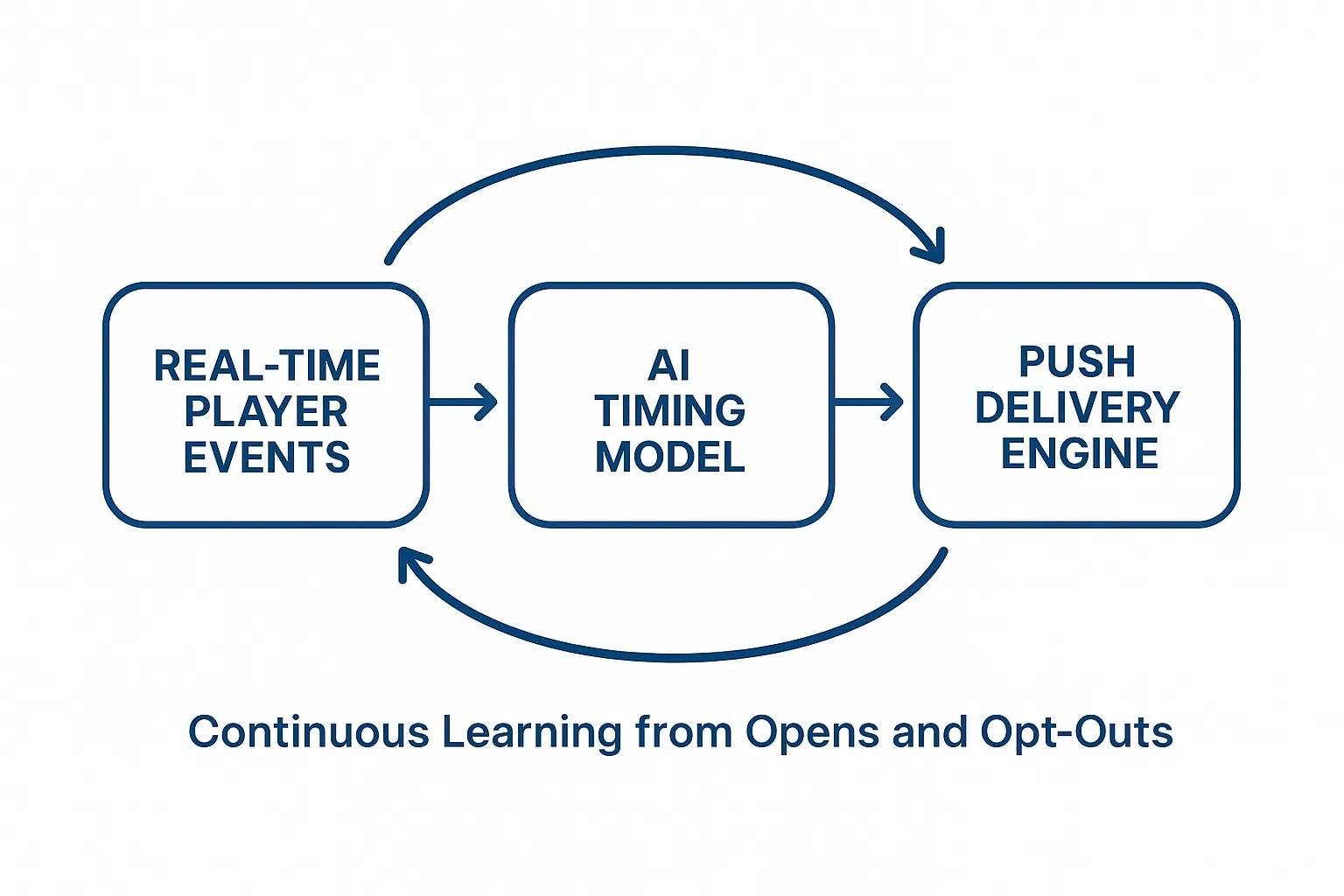
Machine learning models using features like past open times, device usage patterns, and deposit cycles can predict optimal send windows per player. Early Spinlab pilots show an extra 9-11 % CTR lift versus rule-based timing alone.
To test AI timing safely:
- Start with a 10 % traffic slice.
- Set a hard daily cap override (3 pushes) enforced by rules.
- Review fatigue metrics weekly before widening exposure.
Integration Checklist
- Map all in-game events to Spinlab Event Bus.
- Define lifecycle segments and daily caps.
- Configure quiet hours and local time logic.
- Enable Responsible Gaming suppression flags.
- A/B test cool-down windows (start at 15 m vs 30 m).
- Monitor Fatigue Tracker dashboard daily for first 30 days.
Frequently Asked Questions
How many push notifications are too many for an online casino? Spinlab data suggests more than three promotional pushes per 24-hour window increases opt-outs by 12 % and churn by 7 %.
Should I disable all pushes during quiet hours? Not necessarily. Transactional or in-session messages are exempt because the player is already active. Promotional pushes should respect quiet-hour curfews.
Do push notifications need explicit consent? Yes. Under GDPR and most gambling licences, marketing pushes require opt-in. Transactional messages related to an active session often fall under legitimate interest but check local regulations.
How do I test timing without hurting KPIs? Use holdout groups and incremental rollouts. Begin with 10 % of traffic, monitor fatigue metrics, then expand gradually.
See Spinlab’s Push Studio in Action
Building and enforcing sophisticated timing rules is painless when the logic lives inside your platform. Spinlab’s Push Studio gives you:
- No-code rule builder with cool-down, caps, and quiet hours baked in.
- Real-time segmentation tied to bets, wins, and cashier events.
- Responsible Gaming guardrails out of the box.
- AI send-time optimisation you can toggle on per campaign.
Ready to transform your push strategy into a fatigue-free revenue engine? Book a 30-minute live demo and watch Spinlab trigger perfectly timed notifications that keep players spinning—happily.