

Every “Sorry, spinning wheel” moment in your casino costs money. In A/B tests across six mid-tier operators in 2025, a bonus credit delay greater than 1.2 seconds decreased in-session wagers by 9 %. The culprit is rarely the payment rail or the game server—it is almost always the third-party bonus API sitting between the two. In this deep dive we will uncover where hidden latency creeps into bonus calls, how it erodes revenue and player trust, and the concrete fixes operators can deploy right now.
Why Bonus Speed Matters More Than You Think
Bonuses are no longer a once-a-day email coupon. They trigger hundreds of times per player session: quick-spin cashbacks, mystery drops, reel unlocks, dynamic quests, and refund guarantees. Each trigger must round-trip from the game to the bonus service, apply rules, write ledger entries, and respond before the next spin loads. If that journey takes more than a blink, players feel it—and some quit.
| Latency Bucket (ms) | Observed Player Reaction | Avg. Change in Bet Count* |
|---|---|---|
| 0-300 | Perceived as instant | +4.1 % |
| 300-800 | Noticeable but acceptable | –0.8 % |
| 800-1,500 | Annoying – hesitation | –6.7 % |
| >1,500 | Trust damaged | –9.0 % |
*Aggregate across 6 operators, 24 M spin events, Apr-Jun 2025 (Spinlab Analytics Labs)
Where the Latency Hides
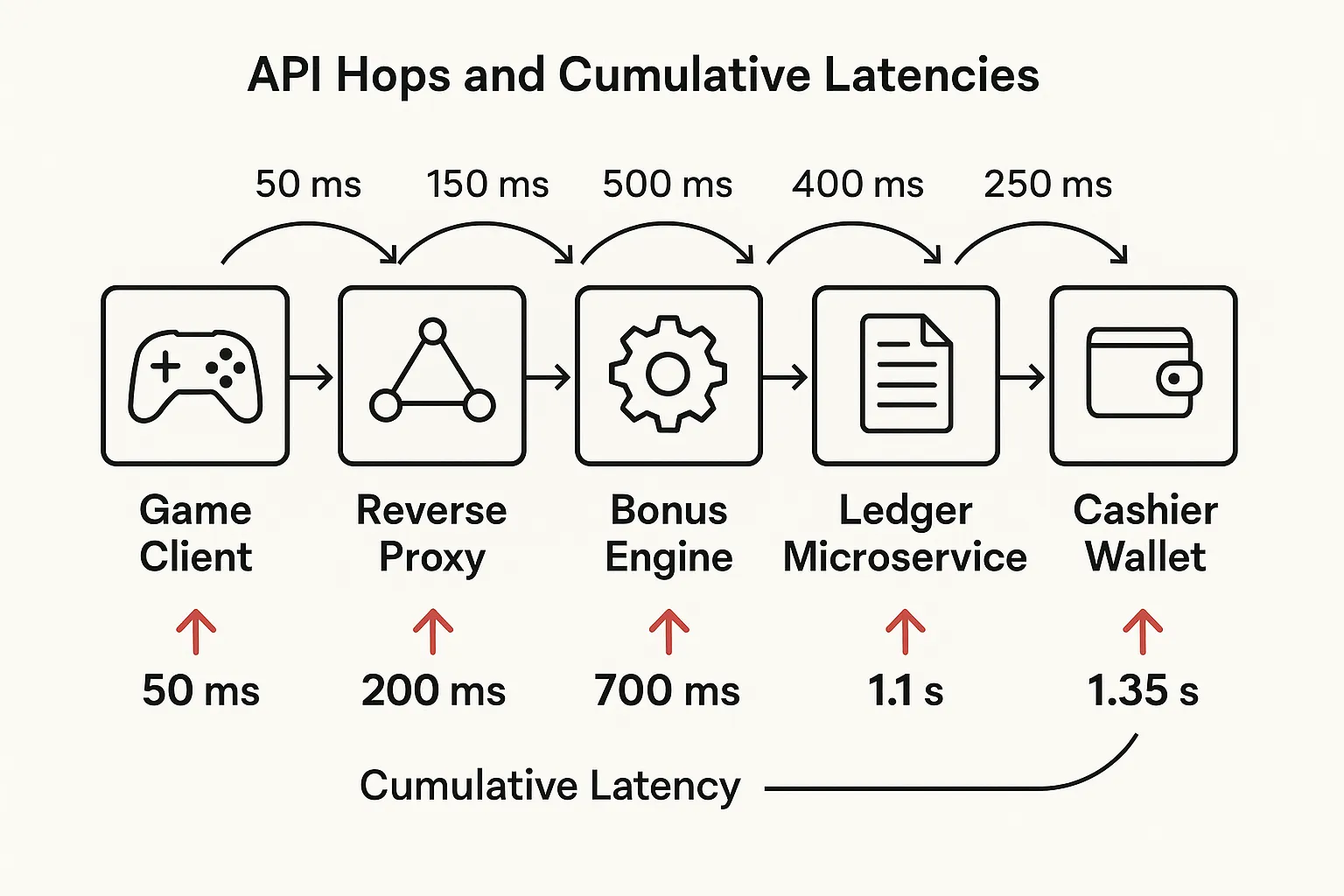
- TLS round-trips: Many bonus providers force calls through a single European data center even for LATAM or APAC traffic. At 180–250 ms RTT, the cost adds up.
- Chatty Auth Flows: Per-request OAuth or HMAC validation can require extra DB reads.
- Rule Engine Joins: Large JSON payloads are parsed, then matched against multi-table SQL joins—often on undersized cloud instances.
- Wallet Settlement: If the bonus engine and cashier don’t share a ledger, a second API call is needed to move funds.
- Webhook Confirmation: Some engines demand a webhook acknowledgment before the bonus is confirmed, doubling hops.
How Much Revenue You’re Leaving on the Table
A mid-sized crypto casino averaging 50 K DAU and US $27 gross gaming revenue (GGR) per daily active user loses roughly US $3.3 M annually from bonus latency alone:
50,000 DAU × $27 GGR × 365 days × 0.9 % latency penalty ≈ $3,304,500
(The 0.9 % penalty is the weighted drop from the table above.)
Add affiliate clawbacks tied to wager volume and the true cost often tops US $4 M.
Diagnosing Your Own Bonus Lag
- Capture front-end waterfall traces (Chrome DevTools, Safari Network tab) on high-volume games.
- Compare
bonus/grantAPI timing during peak vs off-peak hours. - Enable server-side distributed tracing headers (
traceparent,baggage) and aggregate in Grafana Tempo or Datadog APM. - Plot P95 latency against wager abandon rate in your analytics stack (see Real-Time Analytics guide).
If P95 bonus latency >800 ms during peak hours, start remediation immediately.
Five Proven Fixes
1. Deploy an Edge Cache for Static Eligibility
For rules that rarely change (e.g., “VIP Level ≥ 3”), cache eligibility responses at the CDN or in Cloudflare Workers. Success stories show 150-300 ms shaved off each call.
2. Pre-Fund Bonus Wallets
Create ring-fenced bonus wallets topped up in advance. When the bonus engine approves a reward, the cashier can credit instantly without double-spend risk.
3. Switch to Event Streaming, Not Request-Reply
Use Kafka or NATS to push bonus events. The game client publishes an event, gets an immediate receipt, and continues; the bonus engine processes asynchronously and the next spin reflects balance updates. Sub-400 ms end-to-end is achievable.
4. Co-Locate Compute Near Players
Spinlab customers using our regional edge clusters (São Paulo, Manila, Lagos, Bucharest) reduced RTT by up to 70 %. If your bonus vendor lacks global PoPs, pressure them—or migrate.
5. Consolidate Into a Native Bonus Engine
The most bulletproof fix is eliminating the third-party hop altogether. Spinlab’s Fullhouse platform ships with a native Affiliate & Bonus Engine that runs in the same Kubernetes namespace as your games and cashier:
- Single ledger for real-money and bonus funds (no double settlement)
- In-memory rule evaluation <3 ms
- Event-streamed triggers (
Deposited,SpinCompleted,QuestCheckpoint) - No per-call fees; flat SaaS pricing
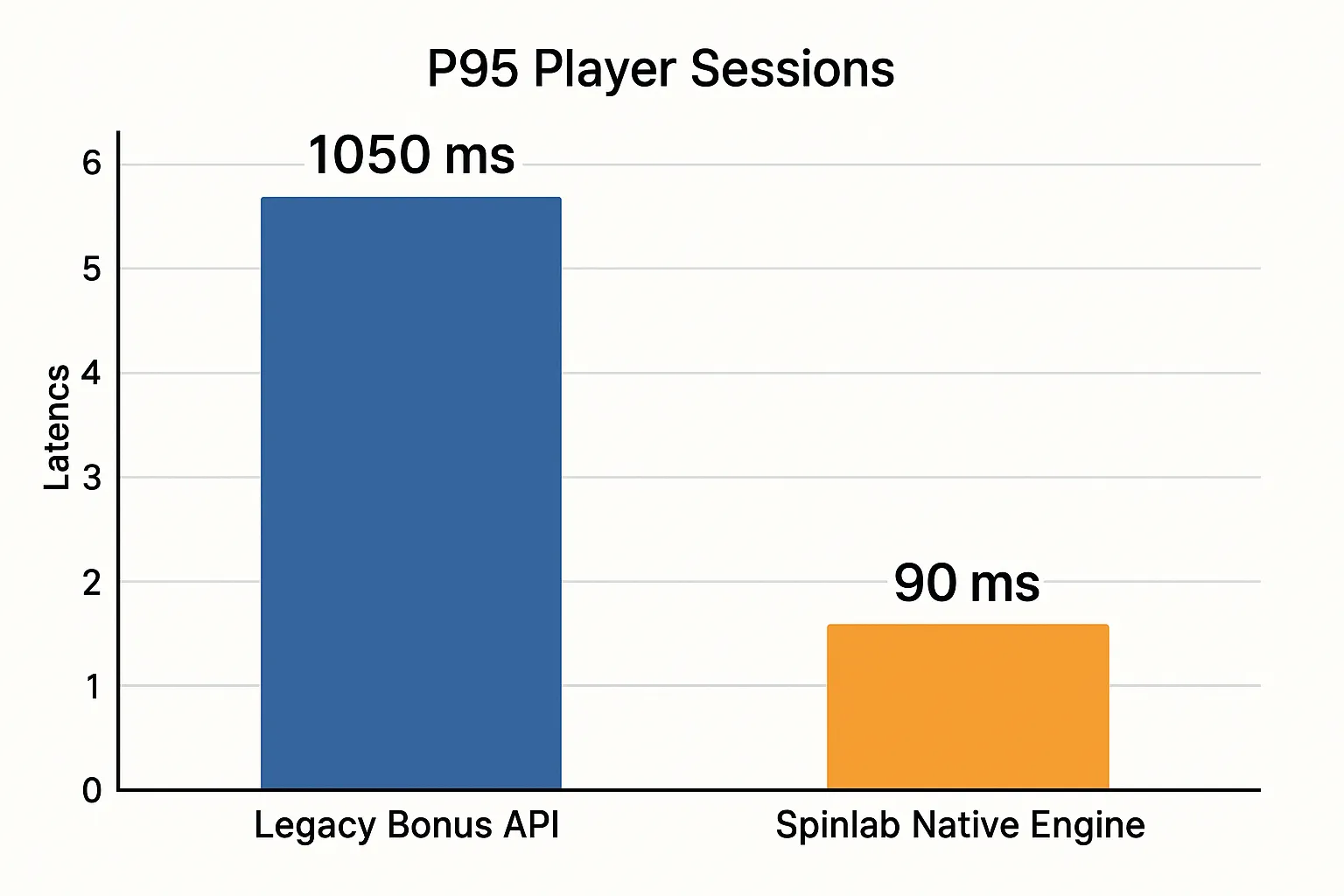
Operators that migrated saw P95 bonus latency drop from 1,050 ms to 90 ms and GGR per active user rise 5-7 % within eight weeks.
Implementation Blueprint
| Week | Milestone | Tools & Tips |
|---|---|---|
| 1 | Instrument tracing & set SLAs | OpenTelemetry, Spinlab Real-Time Analytics |
| 2 | Pilot edge cache rules | Cloudflare Rulesets, Azure Front Door |
| 3 | Stand-up bonus wallets | Spinlab Unified Ledger API |
| 4 | Switch high-vol games to event mode | Kafka topic bonus.triggers.* |
| 5 | Migrate remaining rules to native engine | Spinlab Bonus Rule Builder |
| 6 | Decommission legacy API & monitor | Grafana dashboards, automated alerts |
Common Pitfalls to Avoid
- Partial Migration: Leaving one game provider tied to the old bonus API keeps the long tail of calls slow.
- Under-sized Edge Kernels: Running rule engines on low-tier VM sizes negates the benefit of co-location.
- Forgotten Webhooks: Disable now-redundant confirmation webhooks to prevent duplicate posting.
- No Roll-Back Plan: Always maintain a feature-flagged rollback to the old path for 48 hours post-migration.
Related Reading
- Cashier Conversion Hacks: Optimizing Deposit Forms for 3-Second Checkout
- 8 Signs Your Casino Tech Stack Is Stunting Growth—and How to Fix It
- Real-Time Analytics in iGaming: Turning Live Data into Bigger Profits
FAQ
How do I measure bonus latency without editing game code? Use a session‐wide proxy such as Charles or mitmproxy to capture network calls from the browser or native app.
Will asynchronous bonuses confuse players? If balance increments occur before the next spin, players rarely notice. A subtle “Bonus Applied” toast fixes edge cases.
Does moving to a native bonus engine break compliance logs? No. Spinlab’s unified ledger writes immutable bonus transactions with audit metadata (timestamp, IP, rule-ID) compatible with UKGC, MGA, and Curaçao filings.
Ready to Slash Bonus Latency?
Every 100 ms you shave off puts money straight back into your GGR. Book a 20-minute demo to see how Spinlab’s native Bonus & Quest Engine delivers sub-100 ms rewards, real-time analytics, and a Shopify-simple UI—all at the market’s lowest total cost.
Schedule your live walkthrough now at spinlab.studio/contact and start turning lost milliseconds into found revenue.