

Implementing a modern iGaming platform is no longer just a DevOps exercise. Finance, compliance, and product teams all need crystal-clear answers to a deceptively simple question: Which parts of our stack actually make us money, and which silently burn it? The fastest path to that answer is a rigorous cost-allocation strategy that pairs cloud spending with Gross Gaming Revenue (GGR) at the microservice level.
In this guide you will learn how to design a SaaS cost-tagging taxonomy tailored for online casinos, connect those tags to real-time GGR events, and surface actionable insights that drive both product and FinOps decisions.
Why Track GGR per Microservice?
- Product ROI clarity – When you know that the Crash Game engine generates USD 0.47 in GGR per processing cent while the leaderboard service delivers only USD 0.08, roadmap priorities become self-evident.
- Informed autoscaling – Resource-intensive features can be throttled or routed to cheaper compute tiers during off-peak hours without risking disproportionate revenue loss.
- Pricing negotiations – A clear view of aggregator and payment-gateway margins allows you to renegotiate contracts armed with irrefutable data. See The True Cost of a Game Aggregator for an example of hidden leak points.
- Licensing compliance audits – Many regulators now expect licensees to prove revenue attribution across jurisdictions and game types. Transparent cost allocation streamlines that evidence-trail.
- Investor reporting – Detailed unit economics help growth-stage operators unlock cheaper capital by demonstrating cost discipline.
A 2024 FinOps Foundation survey reported that teams with mature tagging practices recover an average of 18 percent of cloud spend through rightsizing and discount programs compared with 9 percent for teams without enforceable tags.
Core Concepts: Tags, Dimensions, and Cost Objects
• Resource tag – A key–value label applied to cloud objects (VMs, containers, serverless functions, managed databases) that drives cost visibility in vendor consoles such as AWS Cost Explorer or Google Cloud Billing.
• Microservice – The smallest deployable component in your platform that owns a discrete business capability (for example bonus-engine, kyc-service, crash-engine).
• Cost object – The entity against which you want to allocate and potentially optimise spend. In iGaming this is often per jurisdiction, per game vertical, or per feature flag.
Tags and cost objects bridge the language gap between engineering metrics (vCPU-hours, egress GB) and operator metrics (GGR, Net Gaming Revenue, deposits, fraud losses).
Designing an iGaming-Specific Tagging Taxonomy
A generic “Department = Engineering” tag is useless when you need per-feature ROI. Instead, build a taxonomy that mirrors revenue drivers. Below is a proven starter schema.
| Tag Key | Example Values | Purpose |
|---|---|---|
| Service | cashier, game-aggregator, bonus-engine, crash-engine | Groups spend by microservice |
| Vertical | slots, live-casino, crash, sportsbook | Enables cost vs GGR by content type |
| Jurisdiction | MGA, Ontario, Curacao, Brazil | Supports regulatory and tax reporting |
| Environment | prod, staging, dev | Filters non-revenue workloads |
| BuildVersion | v2025.09.28, blue-canary | Correlates performance regressions with releases |
| Owner | @payments-team, @platform-team | Accountability and escalation |
Practical Tips
- Keep keys stable, expand values – Changing a tag key (‘Vertical’ to ‘ProductLine’) can break year-over-year cost queries.
- Automate enforcement – Use policy engines such as AWS Service Catalog, GCP Organization Policy, or an admission controller in Kubernetes to reject untagged resources at deploy time.
- Document edge cases – Decide upfront how shared services (PostgreSQL clusters, Redis caches, Kafka topics) will be tagged. A 70 percent cost weight to the highest-traffic caller is a common rule of thumb.
Implementing Tags Across Your Stack
1. Infrastructure as Code (IaC)
Embed tags directly in Terraform or Pulumi modules so every provisioned resource inherits the correct labels:
module "ecs\_crash" {
  source  = "aws-ecs-service"
  name    = "crash-engine"
  tags = {
    Service       = "crash-engine"
    Vertical      = "crash"
    Jurisdiction  = var.jurisdiction
    Environment   = var.environment
    Owner         = "@games-team"
  }
}
2. Kubernetes Labels and Annotations
If your casino runs on EKS, GKE, or OpenShift, propagate pod labels to node and cluster levels so cloud-billing export tools like kubecost or Finout can ingest them.
metadata:
  labels:
    service: cashier
    vertical: payments
    environment: prod
3. Serverless Functions
Both AWS Lambda and Google Cloud Functions support resource tags. Enforce them either via the console or CLI wrappers in your CI pipeline.
4. SaaS and Third-Party APIs
Where direct tagging is impossible (for example payment gateways), fetch cost reports via API and append “pseudo-tags” in your data lake so they flow through the same allocation logic.
Connecting GGR Events to Cost Tags
Tags alone do not close the FinOps loop. You also need a revenue stream mapped to the same dimensions.
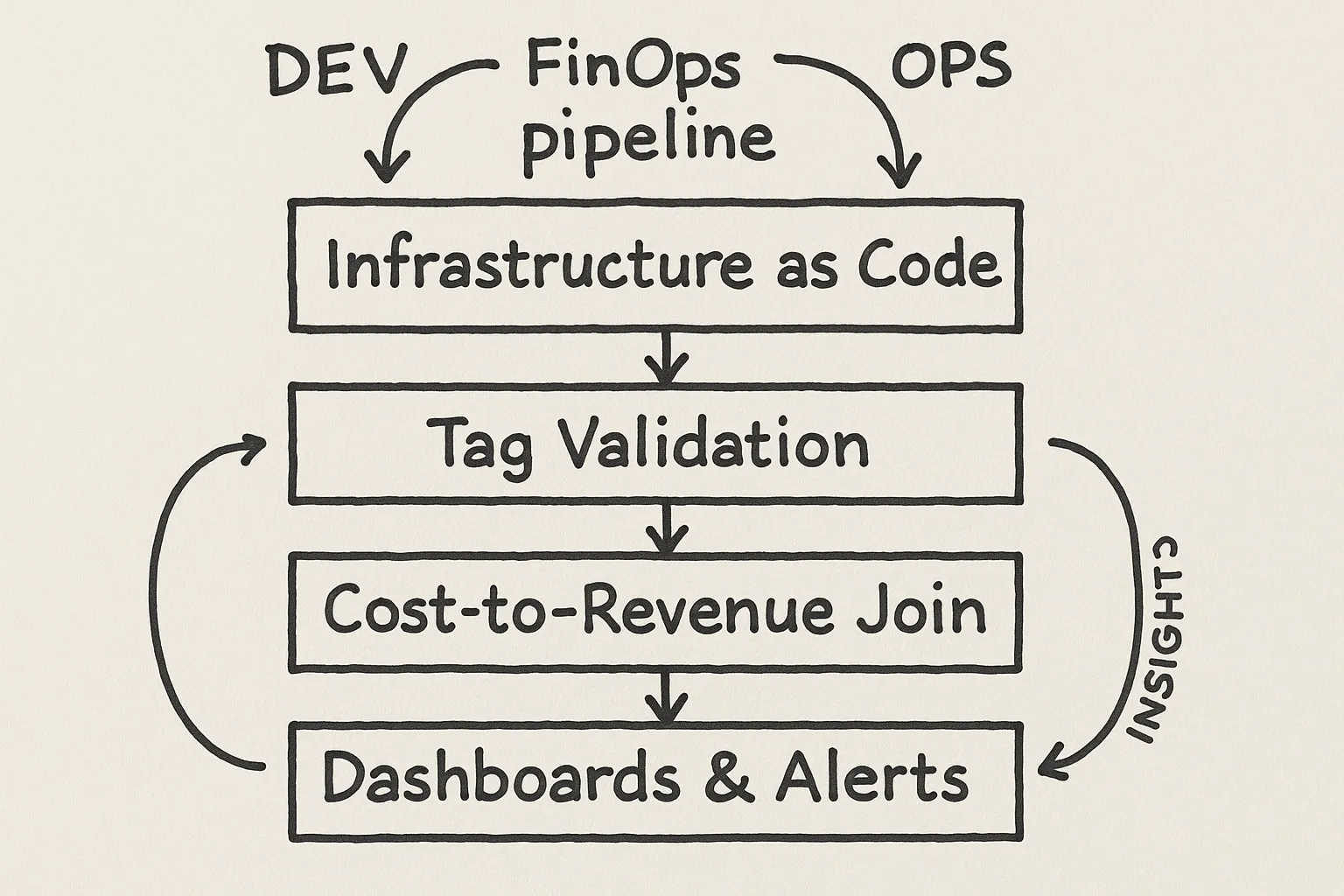
- Emit granular revenue events – Ensure that every wager, win payout, bonus credit, and fee carries fields matching the tagging keys: service, vertical, jurisdiction, player-segment.
- Ingest into a real-time lake – Stream both cloud-billing exports and game ledger events into a common platform such as BigQuery, Snowflake, or ClickHouse. Operators already leveraging the Spinlab Real-Time Analytics Module can simply create a new materialised view that joins
billing_eventsandggr_eventson shared dimensions. (Deep dive in Real-Time Analytics in iGaming.) - Calculate efficiency KPIs
SELECT
  service,
  vertical,
  jurisdiction,
  SUM(ggr) AS ggr\_total,
  SUM(cloud\_cost) AS cost\_total,
  SAFE\_DIVIDE(SUM(ggr), SUM(cloud\_cost)) AS ggr\_per\_dollar
FROM joined\_events
WHERE period = '2025-09'
GROUP BY 1,2,3
ORDER BY ggr\_per\_dollar DESC;
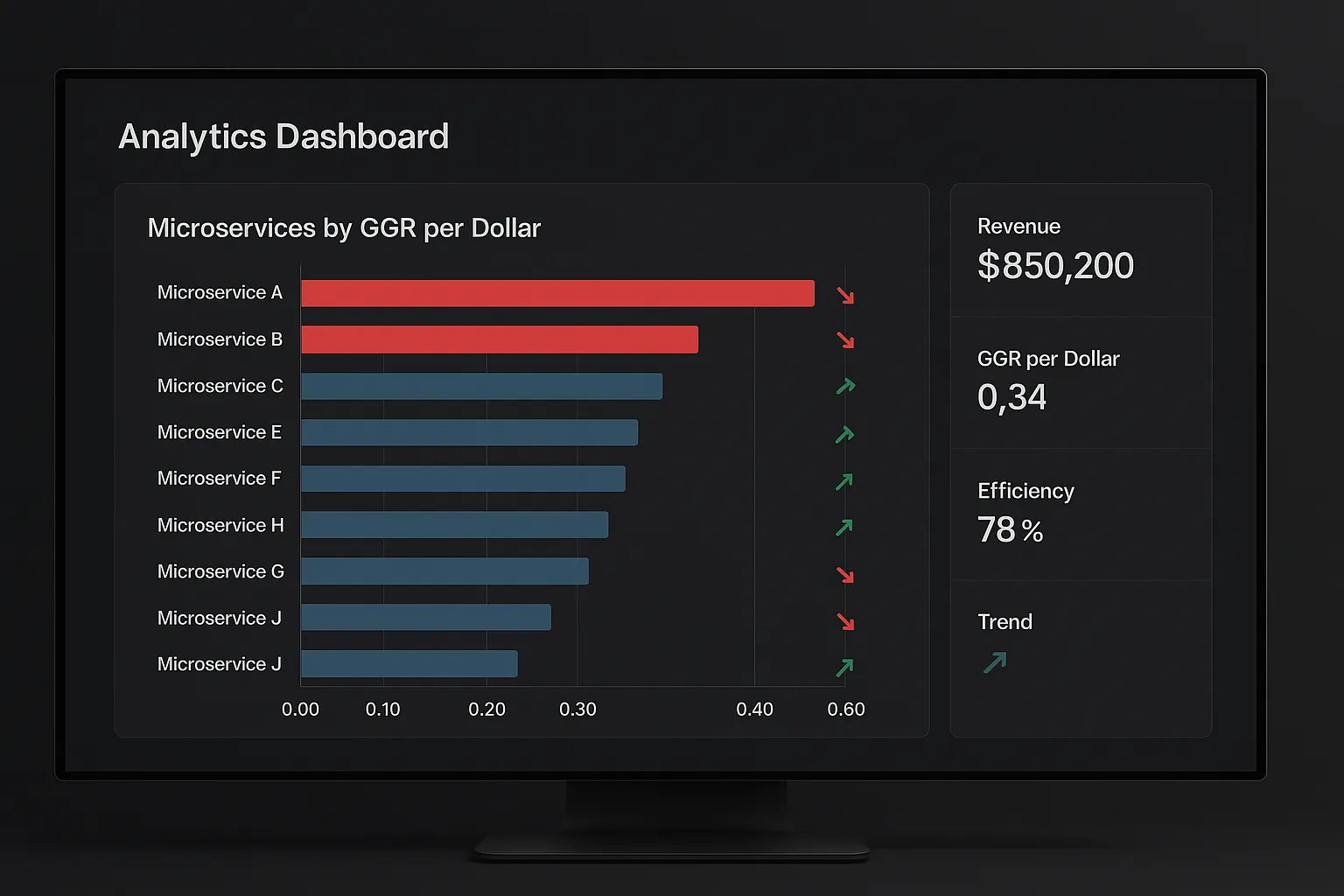
- Surface the numbers – Expose final metrics in dashboards visible to both engineering and finance. Tools like Looker, Metabase, or Spinlab’s built-in BI widgets let you schedule alerts when a service’s GGR-to-cost ratio dips below threshold.
Handling Shared and Indirect Costs
Every microservice consumes some shared resources: Kubernetes control plane, logging pipelines, security scans, and of course human salaries. FinOps literature recommends two main strategies:
- Proportional allocation – Distribute shared costs by each service’s percentage of direct spend. If the Cashier accounts for 25 percent of tagged compute spend, allocate 25 percent of the Kubernetes control-plane fee to it.
- Activity-based allocation – Weight cost by measurable drivers. For example, CDN costs may be allocated by outbound MB, while fraud-scoring API fees are allocated by number of risk checks.
Document your chosen logic and revisit quarterly. Transparency prevents finance and engineering from arguing about “phantom costs.”
Putting It All Together: A Mini Case Study
Operator: Mid-tier global brand running the Spinlab Fullhouse platform across three regions.
| Metric | Before Tagging | 90 Days After Tagging |
|---|---|---|
| Unattributed cloud spend | 37 percent | 4 percent |
| Monthly FinOps analysis time | 3 days | 4 hours |
| Services flagged for optimisation | – | Cashier, Leaderboards |
| Realised annualised savings | – | USD 430k |
What They Did
- Adopted the tag schema in this article and enforced it in Terraform pipelines.
- Enabled AWS Cost Allocation Tags and exported data to BigQuery via Athena.
- Fed Spinlab GGR ledger events into the same warehouse.
- Built a Looker board tracking
ggr_per_dollarper service. - Cut idle provisioned capacity for low-ROI services and migrated certain workflows to AWS Fargate Spot.
Key Takeaway
A clear GGR-per-microservice view revealed that the leaderboards service, despite heavy compute and Redis usage, accounted for less than 2 percent of revenue. By downgrading instance classes and introducing aggressive off-peak auto-suspend, the operator saved USD 37k per month without harming player KPIs.
Operational Guardrails for Sustainable FinOps
- Tag completeness SLO – Alert if more than 2 percent of resources launch without mandatory tags.
- Weekly cost drift check – Compare current tagged costs against the prior four-week average and trigger anomaly alerts beyond a 15 percent delta.
- Release time budgets – Attach spend forecasts to every release ticket. If projected cost exceeds budget, require sign-off from product and finance.
Next Steps
- Audit your current tagging coverage. Even 80 percent accuracy delivers huge visibility gains.
- Align on a unified revenue event schema that mirrors tag keys.
- Deploy an automated pipeline to join costs and GGR daily. Manual CSV merges defeat the purpose.
- Start optimising the lowest GGR-per-dollar microservice and track savings.
Spinlab’s modular platform already emits tag-ready infrastructure templates and granular ledger events out of the box. If you want to see GGR-per-microservice dashboards live on your own data, schedule a 30-minute discovery call with our FinOps architects.
For a broader budgeting framework that pairs perfectly with the tagging approach discussed here, read Budgeting for a Casino Startup: CapEx vs OpEx Explained.
Tracking GGR at the microservice level transforms cost data from a monthly headache into a strategic weapon. The sooner you embed enforceable tags and real-time joins, the faster you will compound that advantage—and out-spin competitors stuck in the dark.