

Influencer campaigns still deliver some of the lowest CPAs in iGaming, but 2025 brings a hard reality check: Brussels, national regulators, and even TikTok itself are cracking down on undisclosed ads, under-age targeting, and “crypto-casino” plugs that fly in the face of new EU rules. Slip up and you’re looking at fines of up to 6 % of global turnover under the Digital Services Act (DSA) or a full advertising ban in jurisdictions like Spain or the Netherlands.
Below we unpack the nine most common compliance pitfalls casino operators and their influencer partners are already tripping over—and how to stay on the right side of the law while still scaling your acquisition funnel.
What Changed? A 60-Second Recap of the New EU Ad Rulebook
| Regulation / Guidance | Effective | Key Points for iGaming Influencers |
|---|---|---|
| Digital Services Act (DSA) | 17 Feb 2024 | Platforms must label paid ads, keep ad libraries for 1 year, and provide audience-targeting transparency. Up to 6 % of global turnover fines. |
| Revised Audiovisual Media Services Directive (AVMSD) | Rolling transposition 2024–25 | Gambling ads cannot target minors; influencers are now classed as “on-demand media services” in many states. |
| EU Consumer Protection Omnibus Directive | May 2024 | Bans hidden sponsorships and misleading “social proof” (fake winnings). |
| National Gambling Acts (ES/DE/NL/BE) | 2024–25 refresh | Tighter bonus caps, watershed hours, and outright influencer bans in Belgium & the Netherlands if under 21k followers. |
EU Commission summary here.
The 9 Influencer Compliance Pitfalls (And How to Avoid Them)
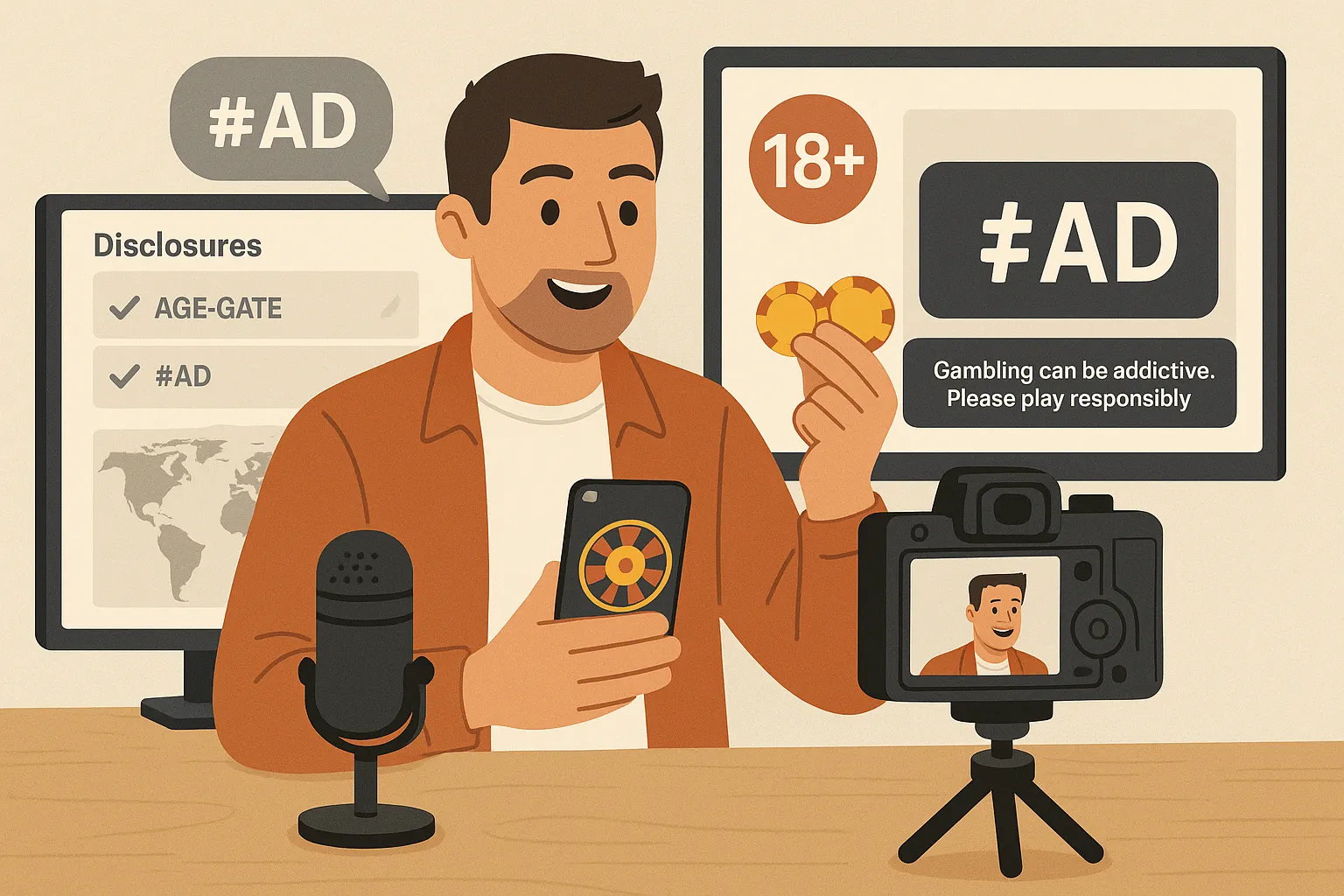
1. Skipping Clear “#Ad” + 18+ Labels in Short-Form Video
TikTok and Reels now require dual disclosures: an in-video textual “#ad” and a persistent 18+ gambling warning. Posts without both risk removal within hours and DSA penalties for “hidden advertising.”
Fix it:
- Supply pre-approved overlay graphics (824×150 px) to all creators.
- Include Age-Screen JSON in Spinlab’s Affiliate API so monitored traffic auto-blocks users whose profile age < 18.
2. Promoting Unlicensed Brands to EU IPs
An influencer streaming from Curacao may think they’re safe, but if their audience geo-locates to Germany they’re facilitating unlicensed gambling—a criminal offence under the Glücksspielstaatsvertrag.
Fix it:
- Whitelist only EU-licensed skins in your influencer briefs.
- Use Spinlab’s Geo-Guard redirect module to bounce EEA IPs to a compliant domain or a generic landing page.
3. Algorithmic Drift Into Minor Audiences
Instagram’s recommendation engine often pushes high-engagement Reels to teen feeds even when a creator’s follower base skews adult. Regulators measure actual reach, not intended.
Fix it:
- Require creators to toggle “Age Gate 18+” on every gambling post (available since Meta v331).
- Pull Instagram Insights via Spinlab’s Social Listener and flag any post where < 5 % of impressions show the 13-17 cohort.
4. Hidden Rev-Share Deals
The Omnibus Directive bans “covert advertising.” If the creator’s compensation depends on first-time deposits or revenue share, it must be explicitly disclosed.
Fix it:
- Add a one-liner in the video description: “I earn a commission if you sign up and play.”
- Store signed compensation annexes in Spinlab’s affiliate vault; auto-expire links if the disclosure sentence is edited out.
5. Overstepping Bonus & Stake Limits
Spain’s Royal Decree 958/2020 caps bonuses at €100 and forbids influencer calls-to-action before a user’s 30-day cooling period. Belgium bans any monetary incentive altogether.
Fix it:
- Localise scripts: one master creative ≠ 27 markets.
- Hook Spinlab’s Rules Engine so country-level bonus caps are enforced at the cashier even if the influencer forgets to mention them.
6. Non-Compliant Giveaways & Raffles
Influencer “like + retweet to win €500” promos can morph into illegal lotteries unless free, equal-chance entry is offered and T&Cs list licence data and draw mechanics.
Fix it:
- Provide boilerplate T&Cs and require pinned comments linking to them.
- Log all on-chain/random.org draw IDs in Spinlab’s Promotion Audit Log for five years.
7. Fake Wins & Lifestyle Misrepresentation
Staged “€50k win in two minutes” clips breach the Unfair Commercial Practices Directive. ASA UK already fined several streamers for doctored balance pop-ups.
Fix it:
- Ban testimonial exaggeration in contracts.
- Serve dynamic balance widgets via Spinlab’s Streamer Overlay SDK that pull live session data—no manual edits possible.
8. Tracking Without GDPR-Grade Consent
UTM links or promo codes that stitch together age, device, and deposit data create a personal profile—squarely personal data under GDPR.
Fix it:
- Fire trackers only after the casino’s CMP registers “marketing” consent.
- Use Spinlab’s CMP hook: if
consent=false, swap to a cookieless fallback link.
9. Failing to Archive Content for the Mandatory Audit Trail
DSA Article 39 obliges “very large online platforms” to keep an ad library for one year; ASA and ARCOM expect advertisers to archive up to five years.
Fix it:
- Auto-scrape every influencer post URL + MP4 into Spinlab’s S3 bucket with hash-based deduplication.
- Generate quarterly compliance reports; share with regulators on request.
Penalties at a Glance
| Country | Typical Fine for First Offence | Special Measures |
|---|---|---|
| Germany | Up to €500k or 6 % of turnover | Blacklisting of domains via ISP order |
| Spain | €100k–€1 m | Two-year ad suspension possible |
| Netherlands | €870k or 4 % of turnover | Influencer ban under 21k followers |
| Belgium | Full advertising prohibition | Ad platform must delist content |
Source: national regulator gazettes, July 2025.
A Three-Step Compliance Workflow You Can Implement This Month
- Pre-Campaign Vetting
- Check creator demographics, prior ASA rulings, and licence coverage.
- Spinlab shortcut: Creator Vetting API + licence filter.
- Real-Time Monitoring
- Scrape live posts, verify disclosure text, track reach by age & geo.
- Spinlab shortcut: Social Listener + Rules Engine alerts in the back office.
- Post-Campaign Archiving & Reporting
- Hash-store assets, export spend vs ROI vs complaints.
- Spinlab shortcut: One-click Compliance Report (CSV + evidential MP4 links).
Frequently Asked Questions
Are influencers completely banned from promoting gambling in the EU? No. Some markets (e.g., Belgium, NL) restrict smaller influencers or impose tighter rules, but pan-EU bans do not exist. Compliance hinges on disclosures, age gating, and licence alignment.
Do I need player consent before passing sub-ID data back from an influencer link? Yes, if the sub-ID can be tied to an identified or identifiable natural person under GDPR. Use a CMP-controlled redirect.
Can a UK-based influencer target EU players under UKGC rules only? No. Cross-border promotion must respect the stricter standard where the audience resides. Always layer local rules on top of UK guidance.
Ready to bullet-proof your influencer funnel and avoid six-figure fines? Spinlab’s Affiliate & Compliance Suite automates age gating, geo blocking, disclosure checks, and five-year ad archiving—so your marketing team can scale safely, not slowly.
Book a 20-minute strategy call now and see a live demo of the compliance dashboard in action.