

Crypto deposits and instant payouts are now table stakes for modern online casinos. That convenience comes with real custody risk. Private key compromise and weak operational controls continue to drive the largest on‑chain losses, according to annual industry reports like the Chainalysis Crypto Crime Report. If your operation runs merchant custodial wallets, you need a rigorous, repeatable security program that product, payments, compliance, and engineering can all execute.
Below is a practical, audit‑ready checklist you can use to validate your iGaming wallet setup, shore up gaps, and brief executives on residual risk.
What “custodial wallets” mean in iGaming
In a custodial model, the operator controls private keys and on‑chain addresses that hold player funds, treasury float, and operational reserves. Players interact with a ledger balance in your platform, while your wallet system manages deposits, sweeps, payouts, and reconciliation on the blockchain. Typical tiers are hot wallets for automated flows, warm wallets for higher limits, and cold or offline storage for reserves. The attack surface spans cryptography, infrastructure, payment policies, human process, and regulation.
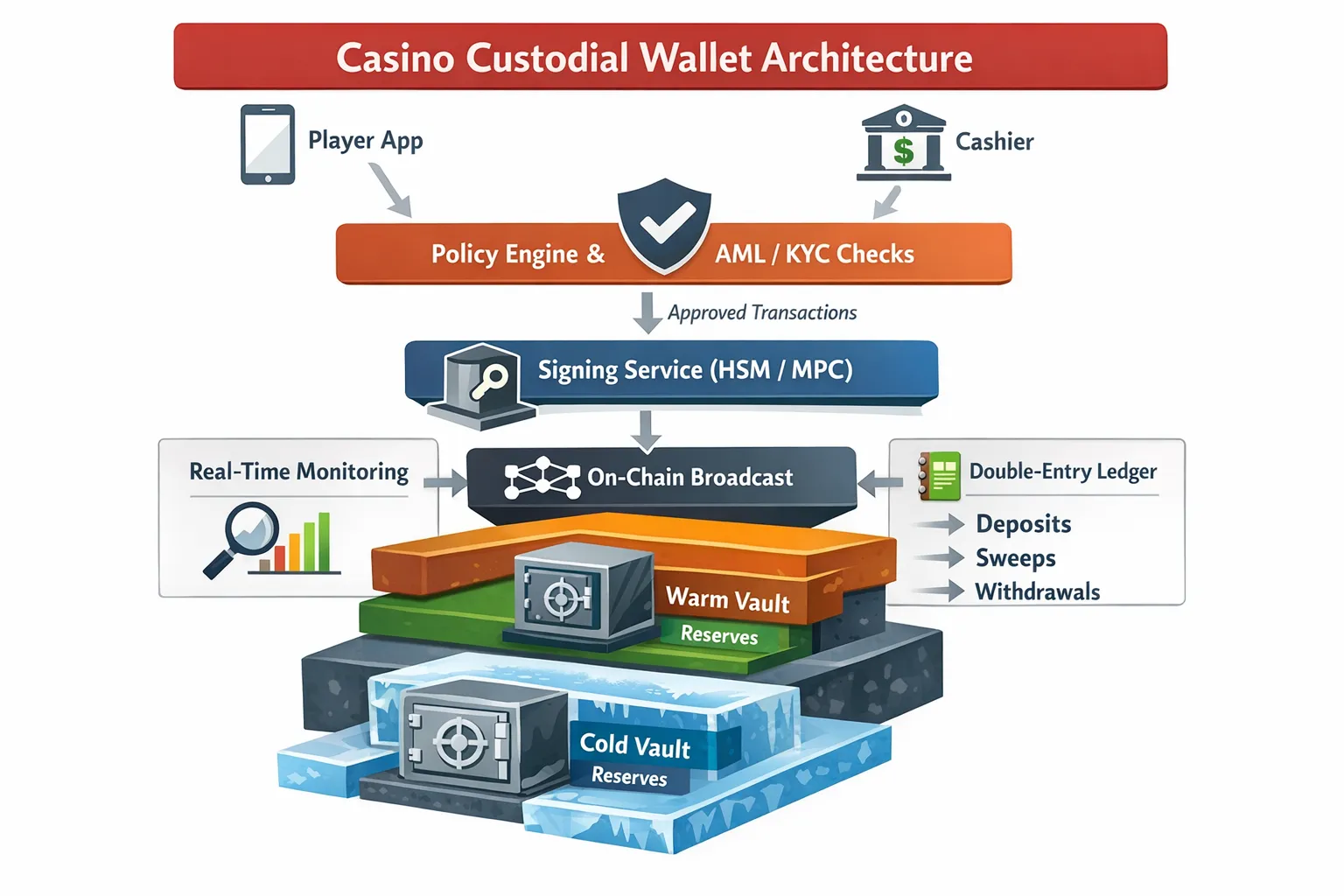
The custodial wallet security checklist for casinos
Use this as a working document with owners and evidence for each control.
1) Governance and fund segregation
- Board‑approved crypto treasury policy that separates player liabilities from operational funds.
- Ring‑fenced wallets or accounts by purpose, asset, and jurisdiction, with documented ownership and signers.
- Daily proof that on‑chain holdings cover the player ledger plus a safety buffer, with variance thresholds and escalation.
2) Key management and signing security
- Avoid single‑key hot wallets. Use hardware security modules or multi‑party computation for transaction signing where feasible.
- Rotations and backup procedures documented, tested, and witnessed. Record key ceremonies and store artifacts in a secure vault.
- Separate keys by environment and asset. Never reuse production keys for staging or testnets.
- Follow recognized guidance on key lifetimes and entropy, for example NIST SP 800‑57 Part 1.
3) Wallet architecture and network isolation
- Hot wallet balances capped to a minimal operational float, with automated sweeps to warm or cold storage on schedule and on thresholds.
- Unique deposit addresses per player or per session, with idempotent crediting to avoid double posting.
- Dedicated VPCs and strict egress controls for signing services. Only outbound to whitelisted nodes or gateways.
- Bridge and Layer‑2 use whitelisted routes. Document bridge trust assumptions and failure procedures.
4) Access control and identity
- Administrative access gated with phishing‑resistant MFA (for example, passkeys or FIDO2), not SMS alone.
- Role‑based access with least privilege. Separate duties for requesters, approvers, and signers.
- Just‑in‑time elevation for sensitive actions, with tamper‑evident logs and session recording.
5) Transaction policies that actually enforce risk
- Programmatic limits by KYC tier, jurisdiction, asset, and velocity. Higher values require two‑person approval.
- Address allowlisting for VIP and high‑risk corridors. First‑time addresses get lower limits until seasoned.
- Real‑time checks before broadcast: balance, gas, risk score, sanctions, Travel Rule completeness, and ledger constraints.
6) Blockchain analytics and sanctions screening
- Integrate a reputable on‑chain risk provider to score inbound and outbound addresses. Block or escalate high‑risk categories.
- Re‑screen counterparties on every new transaction. Avoid one‑time clearance that goes stale.
- Alert on dusting attacks, mixer proximity, ransomware tags, and OFAC‑listed entities.
7) KYC/AML and Travel Rule
- Collect and retain KYC proportionate to limits. Enforce enhanced due diligence for high‑value activity.
- Implement the Travel Rule when applicable, exchanging required originator and beneficiary information with VASPs. See FATF guidance for scope and expectations.
- Maintain suspicious activity reporting workflows and regulator notification timelines by market.
8) Ledger integrity and reconciliation
- Double‑entry ledger with immutable audit trail. All wallet movements mirror on‑chain events and policy decisions.
- Hourly or daily reconciliation across three sources: on‑chain data, internal ledger, and PSP or bank statements for off‑ramps.
- Automated detection and playbooks for negative balances, orphan transactions, and stuck mempool states.
9) Monitoring, alerting, and anomaly detection
- Live telemetry on p95 payout times, approval rates, error codes by rail, and cash‑flow at risk.
- Mempool watchers for unusual fee spikes, nonce conflicts, or replay risks.
- Alerts tied to action. Every alert has a declared owner, severity, runbook, and SLA.
10) Incident response and disaster recovery
- Documented scenarios with drills: key exposure, analytics false negatives, hot wallet drain, bridge outage, and chain reorgs.
- Emergency outflow freeze that does not break deposit crediting or player access to games.
- Regular restore tests for cold vaults, configuration backups, and ledger snapshots. Measure RTO and RPO.
11) Secure change management
- Canary releases for wallet code and policy changes, with automatic rollback criteria and metrics gates.
- Two‑person review on policy updates, fee calculators, and signer quorum changes.
- All dependencies pinned and builds reproducible. Sign artifacts and verify at deploy time.
12) Third‑party risk management
- Due diligence on custody vendors, analytics, and PSPs: certifications (for example ISO 27001, SOC 2), uptime history, breach disclosures, and jurisdiction fit.
- Contractual clarity on incident responsibilities, SLAs, and indemnities. Do not rely on marketing claims of “insurance” without reading exclusions.
- Independent penetration tests at least annually, with remediation evidence.
13) Transport and data security
- TLS 1.3 everywhere with strong cipher suites and mutual TLS where feasible for internal services.
- Keys and secrets in a dedicated secrets manager with rotation policies and least‑privileged access.
- Encrypt sensitive data at rest with separate KMS keys. Plan for crypto‑agility and future post‑quantum migration for long‑lived data.
14) Gas, fees, and address hygiene
- Pre‑fund gas on payout addresses with alerts on low reserves. Use dynamic fee estimation with safe caps.
- Detect and remediate stuck transactions with replacement‑by‑fee procedures.
- Block known honeypot and dust addresses. Validate checksum and chain before signing.
15) People, training, and culture
- Quarterly training on wallet operations, social engineering, and red‑team lessons. Practice phishing and pretexting drills.
- Enforce mandatory vacations and rotation of duties for sensitive roles to surface hidden issues.
- Prevent alert fatigue and burnout, which correlate with human error, by pacing on‑call schedules and promoting healthy routines. Some teams lean on supportive, holistic approaches to reduce burnout and improve focus, and you can explore curated options through holistic wellbeing resources.
16) Responsible gambling ties into payouts
- Link withdrawal limits and manual reviews to responsible gambling flags and affordability checks, not only fraud scores.
- Ensure interventions do not block legitimate access to funds unreasonably. Document fair‑treatment rules by market.
A quick scorecard to operationalize the checklist
| Control domain | What good looks like | Primary owner | KPI to track |
|---|---|---|---|
| Governance & segregation | Ring‑fenced wallets, daily coverage report with buffer | Finance, Compliance | On‑chain coverage ratio above 1.05x |
| Key management | HSM or MPC for hot/warm signing, tested rotations | Security, Platform | Successful rotation drills per quarter |
| Policy engine | Limits by KYC tier and jurisdiction, two‑person approvals | Product, Risk | p95 payout time within SLA, approval rate by tier |
| AML & sanctions | Real‑time scoring on every flow, Travel Rule where required | Compliance | High‑risk block rate and false positive rate |
| Reconciliation | Automated tri‑way matching and variance alerts | Finance, Data | Daily reconciliation completion before cutoff |
| Monitoring & IR | Actionable alerts with runbooks and drills | SRE, Security | Mean time to detect and to contain incidents |
Note: KPI targets vary by license, risk appetite, and game mix. Use this table to define your own baselines.
30‑minute self‑audit you can run today
- Map every wallet you control to a purpose and owner. Flag any orphaned addresses or keys.
- Pull a one‑day sample of payouts. For each, list the KYC tier, policy route, approvals, fees, and on‑chain hash. Count any manual overrides.
- Verify your last key rotation or restore drill date and outcome. If older than 90 days, schedule the next one.
- Check that hot wallet balance caps are enforced in code and monitored. Compare current balances to documented limits.
- Review your top 5 AML alerts from last week. Confirm each had an owner, disposition, and feedback loop into policy.
Compliance touchpoints worth bookmarking
- NIST SP 800‑57 Part 1 for cryptographic key management fundamentals.
- FATF guidance on the Travel Rule for virtual assets and VASPs, which regulators increasingly align with.
- PCI DSS 4.0 still informs secure operations and audit discipline even in crypto‑forward stacks, especially for mixed cashiers.
- Chainalysis Crypto Crime Report for evolving on‑chain risk patterns that should feed analytics and policy updates.
How Spinlab can help
Spinlab’s modular iGaming platform includes merchant custodial wallets for safekeeping funds, crypto and fiat payment support, KYC and AML compliance tooling, advanced fraud prevention, real‑time analytics, multi‑currency support, crypto onramp solutions, and an open API to connect to your custody stack. If you are building on a white label casino platform and want a Shopify‑like admin with fast onboarding and a cost‑efficient footprint, we can map this checklist to your current environment and identify quick wins.
Frequently asked questions
Are HSMs required, or is MPC enough? Both are viable. Many operators use HSMs for regulated markets and MPC for flexible quorum management. What matters is removing single‑key risk, enforcing approvals, and isolating signing from application tiers.
How much should I keep in hot wallets? Keep only what you need for routine payouts and instant withdrawals. Many operators cap hot balances to one or two days of expected outflows, with automated sweeps and alerts.
Do I need the Travel Rule if I only do small payouts? It depends on jurisdiction and thresholds. The EU’s Transfer of Funds Regulation and FATF guidance extend Travel Rule obligations to many crypto transfers. Confirm scope with local counsel and your compliance team.
What is the fastest way to reduce risk without a full rebuild? Enforce strict policy checks before signing, lower hot‑wallet caps, add two‑person approvals for high‑risk corridors, and enable real‑time sanctions and risk screening on every flow.
How often should we run key rotation or restore drills? Quarterly is a common cadence. The key is to test end‑to‑end with real procedures, witnesses, and a written after‑action report that feeds improvements.
Ready to pressure‑test your custodial wallet program against this checklist? Book a Spinlab demo. We will walk you through how our iGaming platform, including merchant custodial wallets, KYC and AML compliance, advanced fraud prevention, crypto onramps, real‑time analytics, and open API integration, can help you launch, secure, and scale a crypto‑ready online casino faster.