

Crypto casinos that handle player deposits and withdrawals in stablecoins or tokens are firmly in scope for Travel Rule obligations in 2025. If you operate a custodial wallet or touch fiat on- and off-ramps, regulators expect you to transmit and receive originator and beneficiary information with qualifying crypto transfers. Getting this right protects banking relationships, speeds up payouts, and avoids costly remediation after audits.
This guide explains what the Travel Rule means for online casinos, where it applies in day-to-day cashier flows, the minimum data you need to move, how to architect a compliant integration, and how to measure performance without tanking UX. It is informational, not legal advice.
What the Travel Rule is, in plain English
The Travel Rule requires regulated entities that send or receive crypto transfers to share specific information about the sender and recipient. In the crypto context this comes from FATF Recommendation 16 and has been transposed into national rules that now cover virtual assets and VASPs or CASPs.
In practice, when your casino sends crypto to another regulated service, you must include originator data about your player and beneficiary data about the recipient. When you receive crypto from a regulated service, you should receive equivalent data from the counterparty and handle it as part of your AML program. Thresholds and exact fields vary by jurisdiction.
Travel Rule duties primarily apply to VASP-to-VASP transfers. Interactions with unhosted wallets are not exempt from scrutiny. You still need strong AML controls such as wallet screening, ownership attestation, velocity caps, and enhanced due diligence on higher risk patterns.
Where it touches a crypto casino’s daily operations
- Outbound withdrawals from a player’s custodial balance to a hosted wallet at an exchange or another operator, Travel Rule messaging required when thresholds and rules apply.
- Inbound deposits from exchanges or other hosted wallets, you should expect to receive counterparty data and reconcile or hold until it arrives.
- Internal transfers between your brands if they are separate legal VASPs, treat as inter‑VASP movements, not just a ledger hop.
- Stablecoin on- and off-ramps connected to fiat rails, Travel Rule and traditional wire rules overlap, plan for both.
- Cross‑network or Layer 2 transfers that look internal to the player, still assess Travel Rule applicability and keep a consistent audit trail.
2025 regulatory snapshot
| Region | Status in 2025 | Operator notes |
|---|---|---|
| European Union | Transfer of Funds Regulation for crypto applies across the EU, with enforcement ramping since December 2024 | CASPs must transmit and receive prescribed originator and beneficiary data for crypto‑asset transfers, minimal exemptions. |
| United Kingdom | Cryptoasset Travel Rule is in effect, FCA expects a risk‑based approach and evidence of attempts to obtain missing data from non‑compliant jurisdictions | Build “sunrise” controls and document outreach and decisioning for incomplete data. |
| United States | FinCEN’s Funds Travel Rule applies to money transmitters, including those dealing in convertible virtual currency, generally at 3,000 USD and above | Confirm your MSB status, maintain required records, and join a messaging network for counterparties that support it. |
| Canada | FINTRAC applies Travel Rule‑style obligations to virtual currency MSBs and requires specific information to accompany qualifying transfers | Align your crypto flows with EFT processes, keep evidence of originator and beneficiary collection and transmission. |
| Singapore, UAE and others | Travel Rule frameworks for regulated providers are in force, with practical expectations similar to FATF guidance | Map legal entity footprints to determine which local rules attach to each flow. |
Thresholds, what counts as a covered transfer, and verification depth differ by jurisdiction. Your policy should encode local variations and default to the strictest control when in doubt.
The minimum data model you should plan for
Exact field lists vary, however a conservative baseline aligned to FATF Recommendation 16 typically includes:
- Originator, player at your casino
- Full legal name
- Unique account or wallet identifier at your platform
- One or more of, address, national ID number, customer ID, or date and place of birth
- Beneficiary, the receiving account at the other VASP
- Full legal name
- Account or wallet identifier at the counterparty
- Transfer details
- Asset and network, for example USDT on Tron, amount, timestamp, transaction hash when broadcast
- Your internal transaction ID and counterparty VASP identifier
For inbound transfers, store the counterpart of the above, check for completeness per your policy, and reconcile with the on‑chain transaction.
Architecture blueprint for Travel Rule at a casino cashier
A clean integration keeps messaging out of the player’s way while giving risk teams full control.
- Classify the transfer. Identify the sending and receiving party types, hosted versus unhosted, jurisdiction of each VASP, asset and network, and effective transfer amount in your policy currency for threshold checks.
- Discover the counterparty. Resolve the receiving or sending VASP by domain, LEI, or network registry, then fetch supported protocols and public keys. Cache results with short TTLs.
- Compose and send the message. Build a Travel Rule payload from your KYC profile and transaction metadata. Sign and encrypt per the protocol your counterparty supports.
- Apply synchronous gating on withdrawals. Do not broadcast on‑chain until you receive an acknowledgement from the destination VASP or your timeout and fallback logic approve release.
- Handle inbound deposits on a hold‑and‑credit basis. If funds arrive before the message, place the deposit in a pending state, attempt retrieval, then credit or escalate on timeout.
- Screen both directions. Run sanctions and wallet risk checks, unify with your bonus and fraud engines to avoid conflicting decisions.
- Store an audit trail. Persist the message, ack or nack, decision, and evidence of outreach under WORM or immutability controls per your retention policy.
- Expose real‑time telemetry. Track coverage, latency, and exceptions in your backoffice so compliance sees live status by brand and jurisdiction.
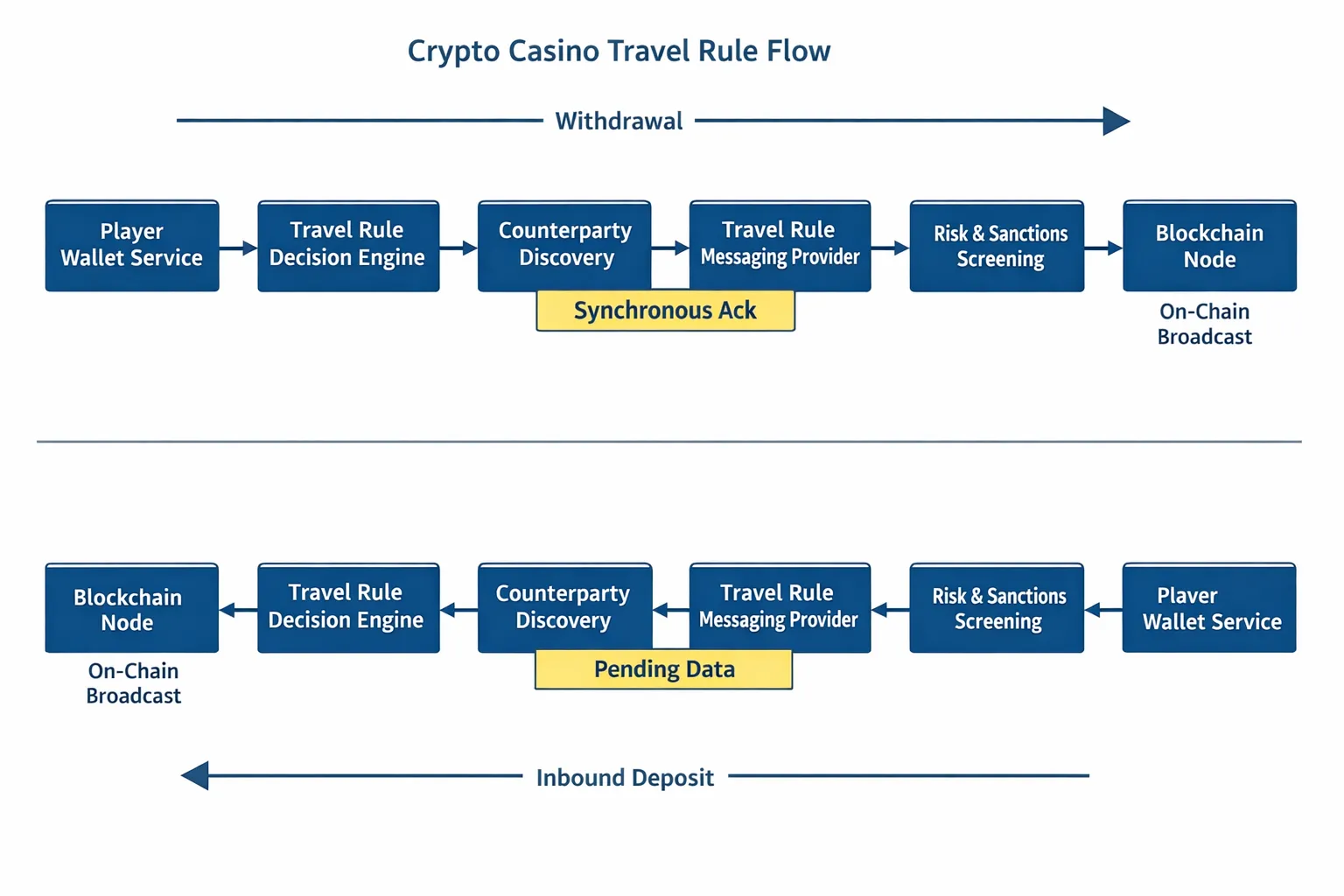
Deposits, withdrawals, and unhosted wallets
- Outbound withdrawals to a hosted wallet. Your casino is the originator. Pre‑validate the beneficiary VASP, send the Travel Rule message, wait for an ack, then broadcast on‑chain. If the counterparty is unreachable or unknown, follow a documented risk‑based fallback. Typical fallbacks include enhanced checks, manual review, or denial based on jurisdiction or risk bands.
- Inbound deposits from a hosted wallet. You are the beneficiary VASP. Auto‑match the transfer, expect a corresponding Travel Rule message, and credit instantly or after a short hold depending on policy and counterparty quality.
- Unhosted wallets. The Travel Rule may not mandate inter‑VASP messaging for these. You still need risk controls, for example whitelisting or ownership attestation, on‑chain risk scoring, velocity and amount limits, geo rules, and triggers for enhanced due diligence.
Reducing user friction without compromising controls
- Pre‑fill and cache verified identity fields so message composition has zero impact on the player’s withdrawal time.
- Use network‑aware rails selection. Suggest lower fee networks for the same asset to keep Travel Rule latency and gas predictable.
- Provide clear status in the cashier. Replace mystery delays with reasoned messaging such as verifying recipient exchange details, typical wait less than 60 seconds.
- Keep a hard timeout. If the counterparty does not respond, follow your fallback tree immediately, do not let pending requests pile up.
Data protection and privacy
Travel Rule data is personal data. Treat it like you treat KYC documents.
- Encrypt data in transit and at rest, use mutual TLS to messaging providers, and rotate keys on a schedule.
- Apply data minimization. Only send what the destination needs by law.
- Limit access through RBAC, with break‑glass procedures for investigations.
- Respect retention and erasure rules where applicable, and keep immutable logs for regulator audits.
KPIs to prove your program is working
- Coverage rate, percentage of eligible transfers with a successfully transmitted and acknowledged message.
- Ack latency, median and P95 time from request to acknowledgement for outbound and inbound.
- Sunrise exceptions, transfers involving jurisdictions without mature rules, with outcomes by decision path.
- Deposit pending time, how long inbound funds wait for data before credit.
- Counterparty reliability, failure rates and latency by VASP, use this to prioritize network relationships.
- SAR or STR conversion rate and time to file, link Travel Rule exceptions to investigations.
A 30‑day rollout plan operators can actually hit
Week 1, map and decide
- Inventory flows by brand and jurisdiction, deposits, withdrawals, internal transfers, and fiat ramps.
- Approve a jurisdictional policy, include thresholds, counterparty tiers, unhosted wallet controls, and fallback rules.
Week 2, wire the cashier
- Add the decision point before withdrawal broadcast and deposit credit.
- Implement counterparty discovery and register with a messaging network or vendor.
- Build message composition from your KYC profile and ledger metadata.
Week 3, test and tune
- Run sandbox exchanges through end‑to‑end tests across supported protocols and networks.
- Instrument dashboards for coverage, latency, and exceptions. Set alerts on P95 latency and failure rates.
Week 4, soft launch with guardrails
- Roll out by cohort, for example top five exchanges first, then long tail.
- Enable on‑call runbooks for sunrise exceptions and customer support scripts to explain holds.
- Review metrics daily, tighten or relax fallbacks based on real data.
Common edge cases you will see
- Cross‑chain bridges and L2 hops that obscure the originating platform. Preserve the full chain of custody in your metadata and message whenever possible.
- Mixed custody flows, for example a user withdraws to a personal wallet then moves funds into an exchange. Treat the first hop as unhosted and the second as out of your direct scope, but monitor patterns tied to the same user profile.
- Counterparty VASPs with partial compliance. Document outreach, expected remediation, and your temporary controls. Regulators expect that paper trail.
Build versus buy for Travel Rule messaging
You can implement Travel Rule transports in house, or you can integrate a specialized provider. In iGaming, speed to market and auditability usually win.
- Build in house if you have a strong compliance engineering team, stable counterparties, and time to maintain registry discovery, protocol changes, and attestations.
- Buy or integrate if you want faster onboarding, broader counterparty reach, dashboards for compliance teams, and SLA support. If you lack internal bandwidth to automate data mapping or workflow orchestration, an expert partner that builds custom automation and integrations can help. A focused agency providing AI audits and custom web and AI platforms, such as Impulse Lab, can reduce the delivery risk for complex compliance workflows and connect messaging, KYC, and analytics without bloating your stack.
How Spinlab fits into your Travel Rule plan
Spinlab’s modular iGaming platform is built for crypto‑ready operations with KYC and AML compliance, advanced fraud prevention, custodial wallet support, multi‑currency cashiers, and open APIs. That combination makes it straightforward to:
- Add pre‑broadcast decisioning for withdrawals and hold‑and‑credit logic for deposits.
- Integrate your choice of Travel Rule provider through open APIs without locking your compliance team into a single vendor.
- Stream real‑time analytics to track coverage, latency, and exceptions across brands.
- Keep UX fast on mobile while policy logic runs in the background.
If you are launching a new casino or migrating from a legacy stack, Spinlab’s Shopify‑like admin and fast onboarding help you hit regulatory deadlines without months of custom development.
Frequently Asked Questions
Does the Travel Rule apply to every crypto transfer my casino touches? No. It primarily applies to transfers between regulated entities such as VASP to VASP. Interactions with unhosted wallets are usually outside the strict messaging requirement, however regulators expect risk‑based controls for those flows.
What is the Travel Rule threshold? It depends on the jurisdiction. The EU regime has broad coverage with limited exemptions. In the United States, the FinCEN Travel Rule typically triggers at 3,000 USD or more for covered transmittals. Your policy should encode local thresholds and default to stricter handling when uncertain.
How do we handle incoming deposits when the counterparty does not send data? Use a pending state, attempt retrieval through your network or vendor, and follow a documented fallback. Options include enhanced screening and manual review, or denial for high‑risk corridors. Keep an audit trail of attempts and decisions.
Do Layer 2 networks change the Travel Rule requirement? No. The obligation attaches to the regulated entities, not the gas layer. Include network identifiers in your messages and maintain a clear mapping in your ledger and analytics.
Will adding Travel Rule checks slow down withdrawals? It should not. With pre‑composed messages and reliable counterparties, acknowledgements can arrive in seconds. Instrument ack latency and set a hard timeout with a policy decision so players see predictable behavior.
What evidence do auditors expect? A jurisdictional policy, message samples with timestamps, coverage and latency dashboards, exception logs with outreach evidence, and proof that data is protected and retained according to local rules.
Ready to de‑risk crypto payments without hurting UX?
Spinlab helps crypto casinos implement Travel Rule workflows the right way. Our platform combines crypto and fiat payments, KYC and AML compliance, real‑time analytics, and fraud prevention behind an open API and a modern backoffice. Book a demo to see how quickly you can add Travel Rule gating to withdrawals and hold‑and‑credit controls to deposits, while keeping your cashier fast and your compliance team in control.