
Interest in the Anjouan gaming license has stayed high heading into 2026, largely because many operators want an offshore path with a relatively fast setup. But “fast” only happens when your corporate documents, AML program, and technical stack are already audit-ready. If you treat licensing as paperwork you do last, you typically lose weeks in back-and-forth, and your payment gateways and game providers may still refuse to onboard.
This guide breaks down Anjouan License 2026 realities: what you usually pay for (and what costs sit outside the license), how long each step tends to take, and the evidence pack you should prepare to launch an online casino without avoidable delays.
What the Anjouan license is (and what it is not)
Anjouan is an island in the Union of the Comoros. The “Anjouan license” commonly refers to an offshore iGaming authorization used by some operators to launch international-facing casino brands.
Two practical points matter in 2026:
- A license is not market access. Even with a license in hand, you still need to geo-restrict prohibited jurisdictions, align advertising rules, and pass payment and provider onboarding.
- Your weakest link will be counterparties. Banks, PSPs, onramps, game studios, and affiliate networks increasingly ask for evidence of KYC/AML controls, source-of-funds checks, sanctions screening, and security posture, regardless of jurisdiction.
So the right question is not only “Can I get the license?” but “Can I operate and get paid with a compliant, documentable stack?”
Anjouan License 2026 costs: what you actually budget for
Because fee schedules and third-party service pricing can change, and because many applicants work through agents or corporate service providers, it is safer to think in terms of a cost stack rather than one fixed number.
Here is a practical budgeting view for 2026, using ranges you will see in the market (always confirm with your agent, counsel, and vendors):
| Cost area | What it covers | Typical range (USD) | Notes on variability |
|---|---|---|---|
| License application and issuance | Government or regulator-side fees, plus processing | Varies widely | Some providers bundle this into a package price rather than itemizing |
| Agent / corporate services package | Application handling, liaison, templates, incorporation admin | $5,000 to $25,000+ | Depends on service level (barebones vs fully managed) |
| Company formation and basic corporate | Incorporation, registered office, nominee services (if used), certificates | $1,000 to $10,000+ | Structure and nominees can materially change cost |
| Compliance program build-out | AML policy, risk assessment, procedures, staff training, records | $2,000 to $30,000+ | Cheapest option is templated, best option is tailored and defensible |
| Technical readiness and security | Hosting, logging, access controls, incident response, audits | $2,000 to $50,000+ | Depends on whether you already run a hardened production environment |
| RNG/game compliance evidence | Lab certificates or provider attestations (when applicable) | $0 to $20,000+ | Often covered by established game providers, custom games can add cost |
| Payments onboarding | PSP setup, rolling reserves, onramp/offramp configuration | Varies | Many PSPs price via fees, reserves, and risk tiers, not only setup |
| Ongoing renewals and operations | Annual renewal, compliance ops, monitoring, reporting | Ongoing | Budget for recurring compliance work, not only the license |
The main “hidden” cost in 2026: time-to-revenue
Operators often underestimate the cost of delays:
- If your license takes 2 extra weeks because documents are incomplete, that is 2 weeks of acquisition you cannot run.
- If your AML program is weak, your PSP or crypto onramp may stall onboarding.
- If your ledger and reconciliation are unclear, you can lose banking access after your first spike in volume.
A good budget includes a contingency buffer for compliance, payments, and security work that your counterparties will request.
Timeline: a realistic Anjouan licensing plan for 2026
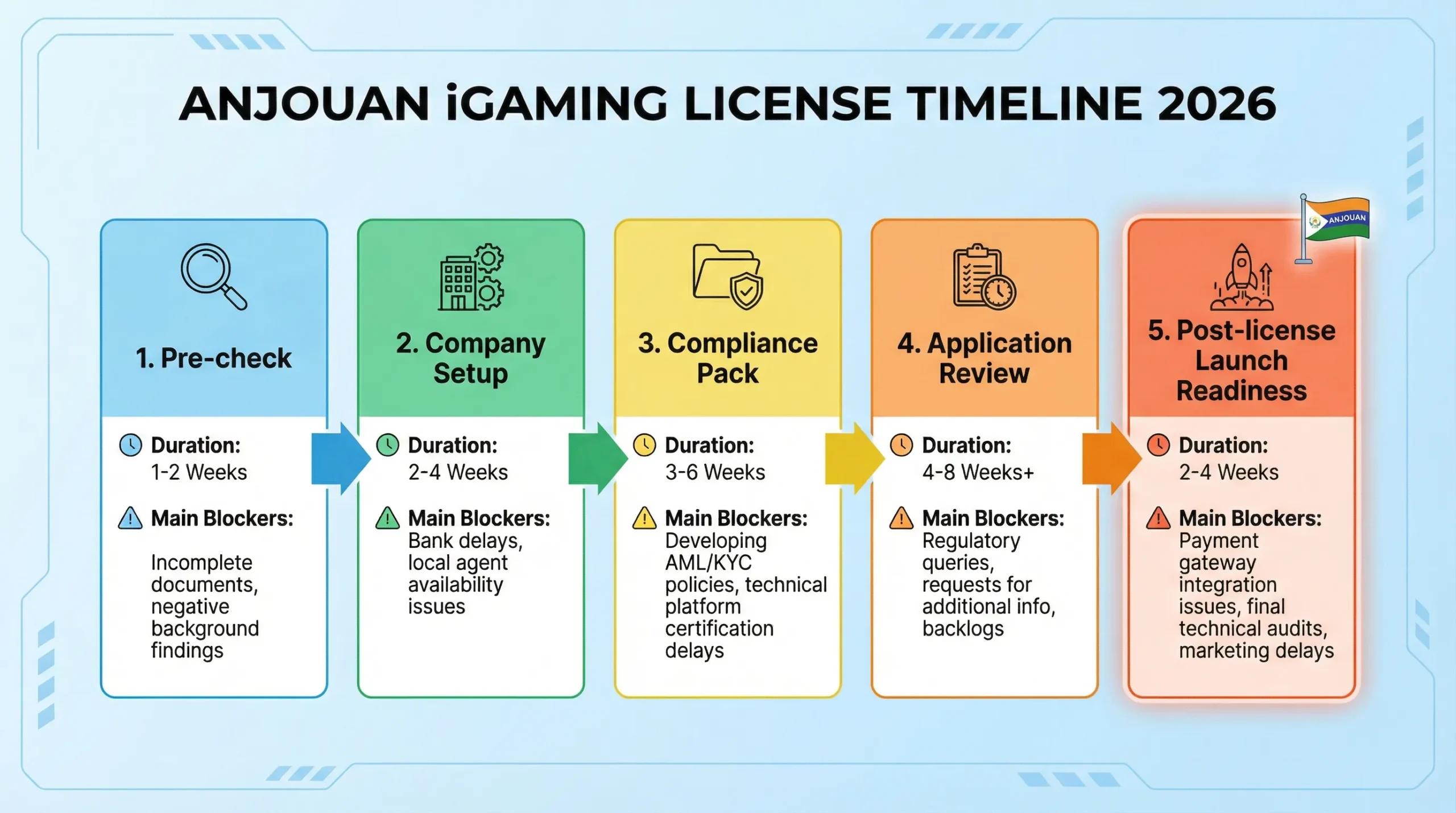
“Fast” licensing timelines are usually achievable only when you run licensing like a delivery project with dependencies. Most delays happen before submission (documents, policies, or technical evidence are not ready) or after approval (payments and providers are not onboarded).
A realistic 2026 plan often looks like this:
| Phase | What happens | Typical duration | What usually blocks it |
|---|---|---|---|
| Pre-check and scoping | Choose entity structure, define target markets, confirm product scope | 2 to 7 days | Unclear UBO structure, unclear markets, unclear payment rails |
| Company setup | Incorporation, registers, beneficial owner documents compiled | 3 to 14 days | Notarization, proof of address issues, inconsistent names across documents |
| Compliance pack | AML risk assessment, KYC flow, RG controls, record retention, vendor list | 3 to 14 days | Copy-paste policies that do not match your product or rails |
| Application submission and review | Filing, Q&A, clarifications, issuance | 2 to 6+ weeks | Missing evidence, unclear funds flow, unclear operational roles |
| Post-license readiness | PSPs, game providers, domain/brand setup, monitoring, soft launch | 2 to 6+ weeks | PSP risk review, KYB, chargeback/fraud controls, sanctions screening setup |
If you want the shortest path, build the evidence pack and the product controls in parallel, not sequentially.
Key requirements: the evidence pack you should prepare
Exact requirements vary by provider and case, but in 2026 the “pass/fail” outcome often depends on whether you can prove three things:
- Who owns and controls the business (and whether they are fit and proper)
- How you prevent financial crime and protect players (AML/KYC/RG)
- How money and game outcomes are controlled and audited (payments, ledger, security, game integrity)
Below is a practical checklist framed as “evidence an external reviewer can understand.”
Corporate and governance (fit-and-proper basics)
You should be ready to provide:
- Beneficial owner (UBO) IDs and proof of address
- Director and key-person IDs and CVs
- Corporate documents (certificates, registers, share structure)
- A plain-English business description (what you offer, where you market, what you block)
- A responsibility matrix (who is MLRO or compliance lead, who handles payments, who approves withdrawals, who controls bonus configuration)
The most common failure mode is inconsistency: names, addresses, and dates that do not match across documents, or unclear ownership chains.
AML/KYC and responsible gambling (what counterparties will ask about)
Even if your licensing path is offshore, your payment and banking partners increasingly align their expectations to FATF-style risk-based controls. The FATF Recommendations are still the most referenced baseline globally.
Your compliance pack should include:
- An AML risk assessment specific to your model (fiat, crypto, or both)
- A KYC policy and step-up rules (when you verify, when you re-verify)
- Sanctions and PEP screening approach
- Source of funds and source of wealth triggers for higher-risk players
- Suspicious activity process (triage, documentation, escalation)
- Responsible gambling controls (limits, self-exclusion, reality checks) and how you enforce them technically
In 2026, reviewers and PSPs often look for one thing: does your policy match your actual product flow? If your cashier allows crypto deposits, but your AML policy only describes cards, you will get challenged.
Technical and security requirements (prove you can operate safely)
Licensing and onboarding reviewers usually want clarity on:
- Hosting approach and environment separation (staging vs production)
- Access control (admin roles, 2FA, least privilege)
- Audit logging (who changed bonus rules, withdrawal decisions, KYC overrides)
- Incident response basics (how you detect and respond to account takeover, payment abuse)
- Data retention and deletion rules (especially if you target multiple regions)
If you need help turning a general security program into something implementation-ready (policies, controls, and evidence), a specialist IT and security partner can accelerate the work. For example, teams like Syneo’s IT and AI consulting focus on implementation support and infosec-oriented delivery, which can be useful when you are trying to translate compliance requirements into engineering tasks.
Payments and funds flow (where most delays happen)
Payments are where licensing plans often break. You should document:
- A funds flow diagram (deposit to playable balance, wagering, withdrawal, refunds, chargebacks)
- Segregation approach (how you separate player balances from operating funds, if applicable)
- Reconciliation approach (ledger vs PSP vs bank or on-chain)
- Fraud controls (velocity limits, device fingerprinting, bonus abuse prevention)
- Crypto-specific controls if you accept crypto (wallet screening, KYT, Travel Rule considerations where applicable)
Even when you can obtain an Anjouan license quickly, PSP and onramp KYB can take longer than the license itself. Budget time for it.
Game content and integrity
For a casino, reviewers and providers typically care about:
- Contracts or LOIs with game providers or a game aggregator
- Evidence of certified RNG and game fairness from providers (where applicable)
- Clear rules for bonuses and wagering requirements
- Complaint handling and dispute process
If you run original games, be prepared for deeper questions on RNG, change management, and release controls.
A “requirements to system” mapping table (what to implement, not only what to write)
Use this table to align your licensing checklist with build tasks and owners.
| Requirement area | What to show (evidence) | What to implement (system behavior) |
|---|---|---|
| KYC | Policy, vendor description, sample workflows | Configurable KYC states, step-up triggers, retry UX, audit logs |
| AML monitoring | Risk assessment, escalation procedure | Risk scoring, alert queues, case notes, SAR-ready exports |
| Responsible gambling | Player-facing policy, enforcement rules | Deposit/loss limits, self-exclusion, cool-downs, immutable logs |
| Payments control | Funds flow, reconciliation approach | Single source-of-truth ledger, idempotent payment events, daily match |
| Security and access | Role matrix, incident process | Admin RBAC, MFA, change logs, anomaly detection |
| Game integrity | Provider certificates, content list | Versioned game catalog, jurisdiction controls, rollback capability |
Common pitfalls that increase cost and extend timeline
Most Anjouan applications that slip do so for predictable reasons:
- UBO documentation gaps. Proof of address older than allowed, missing notarization, or mismatched spelling.
- Generic AML policies. Templates that do not mention your actual payment methods, crypto assets, or risk triggers.
- Unclear withdrawal governance. No documented thresholds, no separation of duties, no audit trail.
- Weak geo and marketing controls. “Worldwide” positioning without clear blocked jurisdictions and enforcement points.
- No audit-grade logs. If you cannot prove what happened, you cannot defend disputes, chargebacks, or compliance questions.
The fastest way to reduce these risks is to run a short “mock audit” on your own stack before you submit.
How an all-in-one iGaming platform can reduce licensing friction
Licensing is not only a legal exercise, it is an operations and systems exercise. A consolidated platform can help because it reduces the number of places where evidence can be inconsistent.
Spinlab Studio’s platform is designed to support operators building and scaling online casinos with:
- Crypto and fiat payment support (including crypto-ready flows)
- KYC and AML compliance tooling
- Advanced fraud prevention
- Game aggregation and mobile-optimized casino UX
- Bonus and affiliate tooling
- Customizable backoffice and open API integration
If you are planning an Anjouan launch, the practical advantage of a modular, integrated stack is speed to an auditable operating model. You can keep your policies, logs, cashier behavior, and backoffice actions aligned, which is exactly what licensing reviewers and payment partners test in 2026.
A short readiness checklist for founders (before you pay any fees)
Before you engage an agent or submit, make sure you can answer these operational questions in one page:
- Who are the UBOs, and are their IDs and proofs of address clean and current?
- Which countries will you target, and which will you block (and where do you enforce it)?
- Which payment rails will you offer on day 1 (cards, APMs, crypto), and what is your withdrawal governance?
- What is your KYC step-up design, and what triggers source-of-funds checks?
- Do you have audit logs for admin actions and money movement events?
- Can you produce a simple funds flow and reconciliation description that your PSP will accept?
If any of these are unclear, fix them first. In 2026, clarity is what buys you timeline.
Next steps
If Anjouan is on your shortlist, treat the license, payments onboarding, and platform build as one integrated plan. Get your evidence pack, funds flow, and compliance controls aligned early, then choose a platform that keeps operations auditable as you scale.
To see how a crypto-ready, modular casino stack can shorten your path from licensing to revenue, explore Spinlab Studio at spinlab.studio.