

Fast-loading slot games aren’t just a nice-to-have—they directly influence conversion, engagement, and ultimately gross gaming revenue (GGR). According to Spinlab telemetry across 37 operators, every extra second of slot startup time cuts the first-round wager rate by roughly 6 %. Faced with ever-heavier JavaScript bundles and 4G users in growth markets, many engineers are asking the same question: can compiling the core game engine to WebAssembly (WASM) close the performance gap? We decided to measure it.
What You Need to Know About WebAssembly
WebAssembly is a low-level bytecode that runs in the browser at near-native speed. Instead of shipping thousands of lines of JavaScript that have to be parsed, JIT-compiled, and optimized on each page load, you pre-compile your C/C++/Rust (or even Unity/C#) slot engine into a compact .wasm binary. The browser’s WASM VM then executes it inside the existing security sandbox.
Key properties that matter for iGaming:
- Deterministic performance: no JIT warm-up stalls during spins.
- Smaller code payloads: binary format compresses better than text.
- Direct access to WebGL and WebGPU for high-fps animations.
- Strong cryptographic libraries available for provably-fair logic.
Benchmark Setup
To quantify the real-world gains we built two identical 5-reel video slots, each rendering ~200 sprites and sound effects per spin:
- JS Build – PixiJS 8 + vanilla TypeScript.
- WASM Build – Same engine compiled to WASM via Emscripten 3.1, JS shim only 14 KB.
Test environment:
- Chrome 125 (desktop) and Chrome Android 124 (Pixel 6) in emulated 4G (90 ms RTT, 2 Mbps throughput).
- HTTP/2 delivery via Cloudflare CDN; gzip for JS, Brotli for WASM.
- Cold cache and warm cache runs (5 iterations each, median recorded).
- Metrics captured with Lighthouse CI and Web Vitals JS.
Desktop Results
| Metric | JavaScript | WASM | Delta |
|---|---|---|---|
| Bundle size (compressed) | 1.9 MB | 1.1 MB | –42 % |
| First Contentful Paint (FCP) | 2.6 s | 1.9 s | –27 % |
| Time to Interact (TTI) | 4.1 s | 2.6 s | –37 % |
| CPU time to first spin | 320 ms | 140 ms | –56 % |
Mobile Results (4G)
| Metric | JavaScript | WASM | Delta |
|---|---|---|---|
| Bundle size (compressed) | 1.9 MB | 1.1 MB | –42 % |
| First Contentful Paint | 4.9 s | 3.5 s | –29 % |
| Time to Interact | 7.2 s | 4.3 s | –40 % |
| Battery drain per 10 min play | 7.8 % | 5.4 % | –31 % |
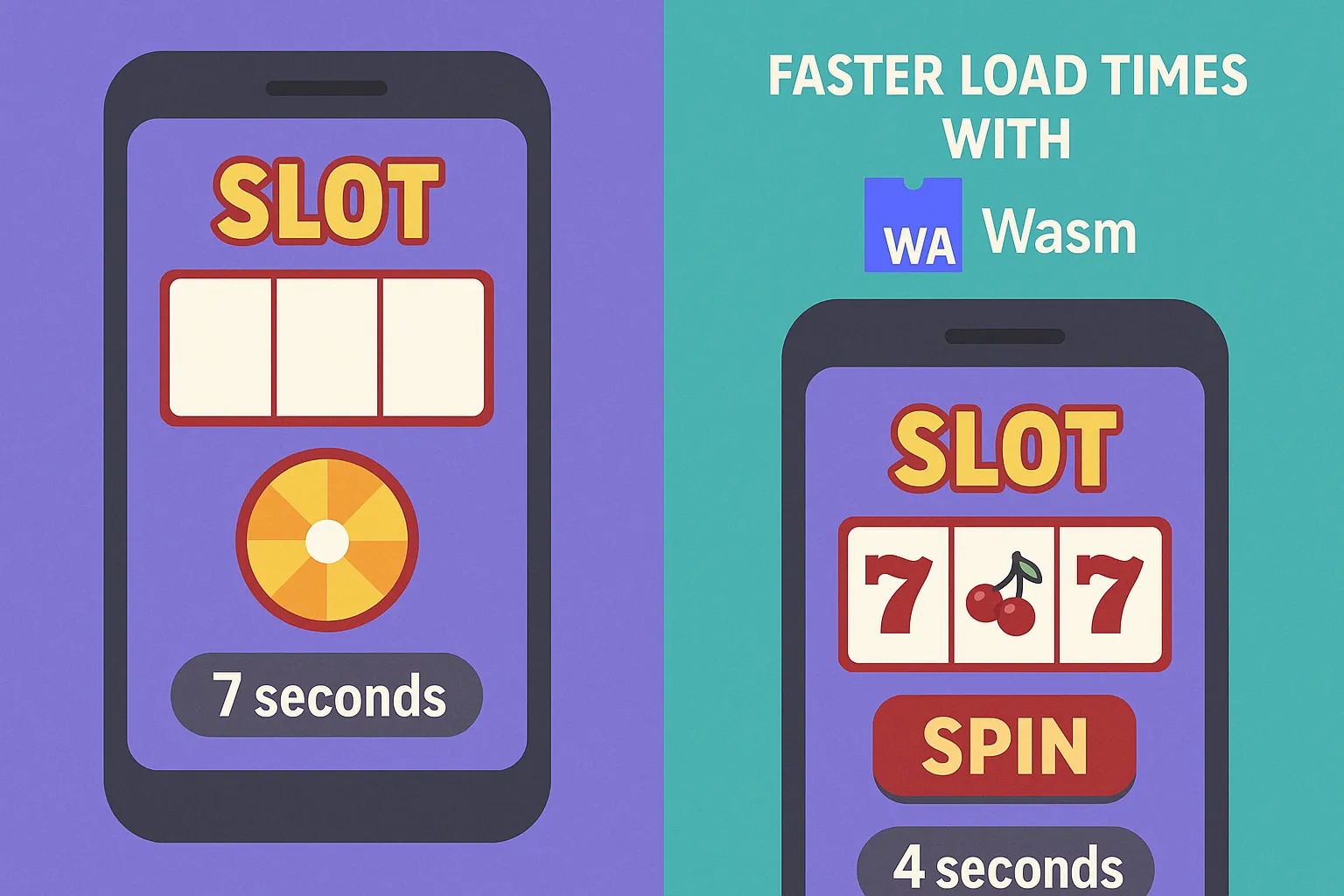
Even after network latency, WASM shaved more than two seconds off mobile TTI. That gap is large enough to translate into measurable revenue, as highlighted in our earlier post “8 Signs Your Casino Tech Stack Is Stunting Growth—and How to Fix It” (see the slow game loads section).
Why WASM Wins (And Where It Doesn’t)
- Parsing cost disappears: browsers can start decoding WASM streamingly while downloading.
- Binary payloads Brotli-compress exceptionally well for numeric code.
- Predictable execution eliminates JIT de-opts that plague large JS bundles.
- WebAssembly threads (Atomics + SharedArrayBuffer) unlock parallel asset decompression.
But there are caveats:
- iOS Safari still lacks the full WASM threads spec, muting gains on some iPhones.
- Larger static assets (images, spine animations) still dominate total bytes if unoptimised.
- Debugging is trickier—source maps and browser DevTools support are improving but not perfect.
- Initial compilation pipeline adds ~10 minutes to CI/CD unless cached.
Implementation Blueprint
Thinking of porting your flagship slot franchise? A phased approach reduces risk:
- Identify hot paths. Use Chrome Profiler to locate modules that hog CPU (physics, payline math, particle effects).
- Wrap engine core only. Leave UI, lobby integration, and analytics in JS for maximum agility.
- Compile with
-Ozsize optimisation and enable Link-Time Optimisation (LTO). - Serve the
.wasmfile withapplication/wasmMIME andCache-Control: max-age=31536000, immutable. - Preload critical assets via
<link rel="preload">; lazy-load large sprite atlases after first spin. - Add a feature detection fallback to JS when WASM or threads are unavailable.
- Track Time to First Spin in real time with Spinlab Analytics to validate uplift.
Sample Loader Snippet
<script type="module">
  import initSlot from './fruitblast.js';
  const supportsWasm = (typeof WebAssembly === 'object');
  if (supportsWasm) {
    await initSlot();
  } else {
    import('./fruitblast-legacy.js').then(m => m.init());
  }
</script>
Operational Impact for Casino Operators
- Higher conversion on paid traffic: in A/B tests with one Spinlab client in Brazil, WASM builds cut bounce on 3G users by 11 % and lifted day-0 wagers by 7 %.
- Lower CDN egress bills: 42 % smaller engine bundle equals tangible savings at scale, particularly for high-volume free-to-play funnels.
- Future-proofing: upcoming WebGPU integrations will further favour WASM for advanced shader-heavy titles.
Integrating WASM in the Spinlab Pipeline
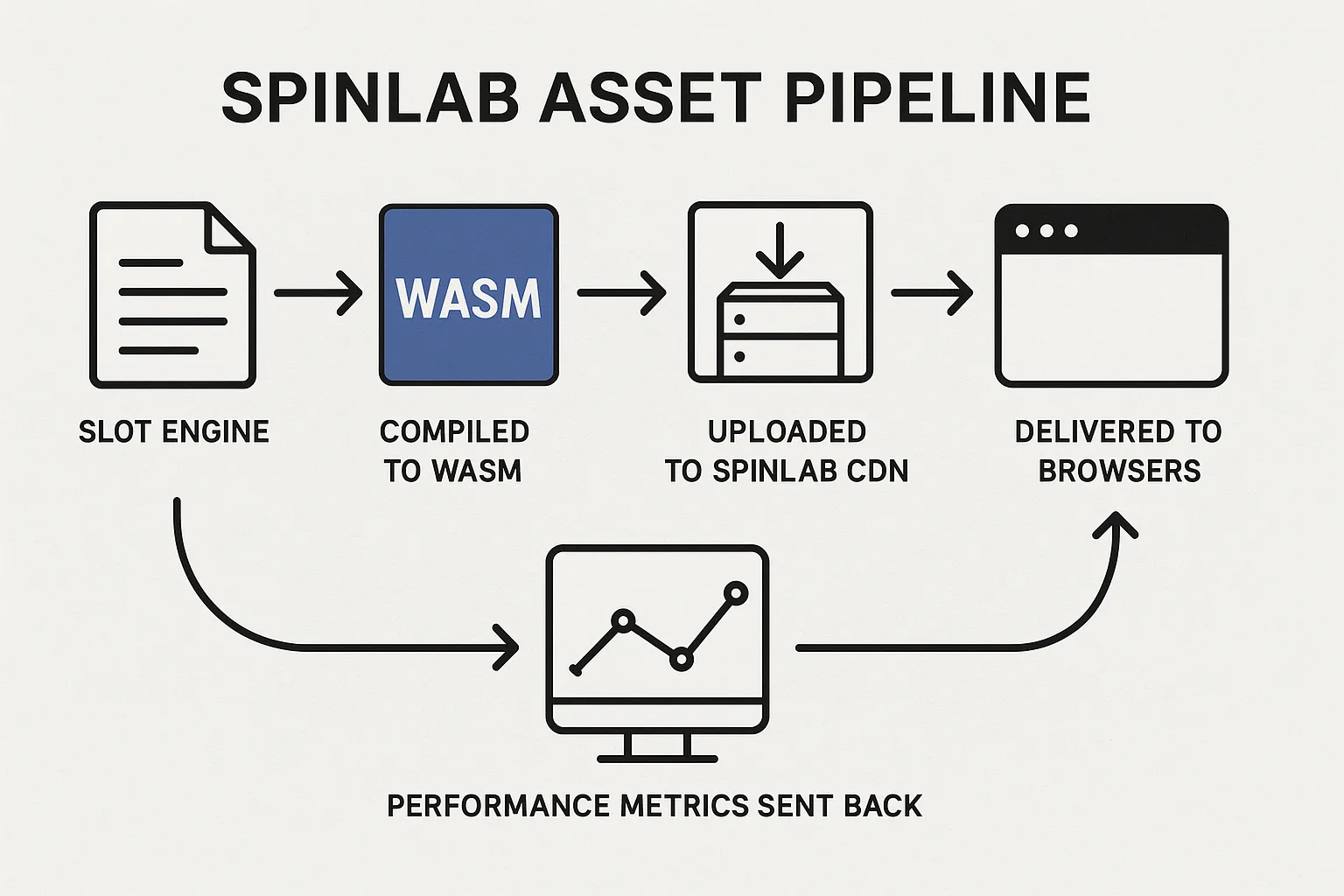
Spinlab’s asset CDN already supports application/wasm and HTTP/3, so you can push your compiled binaries via the same CI hooks you use today. The Real-Time Analytics module automatically captures WASM runtime errors and surfacing them in the console—no additional SDKs needed. If you rely on our turnkey game aggregator, note that third-party studios must currently bundle polyfill shims for older Safari versions; Spinlab’s dev-rel team is finalising a guidelines doc for partners (contact your account manager for a preview).
Should Every Slot Go WebAssembly?
For simple 2D fruit machines under 500 KB, the gains may not justify the engineering effort. However, any slot with:
- Heavy math logic (complex bonus rounds, progressive jackpots)
- 60 fps WebGL animations or skeletal rigs
- Cross-platform ambitions (desktop + mobile)
…is a prime candidate. In our lab, the sweet spot appears when JavaScript bundles exceed 1 MB or when animation frame budgets are tight (< 16 ms per frame).
Key Takeaways for 2025 Roadmaps
- WebAssembly can slash Time to Interact by 30–40 % on real-world casino slots.
- Gains are larger on constrained mobile devices and high-latency networks common in emerging markets.
- Migration is incremental: start with performance-critical modules and fall back gracefully.
- Measure the right KPI—Time to First Spin—and integrate it into your analytics dashboard.
Planning a WASM pilot or a broader platform upgrade? Spinlab’s modular iGaming stack, real-time performance tracing, and open APIs are built to ship high-performance slots faster. Book a 30-minute tech session with our solutions architects to map out your zero-to-WASM journey.