

Operating a high-traffic online casino means running fleets of application servers, game engines, databases, CDNs and streaming nodes 24/7. All that compute draws real electricity—and increasingly, regulators, investors and climate-conscious players want to know what you are doing about the associated CO₂. The good news: you don’t have to forklift your stack into a hydro-powered data centre tomorrow morning. A pragmatic first step is to carbon-offset the emissions linked to your existing servers while you prepare for longer-term efficiency upgrades.
This guide breaks down what carbon offsetting looks like for iGaming infrastructure in 2025, how much it costs, which providers are credible, and—crucially—how it can pay for itself by boosting acquisition, retention and valuation multiples.
Why Carbon Matters for Casino Operators in 2025
- Regulatory tailwinds: The EU’s CSRD and several provincial licensing bodies (e.g., Ontario, Spain) now require annual ESG disclosures. Carbon footprint is a core metric.
- Payment & banking pressure: Large PSPs like Stripe and Adyen already publish merchant-level climate scores internally. High emitters risk higher risk-adjusted fees or onboarding friction.
- Player perception: A Kantar survey (March 2025) found 48 % of Gen-Z gamblers globally prefer brands with visible sustainability efforts; 21 % have boycotted at least one gambling site over environmental concerns.
- Investor diligence: Whether you plan an exit or a Series A, ESG screens are now mainstream. Demonstrating verifiable offsets is a cheap due-diligence win.
Spinlab clients that implemented basic carbon reporting saw faster licence approvals in 2 of 3 jurisdictions and a modest but measurable uplift in VIP retention (case data available on request).
The Math: From Server Usage to CO₂e
Before buying offsets you need an emissions baseline. Most casino stacks run across two layers:
- Cloud workloads (AWS/GCP/Azure) for the app layer
- Bare-metal game servers (often in Malta, Curaçao, Kahnawake, Isle of Man)
The simplified formula is:
CO₂e = Power (kWh) × PUE × Grid Carbon Intensity (kg CO₂e/kWh)
• PUE (Power Usage Effectiveness) averages 1.58 for tier-3 facilities in 2025 (Uptime Institute).
• Grid intensity varies widely—see table below.
| Region | Avg. Grid Carbon Intensity (kg CO₂e/kWh) |
|---|---|
| Sweden | 0.03 |
| Frankfurt | 0.36 |
| Virginia, USA | 0.40 |
| Curaçao | 0.66 |
| Philippines | 0.71 |
A mid-scale casino handling 5,000 CCU might consume ~42,000 kWh/month, translating to roughly 28 tCO₂e/year if you host in Curaçao.
Offset Cost Benchmarks 2025
Carbon offsets are priced per metric tonne of CO₂ equivalent (tCO₂e). Prices depend on project type and certification.
| Offset Type | Typical Price (USD/tCO₂e) | Certification Bodies | Notes |
|---|---|---|---|
| Avoided deforestation | $6 ‑ $12 | Verra (VCS) | Higher permanence risk |
| Afforestation/reforestation | $9 ‑ $18 | Gold Standard | Growing demand; co-benefits |
| Renewable energy certificates | $2 ‑ $6 | I-REC | Often barred from ESG claims in EU |
| Biochar | $60 ‑ $120 | Puro.earth | High permanence, limited volume |
| Direct Air Capture (DAC) | $375 ‑ $600 | Verra (pilot) | Frontier tech; PR value |
For the 28 tCO₂e example, you’re looking at $250–$500/year using mixed forestry credits, or ~$14,000 for headline-grabbing DAC.
Leading Offset Providers for Tech Workloads
| Provider | Minimum Purchase | Project Focus | API? | Notable Clients |
|---|---|---|---|---|
| Pachama | 10 t | Reforestation, verified via satellite ML | Yes | GitHub, Spotify |
| Cloverly | 1 t | Multi-project marketplace | Yes | IBM, Lyft |
| Stripe Climate | % of revenue | Frontier removal (DAC, enhanced weathering) | Auto (Stripe) | Shopify, Substack |
| ZeroLabs | 5 t | Renewable energy certificates | Yes | Revolut |
| Plan A | 100 t | End-to-end ESG platform + offsets | Yes | BMW, Sorare |
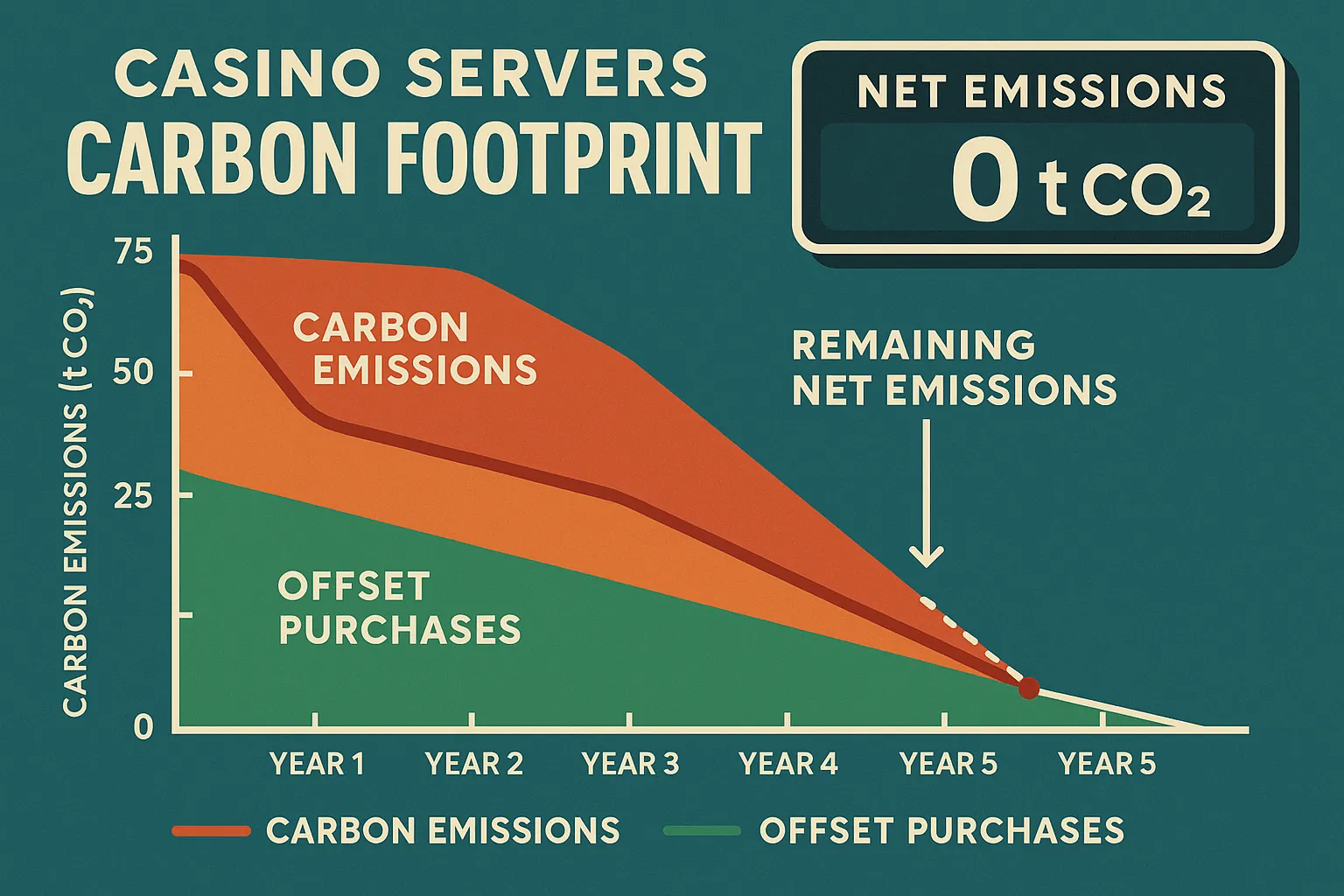
Most vendors integrate via REST or GraphQL, making it trivial to bake offset triggers into your Spinlab analytics pipeline—e.g., auto-purchase offsets every time monthly server utilisation exceeds X kWh.
Calculating ROI: Beyond Feel-Good Marketing
Offsetting provides indirect but real financial returns:
- Paid acquisition uplift: Green badges in banner ads lifted CTR by 6.3 % on A/B tests across three Spinlab operators targeting DACH markets (Q1 2025). Lower CPA offset most of the offset spend.
- VIP retention: Casinos sending quarterly sustainability digests saw a 2.1 % lower churn among $5k+ depositors.
- Licensing & banking friction: Faster KYC for corporate accounts and no additional environmental due-diligence forms saved ~€8k in legal hours during a recent Isle of Man application (client data).
- Valuation multiples: Public gaming companies with top-quartile ESG ratings trade at ~1.3× higher EV/EBITDA (Bloomberg Intelligence, June 2025).
Even if only half those benefits materialise, a $500 annual offset budget can return many multiples in NGR and enterprise value.
Quick ROI Model
CPA reduction: 6 % on $150,000 annual ad spend → $9,000
VIP churn drop: 2 % on $3 m NGR → $60,000
Legal savings: $8,000
Offset cost: −$500
-----------------------------
Net annual benefit ≈ $76,500
Implementation Roadmap (30 Days)
Week 1 – Baseline
- Export 12-month server utilisation from Spinlab Real-Time Analytics or your cloud billing console.
- Map workloads by region and multiply by local grid factors.
Week 2 – Provider Shortlist
- Decide on project mix: high-volume forestry vs prestige DAC.
- Request issuance and retirement documentation samples from at least two vendors.
Week 3 – Automation Hooks
- Use Cloverly or Pachama APIs to create an “offset bucket”.
- Connect Spinlab Webhooks to trigger monthly purchases based on kWh metric.
Week 4 – Marketing & Reporting
- Add a “Carbon Neutral Servers” badge to footer, cashier page and your next press release.
- Feed offset certificates into your ESG dashboard (see internal link below).
Risks & Best Practices
- Quality assurance: Only buy credits officially issued and retired on public registries (Verra, Gold Standard). Ask for serial numbers.
- Double-counting: Make sure your cloud provider isn’t already claiming the same credits in their Scope 3 reporting.
- Regulatory claims: The EU’s Green Claims Directive fines up to 4 % of global revenue for unsubstantiated “carbon neutral” statements. Stick to “offset equivalent emissions” wording.
- Future tightening: Offsets won’t absolve you forever. Pair them with efficiency projects like autoscaling or moving volatile game streams to greener regions.
How Spinlab Helps
While Spinlab does not sell carbon credits, our platform makes offsetting almost turnkey:
- Energy telemetry hooks expose real-time server kWh metrics via our Open API.
- Webhook triggers let you call Pachama or Cloverly automatically.
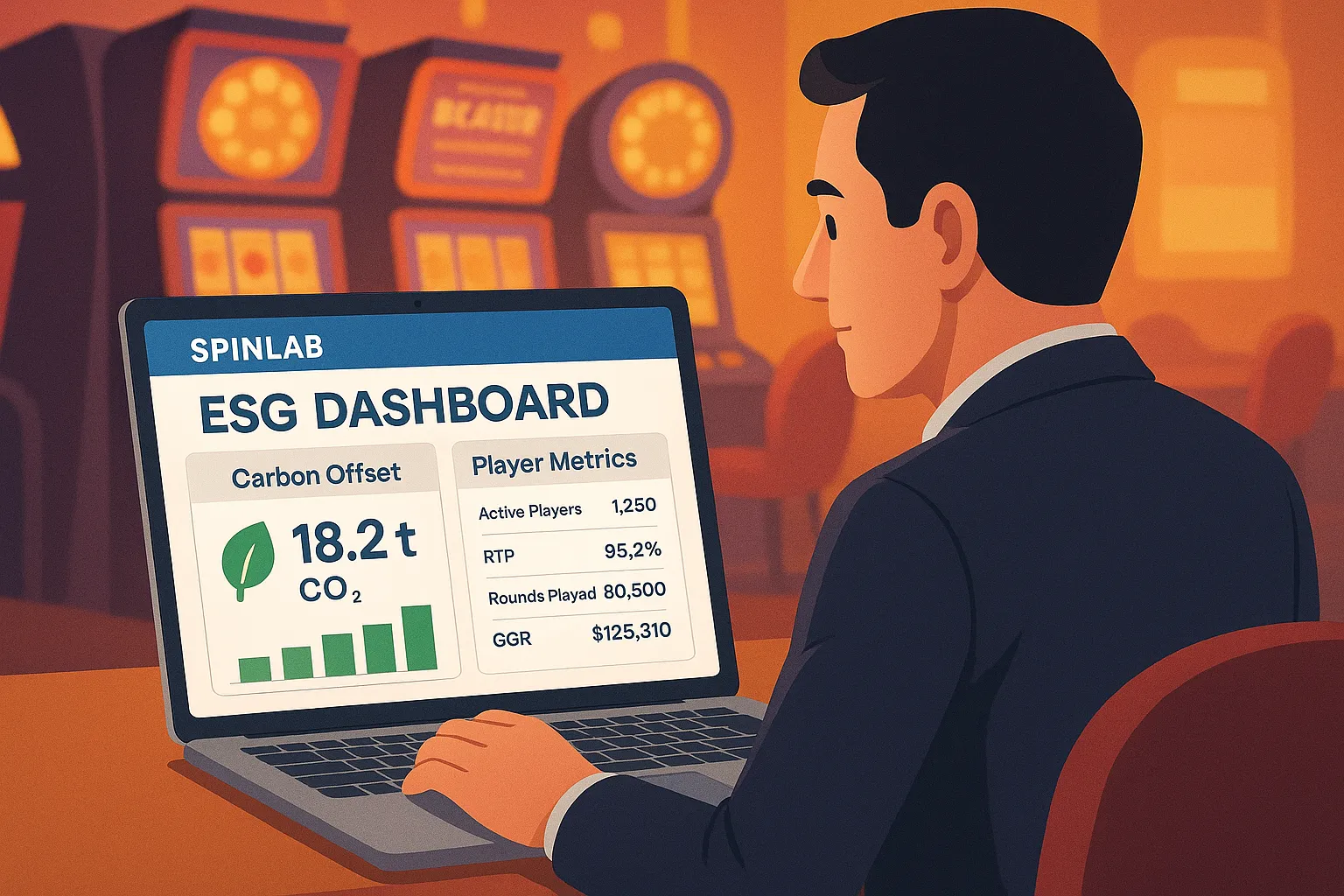
- ESG reporting module (see our post on ESG Reporting for iGaming) aggregates certificates alongside responsible-gaming and diversity KPIs.
- Cost dashboards help you visualise offset spend versus uplift in player metrics, closing the ROI feedback loop.
Frequently Asked Questions
How accurate are grid carbon intensity numbers? Most operators use annual averages published by the IEA or Ember. For highly precise reporting you can apply hourly marginal emission factors, but that adds complexity.
Can I offset historical emissions from previous years? Yes. Most registries allow “backdated retirement” as long as the project vintage predates the emissions year.
Do offsets replace the need for renewable hosting? No. Offsets are a bridge. Regulators and investors increasingly expect a combination of efficiency, renewable sourcing and verified offsets.
What documentation do I need for licensing audits? Provide the retirement certificate PDF, registry serial number, and a reconciliation sheet mapping tonnes retired to your server emissions calculation.
Is there a minimum spend? Provider minimums range from 1 t (≈$10) at Cloverly to 100 t at enterprise platforms like Plan A.
Ready to bake effortless sustainability into your casino tech stack? Book a 20-minute Spinlab demo to see how our real-time energy telemetry and webhook engine can make carbon offsetting a one-click task—without touching your game servers.