

Most casino teams are “data-driven” on paper: they have dashboards, weekly reports, and a BI tool. But profit is rarely unlocked by looking at charts. Profit comes from closing the loop: capturing reliable events, computing trustworthy metrics fast enough to matter, and triggering actions inside the product, payments stack, CRM, and risk workflows.
This guide breaks down a modern casino analytics stack from the ground up, focusing on how to get from raw events to profit actions without building an overcomplicated data science project.
What a “casino analytics stack” actually is
A casino analytics stack is the system that turns gameplay, payments, identity, and marketing signals into decisions that improve NGR, reduce risk, and lower operating cost.
Think of it as layers, each with a clear job and owner.
| Layer | What it does | Typical outputs | Primary owners |
|---|---|---|---|
| Event collection | Captures player, payment, and game activity consistently | Event stream, logs | Product + Engineering |
| Identity and entity graph | Links sessions, players, devices, wallets, affiliates, jurisdictions | Unified player profile, device graph | Data + Risk |
| Storage + compute | Supports real-time and historical queries | Stream tables, warehouse models | Data Engineering |
| Metrics + governance | Defines “truth” (KPI definitions, cohorts, attribution) | Semantic layer, metric catalog | Finance + Analytics |
| Activation | Uses metrics to trigger actions fast, safely, and measurably | Offers, routing decisions, risk holds | Growth + Risk + Ops |
| Experimentation + audit | Proves impact and maintains compliance evidence | A/B results, audit logs | Analytics + Compliance |
The mistake to avoid is treating this as a single tool purchase. It is an operating system for decisions.
Start with events that don’t lie
Your “stack” will only be as good as the events you trust. In iGaming, bad events are expensive because they spill into:
- bonus cost and abuse
- PSP routing decisions
- fraud and AML monitoring
- affiliate payouts and disputes
- responsible gambling interventions
Build an event contract (not just “tracking”)
An event contract is a shared spec for what gets emitted, when, and with which identifiers.
At minimum, define:
- Naming and versioning:
DEPOSIT_ATTEMPTED.v1,BET_SETTLED.v2 - Event time vs processing time: keep both timestamps
- Idempotency keys for money movement and bonus awards
- Consistent identifiers (player_id, session_id, device_id, wallet_id, affiliate_id)
- Jurisdiction context (geo, license, brand) to avoid mixing regulated scopes
If you want an industry-standard way to instrument services, OpenTelemetry is widely used for traces/metrics/logs and can reduce blind spots when debugging “analytics vs reality.”
Server-side first for money and entitlement
Client events are useful for UX, but money, bonuses, and compliance-critical states should be sourced from server-side systems (wallet ledger, cashier, KYC service, bonus engine). That is how you avoid “phantom deposits,” duplicated bonus awards, and inconsistent withdrawal timelines.
A practical starter taxonomy (focused on actions)
Don’t track everything. Track what you can act on.
| Event | Why it matters | Example profit action |
|---|---|---|
REGISTERED |
Defines acquisition cohorts and funnel start | Trigger welcome journey and KYC timing |
KYC_STARTED, KYC_APPROVED, KYC_FAILED |
Compliance, conversion, and risk gating | Route to alternate verification or “pending” UX |
DEPOSIT_ATTEMPTED, DEPOSIT_APPROVED, DEPOSIT_DECLINED |
Cashier conversion and PSP performance | Smart routing, recovery messaging |
GAME_LAUNCHED |
Lobby effectiveness and time-to-first-spin | Improve ranking and content placement |
BET_PLACED, BET_SETTLED |
Core revenue and volatility signals | Detect churn risk or VIP emergence |
BONUS_GRANTED, BONUS_CONSUMED |
Promo cost control and abuse patterns | Apply caps, cooldowns, or step-up checks |
WITHDRAWAL_REQUESTED, WITHDRAWAL_PAID |
Trust and support load | Proactive status updates, reduce tickets |
LIMIT_SET, SELF_EXCLUDED |
Responsible gambling evidence | Enforce controls and log actions |
If you already have real-time analytics in place, the next leap is to make sure your taxonomy is decision-ready, not “dashboard-ready.”
Identity: the glue between payments, games, and marketing
Casino analytics breaks quickly when identity is treated as “a login.” You need an entity model that supports:
- anonymous-to-known journeys (pre-registration browsing, first deposit)
- multi-device play and shared IP environments
- multi-brand and multi-jurisdiction constraints
- affiliate attribution and payout governance
- wallet and payment instrument relationships
A simple entity graph that works
At minimum, model:
- Player (account)
- Session (login and gameplay windows)
- Device (fingerprint or device_id)
- Wallet (fiat/crypto, currency)
- Payment instrument (tokenized reference, not raw PAN)
- Affiliate / campaign (source of acquisition)
This is where many teams accidentally create compliance risk. Your identity graph should be built with data minimization and access control in mind. If you operate in the EU, align designs with GDPR principles (purpose limitation, minimization, retention). The European Commission GDPR overview is a good starting reference for non-lawyers.
Pipeline architecture: fast enough to matter, correct enough to trust
Your analytics pipeline must handle two realities at the same time:
- Real-time needs: stop bonus abuse now, recover a declined deposit now, intervene on RG signals now.
- Financial truth: reconcile NGR, affiliate payouts, and provider costs accurately.
The core pattern: stream + warehouse (and a strict ledger)
Most mature stacks converge on:
- a streaming layer for low-latency facts (seconds)
- an OLAP store or real-time analytics engine for fast queries
- a warehouse model for finance-grade reporting
- a ledger or canonical wallet system as the source of truth for balances
The key is to avoid “two sources of truth.” Wallet and settlement correctness should live in the transactional domain, analytics should consume it.
Data quality gates you should not skip
Instead of trusting every event, enforce:
- schema validation at ingestion
- deduplication and idempotency for money movement and bonus grants
- late-event handling (network delays, provider retries)
- metric tests (for example, approvals cannot exceed attempts)
These gates reduce the most common argument between teams: “the dashboard is wrong.”
Metrics: define the truth before you automate decisions
Profit actions fail when metrics are vague.
“Conversion” can mean:
- deposit initiation
- deposit approval
- time-to-credit under 30 seconds
- first-time depositor within 24 hours
Write definitions like contracts, not slideware.
The casino KPIs that map cleanly to actions
A practical action-oriented KPI set looks like:
- Cashier funnel: deposit initiation rate, approval rate, abandonment rate, time-to-credit
- Revenue: GGR, NGR, NGR per active, margin by game/provider
- Retention: D1/D7/D30 return, churn risk signals (sessions, deposits, net losses)
- Promo health: promo cost-to-NGR, bonus-to-cash ratio, abuse flags per 1k users
- Risk: chargeback rate, withdrawal manual review rate, AML queue volume
- Ops cost: support tickets per 1k withdrawals, time-to-resolve, manual work rate
Notice what is missing: vanity metrics that don’t change a decision.
From analytics to profit actions: close the loop
A profit action is any automated or semi-automated move that increases expected value after costs and risk.
The closed-loop flow
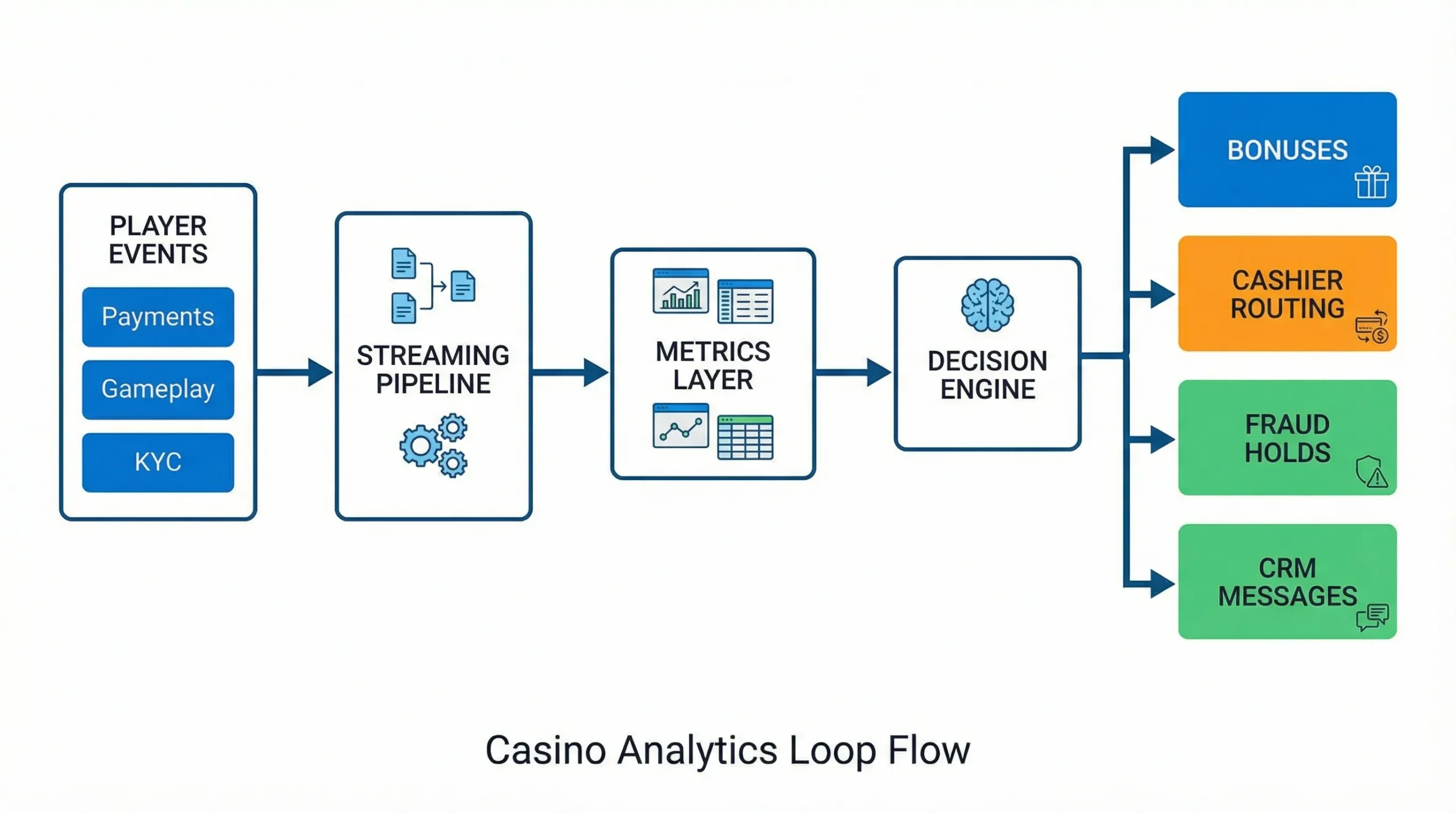
In practice, you need two activation modes.
Mode 1: real-time triggers (in-session)
Best for moments where timing changes outcomes:
- deposit declines and rail switching
- bonus eligibility and cooldown enforcement
- fraud and velocity limits
- responsible gambling interventions
A good real-time trigger is:
- based on a small number of high-signal events
- safe (has cooldowns and caps)
- observable (you can see why it fired)
Mode 2: batch segments (daily or hourly)
Best for:
- LTV-based segmentation
- reactivation and winback
- affiliate quality scoring
- provider performance reviews
Batch is slower but easier to govern and audit.
Map actions to economic levers
Use this mapping to keep “analytics work” aligned with profit.
| Profit lever | Example action | What you need to measure |
|---|---|---|
| Increase approvals | Route to best PSP or APM for the player | Approval uplift, fees, fraud impact |
| Increase early activation | Trigger onboarding offer after first game launch | FTD rate, bonus cost-to-NGR |
| Improve retention | Personalize lobby and missions by player behavior | D7/D30 retention, incremental NGR |
| Reduce promo leakage | Detect bonus abuse patterns, step-up checks | Abuse prevented, false positives |
| Reduce support and ops cost | Proactive withdrawal status + clear SLAs | Ticket volume, time-to-paid |
| Reduce compliance risk | Risk-based KYC/AML holds with evidence | Queue volume, audit readiness |
Experimentation: prove incrementality, not correlation
Dashboards show correlation. Operators need incrementality.
For any action (new bonus rule, routing change, lobby ranking tweak), define:
- a primary metric (usually incremental NGR or incremental margin)
- cost metrics (bonus cost, PSP fees, chargebacks)
- guardrails (RG events, complaint volume, KYC failures)
- a holdout or A/B test where feasible
If you cannot run a clean experiment, run at least a staged rollout with a defined control group and pre-registered success criteria.
The most common failure modes (and how to avoid them)
1) “We have data” but no action layer
Teams build a warehouse and dashboards, then wonder why KPIs don’t move. If your stack does not connect to a bonus engine, payment routing, CRM triggers, and risk tooling, you are missing the last mile.
2) Confusing speed with truth
Real-time is powerful, but financial truth still requires reconciliation logic and ledger alignment. Treat the ledger as canonical for money, and compute fast metrics off ledger-backed events.
3) KPIs without cost context
If you optimize deposit approval rate without accounting for fraud, chargebacks, and fees, you can make the business worse. Every “growth” metric needs a cost and risk pair.
4) Black-box decisions
When risk or bonus actions cannot be explained, ops teams disable them after the first incident. Prefer explainable rules and scores, with clear audit logs.
Build vs buy: a practical checklist for operators
If you are evaluating an iGaming platform or casino software provider, use questions that reveal whether the analytics stack can actually drive profit actions.
| Question to ask | What good looks like | Evidence to request |
|---|---|---|
| Can we define and version event schemas? | Event contracts, schema validation, backwards compatibility | Schema registry or versioned docs |
| Do you support real-time triggers? | Sub-second to seconds decisioning, with caps/cooldowns | Example trigger flows and logs |
| Can we export data cleanly? | Open APIs and webhooks, documented payloads | API docs, webhook catalog |
| Is analytics linked to operations? | Actions inside backoffice, payments, risk, bonuses | Demo of end-to-end loop |
| How do you handle compliance evidence? | Audit logs, RBAC, retention controls | Sample audit trail exports |
Where Spinlab fits (if you want an all-in-one route)
If you want to move fast, buying an integrated platform can remove a lot of integration tax.
Spinlab Studio positions itself as an all-in-one, modular iGaming platform for launching and scaling online casinos, with components that are directly relevant to a closed-loop analytics stack:
- real-time analytics dashboard
- integrated payments for fiat and crypto (including crypto onramp options)
- KYC and AML compliance tooling
- fraud prevention
- affiliate and bonus engine
- open API integration and a customizable backoffice
If your current environment is fragmented (separate payment gateway, separate analytics, separate bonus tooling), consolidating the action layer is often the fastest path to turning “insights” into revenue movement.
Frequently Asked Questions
What is a casino analytics stack? A casino analytics stack is the set of systems that collect events (payments, gameplay, KYC), compute trusted metrics, and trigger actions like offers, routing, and risk holds to improve NGR and reduce risk.
Which events should an online casino track first? Start with events that map to high-value decisions: registration, KYC states, deposit attempt and result, game launch, bet settled, bonus granted/consumed, withdrawal requested/paid, and responsible gambling limit actions.
How real-time does casino analytics need to be? Only some use cases require real-time, especially deposit recovery, fraud/velocity controls, and in-session personalization. Finance-grade reporting can remain batch as long as it reconciles to the ledger.
How do you avoid dashboards that don’t drive profit? Tie every KPI to an action owner and an activation mechanism (bonus engine, payment routing, CRM triggers, risk workflows). Then measure incrementality with holdouts or A/B tests.
What is the biggest data mistake casino teams make? Not having an event contract and identity strategy. Without consistent identifiers and schema validation, metrics drift and automation becomes unsafe.
Do I need a CDP to build this stack? Not always. Many operators can get 80% of value by implementing a clean event contract, an identity graph, a real-time metrics layer, and a simple decision engine connected to CRM and backoffice actions.
Turn your events into measurable profit actions
If you want to see what a closed-loop casino analytics stack looks like in a platform where payments, compliance, bonuses, and analytics work together, explore Spinlab Studio at spinlab.studio and request a walkthrough of the modules relevant to your operation.