

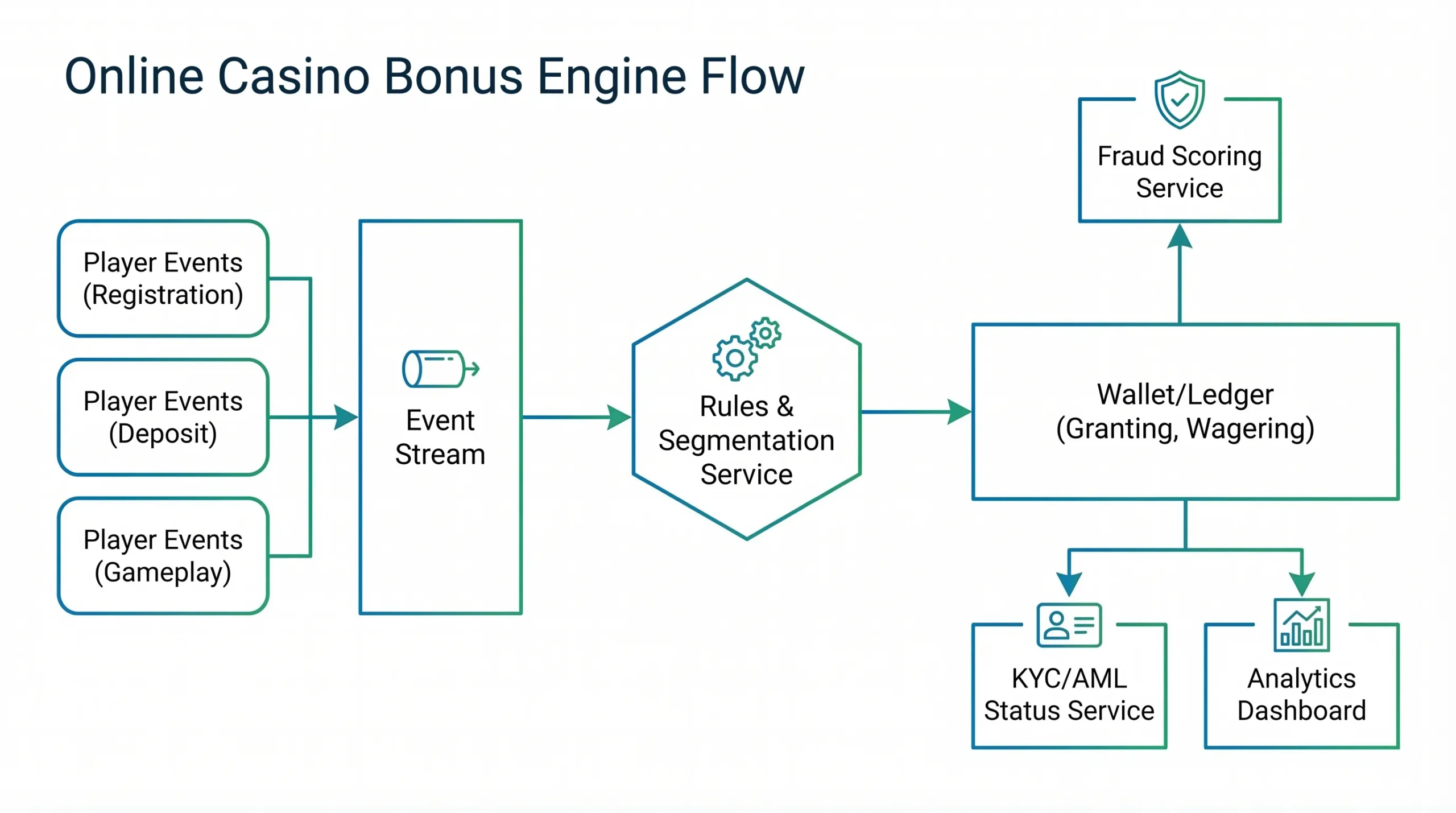
A casino bonus engine can look like “just marketing tooling” in a demo. In production, it is closer to a real-money decision system that touches wallets, game sessions, fraud controls, responsible gambling, and reporting.
If you are choosing a platform or replacing a legacy promo stack, the real question is not “does it support free spins and deposit matches?” It is whether the engine can run profitable offers at scale without creating abuse, support load, or regulatory exposure.
Below are the casino bonus engine requirements that actually matter, with the features you should demand evidence for.
What a bonus engine really does (and why requirements matter)
A bonus engine is the system that decides:
- Who is eligible (segment rules, KYC state, geo, payment method, VIP level)
- When an offer triggers (on registration, after failed deposit, at session start, after a loss streak)
- What value is granted (cash, free spins, cashback, missions, tournaments, loyalty rewards)
- How it is enforced (wagering, max bet, expiry, game contribution, withdrawal restrictions)
- How it is measured (incrementality, cost, abuse rate, LTV impact)
Every one of those decisions has a monetary cost, and many have compliance implications. That’s why “bonus engine requirements” should be treated as product, risk, and finance requirements, not only CRM requirements.
Requirement 1: Offer types that map to real operator use cases
A mature bonus engine should support the common offer families, but more importantly, it should support the constraints that make those offers safe.
At minimum, validate support for:
- Deposit offers: match, tiered match, reloads, “first deposit” logic
- Free spins: game-scoped spins, bet size control, win caps
- Cashback: net loss based, time-window based, capped
- Missions and quests: multi-step progress, time-boxing, partial completion states
- VIP perks: tier-based entitlements, scheduled grants
- Promo codes and referrals: code governance, leak containment
What to look for in a demo: ask the vendor to build one tricky offer live, for example “cashback on net losses, excluding bonus funds, only for verified players, capped per 24 hours, with a cooldown if the player triggers RG risk flags.” If they can’t model this cleanly, you will end up with manual exceptions and support tickets.
Requirement 2: Eligibility and segmentation that works in real time
Most bonus problems are not creative problems. They are targeting problems.
Your requirements should include:
- Event-triggered eligibility (not only batch campaigns)
- Real-time segmentation based on live behavior (deposit attempts, game preference, session length)
- Hard gates: country, jurisdiction, age, KYC state, self-exclusion status
- Soft gates: risk score, device confidence, payment method, affiliate/source
- Deterministic membership: the same player should not “flap” in and out of eligibility due to timing
This is where “nice-to-have” becomes “must-have” quickly. If segmentation is slow or inconsistent, you will see:
- Players receiving an offer after it should have expired
- Double grants when retries happen
- Abuse rings farming any delayed or inconsistent edge case
Requirement 3: Bonus cost controls (so finance can trust promo spend)
If your engine cannot express cost controls, your marketing team will either under-spend (fear) or over-spend (accidentally).
Demand controls that operate at multiple levels:
- Per-player caps: max bonus amount, max bonuses per day/week, cooldown windows
- Campaign caps: daily and total budget, plus pacing rules
- Exposure controls: max bet, game inclusion lists, win caps, wagering multipliers
- Cohort governance: separate budgets by geo, affiliate, payment rail, VIP tier
A practical rule of thumb: if you cannot answer “what is our effective promo cost-to-NGR for this offer, by cohort?” without manual spreadsheets, the engine is not giving you operational control.
Evidence to ask for
Ask for a screenshot or export showing campaign budgeting, plus a report that reconciles “granted value” vs “realized cost” (after forfeits, expiries, and voids).
Requirement 4: Correct wagering and wallet enforcement (idempotent and auditable)
This is the area where vendors often hand-wave, and where operators get hurt later.
Your bonus engine should be tightly integrated with the wallet/ledger so it can:
- Track wagering progress accurately per bonus instance
- Apply max bet rules at bet placement time (not after the fact)
- Handle game contribution (some games contribute 0%, some 100%, some partial)
- Enforce expiry and forfeit states consistently
- Support rollback and dispute scenarios (bonus cancelled, game round voided)
- Guarantee idempotency on grant and settlement, so retries do not duplicate value
If you run multi-currency or crypto plus fiat, require:
- Currency-aware bonus accounting (avoid FX edge cases)
- Clear separation of cash balance vs bonus balance (or a well-defined single-wallet policy)
Requirement 5: Anti-abuse features built into the workflow
Promotions attract adversaries. Your requirements should assume bonus abuse attempts from day one.
Look for:
- Identity and device signals to prevent multi-accounting patterns
- Payment reuse checks (same card, same wallet address, same bank account)
- Velocity controls (rapid registrations, rapid deposits, rapid withdrawals)
- Affiliate abuse hooks (suspicious referral clusters, code leakage)
- Hold and review flows (graceful ways to pause granting or cashout when risk spikes)
Also ensure the engine supports graduated responses, not only hard bans. You often want to throttle, cap, or switch the offer type rather than block a player outright.
Requirement 6: Responsible gambling and compliance guardrails
Bonus tooling intersects directly with responsible gambling (RG). In many jurisdictions, regulators care about inducements, targeting, and whether controls are actually enforced.
Practical bonus engine requirements here include:
- Jurisdiction-aware availability (what promos can show in which markets)
- Suppression rules tied to RG states (limits, cool-off, exclusion, affordability checks)
- Audit logs for bonus configuration changes (who changed what, when)
- Player-level evidence: why an offer was granted or denied (for complaints and audits)
If you operate with crypto rails, you also want consistent linkage between bonus events and AML/KYC controls, especially around withdrawals.
Requirement 7: Analytics that prove incrementality, not just redemptions
A dashboard that shows “claimed bonuses” is not enough. You need to prove whether a bonus created incremental value.
At minimum, your engine should support:
- Funnel measurement: view, click, accept, deposit, wager, withdraw
- Holdout or A/B testing (even simple random splits)
- Cohort reporting by acquisition source, geo, payment rail, and device
- Latency and reliability metrics (if bonus application is slow, it will cost money)
When platforms provide real-time analytics, you can move from “weekly promo post-mortems” to same-day tuning.
Requirement 8: Operator UX (so you are not dependent on engineers)
A bonus engine is only useful if the team can safely operate it.
Look for:
- No-code or low-code offer builder with clear rule previews
- Templates for common promo types (to reduce mistakes)
- Approval workflows (maker-checker) for risky changes
- Versioning and rollback of campaigns
- Backoffice permissions by role (marketing vs VIP vs risk)
If your bonus tooling requires engineering for every iteration, you are effectively paying an “iteration tax” that slows down growth.
Requirement 9: Integrations, APIs, and omnichannel delivery
A bonus engine does not live in isolation. It must activate offers across web, mobile, CRM, and support.
Require:
- Open API access for creating and managing offers
- Webhooks/events for grants, status changes, completion, forfeits
- Integration points for email, SMS, push, and onsite widgets
If native apps are part of your roadmap, ensure your bonus events and entitlements can be consumed cleanly by mobile clients. When you need dedicated native engineering for a branded iOS/Android experience, partnering with a specialist mobile app development agency can help you ship faster without compromising the bonus and wallet logic.
Requirement 10: Performance requirements (bonus latency is revenue)
In-session promos (for example, a reload offer right after a deposit, or a quest step completion mid-session) have a hard latency budget. If the decision arrives late, the moment is gone.
Minimum expectations to clarify contractually:
- P95 decision latency targets for grant/eligibility checks
- Rate limits and burst handling (promos spike traffic)
- Regional performance if you operate across multiple geos
- Clear degraded mode behavior (what happens if the bonus service is down)
A vendor-ready checklist: requirements and the proof to ask for
Use the table below to keep demos honest.
| Bonus engine requirement | Why it matters | Evidence to request in evaluation |
|---|---|---|
| Real-time triggers and segmentation | Prevents delayed, mistargeted offers and reduces manual ops | Live demo using event trigger, plus segment membership rules |
| Budget caps and pacing | Prevents runaway promo spend | Campaign settings showing caps, pacing, cohort filters |
| Wagering enforcement at bet time | Avoids disputes and chargebacks driven by “surprise” voids | Flow walkthrough showing max bet and game contribution enforcement |
| Idempotent grant and settlement | Prevents duplicate bonuses on retries and webhook replays | Technical note or test showing idempotency keys and retries |
| Anti-abuse controls | Protects margins and prevents promo farming | Examples of velocity rules, payment reuse checks, device signals |
| RG and compliance suppression | Reduces regulatory risk | Policy rules tied to RG states, plus audit logs |
| Experimentation support | Proves incrementality | A/B split configuration, holdout reporting |
| Admin UX, roles, approvals | Reduces operator error | Backoffice role matrix and change history view |
| APIs and webhooks | Enables CRM, apps, and automation | API docs, webhook catalog, sandbox access |
| Observability and SLAs | Keeps promos reliable during peaks | SLA language, uptime reports, latency percentiles |
How Spinlab approaches bonus engine needs (without overbuilding)
Spinlab Studio positions its platform as an all-in-one, modular iGaming platform for launching and scaling online casinos, including an affiliate and bonus engine, real-time analytics, fraud prevention, and KYC/AML compliance.
If your current pain is “we need to ship offers quickly, but we also need control,” prioritize platforms that combine:
- A bonus engine tightly connected to payments and wallets (crypto and fiat)
- Real-time analytics so you can tune spend and targeting quickly
- Fraud and compliance primitives that can suppress or throttle offers based on risk
This integrated approach usually beats stitching together separate bonus SaaS, third-party CRM logic, and custom wallet rules.
Frequently Asked Questions
What is the most important requirement in a casino bonus engine? The ability to enforce rules correctly at the wallet and gameplay level (wagering, max bet, expiry, idempotency) while remaining auditable. Creative offer types matter less than correctness.
Do I need real-time segmentation for bonuses? If you plan to run triggered offers (abandoned deposit recovery, in-session quests, loss-streak cashback), yes. Batch-only segmentation typically causes late offers, higher abuse, and lower conversion.
How do I evaluate bonus abuse protection during a vendor demo? Ask them to model a promo with payment reuse limits, device-based restrictions, velocity caps, and a manual review pathway. Then ask to see the audit trail and the exact denial reason shown to ops.
How should a bonus engine handle multi-currency or crypto players? It needs currency-aware accounting, clear balance separation rules (cash vs bonus), and consistent linkage to KYC/AML checks, especially for withdrawals.
What analytics should I expect from a bonus engine? At minimum: redemption funnel metrics, cost-to-NGR, cohort splits (geo, affiliate, rail), and some form of A/B testing or holdout measurement to prove incrementality.
Want to see what a modern bonus engine looks like in a modular iGaming platform?
If you are selecting a white label casino platform or upgrading your promo stack, Spinlab Studio can walk you through how bonus tooling, payments (crypto and fiat), compliance, and real-time analytics fit together.
Explore the platform at Spinlab Studio and request a demo to map your bonus requirements to a launch-ready setup.