

For a new casino operator, compliance is not a single vendor, a spreadsheet, or a policy folder that gets dusted off before an audit. It is a working system that decides who can register, who can deposit, which games can be shown, when risk teams intervene, what marketing can say, and what evidence is available when a regulator, bank, payment provider, or game studio asks questions.
That system is your casino compliance stack.
The goal is not to make operations slower. A well-designed stack should help you launch faster because your controls, data, and evidence are built into the platform from the start. The mistake is treating compliance as a post-launch cleanup project. By then, player data is fragmented, payment decisions are hard to explain, affiliate traffic is messy, and audit trails are incomplete.
This guide is practical operational guidance, not legal advice. Always validate requirements with qualified counsel and your licensing advisors for each target jurisdiction.
What a casino compliance stack actually does
A casino compliance stack is the set of policies, tools, data flows, workflows, and audit records that keep an online casino operating within its regulatory, payment, security, and responsible gambling obligations.
For new operators, it should do three jobs from day one.
First, it should prevent the wrong activity before it happens. That includes underage access, blocked jurisdictions, sanctioned users, duplicate accounts, bonus abuse, unsafe payment behavior, and prohibited marketing exposure.
Second, it should support risk-based decisions without forcing every player through the same level of friction. A low-risk player making a small deposit should not experience the same review path as a high-risk player using multiple devices, mismatched payment instruments, and a large crypto withdrawal request.
Third, it should produce evidence. If a regulator, PSP, bank, game provider, auditor, or internal compliance officer asks why a decision was made, your stack should answer with timestamps, rule versions, user actions, risk scores, case notes, and supporting documents.
| Compliance layer | Primary goal | Tools and controls | Evidence to retain |
|---|---|---|---|
| Governance and licensing | Prove accountability and market readiness | Policies, role permissions, jurisdiction matrix, approval workflows | Policy versions, ownership records, access logs, board or management approvals |
| KYC and onboarding | Verify identity, age, location, and eligibility | Document checks, sanctions screening, PEP checks, geo controls, self-exclusion checks | Verification results, consent records, failed checks, manual review notes |
| AML and payments | Detect suspicious value movement | Transaction monitoring, risk scoring, source-of-funds triggers, ledger controls | Deposit and withdrawal history, alerts, SAR decisions, reconciliation reports |
| Fraud and security | Stop abuse without harming legitimate players | Device intelligence, velocity rules, bot protection, account takeover monitoring | Risk events, blocked attempts, queue decisions, analyst outcomes |
| Responsible gambling | Protect players and meet duty-of-care obligations | Limits, cooling-off, self-exclusion, reality checks, CRM suppressions | Limit changes, alert delivery, exclusions, intervention history |
| Games and content | Ensure permitted, fair, and certified gameplay | Game whitelists, RNG records, RTP configuration controls, provider certificates | Game launch logs, certification files, config changes, jurisdiction rules |
| Marketing and affiliates | Keep acquisition compliant | Creative approval, age and geo targeting, affiliate KYB, disclosure monitoring | Approved creatives, affiliate agreements, traffic logs, takedown records |
| Privacy and reporting | Control data use and respond to audits | Consent management, retention rules, data access controls, regulatory reports | Consent logs, data exports, deletion records, incident reports |
Layer 1: governance and licensing evidence
Before choosing tools, define the operating model. Which legal entity operates the brand? Which markets are in scope? Which license path are you pursuing? Which player segments are allowed? Which payment rails and currencies will you support? Who owns compliance decisions internally?
This layer is often underestimated because it feels less technical. In practice, weak governance creates expensive platform changes later. If you do not define who can approve a new payment method, change a bonus rule, add a game provider, or launch a new affiliate campaign, your compliance stack becomes informal and hard to defend.
A new operator should maintain a jurisdiction matrix that maps markets to player eligibility, payment availability, game availability, bonus rules, KYC thresholds, responsible gambling requirements, language requirements, and reporting obligations. This matrix should not live only in legal documents. It should inform actual platform rules.
Strong governance also means access control. A bonus manager should not be able to modify AML thresholds. A support agent should not be able to override withdrawal holds without review. An affiliate manager should not be able to approve regulated creative without a second check. Every sensitive action should be permissioned, logged, and reversible only through a documented process.
Layer 2: KYC, eligibility, and onboarding controls
KYC is not just document upload. For an online casino, onboarding compliance usually includes age verification, identity checks, location eligibility, sanctions screening, politically exposed person checks, duplicate account detection, terms acceptance, privacy consent, and sometimes source-of-funds escalation.
The challenge for new operators is balancing conversion with control. Asking for every possible document before a player has seen the lobby can destroy activation. Waiting too long can create withdrawal disputes, AML gaps, and regulator concerns.
A better model is progressive verification. Collect what you need at registration, step up checks when risk increases, and make the player experience clear. For example, a player might pass basic account creation first, then complete identity verification before withdrawal, higher deposit limits, or risky payment behavior. Exact timing depends on jurisdiction and license conditions.
Your KYC layer should connect to the rest of the stack. If a player fails verification, that status should affect deposits, withdrawals, bonuses, CRM messages, affiliate attribution, and support workflows. If a document is pending, the cashier should explain the state instead of creating a vague error. If a user is excluded, blocked, or underage, the decision must be enforced consistently across web, mobile, app, and support channels.
The FATF Recommendations emphasize a risk-based approach to AML controls. For casino operators, that principle is useful beyond AML: apply more friction where risk is higher, and make the logic explainable.
Layer 3: AML, payments, wallet, and custody controls
Payments are where compliance becomes operational. Money enters through cards, bank transfers, APMs, e-wallets, crypto deposits, or crypto onramps. It moves through wallets, bonuses, game sessions, withdrawals, refunds, chargebacks, settlements, and treasury accounts. Every movement needs a clear record.
A new operator should treat the ledger as the compliance backbone. Wallet balances are views. The ledger is the source of truth. It should record deposits, withdrawals, reversals, bonus credits, wagering changes, fees, FX conversions, and settlement events in a way that can be reconciled later.
For fiat rails, your stack needs PSP routing rules, fraud checks, 3DS or SCA handling where relevant, chargeback evidence, reconciliation reports, and PCI scope management. Operators accepting cards should understand the latest PCI DSS obligations directly from the PCI Security Standards Council, even if much of the card data environment is outsourced to PSPs.
For crypto-ready casinos, controls must also cover wallet ownership, transaction monitoring, sanctioned address exposure, high-risk wallets, custody policies, withdrawal review thresholds, and Travel Rule considerations where applicable. Stablecoins may reduce volatility, but they do not remove AML responsibilities.
The practical question is not “Do we support crypto or fiat?” It is “Can our stack apply consistent risk, ledger, reconciliation, and reporting logic across both?” Operators that bolt crypto onto a fiat-only system often create reconciliation gaps and manual review bottlenecks.
Layer 4: fraud prevention and security controls
Fraud prevention overlaps with compliance, payments, and player experience. The stack should detect abuse patterns early without creating unnecessary friction for normal players.
Common surfaces include card testing, bonus abuse, multi-accounting, account takeover, affiliate fraud, collusive activity, identity fraud, chargeback abuse, bot registration, and withdrawal laundering attempts. The controls need to combine multiple signals, not rely on one magic score.
Useful fraud signals include device fingerprinting, IP reputation, registration velocity, payment instrument reuse, mismatched country signals, impossible travel, document reuse, bonus claim patterns, gameplay anomalies, withdrawal timing, and affiliate source quality. The most effective stacks route these signals into a decision engine and case queue, where risk teams can take proportionate action.
Security belongs in the same conversation. A casino handles identity data, payment data, gameplay sessions, wallet balances, bonus rules, and administrative permissions. Your stack should include secure authentication, least-privilege access, audit logs, bot protection, API rate limits, incident monitoring, encrypted secrets, backup controls, and change management.
For new operators, a simple rule helps: anything that changes player money, player eligibility, game availability, risk status, or marketing exposure should be logged as if someone will ask about it later.
Layer 5: responsible gambling by design
Responsible gambling cannot be a footer link and a support inbox. It needs to be embedded into the product.
A new operator should support deposit limits, loss limits where required, session reminders, cooling-off, self-exclusion, reality checks, and clear access to responsible gambling tools. These controls should connect to payments, bonuses, CRM, and customer support. For example, a player who self-excludes should not receive winback emails, bonus offers, affiliate retargeting, or push notifications.
The stack should also capture behavioral risk indicators. These may include rapid deposit escalation, repeated failed deposits, chasing losses, unusually long sessions, frequent limit changes, declined withdrawal reversals where restricted, and repeated support messages about affordability. These signals do not automatically prove harm, but they can trigger proportionate interventions.
Good responsible gambling design is measurable. Track tool visibility, limit adoption, alert acknowledgement, self-exclusion enforcement, suppressed marketing sends, and intervention outcomes. The point is not only to satisfy a checklist. It is to prove that protections work in the live player journey.
Layer 6: game integrity and jurisdictional content control
Game compliance covers what players can access, how games behave, and what evidence exists to prove fairness.
Operators need supplier due diligence, game certificates, RNG or provably fair documentation where applicable, RTP configuration controls, game version tracking, launch logs, and jurisdiction-based content permissions. Some markets may restrict certain mechanics, themes, providers, bonus features, or game categories. Your platform should enforce this through whitelists and rule-based availability, not manual lobby edits.
The game layer also affects reporting. Regulators, suppliers, and finance teams may need game-level GGR, session records, refund data, interrupted round handling, jackpot contributions, and bonus contribution logic. If this data is fragmented across provider portals, audits become slow and error-prone.
Game aggregation is powerful for new operators because it accelerates content launch. But aggregation without compliance gating is risky. The best setup normalizes metadata, certificates, jurisdiction rules, wallet callbacks, and reporting events into one operating model.
Layer 7: marketing, affiliates, and privacy controls
New operators often focus on product compliance and underestimate marketing risk. Acquisition can create exposure through prohibited territories, underage audiences, misleading bonus terms, undisclosed influencer deals, non-compliant landing pages, or affiliates using banned tactics.
A marketing compliance layer should include creative approvals, offer term versioning, age-gating rules, geo-targeting policies, affiliate KYB, tracking validation, traffic source monitoring, and takedown workflows. If you use agencies or freelancers, define approval boundaries clearly. For example, if your agency needs flexible paid media capacity, a white-label execution partner such as white-label PPC execution support may help with campaign delivery, but casino operators should still keep regulated messaging, tracking, disclosures, and market eligibility under formal compliance review.
Privacy controls also sit here because marketing depends on data. Consent collection, cookie governance, email permissions, SMS opt-ins, suppression lists, data retention, and data subject request workflows should be connected to your CRM and analytics tools. A player who withdraws consent or self-excludes should not remain in growth campaigns because two tools failed to sync.
The architecture that keeps the stack together
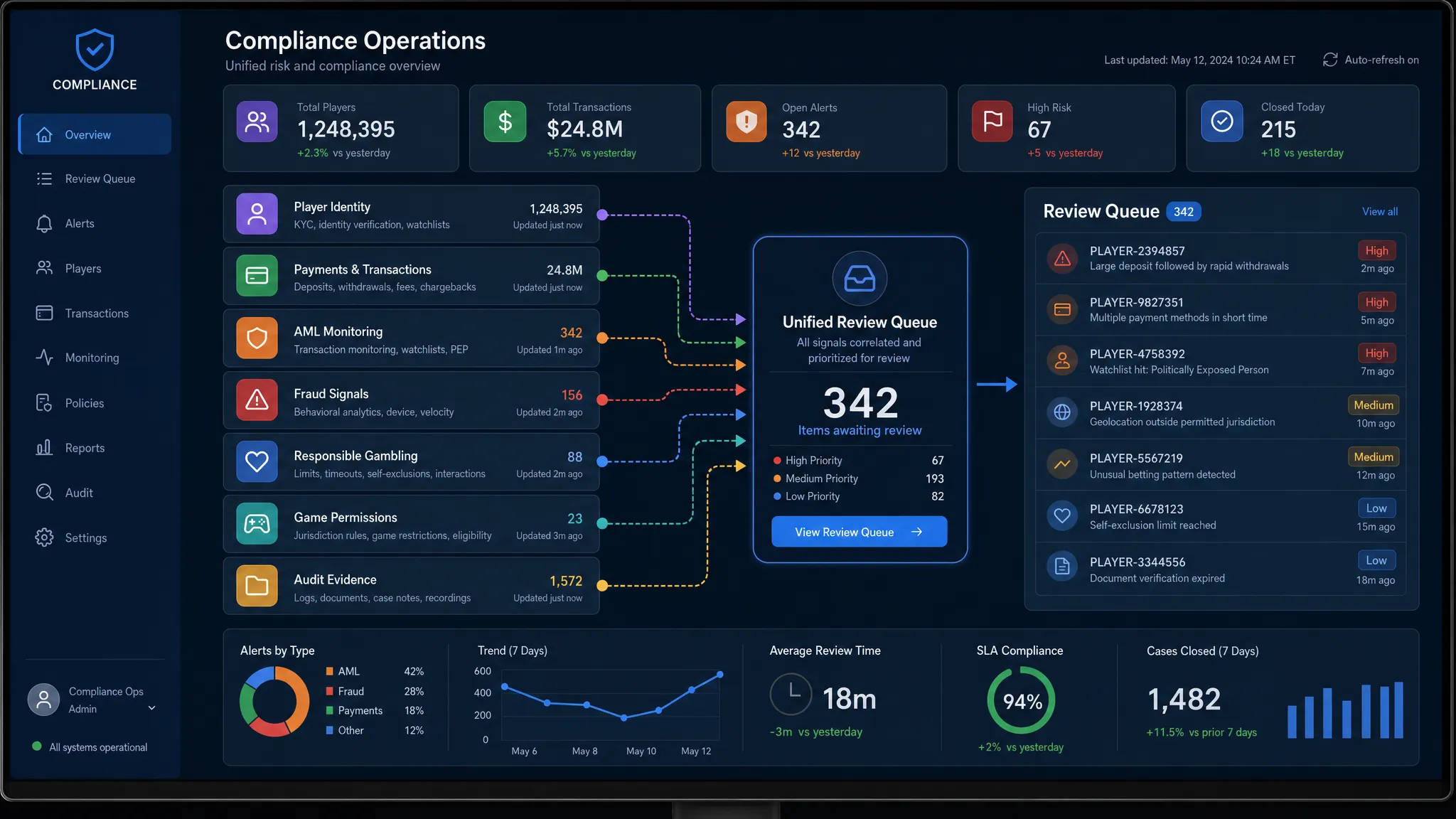
The biggest compliance failure for new operators is not choosing the wrong individual vendor. It is creating a fragmented stack where every vendor has a partial truth.
A workable architecture has a few shared components.
The first is a unified player identity layer. This connects account ID, verified identity, device signals, payment instruments, wallet addresses, affiliate source, jurisdiction, risk status, and consent records.
The second is a policy and decision layer. This is where rules decide whether a player can register, deposit, withdraw, claim a bonus, access a game, receive an email, or require manual review.
The third is an event stream. Every important action should generate structured events, such as registration started, KYC approved, deposit failed, bonus claimed, withdrawal requested, limit changed, session reminder shown, game launched, and risk alert created.
The fourth is case management. Alerts are only useful if teams can investigate, document decisions, escalate, and close cases with reason codes.
The fifth is reporting and audit evidence. Regulators and partners do not want vague explanations. They want reproducible data.
| Core component | Why it matters for compliance | New operator requirement |
|---|---|---|
| Identity graph | Connects player, device, payment, wallet, and risk signals | Single profile view across onboarding, payments, support, and fraud |
| Policy engine | Enforces rules consistently | Versioned rules with timestamps and role-based approvals |
| Event stream | Creates a real-time operational record | Server-side events for money, identity, games, bonuses, and RG actions |
| Case queue | Turns alerts into decisions | Analyst notes, reason codes, SLAs, and escalation paths |
| Audit store | Preserves evidence | Immutable or tamper-resistant logs with exportable reports |
| Admin panel | Lets teams operate controls safely | Role permissions, previews, approvals, and full action history |
Build vs buy: what new operators should not custom-build first
A new operator does not need to custom-build every compliance component. In most cases, the smarter move is to buy or use platform-native modules for commodity controls, then customize policies, risk appetite, market rules, and workflows.
KYC vendors, PSPs, blockchain analytics providers, fraud tools, CRM platforms, and game suppliers all have value. The challenge is integration. If each tool operates in isolation, your team becomes the integration layer. That usually means spreadsheets, manual exports, Slack decisions, and missing audit context.
This is where an integrated iGaming platform can reduce operational load. Spinlab offers a modular, all-in-one casino platform with crypto and fiat payment support, game aggregation, real-time analytics, fraud prevention, KYC and AML workflows, a customizable backoffice, multi-currency support, open APIs, crypto onramp options, merchant custodial wallets, affiliate and bonus tools, and mobile-optimized casino experiences. For lean operators, the advantage is a more Shopify-like operating model: fewer disconnected panels, faster onboarding, and less dependence on developers for everyday configuration.
That does not remove the operator’s responsibility. You still need legal advice, internal ownership, policies, market decisions, partner vetting, and ongoing monitoring. The platform should make those responsibilities easier to execute and prove.
A 30-60-90 day rollout plan for new operators
Days 0-30: define the minimum compliant operating model
The first month is about scope discipline. Choose target markets, license path, accepted currencies, initial payment methods, launch game categories, bonus types, support model, and risk appetite. Avoid launching five markets, ten payment rails, hundreds of bonus variants, and open-ended affiliate deals at once.
During this phase, create your jurisdiction matrix, approval roles, KYC thresholds, withdrawal review policy, AML escalation model, responsible gambling requirements, marketing approval process, and data retention rules. Configure the platform to enforce these decisions before real player traffic arrives.
Days 31-60: connect controls to live workflows
The second month is about integration and testing. Run sandbox deposits, failed payments, KYC retries, blocked jurisdictions, self-exclusions, bonus abuse scenarios, withdrawal reviews, chargeback evidence packs, affiliate tracking tests, and game whitelist checks.
Do not only test happy paths. Test the messy cases that create compliance incidents: duplicate webhooks, mismatched country signals, expired documents, pending withdrawals, excluded players trying to re-register, geo changes during session, and crypto deposits from risky wallets.
Days 61-90: prove readiness with evidence
The third month is about operating rhythm. Build weekly compliance dashboards, fraud queues, AML review SLAs, responsible gambling reports, payment reconciliation checks, affiliate monitoring reviews, and internal audit samples.
Run a mock audit. Pick ten player journeys and prove every key decision from registration to deposit, gameplay, bonus, withdrawal, CRM suppression, and support interaction. If you cannot reconstruct the journey, fix the data flow before scaling acquisition.
Compliance stack scorecard for vendor demos
When evaluating a white label casino platform or turnkey casino solution, ask vendors to demonstrate workflows, not just features.
| Demo question | What a strong answer proves |
|---|---|
| Can you show a player blocked by jurisdiction before deposit? | Geo, eligibility, and cashier rules are connected |
| Can you show a KYC-pending player attempting withdrawal? | Verification status affects money movement correctly |
| Can you show an AML alert with the events that triggered it? | Monitoring is explainable, not a black box |
| Can you show a self-excluded player suppressed from CRM? | Responsible gambling controls extend beyond account status |
| Can you show game availability by jurisdiction? | Content compliance is rule-based, not manual |
| Can you export a payment reconciliation report? | Ledger, PSP, and settlement data can be matched |
| Can you show who changed a bonus rule and when? | Backoffice actions are permissioned and auditable |
| Can you simulate a crypto deposit and withdrawal review? | Crypto readiness includes risk controls, not only wallet support |
The goal is to see the stack behave under real operational conditions. Slides are not enough. Ask for a sandbox, sample events, admin logs, reporting exports, and failure-state demos.
Frequently Asked Questions
What is the minimum compliance stack for a new online casino? At minimum, a new operator needs governance policies, KYC and age checks, geo controls, AML monitoring, payment and ledger controls, fraud prevention, responsible gambling tools, game whitelisting, marketing compliance, privacy controls, and audit-ready reporting.
Can a white label casino platform handle compliance for me? A strong white label casino platform can provide the tools and workflows that make compliance easier, but the operator remains responsible for licensing decisions, legal advice, internal policies, market rules, and ongoing monitoring.
Should new operators build their own compliance stack? Most new operators should not custom-build core compliance infrastructure first. It is usually faster and safer to use integrated platform modules and specialist vendors, then customize risk rules, policies, approval workflows, and reporting.
How does crypto change the casino compliance stack? Crypto adds wallet risk, custody controls, blockchain transaction monitoring, sanctions exposure, Travel Rule considerations, stablecoin treasury policies, and additional withdrawal review logic. These controls should connect to the same KYC, AML, ledger, and reporting systems used for fiat.
What is the biggest compliance mistake new operators make? The biggest mistake is fragmentation. When KYC, payments, games, bonuses, fraud, CRM, and support operate in separate tools without a shared event and audit layer, teams struggle to explain decisions and fix problems quickly.
Build a lean compliance stack before you scale traffic
The best time to design your casino compliance stack is before your first serious acquisition push. Once players, payments, affiliates, and support tickets are moving, every missing control becomes harder to retrofit.
Spinlab helps new operators launch with a modular iGaming platform that brings payments, KYC and AML workflows, fraud prevention, game aggregation, real-time analytics, bonuses, affiliates, crypto onramps, multi-currency support, and backoffice operations into a connected environment.
If you want a cost-efficient, crypto-ready, white-label casino platform with a Shopify-like operating experience, explore Spinlab Studio and see how a connected compliance stack can help you launch faster without building operational risk into your foundation.