

Most casino CRM stacks fail for one simple reason: they are built like marketing tools, not like real-time financial systems.
In iGaming, every message sits downstream of regulated identity, money movement, game sessions, fraud controls, and responsible gambling. If your CRM is missing the right events, or segments drift because identity is messy, “automation” turns into noisy campaigns, player fatigue, and support tickets.
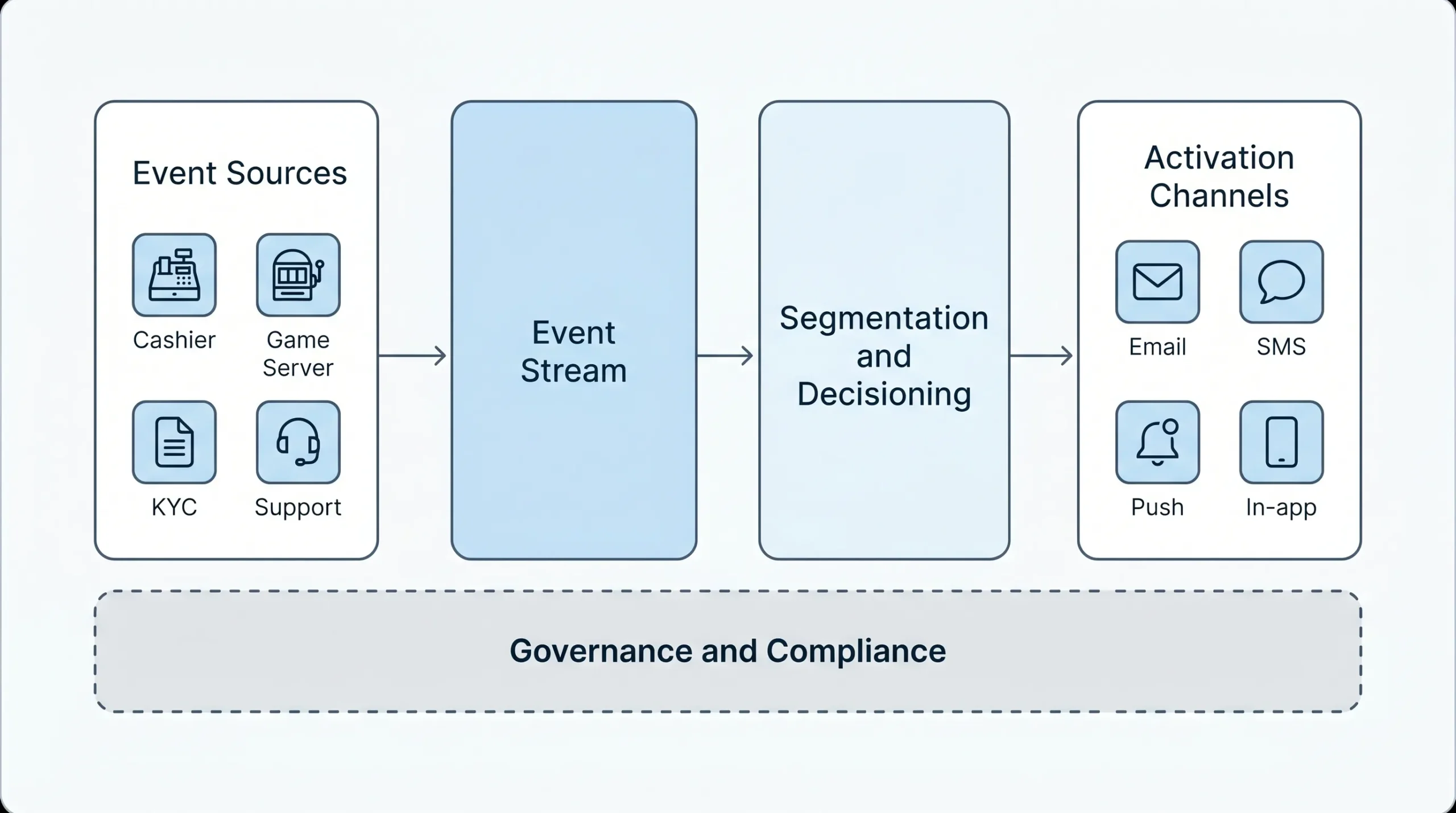
This guide lays out a practical, scalable casino CRM stack built around three layers that compound over time:
- Events (what happened, with audit-grade context)
- Segments (who a player is right now, not last week)
- Automations (what you do about it, with guardrails)
What “CRM stack” really means for an online casino
In a typical eCommerce brand, a CRM stack can be “good enough” if it tracks purchases and emails. In an online casino, the same simplistic setup breaks because:
- Player state changes mid-session (wins, losses, cooldowns, limits, risk flags).
- Payments are multi-rail (cards, APMs, crypto), with asynchronous states and failure modes.
- Compliance requirements demand consistent enforcement and evidence (KYC, AML, consent, RG).
A scalable CRM stack is not just a tool, it is an architecture.
At minimum, you need:
- An event contract (standardized names, properties, and timing)
- A reliable identity model (account, device, wallet, jurisdiction)
- A segmentation layer (batch + real-time)
- An automation and decision engine (rules, cooldowns, experiments)
- Activation channels (email, SMS, push, in-app, on-site widgets)
- Measurement (incrementality, holdouts, deliverability, fatigue)
Layer 1: Events that make CRM reliable (and auditable)
If segments are wrong, automations cannot be right. The fastest way to fix segmentation is to stop arguing about “who is VIP” and start agreeing on what events exist, what they mean, and when they fire.
Event design principles for casinos
A good casino event layer follows five principles.
1) Prefer server-side events for money and compliance. Client-side is useful for UX signals, but deposits, withdrawals, KYC states, and bonus awarding should be recorded server-side.
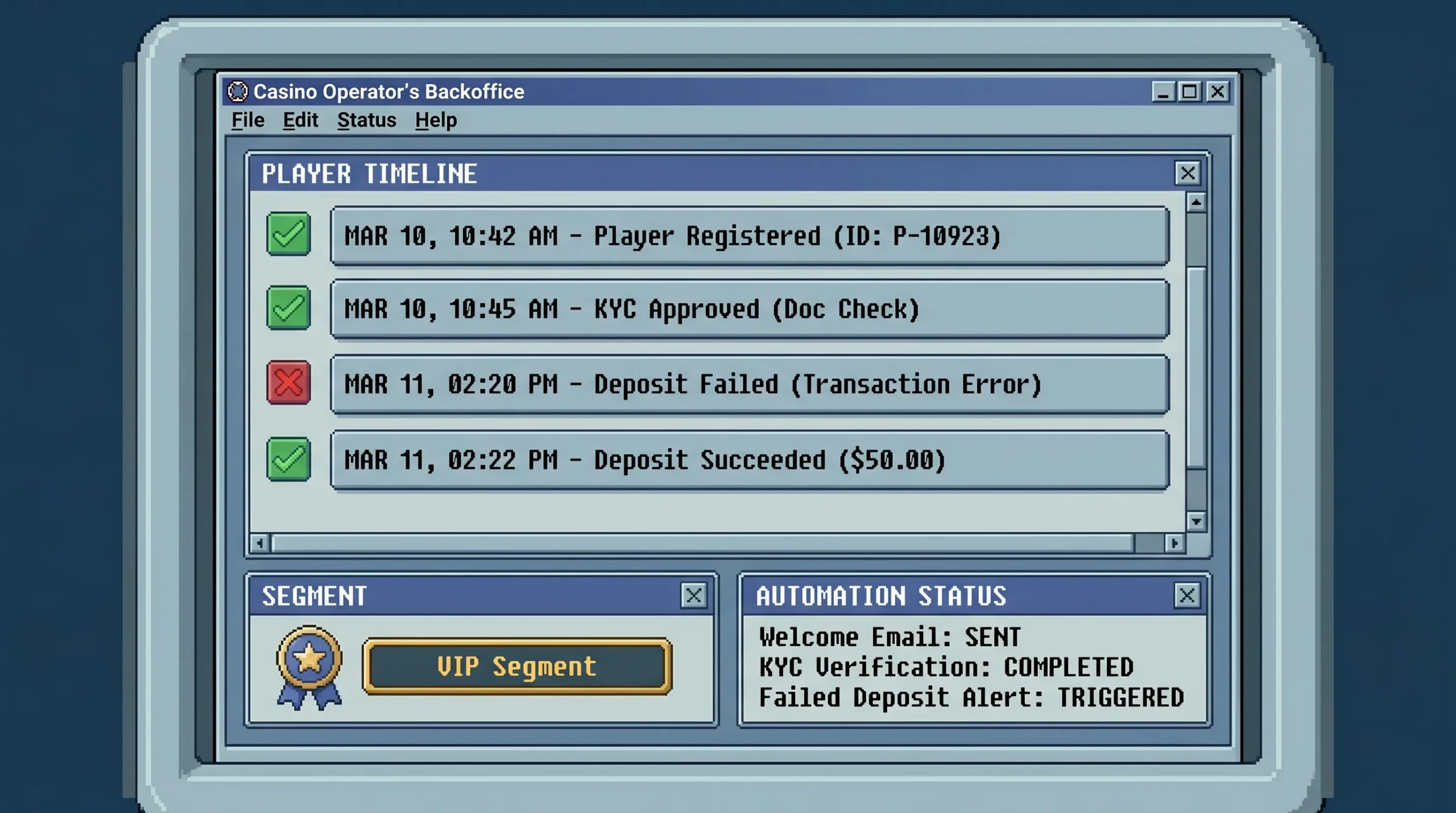
2) Model state transitions, not just clicks. “Deposit clicked” is weak. “Deposit initiated → deposit authorized → balance credited” is operationally useful.
3) Keep events idempotent and traceable. Payments and wallet credits must be deduplicated safely, and every event should carry correlation IDs.
4) Include jurisdiction and consent context. Many CRM mistakes are really policy mistakes: messaging the wrong geo, wrong language, wrong opt-in state.
5) Separate “facts” from “derived metrics.” Send raw facts (amount, currency, rail, status). Compute metrics (LTV, net loss) in analytics/warehouse where definitions are governed.
A starter event taxonomy (the ones that power 80% of automation)
You do not need 400 events to start scaling. You need a clean set that covers the player lifecycle plus risk.
| Lifecycle area | Core event | Why it matters for CRM | Example properties to include |
|---|---|---|---|
| Acquisition | LANDINGPAGE_VIEWED |
Measure funnel quality by source | utm_source, geo, device_type |
| Account | REGISTRATION_COMPLETED |
Starts onboarding clock | country, language, affiliate_id |
| KYC | KYC_STARTED / KYC_APPROVED / KYC_REJECTED |
Drives step-up messaging and holds | vendor, reason_code, attempt_count |
| Deposits | DEPOSIT_INITIATED / DEPOSIT_FAILED / DEPOSIT_SUCCEEDED |
Highest leverage automation triggers | rail, psp, amount, currency, failure_reason |
| Gameplay | SESSION_STARTED / BET_PLACED / SESSION_ENDED |
Engagement and fatigue logic | game_id, vertical, session_duration_sec |
| Bonuses | BONUS_OFFERED / BONUS_ACCEPTED / BONUS_COMPLETED |
Promo governance and ROI | bonus_id, wagering_req, cost_estimate |
| Withdrawals | WITHDRAWAL_REQUESTED / WITHDRAWAL_PAID |
Trust, churn, ticket prevention | rail, amount, review_required |
| RG | LIMIT_SET / COOLDOWN_ENABLED / SELF_EXCLUSION |
Compliance gating for automation | limit_type, duration, jurisdiction |
| Risk | FRAUD_FLAGGED / AML_REVIEW_OPENED |
Suppress promos, route to ops | risk_score, rule_id, case_id |
Two practical tips that reduce CRM incidents immediately:
- Standardize failure reasons (especially for
DEPOSIT_FAILED). If “do_not_honor,” “issuer_decline,” and “3ds_failed” are mixed into one “failed,” your recovery flows will spam players with irrelevant advice. - Track “pending” as a first-class state for bank transfers, APMs, and some crypto flows. Many “churn” players are simply stuck.
Layer 2: Segments that stay accurate as you scale
Segments should answer one question: What should the casino do next for this player, given what we know right now?
That means your segmentation layer should support three segment types.
1) Attribute segments (slow-changing)
Examples: jurisdiction, language, verification level, preferred currency, VIP host assignment.
These are great for routing, compliance, and localization, but weak for timing.
2) Behavioral segments (cohorts)
Examples: “FTD not completed within 24h,” “withdrawal requested twice in 7d,” “bonus abuser pattern detected.”
These drive lifecycle automation and most revenue.
3) Real-time state segments (session-aware)
Examples: “deposit attempt failed in last 3 minutes,” “high intent lobby browsing,” “loss run exceeded threshold.”
These are your highest leverage segments, and also the easiest to get wrong without event quality and guardrails.
A practical segment library (with activation ideas and guardrails)
| Segment | Definition (example) | Best activation | Guardrail to add |
|---|---|---|---|
| New registered, no deposit | REGISTRATION_COMPLETED and no DEPOSIT_SUCCEEDED within 24h |
Onboarding education + low-friction deposit CTA | Suppress if KYC_REJECTED |
| Deposit friction | DEPOSIT_FAILED 2+ times in 2h |
Rail switch suggestion, support shortcut | Cooldown 12h to avoid spam |
| KYC stalled | KYC_STARTED and not approved in 6h |
“Resume KYC” deep link + tips | Respect quiet hours + locale |
| Early value signal | Above-threshold wagering in first 48h | VIP pre-qualification journey | RG check, affordability policies |
| Lapsing | No SESSION_STARTED in 7d, prior activity high |
Winback with personalized content | Exclude self-excluded/cooldowns |
| Withdrawal trust moment | WITHDRAWAL_PAID within last 1h |
“Your payout is complete” + next step | Avoid incentivizing risky behavior |
| Bonus cost risk | Bonus accepted, low progress, high cost estimate | Progress nudge or alternative offer | Abuse controls, eligibility rules |
| High fatigue | Sessions 3+ per day with declining engagement | Reduce messaging, promote breaks | RG-first rules override revenue |
Notice what is missing: “VIP tier = Gold.” Tiers can exist, but scalable CRM uses signals and timing, not just labels.
Layer 3: Automations that scale without burning players (or ops)
Automations should be built like product features:
- deterministic triggers
- clear success metrics
- rollback conditions
- audit-friendly logs
The 6 automation families that produce the biggest impact
1) Onboarding and first deposit conversion
Your goal is to reduce “time-to-first-play.” The most effective onboarding automations are event-driven:
- Trigger on
REGISTRATION_COMPLETED - Branch on
KYC_*state, jurisdiction, and deposit rail availability - End when
DEPOSIT_SUCCEEDEDor a suppression event occurs
KPIs that matter: registration-to-deposit conversion, median time-to-credit, and completion rates by rail.
2) Deposit failure recovery (rail-aware)
A generic “your payment failed” email is worse than doing nothing. A scalable flow:
- Trigger:
DEPOSIT_FAILED - Branch: by
failure_reasonandrail - Action: show one best next step (retry, different rail, support, KYC step-up)
KPIs: recovered deposits, repeat failure rate, support ticket deflection.
3) Session-time personalization (in-app, not just email)
In-session moments convert better and feel less spammy than off-site campaigns, especially when they are utility-based:
- reminding a player about an unfinished verification
- offering a relevant game category based on current browsing
- surfacing a bonus marketplace choice instead of pushing one offer
This is where real-time segments pay off.
4) VIP nurturing (signal-driven)
VIP automation scales when it is not a human spreadsheet.
- Trigger: early value signals, consistent deposit patterns, low risk signals
- Actions: unlock perks gradually, introduce host only when justified
- Measurement: uplift vs holdout, not vanity “VIP count”
5) Churn prevention and winback
Winback should not be a calendar blast. It should be tied to meaningful lapse definitions (by segment) and paired with fatigue controls.
KPIs: reactivation rate, net gaming revenue per reactivated player, complaint rate.
6) Responsible gambling interventions (non-negotiable)
RG automations are part of your CRM whether you like it or not.
Examples:
- reality check prompts based on session duration
- loss-limit alerts with clear actions
- suppression logic that blocks promotional messaging when a player sets limits
Design rule: RG events must override marketing events, every time.
Governance: the “boring” layer that prevents expensive mistakes
Scaling CRM is mostly governance.
Frequency capping and fatigue budgets
Players do not churn because you sent one message. They churn because your system has no concept of “enough.”
At minimum, implement:
- per-channel daily caps
- cross-channel caps (one budget across email/SMS/push)
- cooldown windows per automation
- suppression when engagement drops below a threshold
Experimentation and incrementality
If your CRM stack cannot run holdouts, it cannot tell you the truth.
Build a simple standard:
- every major automation has a control group
- define a conversion window (for example, 24h for deposit recovery)
- track uplift on revenue metrics, not just clicks
Compliance basics for messaging (US and global)
Even if you operate globally, your stack should be able to enforce region rules programmatically.
- Email: follow opt-out and identification rules (see the FTC’s CAN-SPAM guidance).
- Data protection: ensure you have a lawful basis for processing and clear user rights handling under frameworks like GDPR (the UK ICO provides practical GDPR guidance).
Build vs buy: how to choose a CRM stack shape
Most operators end up with a hybrid: platform-native capabilities for real-time and compliance, plus specialized tools for creative and outbound.
| Approach | Strength | Risk | Best fit |
|---|---|---|---|
| All-in-one platform modules | Fewer integrations, consistent identity and policy | Vendor lock-in if APIs are weak | Lean teams, fast launch, multi-brand ops |
| Best-of-breed CDP + CRM tools | Flexibility and deep marketing features | Integration tax, mismatched IDs | Mature data teams, complex channel mix |
| Custom in-house | Full control | High maintenance, slow iteration | Large operators with dedicated engineering |
If you need help operationalizing creative, acquisition, and automation together (beyond the tooling), working with a specialist partner can accelerate execution. Some teams use agencies like Lotiva, an AI-powered digital marketing and design agency to unify campaign production with automation workflows.
Where Spinlab fits in a scalable casino CRM stack
If your biggest CRM bottleneck is fragmented systems (cashier events in one place, bonuses in another, compliance in tickets), consolidation is often the fastest path to better segmentation and safer automation.
Spinlab Studio provides a modular iGaming platform that can reduce “event gaps” by keeping key systems closer together:
- Crypto and fiat payment support (useful for rail-aware deposit and withdrawal automations)
- Real-time analytics (to power timely segments)
- KYC and AML compliance plus advanced fraud prevention (for suppression and risk-aware journeys)
- Affiliate and bonus engine (so offers can be triggered and enforced, not just messaged)
- Open API integration (to connect external CRMs, CDPs, or messaging providers)
If you are evaluating white label options, prioritize how quickly you can instrument events, build segments, and ship controlled automations. A “Shopify-like” operator experience matters because CRM speed is ultimately an operations problem.
Frequently Asked Questions
What is a casino CRM stack? A casino CRM stack is the system of event tracking, identity, segmentation, and automation used to personalize marketing and product messages across email, SMS, push, and on-site channels, with compliance and RG guardrails.
Which events are most important for iGaming CRM automation? Deposits (initiated, failed, succeeded), KYC state changes, gameplay session boundaries, bonus acceptance/completion, withdrawals (requested/paid), and responsible gambling events (limits, cooldowns, self-exclusion).
How do you prevent CRM automation from spamming players? Use frequency caps, cooldowns per flow, cross-channel fatigue budgets, engagement-based suppression, and strict “stop conditions” when the player converts or enters an RG state.
Do you need real-time segmentation for a casino? Not for everything, but real-time segments are high leverage for deposit recovery, in-session personalization, and risk controls. Batch segments are usually enough for lifecycle winback and weekly VIP reviews.
How do you measure whether CRM automations actually work? Use holdouts or A/B tests, define conversion windows by use case, and measure uplift on business metrics like deposit completion, repeat deposits, and net gaming revenue, not just opens and clicks.
Build a CRM stack you can trust (then scale it)
If you want a casino CRM stack that scales, start by tightening your event contract, then promote the segments that drive money movement and risk outcomes, then automate with governance.
To see how an integrated, crypto-ready iGaming platform can simplify CRM inputs and activation, explore Spinlab Studio at spinlab.studio and request a walkthrough of the modules that support events, analytics, bonuses, and compliance-driven automation.