

Most casino “payment issues” are not really payment issues, they are ledger issues that surfaced at the cashier.
If your platform cannot answer simple questions like “What exactly changed the player balance?” or “Which PSP settlement batch funded this withdrawal?” you will bleed time across support, finance, risk, and compliance.
This guide breaks down casino ledger design with a practical focus on three pressure points operators feel every week: audit trails, reversals, and settlements.
What a casino ledger is (and what it is not)
In iGaming, the ledger is the system of record for money movement. It should be the authoritative source for player balances, operator liabilities, fees, and settlement status.
A common failure mode is treating the “wallet balance” as the ledger. In a robust system:
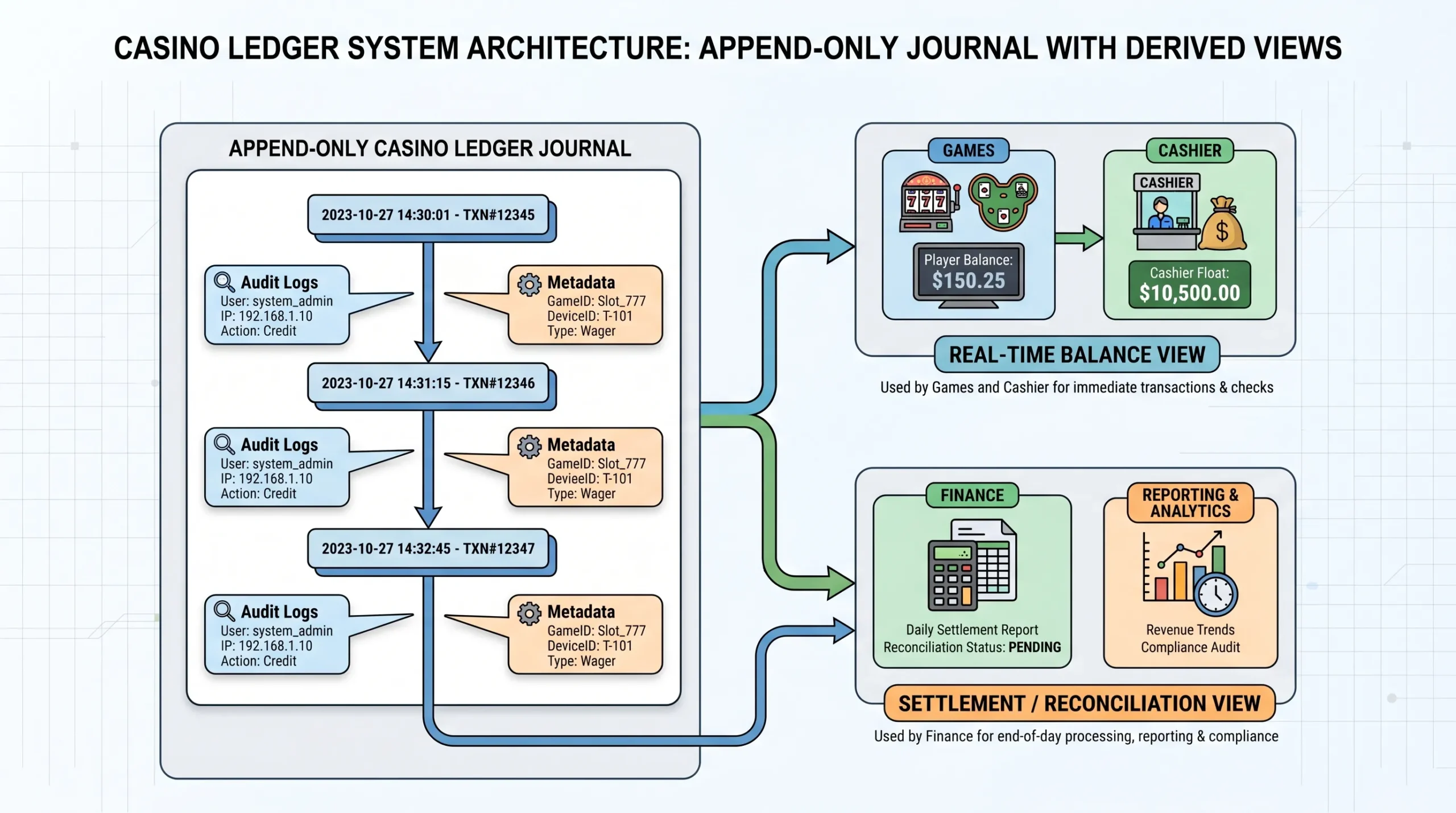
- The ledger is an append-only journal of postings (entries) that create an audit trail.
- Balances are computed views (materialized or on-demand) derived from the journal.
- Reports (GGR, NGR, finance exports) are downstream aggregations, not the source of truth.
Here is a clean separation that scales operationally:
| Layer | What it stores | Why it matters | Typical owner |
|---|---|---|---|
| Ledger of record (journal) | Append-only postings with metadata | Auditability, correctness, dispute defense | Platform / Finance engineering |
| Balance view | Current balance per wallet/account | Fast gameplay and cashier UX | Wallet service |
| Settlement & reconciliation view | Matches between ledger, PSP, bank, chain | Closing, payables, exception handling | Finance ops |
| Analytics | Aggregated events and KPIs | Optimization and monitoring | Data / Product |
If you are designing for crypto and fiat together, the “ledger of record first” approach becomes non-negotiable because different rails settle differently.
Audit trails: design for “prove it,” not “export it”
An audit trail is not a PDF export. It is the ability to reconstruct and explain balance changes, with consistent evidence, across time.
Core properties of an audit-grade casino ledger
Append-only postings
Never mutate past entries. Corrections must be new postings that compensate for earlier ones. This is the foundation for traceability.
Double-entry (or equivalent) accounting discipline
At minimum, every value movement should have a debit and a credit across internal accounts. Even if you do not run a full general ledger, double-entry structure prevents “money from nowhere” bugs.
Strong metadata on every posting
At audit time, the difference between a 5-minute answer and a 5-day incident is usually missing metadata.
Minimum useful fields (practical, not theoretical):
posting_id(unique)idempotency_key(for safe retries)occurred_at(event time) andrecorded_at(write time)actor_typeandactor_id(player, system, admin)reason_code(deposit, bet, win, bonus_credit, fee, chargeback, correction)correlation_id(ties multiple postings into one business transaction)source_reference(PSP transaction ID, bank reference, blockchain tx hash)jurisdiction(if rules differ by region)currencyandamount
Deterministic ordering and immutability controls
- Use monotonically increasing sequence numbers per account, or a global ordering mechanism.
- Store immutable snapshots (for example, daily close snapshots) in tamper-resistant storage.
Access logging for human actions
Admin adjustments and manual approvals are high-risk. Log who did what, when, and what they saw.
Evidence mapping: what audits and disputes usually ask for
You will repeatedly need to produce evidence packs that connect identity, money movement, and gameplay.
A helpful way to think about it:
| Question you must answer | Ledger evidence needed | Common failure |
|---|---|---|
| Why did this balance change? | Postings with reason codes + correlation | Vague “adjustment” entries |
| Did the player accept terms before wagering/withdrawing? | Terms acceptance event linked to transaction timeline | Systems not correlated |
| Was KYC satisfied before payout? | Decision logs, status changes, timestamps | KYC stored outside the money trail |
| Is this withdrawal funded by settled deposits? | Deposit postings + settlement status + clearing account logic | “Available balance” not separated from “cleared balance” |
For security standards that influence audit expectations (especially for payments and data handling), PCI DSS is a common baseline reference. The official resource hub is maintained by the PCI Security Standards Council at PCI SSC.
Reversals: model “what happened,” not “what we wish happened”
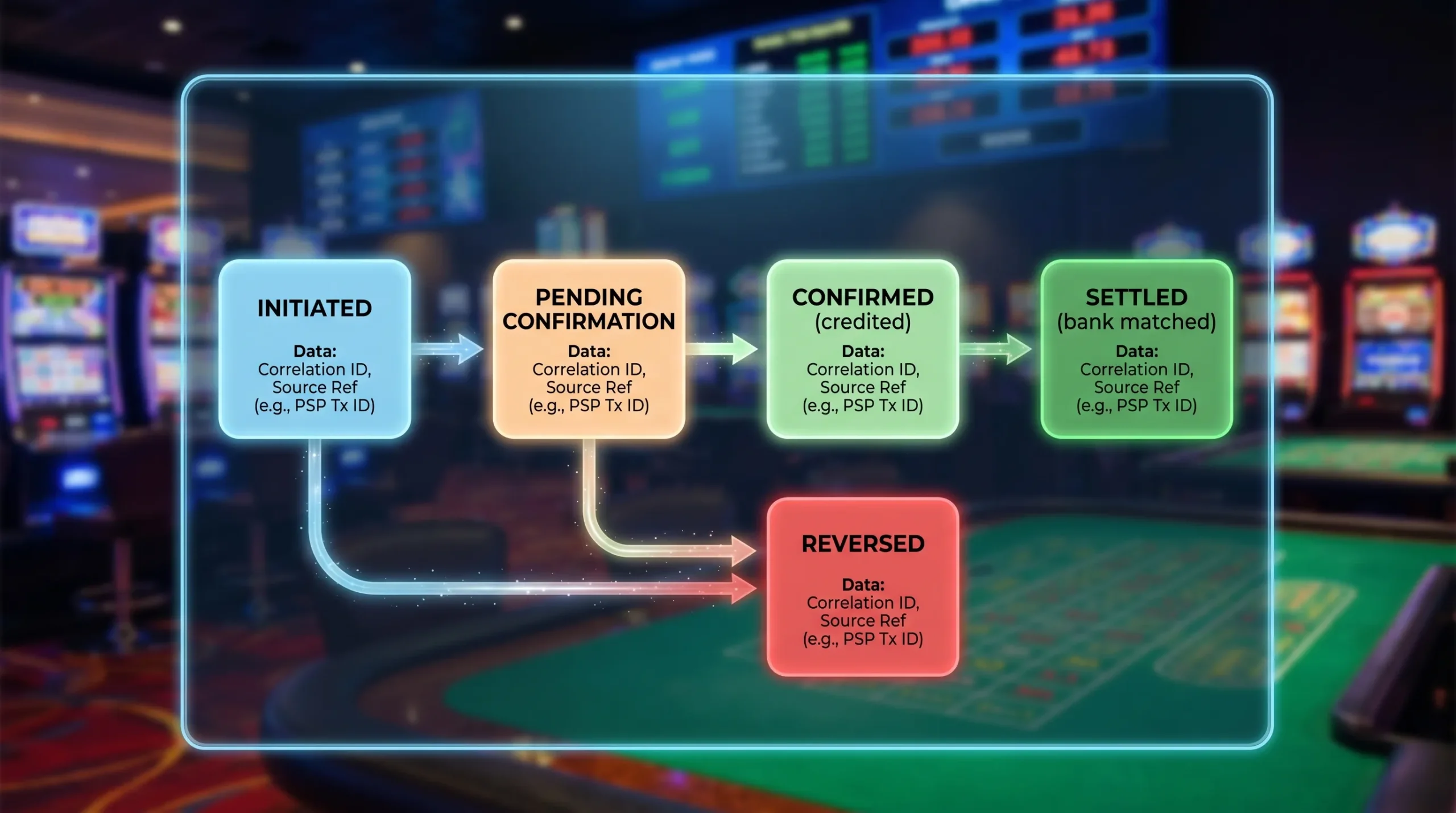
Reversals are where many ledgers become inconsistent because teams mix up four different concepts:
- Reversal: you void a business transaction (usually because it never truly completed).
- Refund: you return funds after a completed deposit or purchase.
- Chargeback: a card scheme dispute that debits you later (often after play).
- Adjustment: a correction posting (bug fix, goodwill credit, manual correction).
Treating these as the same thing creates reporting errors, balance bugs, and weak dispute defense.
The golden rule: do not delete, compensate
If an entry is wrong, you create a compensating entry that cancels it out, and you link them.
A practical pattern:
- Original transaction has
correlation_id = X. - Reversal postings use
correlation_id = Xand includereversal_of_posting_id. - The net sum is zero (or equals the intended correction).
“Reversal-safe” design: idempotency and state machines
A reversal is often triggered by unreliable edges:
- PSP webhooks arriving twice
- A bank transfer that times out
- A crypto deposit detected and later reorged (chain-specific)
- Game callbacks that retry
Your ledger API should enforce idempotency keys so the same business action cannot post twice.
Example (simplified) posting request:
{
  "idempotency_key": "dep_9f8a...",
  "correlation_id": "cashier_intent_1234",
  "reason_code": "DEPOSIT_CONFIRMED",
  "source_reference": "psp_tx_778899",
  "currency": "EUR",
  "amount": "100.00",
  "actor_type": "SYSTEM"
}
Recommended taxonomy: reversal-related operations
| Operation | When it happens | Ledger behavior | Notes |
|---|---|---|---|
| Void / reverse | Payment never completed, game round canceled | Post compensating entries that net to 0 | Common for “pending then failed” |
| Refund | Completed deposit, returned to player | New postings from operator funds back to player | Often includes fees |
| Chargeback | Scheme dispute debits operator later | Post a liability reduction and loss/fee postings | Must link to original deposit |
| Manual adjustment | Support/admin correction | New postings with strict reason codes + admin audit log | Highest governance need |
A mature implementation also separates “player-visible balance” from “cleared balance” (funds available for withdrawal), so reversals and chargebacks do not create negative-balance chaos.
Settlements: connect player activity to real-world money movement
Settlements are the bridge between your internal ledger and external rails:
- Cards and many APMs settle in batches and can be delayed.
- Pay-by-bank and instant rails may confirm quickly but still have reconciliation nuance.
- Crypto is “final” on-chain only after confirmations, and custody choices affect control.
Use clearing accounts to avoid confusing availability with finality
A common, practical accounting structure inside the platform ledger:
- Player wallet account (liability)
- Cashier clearing account (internal suspense)
- PSP receivable account (what PSP owes you)
- Bank account (your actual cash)
- Fees expense account (processing fees)
Simplified flow for a deposit that settles later:
- Player initiates deposit (no posting yet, just a cashier intent state).
- PSP confirms authorization/capture:
- Credit player wallet
- Debit PSP receivable
- PSP settlement batch arrives:
- Credit bank
- Debit PSP receivable
- Post fees as needed
This structure makes it clear what you think happened versus what actually hit the bank.
Settlement patterns by rail (operator reality)
| Rail | Typical confirmation | Typical settlement | Ledger implications |
|---|---|---|---|
| Cards | Near-real-time auth/capture response | Batch, delayed, chargeback risk | Requires chargeback linkage + clearing logic |
| APMs (varies) | Often fast confirmation | Often batch or provider-specific | Fees and references differ per method |
| Pay-by-bank / instant | Fast confirmation | Near-immediate or same-day | Strong references (bank IDs) help matching |
| Crypto deposits | On-chain detection | On-chain finality after confirmations | Must store tx hash, block height, confirmations |
| Crypto payouts | Signed transaction broadcast | On-chain finality after confirmations | Requires custody controls and Travel Rule/KYT workflows where applicable |
Daily close: the settlement checklist that reduces surprises
A daily close is where finance and ops learn whether the platform is “healthy.” A strong ledger design makes this routine.
Key daily close outputs:
- A settlement batch register (per PSP, per currency)
- A three-way match status (ledger vs PSP report vs bank or chain)
- An exception queue with reason codes (missing reference, partial capture, FX mismatch, duplicate webhook)
- A snapshot of liabilities (player balances, pending withdrawals)
Many teams still do parts of this in spreadsheets. If you do, using an AI assistant inside spreadsheet tools can speed up exception classification and narrative writing for audit packs. One example is an AI copilot for Excel and Google Sheets that can help ops teams summarize variances and draft consistent explanations.
Design blueprint: an audit-first ledger data model
You do not need an exotic architecture to get auditability, you need disciplined primitives.
Minimal objects to model explicitly
Account
Represents a bucket of value, for example player wallet EUR, PSP receivable EUR, fee expense EUR.
Posting (journal entry line)
Represents one movement (debit or credit) with metadata.
Transaction (business grouping)
A logical envelope around multiple postings, tied together by correlation_id.
Ledger event log
A stream of state transitions for intents and workflows (deposit intent, withdrawal review, KYC gating), correlated to money.
Concurrency and “exactly once” balance safety
Casino systems are bursty and adversarial. Protect your ledger from:
- Double-crediting on webhook retries
- Out-of-order messages
- Two devices trying to withdraw simultaneously
Common guardrails:
- Idempotency key required on every money-moving call
- Optimistic locking with per-account sequence numbers
- A single writer per account partition (or a deterministic conflict strategy)
- Strict invariants (no negative balance unless you explicitly support credit)
Observability signals that catch ledger issues early
Aim for monitoring that is business-readable:
- Out-of-balance rate (sum debits minus credits should be zero per transaction)
- Duplicate idempotency attempts (attack pressure or broken clients)
- Reversal rate by reason code (PSP instability, UX issues, fraud)
- Settlement lag distribution (P50, P95 time from confirmation to settlement)
- Exception backlog age (finance ops SLA health)
Common failure modes (and how good ledgers prevent them)
Failure mode 1: “We can’t explain the balance”
Cause: postings missing correlation IDs, reason codes, or actor metadata.
Fix: enforce required metadata at the ledger API boundary, not in downstream ETL.
Failure mode 2: “Reversals create negative balances”
Cause: no separation of available vs cleared funds, or reversals applied after withdrawals.
Fix: clearing accounts and withdrawal eligibility rules tied to settlement state.
Failure mode 3: “Settlement doesn’t match, and we don’t know why”
Cause: weak references (missing PSP tx IDs), inconsistent rounding/FX, partial captures.
Fix: store source references on every posting, use deterministic rounding policies, and standardize FX authority.
Failure mode 4: “Manual adjustments become a fraud vector”
Cause: admin tools allow edits without strong governance.
Fix: adjustments must be postings with mandatory reason codes, dual control for large amounts, and immutable audit logs.
Where an integrated iGaming platform helps
Building a ledger is not just an engineering project, it is an operating model. The value of an integrated platform is that payments, wallets, compliance, fraud controls, and reporting can share one consistent money trail.
Spinlab Studio positions its modular iGaming platform around this consolidation, supporting:
- Crypto and fiat payments
- Multi-currency wallets
- KYC and AML compliance workflows
- Fraud prevention controls
- Real-time analytics for operational monitoring
- Open API integration so your internal systems can query and reconcile cleanly
If you are evaluating platforms, ask to see three things in a demo:
- A player timeline that explains every balance change with a reason code
- A reversal flow that creates compensating entries (not silent edits)
- A settlement report that ties PSP batches and bank or chain movements back to ledger entries
Frequently Asked Questions
What is the difference between a casino wallet and a ledger? A wallet balance is a computed view. A ledger is the append-only journal of postings that proves how that balance was formed and supports audit, reversals, and settlements.
Should a casino ledger be double-entry? Yes in practice. Double-entry (or an equivalent debit/credit discipline) prevents value from appearing or disappearing due to bugs, and it makes reconciliation and audits materially easier.
How should we handle reversals without breaking auditability? Never edit history. Post compensating entries that net out the original, and link them with a correlation ID plus explicit reversal references.
Why do we need clearing accounts if players just want instant play? Clearing accounts separate “credited for play” from “settled in the bank.” Without this separation, chargebacks, refunds, and delayed settlement create negative balances and operational disputes.
What settlement data should be stored on ledger entries? At minimum, store the external reference (PSP transaction ID, bank reference, or blockchain tx hash), timestamps, currency, amount, and a settlement status that can be reconciled against provider reports.
Want to review your current ledger and settlement design?
If you are launching or scaling an online casino, the fastest way to reduce payment disputes, support tickets, and audit stress is to make the ledger the single source of truth for every rail, crypto and fiat.
Explore Spinlab’s modular casino platform at spinlab.studio and request a walkthrough focused on ledger correctness, reversals, and settlement workflows.
I have tried several platforms over the years but this one stands out for its reliability. The login process is straightforward and the game library updates regularly. Customer service is always patient and helpful when I need assistance. Really enjoyable experience so far. cagurbetlogin
I have tried quite a few sites in the past but this one stands out for its straightforward approach. No hidden conditions on the bonuses and the customer service team is genuinely helpful. I spend my evenings here and always feel welcome. Definitely worth bookmarking for regular sessions. arplayfortuna
I have been looking for a site with fair rules and quick payouts for a while and this one delivers. The weekly promotions are generous and I never had any trouble cashing out my winnings. Definitely recommend it to friends phsg779