

Buying casino software is one of the first decisions that can quietly decide whether an online casino launches cleanly or spends its first year patching basic operations. New founders often focus on the visible parts of the platform, such as the lobby design, slot games, live casino games, and launch timeline. Those matter, but the costly mistakes usually hide deeper in payments, compliance, wallet logic, data access, backoffice workflows, and contract terms.
The challenge is that many casino software providers sound similar during the sales process. Everyone promises fast launch, game aggregation, mobile support, payment integrations, and scalability. The difference appears when you test real player journeys, ask how edge cases are handled, and calculate what happens after launch when you need new markets, new payment rails, new bonuses, and better fraud controls.
This guide breaks down the most common casino software buying mistakes new founders make, and how to avoid them before signing a contract.
Mistake 1: Shopping for software before defining the operating model
A casino platform is not just a website with games. It is the operating system for deposits, withdrawals, player accounts, bonus rules, compliance checks, affiliate payouts, risk reviews, reporting, and customer support. If you compare vendors before defining how your casino will operate, you are likely to be impressed by the wrong features.
Start with the business model. Are you launching in one market or several? Will you support fiat, crypto, or both? Will you run casino only, or add sportsbook later? Will you need a crypto onramp? Will you manage your own acquisition channels, or rely heavily on affiliates? Will your team need a highly customizable backoffice, or are you comfortable depending on developers for changes?
Founders who skip this step often buy a turnkey casino solution that looks complete but does not fit their actual workflows. For example, a platform might support crypto deposits in a basic sense, but lack the wallet structure, reconciliation tools, or risk monitoring needed for a crypto-ready solution at scale.
A practical first step is to document your must-haves, nice-to-haves, and non-negotiables. If you need a structured starting point, use a casino platform checklist for first-time founders before you begin vendor calls.
Mistake 2: Treating all white label casino platforms as interchangeable
White label casino software can be a smart way to launch faster and reduce build costs, but white label does not mean every provider offers the same depth. Some platforms are essentially skins over rigid infrastructure. Others are modular systems that let you adjust payments, games, markets, bonuses, and admin workflows as the business grows.
The mistake is buying based only on the phrase white label casino platform without asking what is actually included. A founder may assume that game aggregation, payment gateway support, KYC and AML workflows, fraud prevention, analytics, and affiliate tools are all production-ready. In reality, these features can vary widely in quality, configurability, and availability.
Ask vendors to show, not tell. Can you change bonus rules without development work? Can your operations team review withdrawals, documents, and suspicious behavior in the same admin flow? Can you segment players by currency, market, acquisition source, and behavior? Can you add new game providers later without rebuilding the lobby?
A cheap launch can become expensive if the platform is cheap because core systems are missing. The goal is not to avoid affordable casino software. The goal is to avoid buying a low-cost setup that forces you into costly workarounds immediately after launch.
Mistake 3: Underestimating payments, wallets, and reconciliation
Payments are one of the biggest sources of friction in an online casino. New founders often ask whether a provider supports a payment gateway, but that is only the surface. The deeper questions are about deposits, withdrawals, settlement, refunds, chargebacks, failed transactions, bonus balance separation, multi-currency accounting, crypto confirmations, and internal ledger accuracy.
A platform can have a payment integration and still create operational pain. If payment status updates are delayed or unclear, support teams spend hours investigating player claims. If wallet balances do not reconcile cleanly, finance teams lose trust in reports. If crypto and fiat balances are handled inconsistently, risk and compliance reviews become harder.
For crypto-focused founders, wallet and custody questions deserve extra scrutiny. Ask how merchant custodial wallets are handled, how funds are safeguarded, how transaction history is logged, and how suspicious deposit patterns are flagged. If you plan to offer a crypto onramp, confirm how that flow interacts with KYC, AML, limits, fees, and withdrawal rules.
The buying mistake is assuming payments are solved because the sales deck lists logos. In a real-money casino, payments are not a plugin. They are part of the trust layer between the operator, the player, the platform, and the regulator.
Mistake 4: Pushing KYC, AML, and fraud checks until after launch
Compliance is not something to bolt on once the casino has traffic. It affects onboarding, deposits, withdrawals, bonus abuse, market access, payment processing, and long-term brand credibility. Even if you are launching with a lean team, you need to understand how your casino software supports identity checks, document review, sanctions screening, transaction monitoring, limits, and audit trails.
This is especially important if you plan to support crypto. Crypto transactions can introduce risks around source of funds, rapid movement of value, wallet clustering, and jurisdiction exposure. Your platform should help your team detect risky behavior without turning every review into a manual spreadsheet process.
Founders sometimes choose a platform because it gets them live quickly, then discover that compliance tasks require disconnected tools and inconsistent data access. That creates slow withdrawals, poor player experience, and preventable risk. It can also make investor, banking, and partner conversations harder.
This is not legal advice, and requirements differ by jurisdiction. Still, as a buyer, you should treat KYC, AML, and fraud prevention as core platform requirements rather than post-launch admin tasks.
Mistake 5: Choosing a game aggregator by catalog size alone
A large game catalog looks impressive, but volume does not automatically translate into revenue. New founders often chase the biggest number of slot games, the newest branded releases, or a long list of studios. Catalog size matters, but it should be evaluated alongside game quality, provider reliability, market availability, mobile performance, reporting, and promotional tools.
Ask how the game aggregator handles provider onboarding, new game releases, jackpot games, live casino games, lobby categorization, search, favorites, recently played games, and game-level analytics. If your acquisition strategy depends on specific studios or local preferences, confirm availability for your target markets before you sign.
Another missed question is whether the platform supports casino original games or custom-designed games. Originals can help differentiate your brand, especially in crypto casino markets where players often expect fast, simple, provably engaging experiences. But originals only help if they fit your positioning, risk model, and player base.
The right question is not how many games can I launch with? It is whether the game setup supports the player experience, markets, and revenue strategy you actually plan to build.
Mistake 6: Accepting a polished demo instead of testing real workflows
A polished demo can hide workflow gaps. Sales demos often show the cleanest version of the product: a player registers, deposits successfully, claims a bonus, plays a game, and withdraws without friction. Real operations are messier. Players mistype information, deposits fail, KYC documents get rejected, bonuses conflict, affiliates dispute commissions, and fraud patterns emerge.
When evaluating casino software, ask for scenario-based demonstrations. Test the full player journey from registration to withdrawal. Ask the vendor to show what happens when a deposit is pending, a player triggers a risk rule, a withdrawal needs manual review, or a bonus is abused. Watch how the backoffice handles each step.
The best demo questions are specific. Can an admin change a player limit? Can support see payment history and KYC status without switching systems? Can finance export clean reports? Can marketing launch a segmented bonus campaign without developer help? Can the team trace every wallet movement?
Before a purchase decision, compare what you saw against a dedicated casino software demo checklist so your team evaluates workflows, not just screenshots.
| Buying shortcut | Why it creates risk | Better due diligence question |
|---|---|---|
| Choosing the fastest launch | Speed can hide missing controls | What must be configured before accepting real-money players? |
| Comparing only setup cost | Low upfront fees can shift costs to integrations and support | What is included, what is extra, and what requires development? |
| Trusting catalog size | More games do not guarantee better retention | Which providers perform in our target markets and currencies? |
| Assuming payments are simple | Failed deposits and slow withdrawals damage trust | How are wallet balances, settlements, and disputes reconciled? |
| Skipping admin testing | Operators live in the backoffice every day | Can non-technical staff manage bonuses, reviews, reports, and limits? |
Mistake 7: Ignoring the daily backoffice experience
Founders often focus on what players see, but operators spend most of their time in the backoffice. A weak admin panel slows everything down: withdrawals take longer, support lacks context, marketing waits on developers, and leadership cannot see performance clearly.
For a new casino, backoffice usability can be the difference between a lean team and an expensive operations structure. Look for workflows that let your team manage players, payments, bonuses, KYC reviews, affiliate activity, limits, and reports without unnecessary handoffs. A Shopify-like user experience can be especially valuable for founders who want speed and control without building a large technical department from day one.
Real-time analytics also matter. You should be able to understand deposits, withdrawals, game performance, bonus liability, player cohorts, and suspicious activity quickly. If reporting requires manual exports from multiple disconnected systems, your team will make slower decisions and may miss early warning signs.
During vendor evaluation, keep every finding organized. Casino software buying involves legal, finance, compliance, product, marketing, and operations input. A shared project board, such as a Google Workspace project management tool, can help teams track vendor questions, demo notes, contract items, and launch dependencies in one place.
Mistake 8: Not asking enough questions about APIs and integrations
Even if you choose a turnkey casino solution, you are still building a business around it. That business may need CRM tools, analytics tools, affiliate networks, payment providers, blockchain analytics, customer support systems, BI dashboards, marketing automation, or custom front-end experiences.
This is where open API integration becomes important. New founders sometimes assume they will never need custom integrations because the platform is white label. Then growth creates new requirements: a different payment gateway, a new fraud tool, a local affiliate partner, a reporting warehouse, or a custom promotional mechanic.
Ask what the API supports, how authentication works, what documentation exists, and whether there are rate limits or integration fees. Ask how data can be exported and whether you can access raw operational data in a useful format. If the provider controls all data access manually, your reporting and automation options may be limited.
This does not mean every founder needs a highly custom build on day one. It means you should avoid buying a platform that blocks reasonable growth paths.
Mistake 9: Focusing on launch date instead of post-launch scaling
A fast launch is valuable, especially in competitive iGaming markets. But the real test begins after the first deposits. You will need to tune bonuses, improve conversion, manage withdrawals, add payment options, monitor fraud, negotiate game provider performance, support affiliates, and respond to player feedback.
Some founders buy software as if launch is the finish line. They ask how quickly they can go live, but not how quickly they can iterate. Can new payment methods be added without months of work? Can the lobby be updated for seasonal campaigns? Can bonus rules be changed safely? Can the platform handle traffic spikes during promotions? Can the provider support global expansion if the first market performs well?
Scalability is not only server capacity. It is operational scalability. A platform that requires vendor tickets for every small campaign change will slow growth. A platform that does not support multi-currency operations can limit market expansion. A platform without strong analytics can make paid acquisition harder because you cannot understand player value fast enough.
Good casino software should help you launch, learn, and improve. If it only helps you launch, you may outgrow it faster than expected.
Mistake 10: Overlooking bonus, affiliate, and retention mechanics
Acquisition costs in online gambling can be high, and many new casinos rely on bonuses and affiliates to gain traction. Yet founders sometimes treat bonus and affiliate tools as secondary features. That is risky because poorly designed promotions can create bonus abuse, confusing player terms, margin leakage, and disputes with partners.
Ask how the bonus engine handles welcome offers, free spins, reloads, cashback, VIP rewards, wagering rules, excluded games, maximum bet rules, expiry dates, and player segmentation. Ask whether bonus liability is visible in reports. Ask how the platform prevents players from exploiting overlapping promotions.
For affiliates, look beyond whether the system tracks referrals. Ask how commission models work, how fraud is detected, how sub-affiliates are handled, how reporting is shared, and how disputes are resolved. If affiliate data is delayed or incomplete, you may either overpay for low-quality traffic or underpay good partners and damage relationships.
The mistake is treating marketing tools as nice extras. In a casino business, promotions and affiliate workflows directly affect revenue, risk, and brand reputation.
A smarter casino software buying process
The best founders slow down just enough to buy with clarity. They do not spend months in analysis paralysis, but they do create a structured process before committing to a casino software provider.
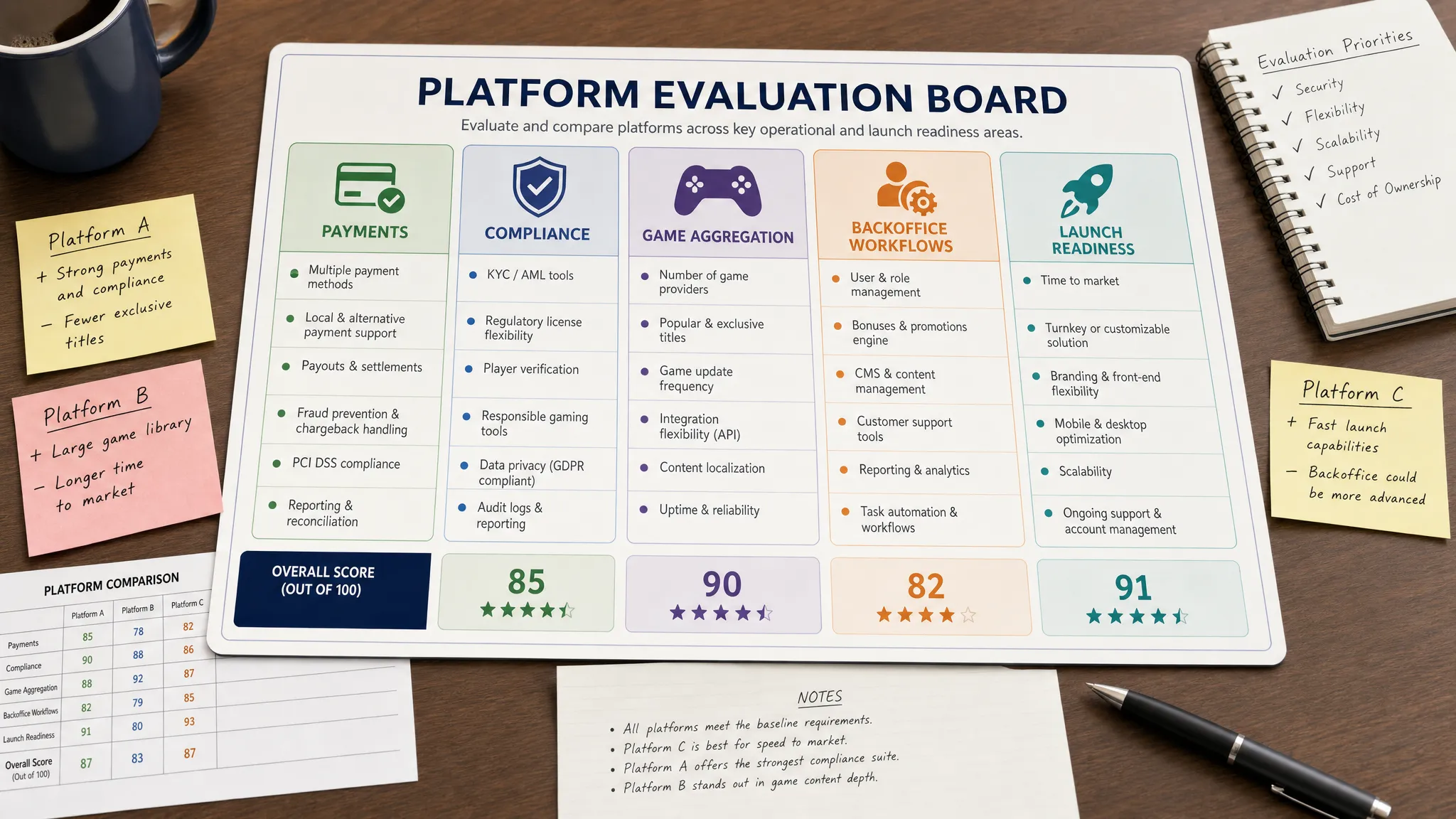
Use a simple evaluation scorecard with categories that reflect your operating model: payments, wallet and ledger logic, compliance, fraud prevention, game aggregation, backoffice usability, analytics, APIs, bonus tools, affiliate management, support, pricing, and contract flexibility. Score each vendor against real scenarios, not vague promises.
Bring the right people into the decision. Even if your founding team is small, review the platform from multiple perspectives: player experience, operations, compliance, finance, marketing, and technical growth. A platform that impresses the founder but frustrates the operator will create problems quickly.
Finally, understand the total cost of ownership. Setup fees and monthly fees are only part of the picture. Consider integration work, payment fees, game provider commercial terms, compliance tooling, support costs, custom development, data access, and the cost of switching later. The cheapest option is the one that gives you the required capabilities without hidden rebuilds, not simply the lowest line item in the proposal.
Spinlab is built for founders who want an all-in-one, modular iGaming platform with crypto and fiat payment support, game aggregation, compliance workflows, fraud prevention, real-time analytics, a customizable backoffice, affiliate and bonus tools, and mobile-optimized player experiences. For lean teams, the goal is to make launching and operating a casino feel more like managing a modern commerce platform than coordinating a patchwork of disconnected vendors.
Frequently Asked Questions
What is the biggest casino software buying mistake new founders make? The biggest mistake is buying before defining the operating model. Without clarity on markets, payments, compliance needs, games, bonuses, affiliates, and team workflows, founders often choose software that looks good in a demo but does not support daily operations.
Is cheap casino software always a bad idea? No. Affordable casino software can be a smart choice for lean founders if the platform includes the core systems needed to operate safely. The risk is choosing a low-cost option that lacks reliable wallets, payments, KYC, fraud controls, analytics, or backoffice tools.
What should I test in a casino software demo? Test real workflows, including registration, KYC, deposit, bonus activation, gameplay, failed payments, withdrawal review, fraud flags, reporting, and admin tasks. Do not rely only on a polished player journey.
Why are payments so important when choosing casino software? Payments affect trust, cash flow, compliance, and player retention. A platform should handle deposits, withdrawals, failed transactions, multi-currency balances, crypto flows, settlement, and reconciliation clearly.
Should a new casino founder choose a white label casino platform or build custom software? A white label casino platform is often faster and more cost-effective for first-time founders, especially when it includes payments, games, compliance, and admin tools. Custom builds may make sense later for highly specialized requirements, but they usually require more capital, time, and technical management.
Launch with software that fits how you actually operate
The right casino software should reduce complexity, not move it from one part of the business to another. Before you buy, make sure the platform can support your payment strategy, compliance obligations, game mix, marketing model, reporting needs, and post-launch growth.
If you are looking for a cost-effective white label casino platform with a modular setup, crypto-ready infrastructure, game aggregation, compliance support, real-time analytics, and a founder-friendly backoffice experience, explore Spinlab and see how quickly your casino concept can move from plan to launch.