

Picture a player who routinely wagers on blackjack. They like the pace, the perceived control, and the low theoretical edge. Yet you know the math—slots deliver 2-3x higher gross gaming revenue per hour than most cash table games. The challenge is not lack of opportunity, but rather how to nudge that blackjack fan toward the reels without killing their engagement or violating responsible-gaming guidelines.
In this playbook we dissect the psychology of cash game loyalists and reveal data-backed behavioral triggers that consistently convert them to slots. We also show how Spinlab’s modular platform lets you automate these triggers, measure lift in real time, and stay compliant in every regulated market.
Why Converting Matters
| Game Type | Average House Edge | Typical Session Length | GGR per Hour (median) |
|---|---|---|---|
| Blackjack (6-deck) | 1.4 % | 21 minutes | $18.60 |
| Roulette (single-zero) | 2.7 % | 18 minutes | $24.10 |
| Video Poker (full-pay) | 0.5 % | 26 minutes | $11.00 |
| Online Slots (mixed RTP 94-96 %) | 4.5 % | 29 minutes | $55.80 |
Source: Spinlab operator benchmarks, Q2 2025; median stake €0.80 per round equivalent.
A 2x–5x revenue delta per hour makes cross-selling irresistible. But poor execution can backfire—players who feel manipulated churn fast or drop ARPU in their primary game. The solution is behavioural science plus granular data.
Step 1. Diagnose Your Cash-Game Segments
Before shoving a 50-spin bundle at every table gamer, segment intelligently:
- Volatility tolerance – derived from bet-sizing variance and session bankroll depth.
- Time-on-device – high session minutes signal stickiness and higher cross-sell receptivity.
- Loss-sequence reaction – how quickly a player lowers stakes after losses predicts tilt sensitivity.
- Reward responsiveness – measured by historical bonus opt-in rate.
Spinlab’s Real-Time Analytics module surfaces these attributes as live traits you can pipe directly into the Bonus & Quest Engine. (See our deep dive on real-time metrics for iGaming profits for the underlying schema.)
Step 2. Choose the Right Behavioral Triggers
Below are seven proven triggers that move the needle. Each maps to one or more cognitive biases and includes field data from Spinlab operators.
| # | Trigger | Core Bias Exploited | How It Works | Median Lift* |
|---|---|---|---|---|
| 1 | Micro-Spin Teaser in Table Lobby | Foot-in-the-door | A single free reel spin appears after a blackjack hand; one click, zero load screen. | 7.8 % more unique slot sessions |
| 2 | Near-Win Highlight Reel | Near-miss effect | Short clip of a recent near-jackpot from a matched volatility slot shown during table shuffle. | 5.4 % CTR to targeted slot |
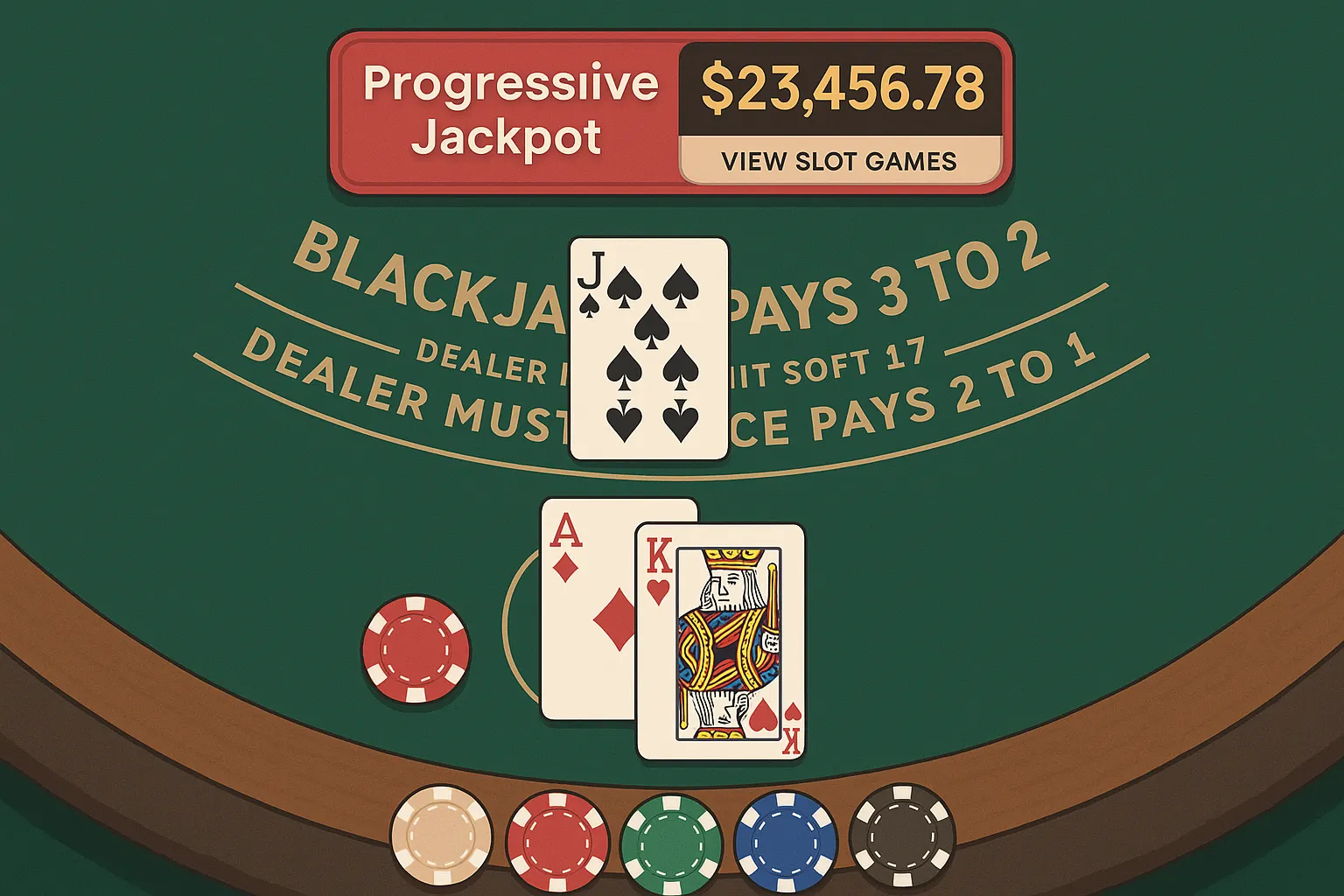
| 3 | Progressive Jackpot Overlay | FOMO | Dynamic ticker sits above chip tray; tap opens qualifying slots list. | 4.9 % lift in first-time slot bets |
| 4 | Endowed Progress Quest | Endowment effect | Players start with “2/10 spins” already completed toward a €5 bonus. | 11.2 % quest completion rate |
| 5 | Wallet Raffle Tickets | Gamification | Every €25 wagered on slots grants a raffle entry visible in real time. | 6.1 % higher slot wager per converted user |
| 6 | Loss-Limit Mood Shift | Loss aversion | After three consecutive losing blackjack rounds, offer 20 low-volatility spins to “reset luck” (no extra cost to player). | 3.3 % lower table-game churn, 8.2 % lift in slot adoption |
| 7 | Social Proof Carousel | Bandwagon effect | “Players like you just won €X on [Slot Name]” personalised by bet size. | 6.5 % click-through |
*Median observed across 14 Spinlab clients, Jan–Jun 2025. All lifts are versus hold-out cohorts, 95 % confidence.
Implementation Tips
- Latency matters. The teaser spin must launch in <450 ms or table immersion breaks. Spinlab’s preload API lets you embed slot resources invisibly during card shoe shuffle animations.
- Respect regional rules. Some regulators limit bonus advertising within live tables. Use Spinlab’s geo-fencing flags to disable overlays in sensitive jurisdictions automatically.
- Volatility matching. Offer low-variance slots to risk-averse video poker players; deliver high-volatility, high-cap titles to roulette chasers. Spinlab’s game catalogue tags every release by RTP, hit rate, and volatility index.
Step 3. Automate Cross-Sell Journeys
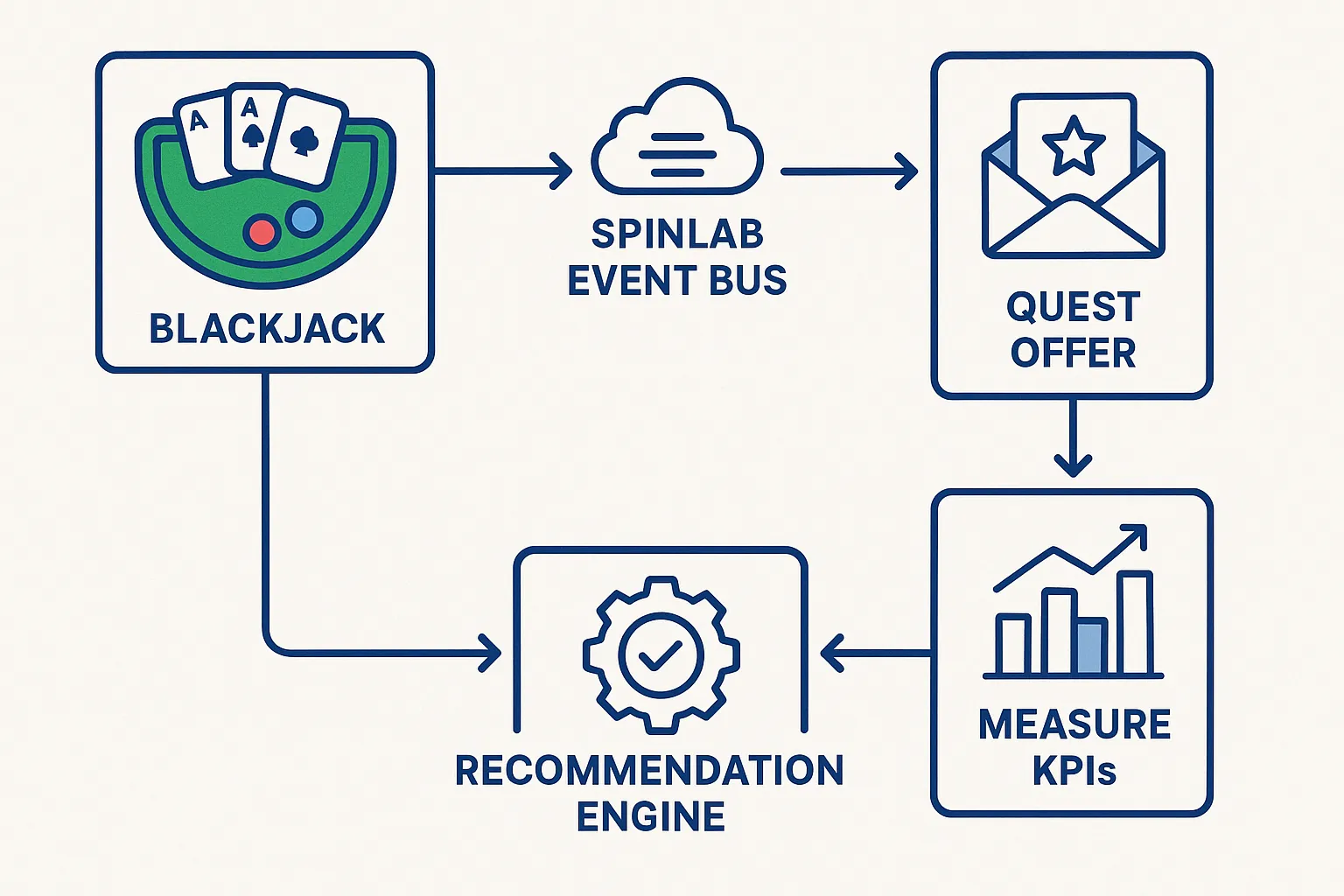
- Event Listener: A player satisfies a trigger condition (e.g., 3 straight losses).
- Rule Evaluation: Spinlab’s Bonus Engine confirms AML/RG flags are green.
- Offer Generation: A personalised free-spin bundle or quest token appears.
- Real-Time Tracking: The Analytics stream records acceptance, completion, NGR and session shift.
- Feedback Loop: Machine-learning model adjusts future offer size based on LTV delta.
Developers can wire this flow via a single webhook call or deploy our no-code journey builder—think Shopify App-like simplicity tailored to iGaming. (See Cashier Conversion Hacks for a similar 3-second execution pattern.)
Case Snapshot: Fullhouse Casino
Fullhouse migrated to Spinlab in 2024 with a 68 % revenue split between live baccarat, blackjack, and roulette. Within eight weeks of deploying three of the triggers above—Micro-Spin Teaser, Endowed Progress Quest, and Social Proof Carousel—the operator saw:
- 19 % of weekly active table gamers place at least one slot bet.
- An incremental €0.94 net gaming revenue per active table user, net of bonus cost.
- No statistically significant increase in self-exclusion or RG flag rates (monitored via Spinlab’s responsible-gaming dashboard).
For the full blueprint see our scaling case study.
Step 4. Measure What Matters
| KPI | Definition | Target Benchmark |
|---|---|---|
| Cross-Sell Activation Rate | Table players who complete ≥1 slot spin within 24 h of trigger | 14 %+ |
| Incremental Slot NGR | Additional slot NGR minus promo cost per triggered user | €0.70+ |
| Primary Game Retention | 7-day retention of table activity post cross-sell | ≥95 % baseline |
| RG Flag Delta | Change in net new RG events vs control | ≤0.5 pp |
Spinlab’s dashboards refresh each KPI in under 3 s, allowing on-the-fly A/B test pivots. Read how to interpret Active Player Value and Cash-Flow at Risk for deeper insight.
Compliance and Responsible Gaming
Cross-sell initiatives invite extra scrutiny. Best practice:
- Explicit opt-ins for any bonus that changes RTP display.
- Dynamic stake caps on free spin offers tied to player affordability checks.
- Automated cooling-off messages if both table and slot activity exceed pre-set intensity thresholds.
Spinlab’s compliance layer provides pre-built rule templates for UKGC, MGA, and Ontario AGCO, ensuring you can run behavioural triggers without risking sanctions.
What’s Next: AI-Curated Reel Journeys
In Q1 2026 Spinlab will launch a slot recommendation service powered by on-device deep learning. It blends wager velocity, emotional sentiment (via gameplay telemetry), and external taste graphs to serve Netflix-style carousels inside table lobbies. Early closed-beta data shows a further 4-6 % cross-sell lift. Operators can join the beta waitlist today.
Frequently Asked Questions
Isn’t converting players to slots cannibalising profitable table revenue? Real-world data shows overall revenue per user rises because table play dip is marginal (<2 %) while slot GGR adds incremental margin.
How do I avoid overwhelming players with pop-ups? Use progressive disclosure—micro-spin teasers appear only after natural pauses, and frequency capping ensures no more than one offer every 30 minutes.
Does this strategy work for high-rollers? Yes, but tailor volatility and bonus value. VIP table players respond better to high-cap jackpot promotions than to low-stake free spins.
What tech resources do I need? If you are on Spinlab’s Fullhouse stack, you only need to configure triggers in the back office. All data streams, wallets, and bonus logic are already integrated.
Ready to watch your table gamers spin up a new revenue stream? Schedule a 30-minute demo to see how Spinlab’s Bonus & Quest Engine can deploy every trigger in this playbook—no additional dev work, fully compliant, and crypto-ready out of the box.