

Testing payment flows can make or break an online-casino launch. If your first real-money deposit fails, you lose a customer forever. That is why every serious operator builds a robust sandbox that covers both card rails and blockchain rails before going live. In this guide you will learn how to create a sandbox environment for PSP test cards and crypto faucets, how to automate realistic edge-case scenarios, and how to leverage Spinlab’s modular platform to shorten certification timelines.
Why a Dedicated Sandbox Matters
- Zero-risk validation. You can simulate thousands of deposits, withdrawals, and chargebacks without touching real funds.
- Faster iteration. Engineers, QA, compliance and product teams work in parallel on isolated data sets.
- Lower certification cost. Most PSPs and blockchain auditors require reproducible test evidence. A reusable sandbox eliminates ad-hoc manual screenshots.
- Better fraud resilience. You can pre-train machine-learning models and rule engines with synthetic attack patterns before they appear in production.
According to the 2025 Merchant Risk Council Annual Report, merchants that maintained a full-coverage sandbox reduced post-launch payment incidents by 38 percent compared with peers who relied on production “canary” tests.
Core Building Blocks of an iGaming Payment Sandbox
| Component | Purpose | Typical Tools |
|---|---|---|
| Test PSP Gateway | Simulate card deposits, 3-DS challenges, declines, chargebacks | Stripe test mode, Adyen test env, bespoke BIN mocks |
| Card Test Suite | Catalog of PANs covering success, AVS mismatch, insufficient funds, etc. | Visa & Mastercard public docs, PSP sample data |
| Blockchain Testnet | Mirror on-chain cashier flows without real value | Bitcoin Testnet, Ethereum Holesky, Polygon Mumbai |
| Crypto Faucet | Drip test tokens or stablecoins to player wallets | Public faucets, self-hosted node with faucet script |
| KYC & Fraud Stubs | Emulate identity verification and risk scores | Mock API returning configurable status codes |
| Real-Time Log Stream | Unified view of all sandbox events | ELK stack, Datadog, Spinlab Analytics preview |
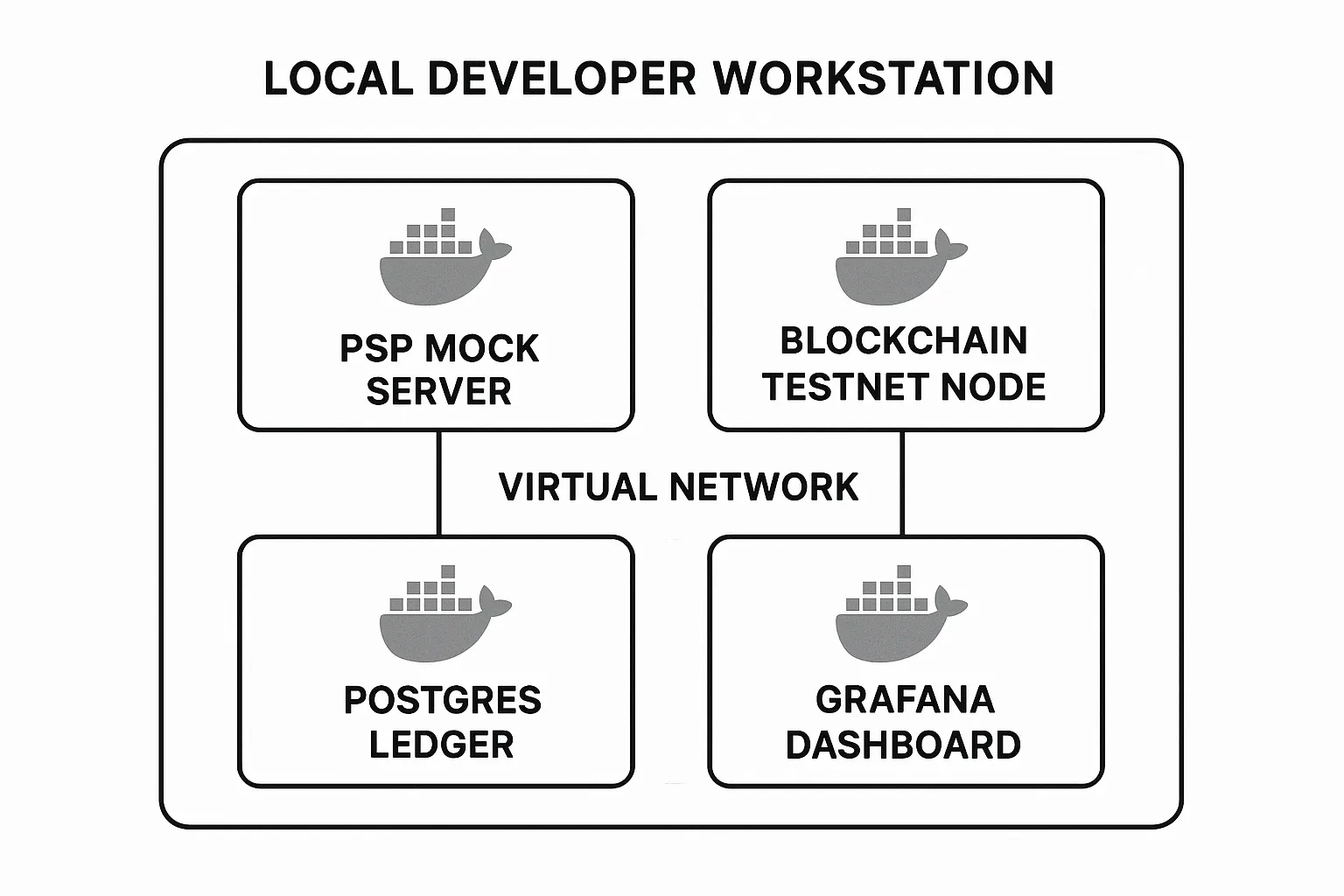
A useful sandbox mirrors production architecture as closely as possible. Spinlab clients typically run one Docker compose file that spins up:
- A PSP mock server exposing
/v1/charge,/v1/refund, and/v1/3ds/challengeendpoints. - A lightweight Ethereum testnet node (Geth or Hardhat) seeded with 10 ETH in a faucet account.
- A Postgres ledger replica for reconciliation testing.
- Grafana dashboards connected to Spinlab’s streaming events so analysts can watch synthetic traffic in real time.
Step 1 – Provision PSP Test Cards
PSPs publish BIN-level and PAN-level test numbers that trigger deterministic responses. Table 1 lists common patterns you should script into your automated suite.
| Scenario | Visa Test PAN | Mastercard Test PAN | Expected Outcome |
|---|---|---|---|
| Successful auth & capture | 4111 1111 1111 1111 | 5555 5555 5555 4444 | HTTP 200, status = approved |
| Insufficient funds | 4000 0000 0000 9995 | 5555 5555 5555 6654 | HTTP 402, code = insufficient_funds |
| Lost/stolen card | 4000 0000 0000 9987 | 5555 5555 5555 5599 | HTTP 403, code = pickup_card |
| 3-D Secure 2 frictionless | 4000 0000 0000 3220 | 5454 5454 5454 5454 | Redirect → 3DS, result = authenticated |
| Hard decline (do not retry) | 4100 0000 0000 0019 | 5585 5585 5585 5585 | HTTP 402, code = do_not_honor |
Source: Visa Developer Center, Mastercard Developers, retrieved October 2025.
Implementation tips:
- Rotate CVV and expiry values in each run to avoid caching artefacts in PSP gateways.
- Cover regional quirks such as AVS responses where the address check passes but ZIP fails.
- Simulate network blips by injecting timeouts or 5xx responses using tools like toxiproxy.
For an end-to-end Spinlab integration you would:
- Open the Payments > PSP Connections tab in the admin panel.
- Toggle “Sandbox” and paste your PSP test API keys.
- Upload the YAML test-case file generated from the table above.
- Run
spinlab-cli test payments --env sandboxto execute all cases in under 60 seconds.
Internal resource: Read the optimisation tactics in “Cashier Conversion Hacks: Optimizing Deposit Forms for 3-Second Checkout” for UX considerations during sandbox runs.
Step 2 – Spin Up a Crypto Testnet and Faucet
Card testing covers fiat rails, but crypto is now responsible for 34 percent of iGaming GGR (SoftSwiss Q2-2025 report). A sandbox must therefore mimic on-chain deposits, internal ledgers, and withdrawals.
Selecting the Right Testnet
| Mainnet | Recommended Testnet | Average Confirmation | Faucet Availability |
|---|---|---|---|
| Bitcoin | Bitcoin Testnet (signet) | 10 min | Public faucet, limited supply |
| Ethereum | Holesky (Sep 2023+) | 2 – 3 sec (PoS) | Many, ample ETH |
| Polygon | Mumbai | 3 – 4 sec | Public & private |
| Solana | Devnet | < 1 sec | High throughput, low queue |
For stablecoin flows you can deploy test USDC contracts on Holesky or mint dummy ERC-20 tokens. Spinlab’s open-API cashier can be pointed at any RPC endpoint you define in Settings > Crypto Nodes.
Operating Your Own Faucet
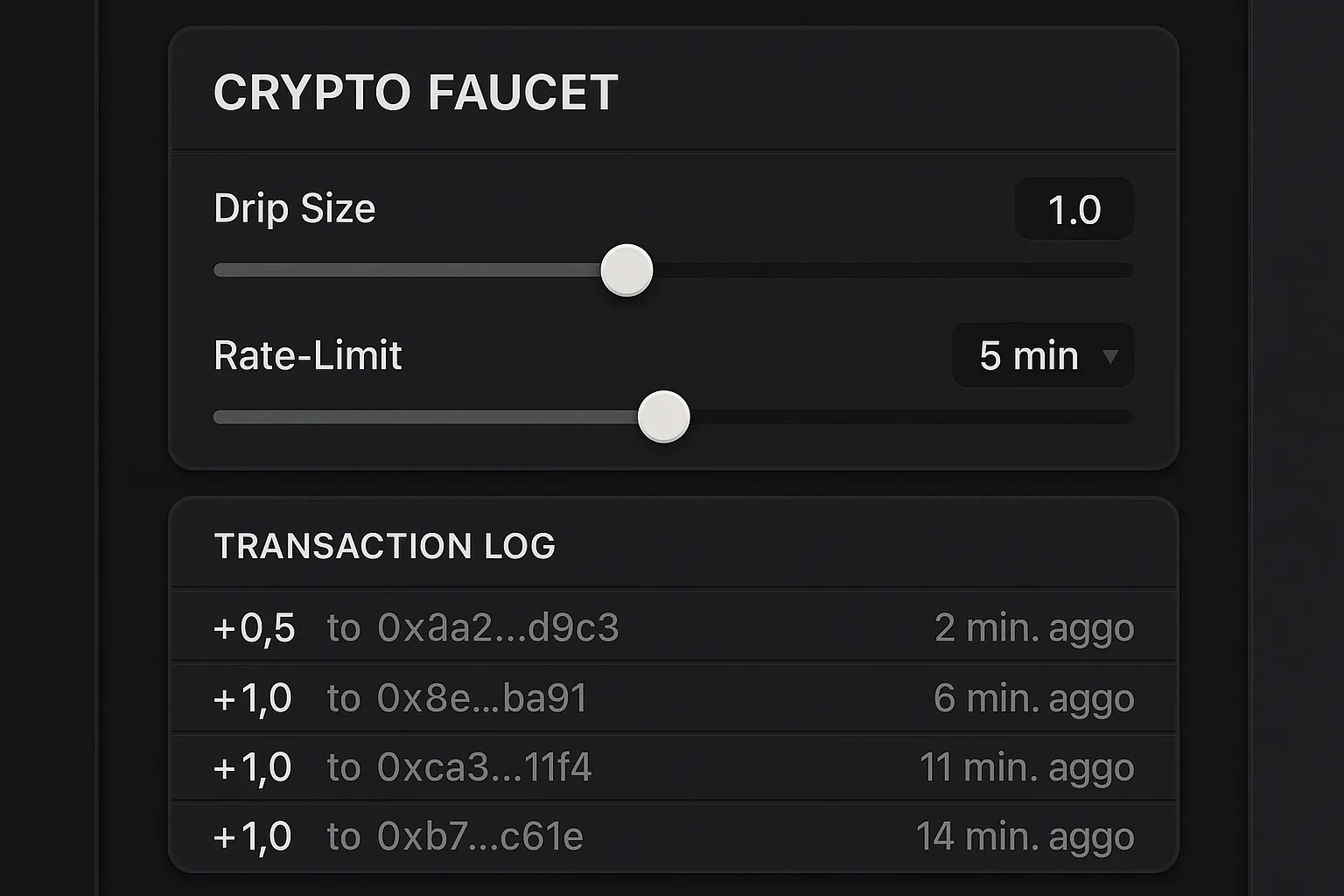
Public faucets often impose strict rate limits and may run dry. Running a private faucet provides:
- Guaranteed liquidity for parallel tests.
- Adjustable drip amounts to match real deposit brackets.
- API hooks so CI jobs can request funds on demand.
A minimal Hardhat script:
// faucet.js
import { ethers } from "hardhat";
const faucet = async (to, amount) => {
  const \[owner\] = await ethers.getSigners();
  await owner.sendTransaction({ to, value: amount });
  console.log(\`Dripped ${ethers.utils.formatEther(amount)} ETH to ${to}\`);
};
export default faucet;
Call it from your GitHub Actions workflow before executing deposit tests.
Important: Tag all faucet transactions with a memo—test_integration_<build_id>—so your on-chain analytics can filter them out when you graduate to staging.
For deeper insight into faucet economics, revisit “Crypto Faucet Promotions: Do They Attract Depositors or Freebie Hunters?”.
Step 3 – Wire Everything Together in a Unified Test Matrix
Creating siloed PSP and crypto tests is easy. The real challenge is orchestrating multi-rail scenarios: a player deposits with a test Visa card, wins on a slot, swaps chips to USDC, and withdraws on Solana Devnet. The matrix below shows a condensed version used by Spinlab’s QA team.
| Test ID | Ingress Rail | Currency | Mid-Game Action | Egress Rail | Expected Ledger Delta |
|---|---|---|---|---|---|
| T-001 | Visa success | USD | Play slots (RTP 96 %) | Visa refund | ±0 (play money) |
| T-009 | Visa decline | USD | N/A | N/A | Deposit blocked |
| T-014 | BTC testnet | tBTC | Provably Fair dice | USDC (ERC-20) | ‑0.2 % FX fee |
| T-022 | USDC (Holesky) | USDC | Crash game 2× cashout | SOL | Payout minus network fee |
| T-037 | ETH (low gas) | ETH | Swap to in-game credits | ETH | Failure – gas too low |
Automate the matrix using a test runner such as Playwright, then stream events into Spinlab’s real-time analytics. If you already run Apache Kafka for production, simply create a sandbox topic and patch environment variables so no traffic reaches compliance or CRM tools.
Step 4 – Automate Regression in CI/CD
- Containerise everything. Your
docker-compose.test.ymlshould spin up PSP mocks, blockchain nodes, and Spinlab micro-services in minutes. - Seed data on every run. Use SQL fixtures for players and Hardhat scripts for wallets so tests are deterministic.
- Gate merges. A pull request must not deploy to staging unless all payment scenarios pass in the sandbox.
- Snapshot gas and fee metrics. Regression alerts fire if average confirmation time or PSP approval rates deviate more than 5 percent week-on-week.
This practice mirrors the advice in “8 Signs Your Casino Tech Stack Is Stunting Growth—and How to Fix It.” Continuous payment testing is one key remedy.
Common Pitfalls to Avoid
- Leaving test PANs in production. An auditor will fail you instantly. Use environment guards that reject any BIN listed as test-only.
- Faucet abuse. Without CAPTCHA or API keys your private faucet can be drained. Throttle by IP and wallet age.
- Ignoring 3-DS v2 whitelists. Some issuers bypass challenges for trusted beneficiaries. Simulate both frictionless and challenge flows.
- Hardcoding RPC URLs. Use environment variables so you can switch from Holesky to Sepolia or a local Ganache node with zero code edits.
- Skipping negative paths. Declines, network errors, gas exhaustion and chain re-orgs must all be covered.
Security and Compliance Considerations
• PCI DSS scope remains even in sandbox if you store PANs, albeit truncated. Spinlab’s Payment Hub tokenises card data on ingest to keep your environment out of scope—see our PCI guide for details.
• AML Monitoring. Regulators expect that your test flows cannot be weaponised for money laundering. Use value caps and allow-listed wallet addresses.
• Data segregation. Never mix synthetic player IDs with production marketing databases; anonymise all logs.
• Audit trail. Archive sandbox events for at least 90 days so you can demonstrate test coverage during licensing inspections.
Internal link: “PCI DSS for iGaming: A Plain-English Compliance Guide for 2025”.
When to Graduate From Sandbox to Staging
- Pass 100 percent of the payment matrix for three consecutive CI runs.
- Achieve latency and approval KPIs within 10 percent of production targets.
- Obtain sign-off from Compliance that KYC/AML stubs cover all regulatory obligations for your target licence (see the Curaçao vs Anjouan comparison guide).
- Freeze sandbox data fixtures; future tests run against tagged versions.
Some operators keep the sandbox alive post-launch for hotfix verification and PSP certification renewals. With Spinlab’s pay-as-you-scale model, you can spin additional sandboxes at marginal cost—ideal for A/B testing new cashier UX without risking revenue.
Final Thoughts
A well-architected sandbox pays dividends far beyond the first go-live date. It slashes payment bugs, accelerates feature velocity, and arms compliance officers with hard evidence. By pairing PSP test cards with crypto faucets you create a single, deterministic playground that mirrors the hybrid cashier reality of modern iGaming.
If you want to see how Spinlab’s Shopify-style interface can provision a full sandbox—including card mocks, blockchain testnets, and real-time dashboards—in under 15 minutes, book a demo with our solutions team today.