

Fraud teams in online casinos fight an asymmetric battle. Attackers can spin up new emails, swap SIMs, use VPNs and virtual machines, and rinse introductory bonuses at scale. Operators, on the other hand, must protect payments, promotions, compliance, and experience without blocking legitimate players. Device fingerprinting is one of the few techniques that tilts the field back toward the house. This primer explains what it is, how it works in iGaming specifically, where it fails, and how to deploy it responsibly and effectively on a modern casino platform.
What is device fingerprinting?
Device fingerprinting is the process of collecting a set of device and environment signals, then computing a stable identifier or risk score that helps determine whether two sessions likely come from the same device, even if cookies are deleted or accounts change. In iGaming, the goal is not advertising personalization, it is fraud prevention and compliance. Fingerprints are combined with behavioral data, payments telemetry, KYC outcomes, and historical labels to prevent multi‑accounting, bonus abuse, chargebacks, stolen-card testing, botting, chip dumping, and self‑exclusion evasion.
Two practical approaches coexist:
- Deterministic fingerprinting, relies on high-stability signals, for example mobile app attestation or a persistent hardware attestation token. This is strongest in native apps.
- Probabilistic fingerprinting, relies on a blend of weaker signals, for example IP ASN, browser and GPU characteristics, time zone, and language. This is more common on the mobile web and desktop browsers.
Fingerprints should be treated as signals into a risk model, not as a single source of truth. Browsers change, networks rotate, and privacy features are designed to reduce cross‑site tracking. Your design must degrade gracefully.
Why casinos rely on it
- Stop bonus abuse and multi‑accounting, cluster signups by device profile to cap offers per device or household.
- Reduce payment fraud, link first‑time deposits and declines to known risky device clusters and step up to 3DS, open banking, or crypto onramp.
- Protect withdrawals, hold or review payouts if the withdrawal device does not match the deposit or gameplay devices.
- Filter bots and automation, detect headless or scripted sessions during registration, KYC upload, and slot play.
- Strengthen responsible gambling controls, block re‑registration attempts from self‑excluded devices, while following regional legal bases.
The signals that matter in iGaming
Below is a practical map of signal categories, how they help casinos, and their caveats. Use a mix to reduce collision and evasion.
| Signal category | Examples | Use in iGaming | Caveats |
|---|---|---|---|
| Network | Public IP, ASN, geolocation, carrier vs Wi‑Fi, proxy/VPN heuristics | Geo and licensing compliance, velocity checks, household rules | NAT creates crowding, VPNs and mobile carriers rotate IPs |
| TLS fingerprint | JA3 or JA4 hash of TLS ClientHello | Bot and automation detection, unusual stacks and headless browsers | Version updates change hashes, requires server-side capture |
| Browser/env | User agent, Accept headers, language, time zone, platform, screen size | Cross-check for consistency with geo and profile data | User agents are spoofable, privacy features reduce entropy |
| Rendering | WebGL vendor/renderer, canvas/audio hash, font list | Detect emulators and large bot farms with identical GPUs | Safari and privacy tools randomize, upgrades change values |
| Storage | First‑party cookies, localStorage, IndexedDB presence | Session continuity, soft persistence between visits | Users clear storage, ITP caps lifetimes |
| Mobile attestation | iOS App Attest, DeviceCheck, Android Play Integrity | Detect tampering, rooted devices, cloned app builds | App only, platform policies apply |
| Behavior | Typing cadence, pointer path, submit timings | Bot and script detection during signup and cashier | Accessibility concerns, tune thresholds carefully |
Do not rely on any single signal. Your fingerprint should be a salted, versioned composite that supports rotation without orphaning historical labels.
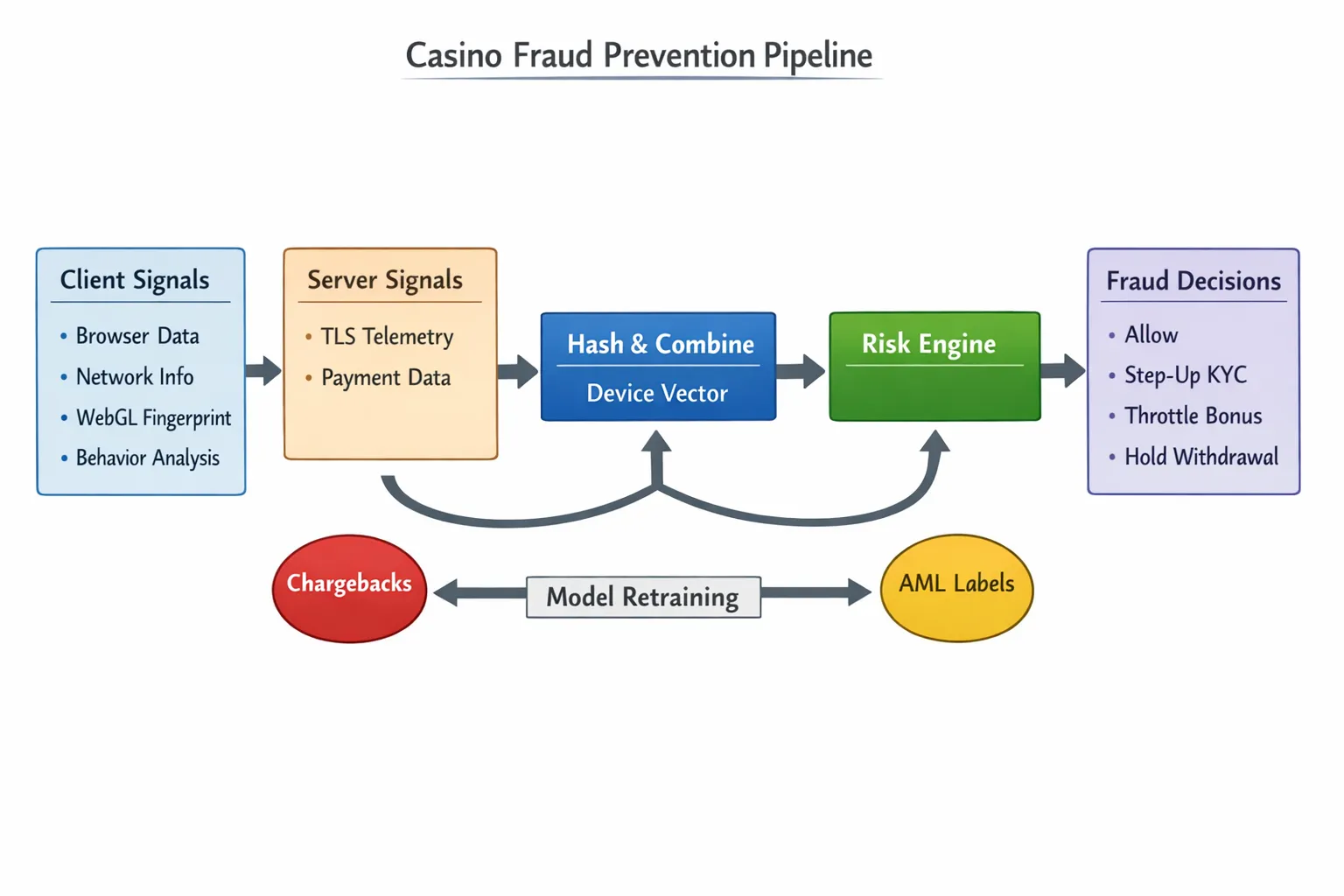
Architecture blueprint for casinos
Where to collect
- Client side, registration, login, cashier, KYC upload, and during sensitive promo pages. Use lightweight collectors with progressive enhancement so the UI remains fast if signals are blocked.
- Server side, add IP, ASN, TLS fingerprint, and payment gateway telemetry. Store the minimal raw data required to reproduce a fingerprint and audits.
Building the device graph
- Create a device entity in your player graph that links many accounts, sessions, and payment instruments to the same fingerprint cluster. Track recency and frequency, not just a static ID.
- Maintain a household construct, for example IP plus ASN plus coarse geo. This prevents over‑blocking roommates or families that share a connection. Treat household caps and device caps separately.
Real‑time decisioning
- Compute a risk score at key moments, signup, first deposit, bonus claim, withdrawal request, device change.
- Plug outcomes into actions, allow, silent friction like Turnstile, step‑up KYC, limit bonus eligibility, delay withdrawal, manual review, or hard block. Keep actions proportional and audit every decision.
Storage and privacy
- Hash and salt sensitive attributes before persistence. Rotate salts on a schedule and version your schemas so you can re‑compute fingerprints deterministically when required.
- Enforce data minimization, separate storage for raw and derived data, short retention for high‑entropy raw values, longer retention for derived device IDs with purpose limitation to fraud prevention.
Handling modern browser privacy features
Safari’s Intelligent Tracking Prevention, Firefox Enhanced Tracking Protection, and Chrome’s Privacy Sandbox reduce cross‑site tracking and randomize or limit access to high‑entropy APIs. That is a feature, not a bug. To cope:
- Prefer server‑side and network‑level signals that are not blocked by client privacy settings, for example TLS, ASN, rate limits.
- Accept lower persistence on web, favor confidence scores over strict binary matches, then use step‑up journeys when confidence is low.
- Invest in native apps for higher‑risk flows where allowed, mobile attestation provides stronger device integrity.
Payment and KYC synergy
Device fingerprints are most powerful when joined with cashier and KYC data:
- Link first‑time deposits to device clusters, new device plus high‑risk PSP BIN plus VPN equals step‑up 3DS or switch to open banking. On crypto, enforce whitelists and Travel Rule checks for self‑custody.
- Require additional KYC when a withdrawal is requested from a device that never deposited or played, this is a common mule pattern.
- Feed KYC outcomes, approval, rejection, suspected forgery, back into the device graph so future accounts from the same cluster trigger stricter flows.
Spinlab’s modular iGaming platform already wires these pieces together, device and network signals, a hybrid cashier with crypto and fiat rails, KYC and AML checks, and a real‑time analytics layer, so operators can act on risk in milliseconds rather than hours.
Measuring effectiveness
Track a small set of program KPIs, report them weekly, and tie them to dollars:
- Coverage rate, percent of sessions where a fingerprint is computed within latency targets.
- Match persistence, median days a device remains linkable across logins and cookie clears.
- Collision rate, percent of distinct devices that collide to the same ID, lower is better.
- Lift over baseline, reduction in bonus abuse and payment fraud versus a rules‑only control.
- False positive rate, percent of legitimate players who experienced unnecessary friction.
Bring outcomes back to model training, especially chargebacks, confirmed multi‑account clusters, SAR or STR filings, and reversed withdrawals. Label quality matters more than model complexity.
Common pitfalls and how to fix them
- Over‑blocking shared networks, dorms and offices create many players behind the same NAT. Separate household caps from device caps, and allow frictionless verification to unlock limits.
- One‑time checks only, attackers adapt quickly. Re‑evaluate device risk at key moments like big bonus claims and high‑value withdrawals.
- Storing raw fingerprints indefinitely, hash and salt, then rotate. Keep the raw minimum for audit windows only.
- Treating fingerprints as identities, device signals support decisions, they do not replace KYC or responsible gambling checks.
- Ignoring accessibility, behavior models can penalize screen readers or assistive tech. Whitelist known accessibility patterns and monitor bias.
Compliance, consent, and audits
This article is informational, not legal advice. In many jurisdictions, device fingerprints are considered online identifiers, which are personal data when linked to a person. Practical guidance that usually applies:
- Fraud prevention purpose, document a legitimate interest or equivalent legal basis where applicable, complete a DPIA, and publish clear disclosures.
- ePrivacy and consent, where fingerprinting is not strictly necessary for security, consent may apply in some countries. Work with counsel to set region‑specific banners and flows.
- Data subject rights, ensure you can respond to access and deletion requests related to derived device IDs without undermining security. Pseudonymization and purpose limitation help balance these duties.
- Regulator expectations, many gambling regulators expect effective, auditable fraud controls. Keep change logs, test evidence, and decision explanations for inspections.
Quick‑start implementation checklist
- Define objectives and guardrails, for example reduce bonus abuse chargebacks without increasing false positives above a defined threshold.
- Select collection points, registration, deposit, withdrawal, and promo claim pages. Add server‑side TLS and ASN capture.
- Choose a feature set, start with network, browser, and rendering signals, then layer in behavior and attestation where available.
- Build a scoring policy, map risk bands to actions and step‑ups. Document review playbooks for edge cases.
- Integrate with payments and KYC, route risky flows to stronger rails and verification. Log everything in real time.
- Measure and iterate, report coverage, persistence, collisions, false positives, and financial impact. Schedule monthly salt rotation and quarterly model reviews.
Entering new markets, why local expertise still matters
Fraud patterns, onboarding norms, and regulatory expectations vary by region. If you expand your wider business footprint into hubs like the UAE for non‑gaming operations, work with local specialists on licensing, documentation, and banking. For example, operators with ancillary or B2B activities often lean on dedicated advisors that handle end‑to‑end setup, a service like Dubai Invest, your gateway to business setup and investing in Dubai from Australia illustrates how cross‑border consultancy streamlines entity formation and ongoing administration. Pair commercial expansion with a region‑aware fraud posture and data processing assessment.
How Spinlab helps
Spinlab’s all‑in‑one, modular iGaming platform gives operators a practical path to production:
- Advanced fraud prevention, capture client and server signals, unify them in a device graph, and act in real time with configurable rules.
- KYC and AML compliance, plug step‑ups into identity and transaction monitoring so risky devices face stronger checks.
- Hybrid cashier with crypto and fiat, route risky deposits to safer rails, apply throttles on bonuses and withdrawals, and record auditable decisions.
- Real‑time analytics dashboard, monitor coverage, false positives, and fraud saves as they happen, not at end of week.
- Open API integration, bring your preferred signal vendors and data science notebooks, keep your data portable and your options open.
If you want to deploy device fingerprinting without slowing down your signup to first‑deposit journey, schedule a strategy call with our team. We can activate collection, scoring, and actions in days, then tune rules with your fraud analysts as new patterns emerge.
Key takeaways, fingerprints are powerful when used as risk signals, not as static IDs, server and client data together are more resilient, payment and KYC context turbocharge precision, privacy by design reduces regulatory risk, and measurement keeps your model honest. With a platform that ties these threads together, you can cut abuse, protect margins, and keep genuine players moving at full speed.