

Most casinos still treat the game lobby like a static catalog: “New,” “Popular,” and a grid that looks the same for everyone. But the lobby is one of the highest-leverage surfaces you own. The first 10 to 30 tiles a player sees can determine what they try next, how fast they get to first spin, and whether their session turns into meaningful Gross Gaming Revenue (GGR) or a quick bounce.
Game lobby personalization is the discipline of ranking slots (and other games) per player and per moment, using data you already have (history, device, geo, bankroll patterns, promo eligibility, compliance rules) to maximize value while keeping risk and responsible gaming (RG) under control.
What “ranking slots” actually means (and why it lifts GGR)
In practice, ranking is not “recommendations” in the abstract. It is an ordered list with business consequences.
A good ranking system improves four upstream drivers that compound into GGR:
- Lobby CTR: more players click into a game.
- Time to first spin: less browsing, faster wagering.
- Session depth: more spins per session and more sessions per week.
- Retention and return behavior: players come back because the lobby “gets them.”
The subtle part is that your optimization target is rarely pure GGR. Most operators should optimize incremental NGR (after bonuses, provider costs, and fraud/RG leakage) and use GGR as a primary leading indicator.
The minimum data you need to personalize a slot lobby
You do not need a PhD model to start. You need consistent inputs.
Player signals (who is this?)
Examples that tend to be reliably predictive:
- Game history: last played, most played, last 7/30-day category mix
- Spend signals: average bet, deposit frequency, typical session length
- Volatility tolerance proxy: preference for high-volatility titles vs steadier games
- Lifecycle stage: new, first depositor, returning, VIP, lapsing
- Bonus state: active wagering, eligible offers, recently redeemed offers
Context signals (what moment is this?)
“Same player, different moment” is where many lobbies fail.
- Device and network: low-end Android on 4G vs desktop fiber
- Time and day: payday windows, late-night micro-sessions, weekend long sessions
- Geo and currency: market-specific preferences and compliance constraints
Game metadata (what are we ranking?)
You need clean tags (manual or automated) for:
- Provider/studio
- Theoretical RTP, hit rate, volatility band (where available)
- Theme, features (buy bonus, megaways-style mechanics, jackpots)
- Load performance tier (especially on mobile)
If your aggregator does not expose consistent game metadata, your personalization ceiling is lower. Lobby ranking is only as good as the features you can trust.
Three ranking approaches that work in real casino operations
Most successful implementations evolve through these stages.
| Approach | What it is | Strengths | Weak spots | Best use case |
|---|---|---|---|---|
| Rules-based ordering | If/then sorting (for example: “show recently played first”) | Fast to ship, easy to explain to compliance | Plateaus quickly, hard to tune at scale | New brands, early data, strict jurisdictions |
| Scoring model | Weighted features produce a score per game | Balance of performance + control, debuggable | Needs data hygiene and monitoring | Most mature operators |
| Contextual bandit / online learning | Learns best ordering while exploring | Adapts to drift and new games, strong uplift potential | Needs strong guardrails and experimentation discipline | High-traffic brands with strong analytics |
A practical playbook: start rules-based, graduate to scoring, then add bandit exploration on top of the scoring model.
A simple scoring model you can implement (without black-box risk)
A clean way to rank slots is a transparent score made of normalized components.
Example (illustrative):
Score(game, player, context) =
- Affinity (similarity to games the player enjoyed)
- Recency and continuity (recently played, recently searched, “continue playing”)
- Value (expected session value proxy based on cohort outcomes)
- Context fit (device performance tier, language, time-of-day)
- Offer synergy (eligible missions, free spins, tournaments)
- Diversity penalty (avoid showing 20 near-identical tiles)
- Risk and RG penalty (fraud flags, jurisdiction limits, RG state)
The key is not the math, it is the governance:
- Which signals are allowed?
- Which are forbidden (sensitive traits, regulated constraints)?
- Who can change weights?
- How do you roll back?
The highest-impact signals for ranking slots (and the guardrails to apply)
Not all features are worth the operational complexity. These are typically high ROI.
| Signal category | Examples | Why it impacts GGR | Guardrail to add |
|---|---|---|---|
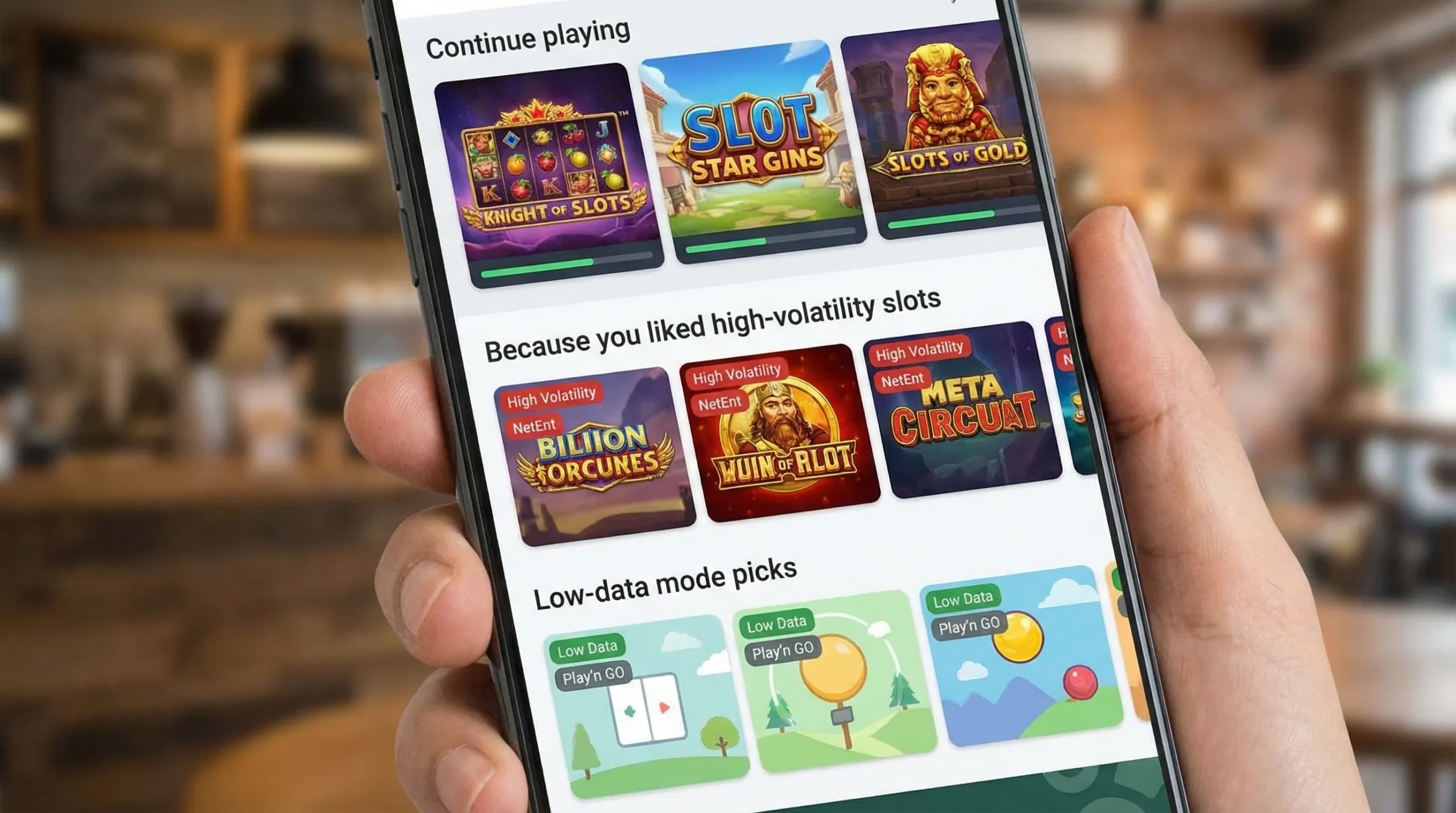
| Continuity | “Continue last game,” recently played row | Reduces choice friction, speeds first spin | Cap exposure so one title does not dominate forever |
| Preference fit | Volatility band, themes, feature preferences | Improves engagement and session depth | Diversity constraint to avoid filter bubbles |
| Performance fit | Game load time tier, device FPS stability | Prevents rage quits on mobile | Fallback to lighter titles on weak devices |
| Promo fit | Tournament eligibility, missions, bonus constraints | Aligns content with current motivation | Hard rules to avoid misleading promo impressions |
| Economics | Provider deal classes, margin considerations | Protects NGR when two games perform similarly | Use only as a tie-breaker, log every use |
| Risk/RG | Fraud flags, deposit limits, cool-off states | Avoids bonus loops and RG breaches | Never personalize to increase harmful play |
| Compliance | Geo restrictions, jurisdictional content blocks | Prevents illegal exposure | Must be enforced before any ranking |
This is also where many teams accidentally optimize the wrong thing. If your model pushes “high excitement” games to everyone, you might lift short-term GGR and increase churn, chargebacks, or RG interventions later.
Measuring whether personalization actually lifts GGR (not just shuffles clicks)
Ranking changes are famous for producing “vanity wins” (CTR up, revenue flat). To prove impact, measure incrementality.
Metrics that matter for slot ranking
Use a mix of leading and lagging indicators:
- Lobby CTR to game launch
- Time to first spin
- Spins per session and sessions per user
- GGR per active (and ideally NGR per active)
- Promo cost per incremental GGR (to avoid hidden margin loss)
- Retention (D1, D7, D30) segmented by lifecycle stage
Experiment design that avoids false positives
A few operational rules that prevent most mistakes:
- Use holdouts: keep a small percentage on the old ranking, continuously.
- Segment carefully: new users and VIPs behave differently, do not average them.
- Run long enough to cover weekly seasonality.
- Guardrail metrics: RG interventions, complaints, failed deposits, fraud rates.
If you already operate real-time analytics, your ranking system becomes dramatically easier to tune because you can observe impact quickly and roll back fast.
Common failure modes (and how to avoid them)
1) Over-personalization that kills discovery
If you only show “more of the same,” players miss new titles and your catalog under-monetizes.
Fix: enforce diversity. For example, require that each screen includes a mix across providers, volatility bands, or categories.
2) Cold-start problems for new games
New releases often have no personal performance data.
Fix: combine:
- Metadata similarity (theme, volatility band)
- Exploration budget (a small, controlled percentage of impressions)
- Editorial boosts (time-boxed)
3) Incentive conflicts between product and compliance
Teams sometimes want “aggressive” ranking that creates RG risk.
Fix: bake RG constraints into the ranking contract. Ranking should be incapable of violating jurisdictional limits or responsible gaming policies.
4) Personalization that ignores payments reality
If a player’s deposit failed or they are in a pending KYC state, pushing high-friction journeys wastes the session.
Fix: treat cashier/KYC context as first-class signals. Personalization is not only “which slot,” it is “which next best action.”
Implementation blueprint: how to ship lobby ranking in 30 to 60 days
This is a pragmatic build order that works even for lean teams.
Step 1: Define the surfaces and goals
Start with one surface: home lobby grid ordering (first screen). Define whether the target is GGR, NGR, retention, or a blend.
Step 2: Create a clean game taxonomy
Your taxonomy is the foundation. If “volatility” or “jackpot” tags are inconsistent, your model will be noisy.
Step 3: Start with transparent rules
Examples that are usually safe and effective:
- Continue playing (if last session ended recently)
- Recently played
- Top performers in player’s preferred categories
Step 4: Add scoring and guardrails
Introduce weights gradually. Add diversity constraints and compliance gating.
Step 5: Add controlled exploration
Only after you have stable monitoring. Exploration can be as simple as “swap 1 tile out of 20 from a candidate pool.”
Step 6: Operationalize tuning
Set a weekly cadence: review metrics, adjust weights, document changes, run rollbacks when needed.
Where Spinlab fits if you want personalization without rebuilding your stack
Personalization is easiest when your platform already centralizes the building blocks: game aggregation, real-time analytics, bonus logic, compliance controls, and a configurable back office.
Spinlab is built as a modular, all-in-one iGaming platform (including a white label casino platform option) with components that map directly to lobby ranking execution:
- Seamless game aggregation to unify catalog and metadata
- Real-time analytics dashboard to measure uplift and detect drift quickly
- Affiliate and bonus engine to align ranked games with missions, tournaments, and offers
- KYC and AML compliance plus fraud prevention hooks for ranking guardrails
- Mobile-optimized casino platform so performance-based ranking can actually matter
- Open API integration to plug in your own scoring service or CDP
If you are also investing in acquisition pages for game releases and promos (so players land on the right titles from search), an AI content system like BlogSEO can help automate SEO article production while your product team focuses on in-product personalization.
Frequently Asked Questions
What is game lobby personalization in an online casino? Game lobby personalization is the process of tailoring the lobby experience for each player by ranking slots and games based on their preferences, behavior, and context to improve engagement and GGR.
How do you rank slots to lift GGR without increasing risk? Rank using a transparent scoring model that includes performance and preference signals, then apply hard guardrails for compliance, fraud prevention, and responsible gaming (for example, jurisdiction gating and RG state penalties).
Should casinos optimize for GGR or NGR when personalizing lobbies? Use GGR as a leading indicator, but optimize toward incremental NGR when possible, because bonus costs, provider economics, and fraud can make “GGR wins” unprofitable.
How do you A/B test lobby ranking changes correctly? Use a persistent holdout group, segment by lifecycle stage, run for at least one full weekly cycle, and track guardrails like RG events, fraud rates, and promo cost per incremental revenue.
What is the fastest way to start personalizing a slot lobby? Start with rules-based rows like “continue playing” and “recently played,” then add a scoring layer using a small set of reliable signals and diversity constraints.
Build a lobby that earns more per session
If your casino is already acquiring traffic, lobby ordering is one of the fastest ways to convert attention into wagering. Spinlab’s modular platform (game aggregation, real-time analytics, bonus tooling, and compliance controls) is designed to let teams ship and iterate on personalization quickly.
Explore the platform at spinlab.studio to see how you can launch, rank, and optimize your slot lobby without stitching together five separate vendors.
The governance section resonated with me—deciding which signals are allowed and maintaining rollback controls is often the real bottleneck, not the math. We apply the same discipline to our casino affiliate site’s link building: instead of manually submitting to directories and tracking every placement, we use LinkJuice – AI Backlink Assistant to automate and monitor that process. It gives us back time to focus on lobby personalization and player engagement, while keeping our link profile clean and auditable.