

Picking a white label casino platform in 2026 is less about “who has the biggest lobby” and more about who can keep your operation safe, compliant, and profitable when you add more geos, more payment rails, and more traffic.
The market has matured: players expect instant deposits, smooth KYC, fast withdrawals, and mobile-first UX. Regulators increasingly expect audit-grade controls, not a PDF policy. And payments are no longer “just a gateway”, they are a product and risk surface (cards, local APMs, pay-by-bank, stablecoins, crypto onramps, chargebacks, settlement, reconciliation).
This guide is a practical decision framework for founders, operators, and product leads choosing a white label casino platform in 2026.
What “white label casino platform” really means in 2026
A 2026 white label casino platform is not merely a skin on a shared website. In practice, you are buying a bundled operating system for regulated money movement and content delivery:
- Cashier + wallet + ledger that can handle fiat and (often) crypto flows safely
- Game aggregation (and the operational tooling to manage catalogs, jurisdictions, and certificates)
- Compliance primitives (KYC/AML, responsible gambling controls, geo controls, audit logging)
- Backoffice tooling for risk, support, payments operations, bonuses, and affiliates
- Data and analytics you can trust to run growth loops and manage risk
- APIs and integration points that determine how locked-in you are
If a vendor’s “white label” is primarily front-end theming but you still need to stitch together payments, compliance, and analytics yourself, you are not buying a turnkey casino solution. You are buying a partial build.
Step 1: Start with your operating model, not a feature list
Before comparing vendors, write down what you are actually building. Two operators can both say “online casino”, while needing very different platform capabilities.
Use this as a quick alignment table for your stakeholders (founder, compliance, payments, marketing, and engineering).
| Decision you must make | Examples | What it changes in platform requirements |
|---|---|---|
| Target jurisdictions and license path | Curaçao reform-driven markets, Anjouan-style offshore, regulated EU markets | KYC/AML depth, audit logging, geo controls, data residency, reporting expectations |
| Payments strategy | Cards + APMs, open banking/pay-by-bank, crypto-ready hybrid cashier | PSP coverage, routing/orchestration, chargeback tooling, onramp UX, custody and reconciliation |
| Business model | Single brand vs multi-brand, affiliate-heavy vs product-led | Backoffice workflows, affiliate engine, bonus governance, per-brand segmentation |
| Differentiation | Faster payouts, exclusive original games, localized lobby | Wallet and treasury design, game aggregation flexibility, original game support, CMS capabilities |
| Team capability | Lean team, no in-house engineers vs experienced platform team | “Shopify-like” admin UX, modularity, API depth, support and onboarding quality |
This step prevents a common failure mode: buying a platform optimized for someone else’s go-to-market.
Step 2: Build a weighted scorecard (and force trade-offs)
In 2026, most vendors can demo a good-looking lobby and a big logo wall of providers. The real differences show up in operations, payments correctness, compliance evidence, and total cost.
A scorecard forces you to decide what matters most for your strategy.
Here is a pragmatic scoring structure many operators use. Adjust weights based on your situation.
| Category | What “good” looks like | Typical evidence to request |
|---|---|---|
| Compliance and responsible gambling | Built-in RG patterns, enforceable limits, self-exclusion, audit trails | Screenshots of controls, policy-to-product mapping, sample audit logs |
| Payments, wallet, and treasury | Multi-rail cashier, clear settlement and reconciliation, fraud controls | Ledger model explanation, reconciliation workflow, PSP reporting examples |
| Game aggregation and content ops | Jurisdiction gating, low-latency launches, reliable callbacks | SLA terms, uptime/latency reporting, certification workflows |
| Analytics and experimentation | Real-time metrics that can trigger actions, exportable event data | Sample dashboards, event schema, webhook catalog |
| Backoffice UX and operations | Fast case review, clear permissions, scalable workflows | Demo of queues/timelines, roles/permissions model, audit logging |
| Architecture and scale | Predictable performance under spikes, safe deployments | Reference architecture, scaling approach, release process |
| Commercials and true TCO | Transparent pricing, predictable add-ons | 24-month TCO worksheet, list of pass-through fees |
| Vendor fit and roadmap | Clear ownership, support responsiveness, credible roadmap | Customer references, support SLAs, product roadmap themes |
If you want a shortcut, prioritize categories that are expensive to fix later:
- Payments and wallet correctness
- Compliance and auditability
- Data quality and export
- Vendor lock-in risk (API and contract terms)
Step 3: Validate “non-negotiables” with proofs, not promises
A polished demo can hide the sharp edges that only appear after launch. In procurement, ask for artifacts that prove the platform works the way you need.
Payments: treat the cashier like your main conversion funnel
In 2026, payments is where growth and risk collide. A platform can have great games and still fail if deposits are unreliable, KYC is timed poorly, or withdrawals create support chaos.
What to validate:
- Rail coverage: cards plus local rails/APMs where you operate, and a credible plan for new rails
- Routing/orchestration capability: can you route by geo, BIN, device, risk score, provider health
- Crypto readiness (if relevant): onramp support, stablecoin flows, multi-currency handling, and custody controls
- Reconciliation workflow: how do you match ledger events to PSP reports and bank statements
- Chargeback and dispute support: what evidence is captured automatically (terms acceptance, authentication, ledger, gameplay)
If you want to go deeper on what modern routing looks like, Spinlab’s overview of casino payment orchestration is a useful reference for the kinds of signals and guardrails to look for.
Compliance: your platform should generate audit evidence by default
Compliance in 2026 is increasingly “show me the system behavior”, not “show me your policy document.” Look for compliance-by-design patterns:
- KYC and AML: risk-based monitoring, repeatable review flows, clear escalation and SAR support processes (where applicable)
- Responsible gambling: limits, reality checks, self-exclusion enforcement, and audit logging
- Geo controls: blocking at registration, gameplay, and cashier layers, with logged decisions
- Data protection: consent and retention behaviors that match your jurisdictions
A helpful north star is whether the vendor can describe compliance in terms of events, decisions, and logs rather than vague assurances.
For a modern view of product-led RG in 2026, see Spinlab’s pattern library on responsible gambling by design.
Game aggregation: ask about latency, gating, and the “hidden work”
Most operators judge aggregation by the number of studios. In reality, the hard parts are:
- Jurisdiction-aware catalogs (what can be shown and launched for a given player)
- Operational tooling for certificates, provider incidents, game-level exclusions
- Session launch reliability and consistent wallet callbacks
- Data rights: what gameplay and transaction data you can export and how quickly
If you have not modeled aggregator cost beyond rev-share, it is worth reading a breakdown like The True Cost of a Game Aggregator and applying the same thinking to any “included” aggregation.
Data and analytics: dashboards are not the same as decisioning
“Real-time analytics” is now a common claim. What you really want is:
- A consistent event schema (deposits, declines, KYC states, bonus events, withdrawals)
- Fast segmentation for CRM and risk actions
- Exportability (webhooks, APIs) so you can avoid a data dead-end
If analytics only exists inside a dashboard, your marketing and risk teams will hit ceilings quickly.
Step 4: Run a pilot that mirrors real money behavior
A serious evaluation includes a short, structured pilot. The goal is not to test every feature, but to validate the workflows that decide revenue and risk.
A strong pilot focuses on:
- Registration to first deposit (including declines, retries, and support paths)
- KYC timing and retries (mobile capture quality, pending states, fallbacks)
- First withdrawal (status visibility, manual review handling, time-to-paid)
- Top 20 games launch flow (latency, failures, catalog accuracy)
- Operational backoffice (fraud queue, payment exceptions, player support tooling)
Make the vendor show how issues are handled when something goes wrong. For example:
- A PSP outage or approval drop in one geo
- A spike in bonus abuse attempts
- A reconciliation mismatch at day close
If the vendor cannot demonstrate how the platform helps you diagnose and act, you are buying future downtime and tickets.
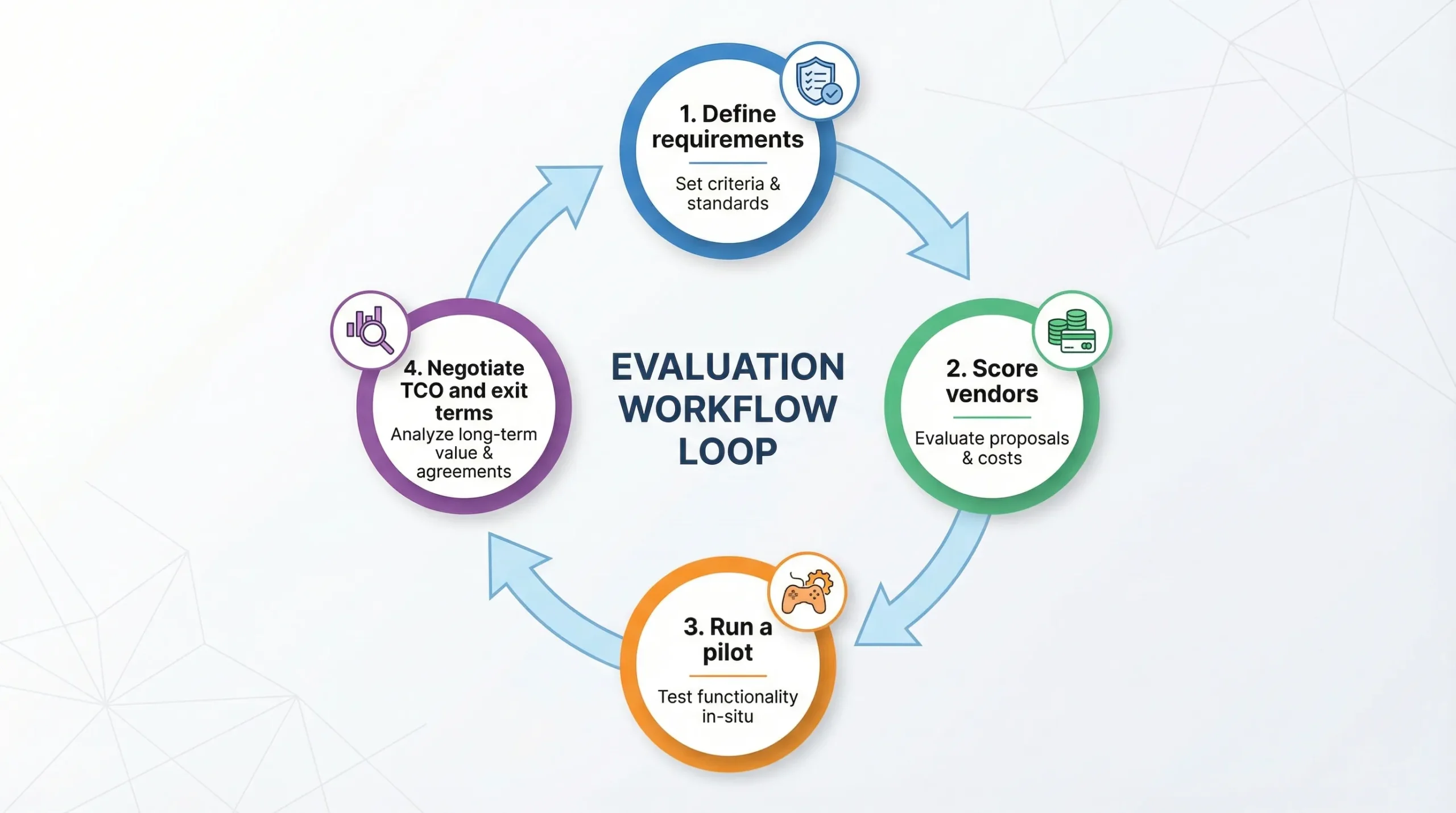
Step 5: Compare vendors on 24-month TCO, not month-one platform fees
In 2026, “cheap” and “expensive” are often illusions created by pricing structure. A low platform fee can hide expensive pass-throughs, while a higher platform fee can include components you would otherwise pay for separately.
Your 24-month model should include:
- Platform fee (fixed, rev-share, hybrid)
- Game content costs (rev-share, minimum guarantees, premium studio uplifts)
- Payments costs (PSP fees, chargeback costs, FX leakage, crypto onramp fees if applicable)
- KYC/AML vendor costs (per check, retries, fallbacks)
- Hosting and scaling costs (traffic spikes, new regions)
- Support and account management
- One-time setup and certification costs
Spinlab has a detailed breakdown of what operators really pay in 2026 in White Label Casino Pricing: What You Really Pay in 2026. Even if you do not choose Spinlab, use a similar worksheet to prevent surprises.
Step 6: Reduce lock-in risk before you sign
Vendor lock-in is rarely technical alone. It is usually a combination of:
- Limited APIs (or APIs that exist but are commercially restricted)
- No clean data export
- Long termination windows and migration penalties
- Proprietary wallet or bonus logic you cannot replicate
What to insist on:
- Documented APIs and a clear integration surface (identity, wallet, payments, bonuses, affiliates, events)
- Data ownership and export clauses (format, frequency, and timelines)
- Exit plan: what happens to domains, player data, game contracts, and wallets
If you want a concrete procurement checklist for API reality, Spinlab’s open API checklist for iGaming platforms is a good template to adapt.
Step 7: Use a demo script that exposes operational truth
Instead of asking “Do you have feature X?”, ask questions that force specifics and evidence.
| Demo question | Why it matters | What a good answer includes |
|---|---|---|
| “Show me a deposit decline and the recovery path.” | Declines are where conversion dies | Decline reason capture, rail switching, retry UX, analytics hooks |
| “Show me withdrawal status from player view and ops view.” | Withdrawals drive trust and ticket volume | Player-facing tracker, exception queues, SLAs, audit log |
| “How do you enforce RG limits at the system level?” | Regulators expect enforcement, not UI hints | Decision engine, immutable logs, consistent enforcement across games |
| “How do you gate games by jurisdiction and player state?” | Prevents compliance and commercial breaches | Policy rules, catalog segmentation, evidence of gating |
| “What data can I export in real time?” | Avoids analytics lock-in | Webhooks/events, schemas, retry logic, latency expectations |
| “What happens when a PSP is down in one country?” | Outages happen | Health checks, routing rules, fallbacks, comms tooling |
Ask the vendor to run the demo using a realistic scenario for your target market, currencies, and rails.
Where Spinlab Studio fits (and how to evaluate it fairly)
Spinlab Studio positions itself as an all-in-one, modular iGaming platform for building, launching, and scaling online casinos, with crypto-ready and fiat payment support, game aggregation, KYC/AML compliance, fraud prevention, and real-time analytics.
If you are evaluating Spinlab specifically, assess it the same way you would any casino software provider:
- Validate that its modular approach matches your build vs buy strategy
- Confirm the payment mix you need (fiat, crypto, multi-currency, onramp, custody) is supported for your target geos
- Test the backoffice usability with your actual ops team (risk, payments, support)
- Run the pilot flows (FTD, KYC, withdrawal, reconciliation)
Spinlab also claims a “Shopify-like” experience and very competitive pricing for white label casino software. Treat those as hypotheses and verify them in a pilot, especially around onboarding speed and the total cost line items that matter for your model.
One non-obvious tip: platform selection is a high-pressure, high-stakes process. Founders and operators make better decisions when they keep a steady cadence and avoid burnout. Even small routines help, and some teams use outside structure like personal training covered by insurance to stay consistent during intense build and launch periods.
The simplest way to choose correctly in 2026
If you do nothing else, do these three things:
- Write down your operating model (geos, payment rails, differentiation, team capability)
- Score vendors with weights that reflect what is hard to change later (payments, compliance, data, lock-in)
- Run a pilot around real money workflows (deposit, KYC, withdrawal, reconciliation), then negotiate using a 24-month TCO model
That is how you pick a white label casino platform that will still work when you scale, not just when you launch.
If you want to see how a modular, crypto-ready iGaming platform is packaged end-to-end, explore spinlab.studio and compare it to your scorecard objectively.