

Choosing casino software for one country is hard enough. Choosing it for global markets is a different procurement problem entirely. You are not just buying a frontend, a game library, or a payment gateway. You are selecting the operating system for licensing, localization, payments, player protection, risk, analytics, and growth across jurisdictions that may all behave differently.
The right platform should let you launch fast without trapping you in a stack that breaks when you add a new country, currency, provider, or compliance rule. The wrong one can look cheap in a demo, then become expensive through custom development, failed payment approvals, slow game launches, manual compliance work, and market-by-market replatforming.
This guide gives operators, founders, and product teams a practical framework for choosing casino software that can support international expansion from day one.
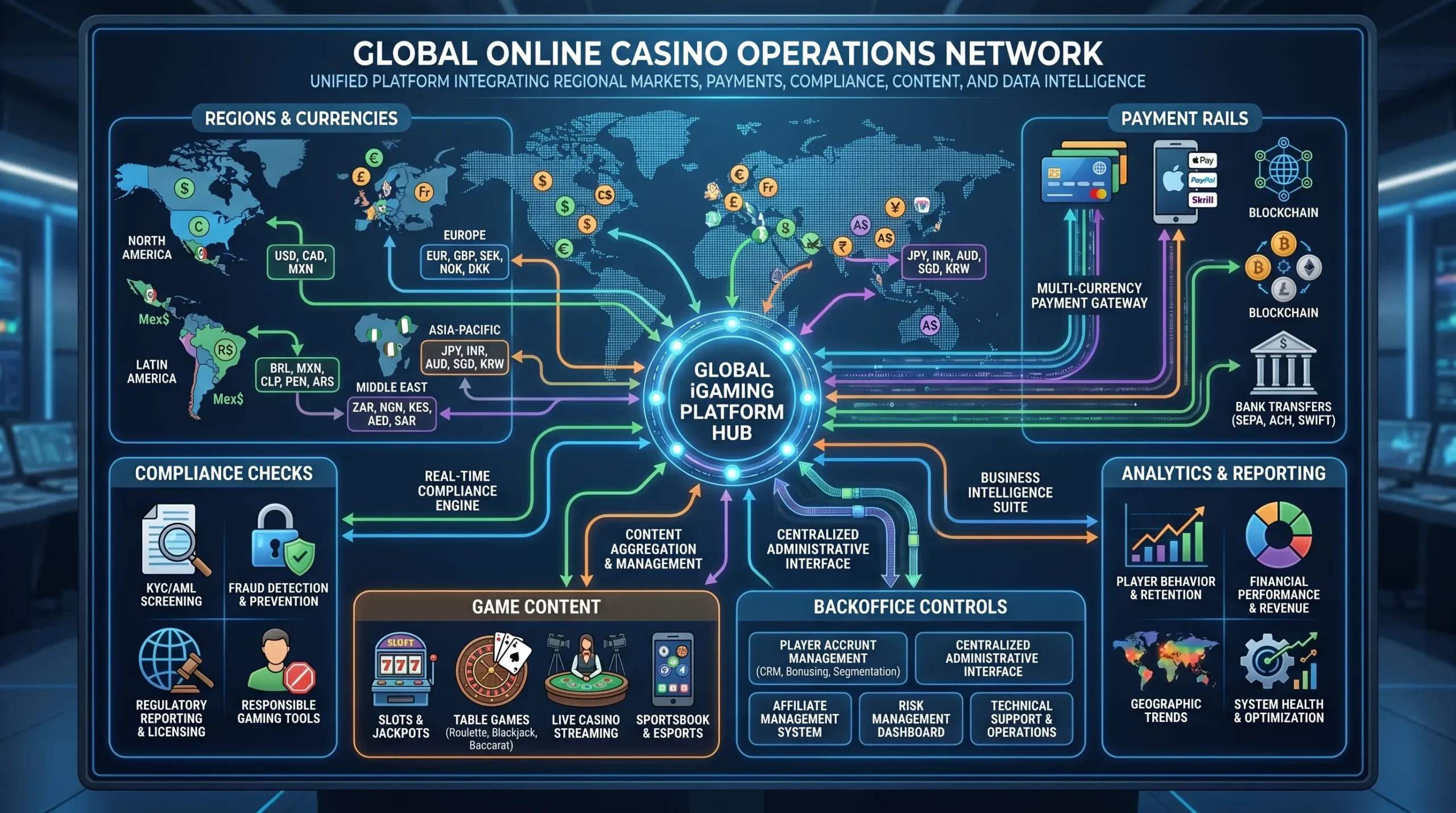
Start With Your Global Operating Model
Before speaking with casino software providers, define how you actually plan to operate. A startup launching one crypto-first casino in two regions needs a different setup from a multi-brand operator entering regulated European markets with fiat payments, localized bonuses, and strict reporting.
A strong operating model answers five questions:
- Which markets are launch targets, expansion targets, and excluded territories?
- Which licenses, legal opinions, or local authorizations will you rely on?
- Which payment rails matter in each market, including cards, bank transfers, APMs, stablecoins, and crypto onramps?
- Will you run one brand, multiple localized skins, or a portfolio of casino brands?
- What product mix will drive revenue, such as slot games, live casino games, crash games, sportsbook cross-sell, or casino original games?
This exercise prevents a common mistake: comparing platforms by generic feature lists instead of market readiness. A vendor may have a beautiful lobby and hundreds of games, but if it cannot support local KYC flows, multi-currency wallets, jurisdiction-specific game blocking, and auditable payment logs, it is not global-ready software.
Use a Global Casino Software Scorecard
A structured scorecard keeps procurement focused on evidence, not sales language. The goal is not to find the platform with the longest feature list. It is to find the platform that can prove it supports your markets, your launch speed, your compliance obligations, and your margin model.
| Evaluation area | Why it matters globally | Proof to request from vendors |
|---|---|---|
| Jurisdiction controls | Different markets require different access, content, payment, and reporting rules | Geo rules demo, audit logs, compliance exports, role permissions |
| KYC and AML workflows | Global casinos face varied identity, age, sanctions, and source-of-funds expectations | Vendor integrations, risk rules, case management flow, evidence pack samples |
| Payments and ledger | Local payment fit often determines deposit conversion and withdrawal trust | Supported rails, ledger design, reconciliation reports, failure taxonomy |
| Multi-currency support | FX leakage, bonus abuse, and settlement gaps increase with every new currency | Wallet model, FX policy controls, stablecoin support, accounting exports |
| Game aggregation | Content rights, certifications, latency, and metadata vary by jurisdiction | Provider list, launch flow, certificate handling, game blocking rules |
| Localization | Translation alone does not create local trust or conversion | Locale demos, currency formatting, RTL support if needed, localized cashier flow |
| Backoffice usability | Global operations fail when teams need developers for everyday changes | Admin panel demo, permissions, bonus setup, affiliate controls, reporting views |
| APIs and extensibility | Expansion often requires new providers, CRMs, compliance tools, and data pipelines | API documentation, sandbox, webhook catalog, versioning policy |
| Fraud prevention | More markets mean more bonus abuse, payment fraud, and account takeover risk | Device signals, rule engine, velocity controls, case queues |
| Pricing and TCO | Setup fees, rev-share, integrations, hosting, and support can change the real cost | 24-month cost model, module pricing, hidden fee disclosure, exit terms |
Weight each category based on your strategy. If your first markets are payment-fragmented, cashier and ledger capability may deserve 20% to 25% of the score. If your edge is proprietary slot content, game aggregation and IP control may rank higher.
Put Compliance Architecture Before Design Preferences
A global online casino cannot treat compliance as a plugin. Compliance logic must sit inside player onboarding, cashier flows, game access, bonuses, affiliate tracking, reporting, and backoffice permissions.
At minimum, your platform should support risk-based KYC and AML workflows, age and location controls, sanctions and PEP screening through appropriate vendors, responsible gambling tools, audit logging, and jurisdiction-specific content rules. The FATF Recommendations emphasize risk-based AML controls, which is especially relevant for operators handling multiple currencies, cross-border payments, and crypto assets.
The practical test is simple: can the software prove why a player was allowed, blocked, limited, verified, paid, or reviewed?
If the answer depends on a spreadsheet, a Slack message, or a developer checking logs manually, the platform is not ready for scalable global operations. Regulators, payment partners, banks, and internal risk teams all need consistent evidence.
Key compliance capabilities to verify include:
- Jurisdiction whitelists and blacklists for registration, login, payments, games, and promotions
- Configurable KYC thresholds based on geography, risk, deposits, withdrawals, and behavior
- AML monitoring across deposits, withdrawals, wallet movement, gameplay, and bonus activity
- Responsible gambling controls such as limits, cooling-off, self-exclusion, and player risk indicators
- Immutable logs for player actions, admin changes, bonus grants, and payment decisions
- Data retention, deletion, and export workflows for privacy obligations such as GDPR where applicable
Do not ask only whether the platform “supports compliance.” Ask how rules are configured, who can change them, how changes are logged, and what evidence can be exported during an audit.
Treat Payments as a Market Entry Strategy
Payments are often the biggest difference between a casino that launches globally and a casino that actually converts globally. In many markets, cards are not enough. Players expect local bank methods, digital wallets, instant transfers, vouchers, stablecoins, or direct crypto deposits.
A global-ready iGaming platform should not force every payment method into a separate operational workflow. It should normalize deposits and withdrawals into a consistent wallet, ledger, reconciliation, and risk model.
| Market challenge | Software requirement |
|---|---|
| Players prefer local payment methods | Payment orchestration with cards, APMs, bank rails, and crypto where permitted |
| Cross-border card declines are high | Smart routing, fallback rails, decline analytics, and risk-based step-up checks |
| Crypto users want fast deposits | Direct wallet deposits, stablecoin support, crypto onramp options, and clear fee UX |
| Finance needs accurate settlement | Three-way reconciliation across ledger, payment provider, and bank or wallet records |
| Multiple currencies create margin risk | Multi-currency wallet support, FX policies, and transparent conversion rules |
| Fraud pressure varies by region | Velocity limits, device intelligence, bonus controls, and payment risk scoring |
For crypto-ready markets, look beyond whether the vendor can display a wallet address. You need custody controls, transaction monitoring, stablecoin policies, onramp UX, withdrawal rules, and audit-ready records. For fiat-heavy markets, you need strong approval analytics, PSP failover, chargeback evidence, and reconciliation discipline.
Spinlab’s platform, for example, is designed to support both crypto and fiat payments, multi-currency operations, crypto onramp solutions, merchant custodial wallets, and integrated fraud and compliance controls. That kind of integrated approach matters because payments should not be isolated from KYC, AML, bonuses, analytics, or the player wallet.
Verify Game Aggregation, Rights, and Market Fit
Game quantity matters, but global game strategy is not just about having thousands of titles. You need the right games for each market, with the right certifications, metadata, performance, and commercial terms.
A robust game aggregator should support provider onboarding, game metadata normalization, jurisdiction-based availability, session launch reliability, wallet callbacks, reporting, bonus hooks, and game-level analytics. It should also help teams curate localized lobbies, not simply dump every slot into one generic grid.
Ask vendors how they handle:
- Certified availability by jurisdiction
- Provider-specific downtime and failover visibility
- Game launch latency by region and device type
- Metadata for volatility, RTP, themes, languages, and features
- Bonus compatibility for free spins, wagering, tournaments, and missions
- Commercial reporting by provider, studio, title, market, and currency
If you plan to use casino original games or custom-designed slot IP, also examine ownership and contract terms. Who owns the math model, artwork, source code, trademarks, theme, characters, and localized assets? Can you use the game globally, or only in certain territories? Can the supplier resell similar versions to competitors?
For operators building original brands, slot concepts, or exclusive content, it is worth involving intellectual property counsel early. Firms focused on trademarks, design protection, and commercial contracts, such as Studio Legale Coviello, can help operators think through brand and IP protection before international expansion creates avoidable disputes.
Localize the Product, Not Just the Text
Translation is only the first layer of localization. Global casino software should let teams adapt the entire player experience to local expectations without opening a development ticket for every market change.
Good localization covers language, currencies, number formats, date formats, local payment names, promotion timing, bonus terms, game sorting, onboarding copy, support flows, responsible gambling resources, and trust signals.
For example, a player in Brazil, Canada, India, Germany, or the Gulf region may have very different expectations around deposits, identity checks, preferred games, bonus wording, and mobile behavior. Even within the same language, terminology and payment preferences can vary.
Look for software that supports:
- Multi-language content management for lobby pages, terms, emails, and promotions
- Local currency display, wallets, rounding rules, and FX logic
- Market-specific game lobbies and category pages
- Configurable bonus rules by country, segment, payment method, and currency
- Mobile-optimized registration, cashier, KYC, and gameplay flows
- Localized responsible gambling messaging and help resources
- Region-specific SEO content structures if organic acquisition is part of your strategy
A platform with a Shopify-like admin experience can be valuable here because non-technical teams need to update offers, pages, assets, and lobbies quickly. If every market change requires a sprint, localization becomes too slow for competitive growth.
Check Architecture for Scale, Speed, and Extensibility
Global expansion increases technical pressure. More markets mean more traffic patterns, more payment events, more game providers, more regulatory rules, more languages, more currencies, and more fraud attempts. Your casino software must scale operationally and technically.
The architecture does not have to be fully custom to be powerful. In fact, many operators benefit from modular white label casino software because it gives them proven infrastructure while still allowing configuration and integrations. The key is avoiding a rigid black box.
Important architectural questions include:
- Does the platform expose open APIs for payments, identity, games, analytics, CRM, and reporting?
- Can you integrate external vendors without breaking the wallet or ledger?
- Are game launches and cashier flows optimized for mobile networks?
- Can you deploy localized brands or skins without duplicating the entire stack?
- Is data captured in real time for fraud, CRM, analytics, and compliance decisions?
- Does the vendor provide observability for uptime, latency, payment failures, and game issues?
- Can you export your data if you migrate later?
For payment and personal data security, confirm which parts of the stack are in PCI scope and how the vendor handles tokenization, access control, encryption, and monitoring. The PCI Security Standards Council maintains the PCI DSS requirements that are relevant when cardholder data is stored, processed, or transmitted.
Speed also matters commercially. Slow lobbies, slow game launches, slow KYC, and slow cashier flows all reduce conversion. For global markets, measure platform performance by region and device, not just from the vendor’s office network.
Demand a Backoffice Your Team Can Actually Run
Global casino operations are won or lost in the backoffice. The admin panel is where teams manage players, payments, KYC, AML cases, bonuses, affiliates, games, risk rules, content, and reporting. If it is confusing, slow, or developer-dependent, operational costs rise quickly.
A strong backoffice should give role-based teams the tools they need without exposing sensitive controls to everyone. Payments teams need reconciliation and withdrawal queues. Risk teams need player timelines, device signals, and case notes. CRM teams need segmentation and bonus controls. Finance needs exports and settlement visibility. Executives need real-time performance dashboards.
For vendor demos, do not settle for a polished frontend preview. Ask the vendor to perform real workflows:
| Workflow to demo | What to watch for |
|---|---|
| Create a localized bonus | Can CRM configure eligibility, wagering, budget caps, and exclusions without code? |
| Review a withdrawal | Can risk see KYC, payment history, gameplay, device, and AML signals in one place? |
| Block a game in one country | Is the rule immediate, logged, and testable? |
| Add a payment method | Does it connect to ledger, reconciliation, limits, and reporting? |
| Investigate bonus abuse | Are identity, device, affiliate, payment, and gameplay signals connected? |
| Export audit evidence | Are logs complete, timestamped, and understandable to third parties? |
Spinlab’s all-in-one platform includes a customizable backoffice admin panel, real-time analytics dashboard, affiliate and bonus engine, fraud prevention, KYC and AML compliance, game aggregation, and open API integration. For lean teams, consolidating these functions can reduce vendor sprawl and make operations easier to manage.
Model Total Cost of Ownership, Not Just Platform Fees
Global casino software pricing can be difficult to compare because vendors package costs differently. One platform may look cheaper upfront but charge more for setup, game provider access, payment integrations, hosting, extra brands, API usage, support, compliance modules, or revenue share.
Build a 24-month total cost of ownership model before signing. Include conservative and growth scenarios. If you plan to launch multiple markets, model each country with its expected currencies, payment methods, game providers, support needs, and compliance requirements.
| Cost category | Questions to ask |
|---|---|
| Setup and onboarding | What is included, what requires paid professional services, and what is the realistic launch timeline? |
| Platform fee | Is pricing fixed, revenue-share, hybrid, per-brand, per-market, or per-module? |
| Game content | Are aggregator fees, studio rev-share, minimum guarantees, and premium content surcharges included? |
| Payments | Are PSP fees, crypto onramp fees, chargeback costs, FX spreads, and reconciliation tools separate? |
| KYC and AML | Are verification checks, monitoring, case management, and compliance exports included or usage-based? |
| Hosting and traffic | Are there overages for bandwidth, storage, API calls, game sessions, or analytics events? |
| Customization | Which changes are no-code, which are configuration, and which require paid development? |
| Exit costs | Can you export player, transaction, bonus, and reporting data in usable formats? |
This is where a modular white label casino platform can be attractive for startups and growth operators. Spinlab is positioned as a cost-efficient, Shopify-like option for teams that want fast onboarding, integrated core modules, and lower operational complexity than assembling many separate vendors.
Red Flags When Choosing Casino Software
Some risks are visible only if you know what to ask. Be cautious if a provider gives vague answers, avoids live demos of operational workflows, or cannot show evidence behind its claims.
Common red flags include:
- “We support global markets” but no market-by-market compliance controls
- Payment integrations that do not connect cleanly to a ledger and reconciliation process
- Game aggregation without jurisdictional blocking, certificate handling, or performance visibility
- No clear API documentation, sandbox, webhook retry logic, or versioning policy
- Manual backoffice workarounds for KYC, withdrawals, fraud, bonuses, or reporting
- Pricing that excludes key modules needed for launch
- No data export plan or restrictive termination terms
- Frontend customization that is easy, but operational customization that requires expensive development
A good vendor should welcome detailed questions. If the platform is truly ready for global markets, the provider should be able to demonstrate controls, exports, logs, and workflows rather than simply describing them.
A Practical Vendor Selection Process
The safest way to choose casino software is to move from strategy to proof in stages. Do not rely on one sales demo and a proposal PDF.
Use this process:
- Define target markets, excluded markets, product mix, payments, licensing assumptions, and launch timeline.
- Build a weighted scorecard across compliance, payments, games, localization, backoffice, APIs, security, analytics, support, and TCO.
- Shortlist vendors that can support your first market and your next two expansion markets.
- Run workflow-based demos using real scenarios, not generic product tours.
- Request documentation for APIs, payment flows, KYC/AML, ledger design, game aggregation, data exports, and audit logs.
- Model 24-month TCO under base, growth, and stress scenarios.
- Run a pilot or sandbox validation for registration, KYC, deposits, gameplay, bonuses, withdrawals, reporting, and support workflows.
- Negotiate service levels, data rights, pricing transparency, compliance responsibilities, and exit terms before launch.
This process takes more effort upfront, but it reduces expensive surprises after you start acquiring players.
Where Spinlab Fits
Spinlab offers an all-in-one, modular iGaming platform for building, launching, and scaling online casinos. It is built for operators that need a flexible white label casino platform with crypto and fiat payment support, game aggregation, real-time analytics, fraud prevention, KYC and AML workflows, multi-currency support, a customizable backoffice, affiliate and bonus tools, open APIs, and mobile-optimized casino experiences.
For teams evaluating global casino software, the main advantage of a modular platform is speed with control. You can start with the core components needed to launch, then expand payment methods, markets, games, brands, APIs, and compliance workflows as the business grows.
That does not remove the need for legal, licensing, payment, or operational planning. But it can reduce the technical fragmentation that often slows global casino launches.
Frequently Asked Questions
What is the most important feature in casino software for global markets? The most important capability is configurable control across jurisdictions. Payments, games, KYC, AML, bonuses, and reporting must adapt by market without relying on manual workarounds or custom code for every change.
Should global operators choose white label casino software or build custom? White label casino software is usually faster and lower-risk for startups and teams entering new markets. Custom builds can make sense for large operators with deep engineering resources, but they require more time, budget, and compliance ownership.
How important is crypto support in global casino software? Crypto support is valuable in markets where players expect stablecoins, direct wallet deposits, fast withdrawals, or onramp options. It should be integrated with KYC, AML, custody, ledger, and reporting controls rather than added as a standalone wallet plugin.
How many payment methods should an online casino offer? There is no universal number. The right mix depends on your target markets. A global platform should support cards, local alternatives, bank rails, and crypto options where appropriate, while keeping reconciliation and risk controls centralized.
What should I ask during a casino software demo? Ask the vendor to show real workflows: localized registration, KYC review, deposit routing, game blocking by country, bonus creation, withdrawal review, fraud investigation, analytics, and audit export. A demo should prove operations, not just design.
How do I avoid vendor lock-in? Prioritize open APIs, usable data exports, clear exit terms, documented integrations, and a ledger model you understand. Avoid platforms that hide core data, restrict provider choices, or require paid development for basic operational changes.
Choose Software That Can Grow Market by Market
Global expansion rewards operators that can adapt quickly without losing control. The best casino software gives you a strong foundation for compliance, payments, games, localization, analytics, fraud prevention, and day-to-day operations across markets.
If you are comparing platforms, focus on proof: workflows, logs, APIs, cost models, and operational evidence. A polished frontend is useful, but a scalable global casino business needs much more underneath.
To explore a modular, crypto-ready white label casino platform built for fast onboarding and international growth, visit Spinlab Studio and request a walkthrough tailored to your target markets.