

Running a global online casino means juggling dozens of wallets, from euro and U.S. dollar accounts to BTC, USDT, and even BRL Pix floats. One hard-to-ignore pain point appears the moment any of those ledgers slip below zero: negative balances. Left unmanaged, they silently erode liquidity, distort revenue reporting, and can even land you on the wrong side of a regulator’s solvency test.
In this guide you will learn why negative balances happen in multi-currency wallets, the real risks behind them, and a step-by-step framework to detect, prevent, and resolve deficits before they snowball. Examples and code snippets reference Spinlab’s unified ledger, but the principles apply to any iGaming or fintech stack.
Why Negative Balances Happen in Casino Wallets
Negative balances rarely stem from a single cause. Below are the six most common culprits operators report on Spinlab’s platform:
| Root Cause | Typical Trigger | Example |
|---|---|---|
| Chargebacks & card recalls | Cardholder disputes deposit | €200 card deposit reversed after player losses |
| Aggressive bonus credits | Bonus engine issues a reward before deposit settles | $50 no-deposit free spins credited, player withdraws winnings |
| Volatile FX or crypto re-valuation | Sharp rate swing between authorization and settlement | BTC deposit worth $750 at T+0, worth $690 at T+1 |
| Cascading bet settlements | Multi-leg parlays or progressive jackpots pay out in advance of feeds | Sports parlay legs voided post-payout |
| Operator fees & taxes | Automatic rake, network, or gas fees deducted in wrong wallet | 0.0006 ETH gas fee charged against player ETH wallet |
| Ledger race conditions | Concurrency bugs under heavy throughput | Simultaneous cash-out and bonus credit double-spend funds |
Even small, temporary deficits complicate reconciliation. Worse, repeated negatives can trigger regulator capital-adequacy alerts or—if you support crypto—force emergency on-chain rebalancing at punitive fees.
The Hidden Costs of Letting Balances Dip Below Zero
- Liquidity Drain: Each negative ledger line requires an internal float top-up, tying up working capital that could fund marketing or game launches.
- Distorted KPIs: Gross Gaming Revenue (GGR), net deposits, and LTV calculations become unreliable if debits are back-dated to prior reporting periods.
- Compliance Red Flags: Many licences (e.g., MGA 2.5.6, UKGC RTS 14) mandate player funds segregation and solvency ratios. Persistent negatives invite audits.
- FX & Gas Exposure: Scrambling to buy fiat or crypto during a liquidity shortfall often means paying worst-case spreads or network fees.
- Customer-Experience Hits: Players who see a pending withdrawal reversed due to “insufficient merchant funds” rarely return.
Designing Wallets to Prevent Negatives
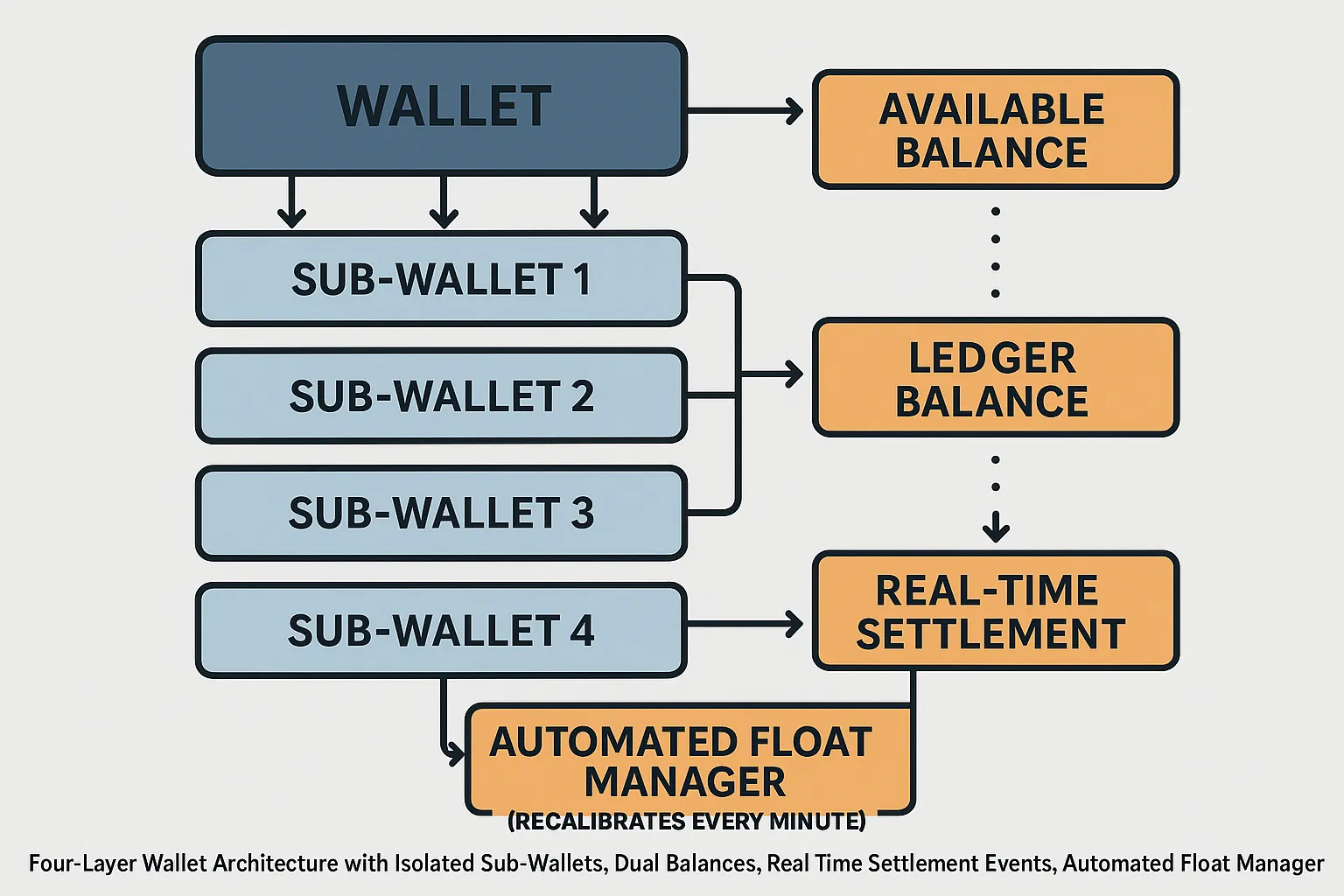
The most effective cure is architectural. Below is Spinlab’s recommended four-layer design; adapt it to your stack if you self-host.
- Isolated Sub-Wallets per Currency
- Create a dedicated ledger for every supported currency or token.
- Keep player funds, bonus funds, and operational funds partitioned inside each currency.
- Dual-Balance Model (Available vs Cleared)
- Available Balance: What the player can currently wager or withdraw.
- Cleared Balance: Funds irrevocably settled with PSP, bank, or blockchain confirmation.
- Only cleared funds may be transferred out of the core treasury.
- Real-Time Settlement Orchestration
- Stream PSP and blockchain webhooks into an event bus (Kafka, Redis Streams).
- Atomically update both the player and treasury ledgers on confirmation.
- Automated Float Manager
- A daemon recalculates required float per currency every 60 seconds based on open liabilities and pending debits.
- If projected balance < threshold (e.g., 110 % of outstanding withdrawals), trigger an auto-top-up via banking API or crypto custodian.
Detecting Negatives in Real Time (Sample SQL)
For operators already running a unified ledger in Postgres or ClickHouse, a lightweight detection query can run every minute:
SELECT currency, SUM(balance) AS net\_balance
FROM player\_wallets
GROUP BY currency
HAVING SUM(balance) < 0;
On Spinlab’s platform, this check is baked into the Risk & Treasury dashboard with Slack/Telegram alerts. If you roll your own, pipe results into OpsGenie or PagerDuty and include:
- Currency
- Magnitude of deficit
- Top 5 contributing player IDs
- Time since first negative entry
Playbook for Resolving Existing Negative Balances
- Freeze Outflows
- Immediately block new withdrawals in the affected currency.
- Continue allowing deposits to avoid extra churn.
- Identify the Deficit Source
- Query the transaction log for the first negative-causing event.
- Classify: chargeback, bonus misfire, FX swing, etc.
- Reconcile and Reverse (if applicable)
- For chargebacks or bonus errors, roll back related bets or credits.
- For FX swings, decide whether to absorb cost or claw back via house edge.
- Replenish Wallet
- Use on-ramp (MoonPay, Sardine), OTC desk, or treasury bank transfer.
- Record top-up as a separate capital injection, not player revenue.
- Communicate Internally and Externally
- Update finance and compliance teams.
- If withdrawals were held, email affected players with ETA and goodwill gesture.
- Patch Root Cause
- Hot-fix bonus engine, update FX buffer, or refactor ledger locking.
Setting Smart Thresholds and Alerts
Static thresholds (e.g., “alert at −1 BTC”) miss the point when exposure scales with bet volume. Instead, calculate a dynamic floor:
Floor = (Pending Withdrawals + Active Bonus Liabilities + 3σ Bet Volatility) × Safety Factor
Where Safety Factor = 1.10–1.25 depending on risk appetite.
Spinlab lets operators tune this multiplier in the back office. The system then fires a webhook if projected balance will breach the floor in the next 30 minutes, giving treasury time to move funds.
FX and Crypto Volatility Buffers
For fiat pairs, a 30–50 bps intraday buffer usually suffices. Crypto needs more headroom. Below are 2025 intraday volatility percentiles from Kaiko and Bitfinex data:
| Asset | 90th-Percentile 24h Move |
|---|---|
| BTC | 5.2 % |
| ETH | 7.8 % |
| SOL | 12.4 % |
| USDT | 0.2 % (peg) |
A rule of thumb: set crypto buffers at 2× the 90th percentile move. For BTC that’s roughly 10 % of total player BTC balance.
Treating Player-Level Negative Balances
Players themselves can also dip below zero (for instance, due to currency conversion fees on cross-game wallets). Options to handle:
- Auto-Convert Profits: When an affected player next wins in another currency, divert winnings to clear debt first.
- Small Debt Forgiveness: Write off micro-deficits below a fixed fiat value (e.g., <$1) rather than annoy players.
- Mandatory Top-Up Prompt: Block gameplay until outstanding negative is funded.
Always check licence conditions—some regulators forbid extending credit to players even temporarily.
Regulatory Checklist (2025 Update)
- MGA B2C 11: Maintain “unencumbered liquid assets” ≥ player balances at all times.
- UKGC RTS 11: Real-time segregation of customer funds; no mingling with operational costs.
- Curacao (post-2024 reforms): Monthly solvency attestation plus auditor sign-off for crypto reserves.
- MiCA (EU Crypto): If you custody stablecoins, you’re subject to minimum capital and disclosure rules from July 2026.
Failure to keep balances positive can be interpreted as a breach of these standards, attracting fines or licence suspension.
Key Metrics to Monitor
| Metric | Target | Why It Matters |
|---|---|---|
| Average Treasury Coverage Ratio | ≥ 1.10 | Cushion for intraday spikes |
| Time-to-Deficit Detection | < 60 s | Prevent cascading payouts |
| Negative Wallet Incidents / month | 0 | Zero tolerance KPI for compliance |
| FX P&L Drift | < 0.5 % of deposits | Flags buffer mis-calibration |
| Emergency Top-Ups / quarter | < 1 | Indicates healthy forecasting |
Sample Auto-Top-Up Lambda (Node.js)
exports.handler = async (event) => {
  const { currency, projectedDeficit } = JSON.parse(event.body);
  const buffer = 1.15; // 15% safety
  const amountNeeded = Math.abs(projectedDeficit) \* buffer;

  // Call banking or on-ramp API
  await fetch(process.env.TOPUP\_ENDPOINT, {
    method: 'POST',
    headers: { 'Authorization': \`Bearer ${process.env.API\_KEY}\` },
    body: JSON.stringify({ currency, amount: amountNeeded })
  });

  return { statusCode: 200, body: 'Top-up initiated' };
};
Integrating Spinlab’s Unified Wallet
If you prefer not to build the above yourself, Spinlab’s platform ships with:
- Multi-currency ledger supporting 150+ fiat, crypto, and tokens
- Dual-balance model with real-time FX and gas-fee buffers
- Configurable float manager that auto-tops via open-banking rails or fire-walled custodians
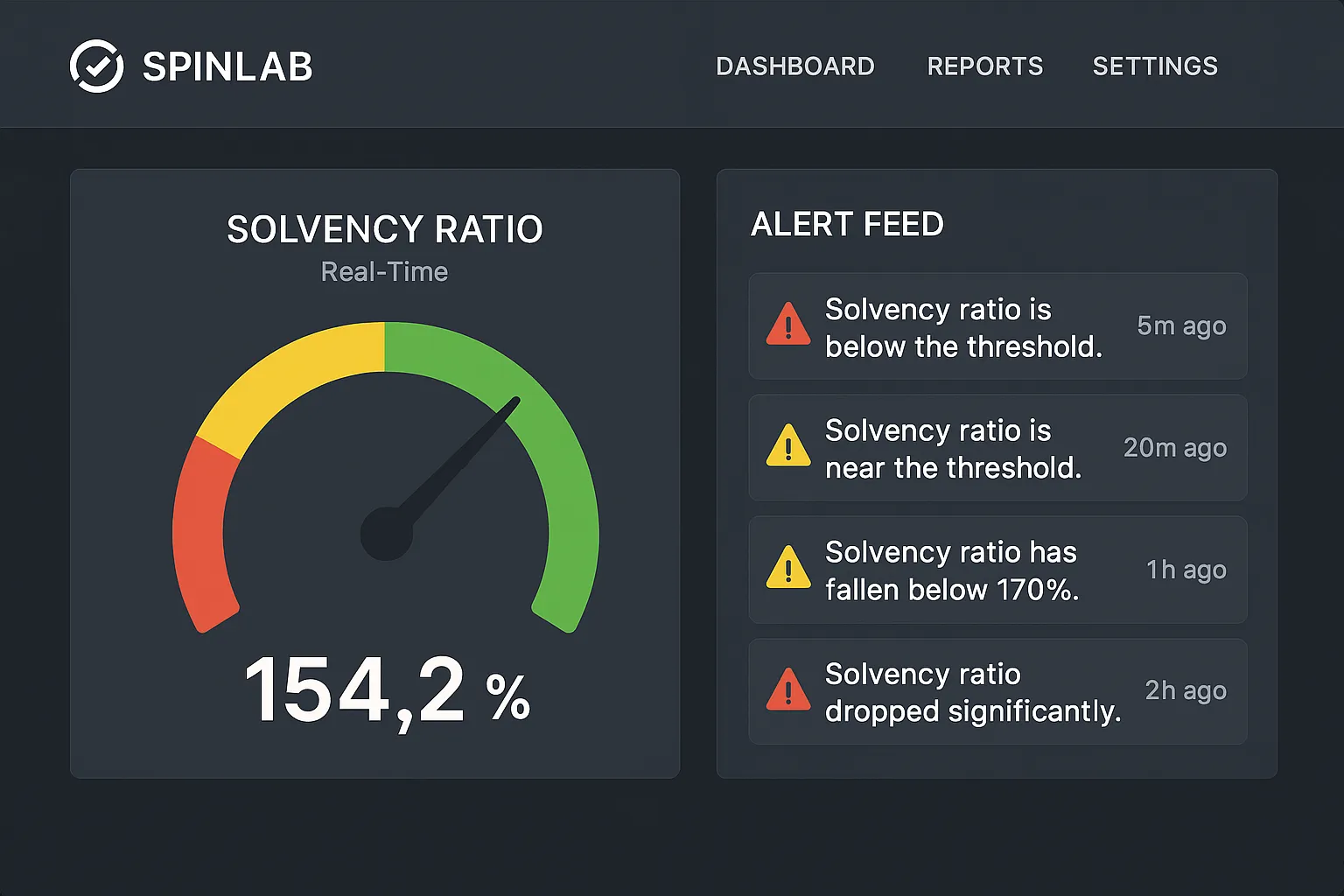
- Treasury dashboard showing live solvency ratios, FX drift, and incident heat-maps
- Webhooks that integrate with incident tools and BI platforms
For a walk-through, the article “Cashier Conversion Hacks: Optimizing Deposit Forms for 3-Second Checkout” explains how Spinlab’s hybrid cashier plugs into the same ledger. You can also see how treasury data informs risk scoring in “Building a Risk Matrix: Prioritizing Threats in Online Casinos.”
Action Plan
- Audit every currency ledger for historical negatives; back-fill if needed.
- Implement real-time detection queries and webhook alerts.
- Configure volatility buffers—especially for BTC, ETH, and fast-moving altcoins.
- Automate float top-ups via API; test fail-safes monthly.
- Review and certify compliance reporting workflow every quarter.
Operators who nail negative-balance management free themselves to focus on growth campaigns, not firefighting liquidity holes. If you want a faster route, book a 30-minute demo and see how Spinlab keeps over 1.2 million daily player wallets firmly in the black.