

A casino MVP is not a half-built casino. It is a tightly scoped, compliant, measurable version of your online casino that lets you test the riskiest assumptions before you spend months on custom features, huge game catalogs, complex bonus logic, and multi-market expansion.
The 30-day goal is simple: launch a controlled real-money or near-real-money soft version of the brand, prove that players can register, verify, deposit, play, withdraw, and return, then use the data to decide what to build next.
That is very different from launching a full-scale online casino. A full launch tries to maximize coverage. A casino MVP tries to maximize learning while keeping risk, cost, and operational complexity low.
What a Casino MVP Should Actually Prove
Before choosing an iGaming platform, payment gateway, or game aggregator, define what your MVP must validate. Most new operators try to prove too much at once. They add too many countries, payment rails, bonus types, affiliates, languages, and game providers, then wonder why the launch slips.
A strong casino MVP should answer five questions:
- Can your target players understand and trust the brand?
- Can they register, pass KYC, deposit, and start playing without friction?
- Can your team operate payments, fraud checks, bonuses, and support without chaos?
- Can you acquire players at a cost that has a path to profitable payback?
- Can your platform scale from early traffic to a larger launch without rebuilding?
If your MVP does not answer those questions, it is just a demo.
| Area | MVP Scope | Save for Later |
|---|---|---|
| Markets | 1 primary jurisdiction or test geography | Multi-country rollout |
| Payments | 1 to 2 core deposit methods, plus crypto if strategic | Every local APM and niche wallet |
| Games | Curated lobby of proven slots and a few live casino games | Thousands of titles with complex filters |
| Bonuses | One welcome offer and one retention mechanic | Multi-layer VIP, missions, tournaments, and loyalty shops |
| Compliance | KYC, AML, responsible gambling, audit logs, geo-controls | Advanced custom compliance automation per market |
| Analytics | Activation, deposits, gameplay, withdrawals, fraud, retention | Predictive LTV and advanced personalization |
| Brand | Polished mobile-first UI with clear trust signals | Full custom design system and experimental UX |
The Non-Negotiables: What You Cannot Cut
A 30-day launch is only realistic if you cut scope, not controls. The most dangerous mistake is treating MVP as permission to skip compliance or payment correctness.
Your MVP still needs proper age verification, KYC and AML workflows, responsible gambling controls, bonus terms, payment reconciliation, fraud monitoring, and a clear audit trail. Licensing requirements vary by jurisdiction, so legal counsel should be involved before you accept real-money play.
In practical terms, the minimum viable casino must include:
- A mobile-optimized casino frontend
- A secure player account and wallet system
- KYC and AML checks appropriate to the target market
- Fiat and/or crypto payment support with ledger accuracy
- A curated game catalog through a reliable game aggregator
- Bonus enforcement rules that prevent abuse
- Fraud prevention for registrations, payments, devices, and promotions
- Admin tools for support, risk, payments, and content operations
- Real-time analytics for player journey and operational health
- Responsible gambling tools such as limits, self-exclusion, and reality checks where required
This is why most 30-day launches are better suited to modular whitelabel casino software than a custom build. You want to configure and validate the business model, not spend the first month wiring basic wallet callbacks.
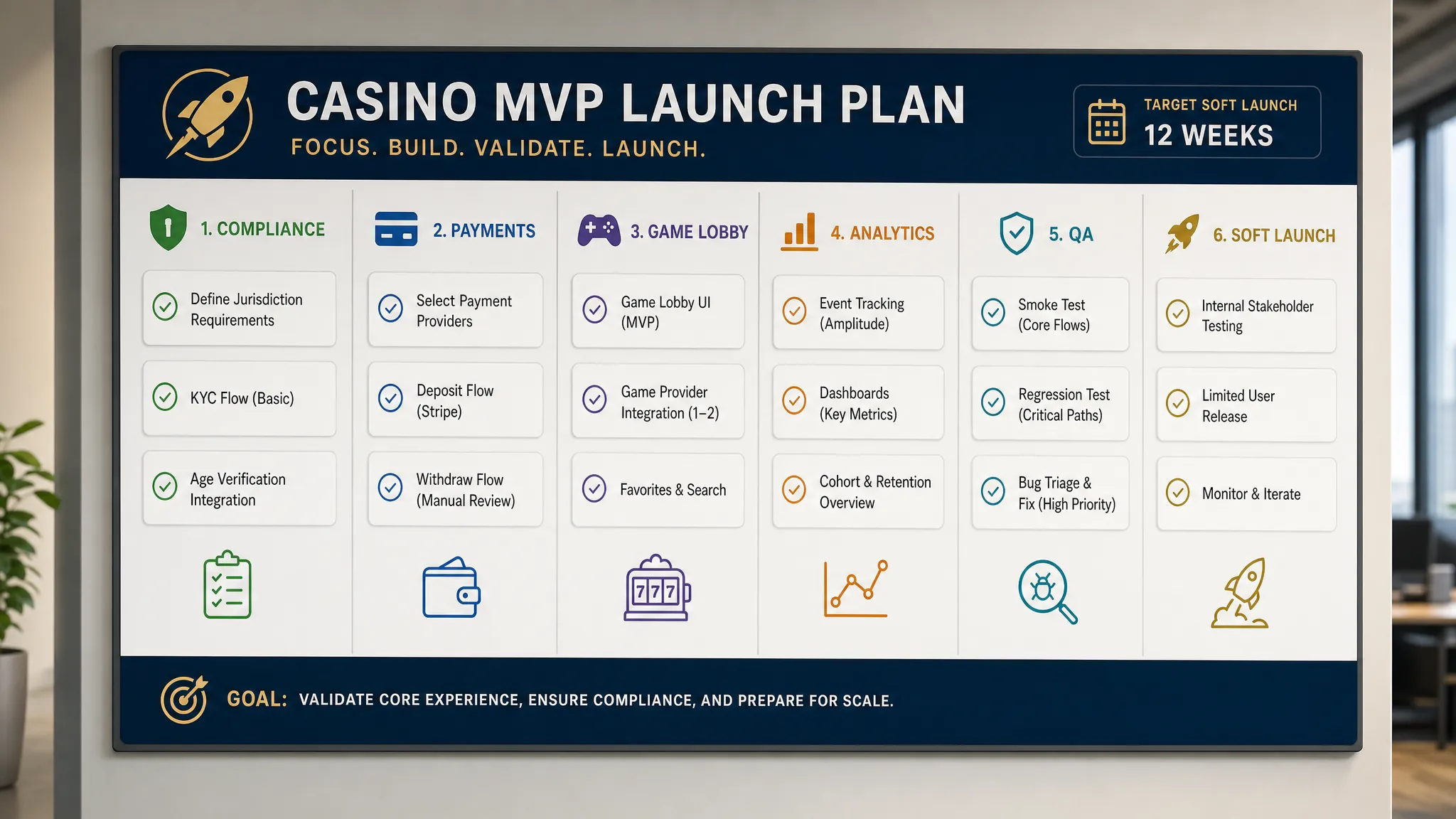
Days 1 to 3: Choose the Operating Model and Cut the Scope
The first three days decide whether the launch is realistic. Do not start with colors, logos, or game banners. Start with the operating model.
Pick one target player segment, one primary market, one default currency, one acquisition strategy, and one simple promise. For example, your MVP might be a crypto-ready slot casino for mobile-first players in a specific region, or a fiat-first whitelabel casino focused on fast deposits and live casino games.
Your biggest enemy in the first 72 hours is optionality. Every extra option creates more compliance review, PSP setup, QA, support training, and analytics complexity.
Define Your MVP Boundaries
Write a one-page launch charter with these decisions:
- Target market and restricted markets
- Licensing and legal assumptions
- Default currency and secondary currencies
- Payment rails for launch
- Game categories for launch
- KYC trigger points
- First bonus offer and terms
- Responsible gambling controls
- Soft-launch traffic limit
- Success metrics for day 30
The MVP should be small enough that every team member can describe it in two minutes.
Days 4 to 7: Select the Platform and Confirm Compliance Readiness
The fastest route is usually a white label casino platform or modular turnkey casino solution that already includes the operational core: frontend, backoffice, wallet, payments, game aggregation, KYC and AML workflows, fraud controls, analytics, and bonus tools.
This is where Spinlab fits the MVP use case. Spinlab offers an all-in-one, modular iGaming platform for building, launching, and scaling online casinos, with crypto and fiat payment support, game aggregation, real-time analytics, fraud prevention, KYC and AML compliance, multi-currency support, customizable backoffice tools, open API integration, and original games that can be custom designed.
For a 30-day MVP, the most important platform trait is not the number of features. It is how quickly a non-technical team can configure the essentials without waiting on developers for every change. A Shopify-like casino operations experience helps founders move faster because content, payments, bonuses, and admin workflows can be managed through a usable interface rather than a fragmented technical stack.
Ask Vendors for Proof, Not Promises
During vendor evaluation, request evidence for the workflows you will actually use in the MVP. A polished sales deck is less useful than a working admin panel, a payment flow demo, a game launch test, and sample audit logs.
| Vendor Proof | Why It Matters for a 30-Day MVP |
|---|---|
| Working cashier demo | Shows deposit and wallet crediting reliability |
| KYC and AML workflow screenshots | Confirms compliance can be operated from day one |
| Game launch test | Validates aggregation, sessions, and wallet callbacks |
| Bonus configuration demo | Shows whether non-developers can create controlled offers |
| Backoffice role permissions | Protects operational security and auditability |
| Analytics event examples | Confirms you can measure the launch properly |
| API and webhook documentation | Keeps future integrations open as you scale |
If a vendor cannot show the money path, identity path, and game path in action, do not assume they will be ready inside 30 days.
Days 8 to 14: Configure Payments, Wallets, Games, and KYC
Week two is where your MVP becomes operational. The main risk is trying to launch with too much variety. Payments, games, and KYC should be configured for conversion, security, and support simplicity.
Keep the Cashier Narrow but Reliable
For most MVPs, the cashier should offer one strong fiat option and one strategic alternative, such as crypto or a local APM, depending on the target player base. If your audience is crypto-native, direct crypto deposits and a crypto onramp can be central to the launch. If your audience is mainstream, card, bank, or wallet-based deposits may be more important.
The key is to unify payment activity under one ledger and one operational view. Fragmented payment setups create reconciliation headaches and support tickets. The MVP needs clear deposit states, withdrawal states, payment failure reasons, and admin visibility.
A crypto-ready solution also needs custody and treasury thinking from day one. Even if crypto volume is small, you still need wallet controls, transaction monitoring, KYT or AML screening where relevant, and reconciliation between blockchain events and the casino ledger.
Curate a Small Game Lobby
A casino MVP does not need thousands of games. It needs enough variety to validate player behavior. A lean game lobby might include popular slot games, a few live casino games, and one or two exclusive or original games if differentiation is part of the brand.
A smaller lobby is easier to QA, easier to merchandise, and easier to analyze. It also helps your team understand which content actually drives deposits, first spins, repeat sessions, and retention.
For the first 30 days, prioritize:
- Fast-loading mobile games
- Clear RTP and volatility information where appropriate
- Providers approved for your target market
- Games that support your bonus rules
- A simple lobby taxonomy such as Slots, Live Casino, New, Popular, and Originals
The MVP question is not whether you can offer every game. It is whether the first 50 to 150 games create enough engagement to justify expansion.
Make KYC Feel Like a Product Flow
KYC is often treated as a compliance back-office task, but in an MVP it is a conversion-critical product flow. If players hit unclear document requests, long pending states, or unexpected verification at withdrawal, your early data will be distorted.
Decide when verification happens, what documents are required, how pending players are handled, and how support responds. Risk-based KYC can reduce friction, but only if the operator still meets regulatory obligations in the target market.
Days 15 to 21: Build the Measurement Layer and Operational Runbooks
A casino MVP without analytics is just a risky launch. By week three, you should know exactly what events you are tracking and who reviews them daily.
At minimum, instrument the full player journey: landing page visit, registration started, registration completed, KYC started, KYC approved, deposit initiated, deposit approved, first game launched, first wager, bonus claimed, withdrawal requested, withdrawal paid, support ticket opened, and account restricted.
Real-time analytics matter because casino operations move quickly. A payment issue, bonus abuse pattern, or KYC bottleneck can burn acquisition budget before a weekly report catches it.
| KPI | What It Tells You | MVP Target Question |
|---|---|---|
| Registration completion rate | Whether onboarding is understandable | Are players willing to create accounts? |
| KYC pass and pending rates | Whether verification is too strict or unclear | Is compliance hurting valid players? |
| First-time depositor rate | Whether the cashier and offer work | Can the brand convert interest into deposits? |
| Deposit approval rate | Whether payment routing and fraud rules are healthy | Are good players being declined? |
| Time to first spin | Whether the core journey is fast | Can players reach gameplay quickly? |
| Withdrawal completion time | Whether trust can be sustained | Can players cash out without confusion? |
| Bonus cost to NGR | Whether promotions are controlled | Are offers creating value or abuse? |
| Support tickets per 100 active players | Whether operations are scalable | What is breaking or unclear? |
Write Runbooks Before Launch
A runbook is a short operational guide for predictable problems. You do not need a large operations department, but you do need clear responses.
Create runbooks for deposit failures, KYC pending cases, withdrawal holds, bonus abuse, suspicious multi-accounting, game launch errors, and responsible gambling escalations. Each runbook should identify the owner, evidence needed, player communication, escalation path, and resolution SLA.
This is where an integrated backoffice admin panel becomes valuable. If support, payments, risk, and marketing all work from different tools, the MVP becomes slower and less reliable.
Days 22 to 26: QA the Money Path, Bonus Rules, and Mobile UX
Most casino launch problems appear in the handoffs: PSP to ledger, game provider to wallet, KYC vendor to player status, bonus engine to wagering logic, and backoffice action to audit log.
Your QA plan should focus on these handoffs rather than only visual checks.
Test the complete money path:
- Successful deposits and failed deposits
- Wallet crediting and idempotent retries
- Game bets, wins, refunds, and canceled rounds
- Bonus balances, wagering contribution, and max bet enforcement
- Withdrawal requests, holds, approvals, rejections, and payouts
- Ledger, PSP, and bank or wallet reconciliation
Then test the mobile journey on real devices. Many MVPs look fine on desktop but fail where players actually convert: mobile registration, document capture, cashier forms, game launch, and support chat.
Do not launch until the team can complete the full journey from registration to withdrawal in a test environment and explain every status change in the backoffice.
Days 27 to 30: Soft Launch With Controlled Traffic
The final four days should not be a loud public launch. Start with controlled traffic and strict monitoring. Your first players are not just customers, they are validation signals.
Limit acquisition sources at first. A small group of affiliates, warm audiences, CRM lists, or carefully targeted paid campaigns is easier to analyze than traffic from every channel. If you need to build partner or affiliate conversations quickly, especially around B2B-style casino services, media partnerships, or sales-led growth, a specialist B2B customer acquisition agency can help structure outbound campaigns and qualified call pipelines while your product team focuses on launch execution.
For player acquisition, keep advertising compliant. Gambling marketing rules differ significantly by region, and promotional claims, influencer content, age targeting, and bonus wording must be reviewed before spend scales.
Use a Launch War Room
For the first 72 hours of traffic, review metrics at least twice per day. Watch payment failures, KYC delays, bonus redemptions, support tickets, withdrawal holds, game errors, and suspicious account clusters.
Your day 30 decision should be based on evidence:
| Decision | Evidence You Need |
|---|---|
| Scale traffic | Stable deposits, acceptable fraud, positive early retention signals |
| Add payment rails | Deposit failures tied to missing preferred methods |
| Add more games | Search, lobby, and gameplay data showing content gaps |
| Revise bonuses | Bonus cost too high, abuse signals, or weak activation |
| Improve KYC UX | High pending rate, resubmission rate, or support tickets |
| Pause and fix | Ledger issues, withdrawal confusion, compliance gaps, or high fraud |
A good MVP may reveal that you should slow down. That is still a successful outcome if it prevents a costly public launch failure.
What to Build Yourself vs What to Buy
In a 30-day launch, custom development should be reserved for brand differentiation, not core gambling infrastructure. Building wallets, payment orchestration, compliance workflows, or game aggregation from scratch is rarely compatible with a fast MVP unless you already have an experienced engineering team and licensed operational setup.
| Component | Buy or Configure for MVP | Customize Later If Needed |
|---|---|---|
| Wallet and ledger | Buy | Rarely worth rebuilding early |
| KYC and AML | Buy and configure | Add custom risk models later |
| Game aggregation | Buy | Negotiate direct provider deals after traction |
| Cashier | Buy with flexible configuration | Add local rails as data proves demand |
| Backoffice | Buy | Customize workflows after operator feedback |
| Brand frontend | Configure | Deep custom UI after conversion data |
| Original games | Optional differentiator | Invest more after retention proof |
| Analytics | Use platform foundation | Add advanced models after event quality is proven |
The MVP should leave you with options. That is why open API integration matters. You may start with a turnkey casino solution, but as the brand grows you might need custom CRM, external BI, specialized fraud tools, new payment providers, affiliate systems, or proprietary games.
Common Casino MVP Mistakes That Delay Launch
The first mistake is launching too many markets. Every jurisdiction adds legal review, content restrictions, payment complexity, support needs, and compliance differences. Start narrow, prove the model, then expand.
The second mistake is overbuilding the bonus strategy. A complex welcome package with free spins, cashback, wagering tiers, VIP ladders, and time-limited missions creates abuse risk and support confusion. One clear offer with enforceable terms is usually better.
The third mistake is treating crypto as a plugin. Crypto deposits, stablecoins, onramps, custodial wallets, Travel Rule expectations, sanctions screening, treasury, and reconciliation are operational systems. A crypto-ready casino must connect the cashier, wallet, compliance, and ledger from the beginning.
The fourth mistake is ignoring withdrawals until the end. Players judge casino trust by cashout clarity. Even in an MVP, withdrawal statuses, review reasons, payout timing, and support messaging need to be designed.
The fifth mistake is measuring only revenue. Early GGR is useful, but it can hide broken onboarding, bonus leakage, or fraud. A casino MVP should measure conversion quality, compliance friction, payment reliability, and operational load.
Why a Modular Platform Is the Fastest MVP Path
A modular all-in-one platform gives founders the practical benefits of a white label casino while preserving flexibility for growth. You can launch with the modules you need now, then expand into additional payment rails, currencies, brands, game categories, bonus types, and API integrations as the data supports it.
For a 30-day MVP, the ideal platform should combine:
- Crypto and fiat payment support
- Multi-currency wallet capabilities
- Game aggregation across slots and live casino games
- KYC, AML, and fraud prevention workflows
- Real-time analytics dashboards
- Bonus and affiliate tools
- A customizable backoffice admin panel
- Mobile-first frontend performance
- Open APIs for future integrations
- Fast onboarding and operational support
Spinlab is built around this exact need: a cost-conscious, Shopify-like path for operators who want to launch faster without stitching together every core system themselves.
Frequently Asked Questions
Can you really launch a casino MVP in 30 days? Yes, if you use a launch-ready white label casino platform, limit scope, start with a narrow market, and treat the first release as a controlled soft launch. Licensing, PSP approval, game provider approvals, and local legal requirements can still affect timing.
Is a casino MVP the same as a demo casino? No. A demo shows how the product could work. A casino MVP is operationally useful because it validates real player journeys, payments, KYC, gameplay, support, fraud controls, and retention signals under controlled conditions.
How many games should a casino MVP launch with? Enough to validate player behavior, not enough to overwhelm QA and operations. Many MVPs can start with a curated selection of slots, a small live casino category, and optional original games if differentiation matters.
Should a casino MVP support crypto payments? It depends on your audience and market strategy. Crypto can improve speed, global reach, and player appeal for certain segments, but it also requires custody, AML, KYT, treasury, and reconciliation controls.
What is the biggest risk in a 30-day casino launch? The biggest risk is confusing speed with shortcuts. Fast launches fail when operators skip compliance evidence, money-path QA, fraud controls, withdrawal design, or analytics instrumentation.
Do you need developers to launch a casino MVP? Not always. A Shopify-like whitelabel casino platform can let non-technical teams configure many core operations. Developers may still be needed for custom integrations, advanced tracking, bespoke frontends, or complex API work.
Launch Lean, Learn Fast, and Scale With the Right Foundation
A 30-day casino MVP is not about racing to put a logo on a generic casino. It is about proving that your brand, platform, payments, game content, compliance workflows, and acquisition strategy can work together under real operating pressure.
If you want to launch with a modular, crypto-ready, mobile-optimized casino platform that includes payments, game aggregation, KYC and AML compliance, fraud prevention, analytics, bonuses, backoffice tools, and open API flexibility, Spinlab can help you get from idea to controlled MVP faster.
Start with a narrow scope. Measure everything. Fix what breaks. Then scale only when the data says the foundation is ready.