

Registration is your highest-leverage funnel step because it sits between paid traffic and everything that makes money: deposits, retention, and VIP. Yet casino sign-up flows often inherit friction from compliance, fraud defenses, localization gaps, and mobile performance issues. The result is predictable: high-intent visitors bounce, while the players who do complete registration skew toward the most persistent (not always the most valuable).
This guide breaks registration drop-off into measurable failure modes and gives practical fixes you can ship without “loosening compliance.”
Start with a registration drop-off map (so you fix the right thing)
Before changing UX, you need a shared definition of “registration complete” and a funnel view that separates:
- Registration friction (field count, OTP failures, password issues)
- Trust friction (brand credibility, licensing, privacy, payments clarity)
- Technical friction (slow pages, API errors, blocked scripts)
- Risk friction (bot defense, fraud checks, KYC/AML requirements)
A useful baseline is to instrument the steps below with timestamps and reason codes:
REG_VIEW(registration UI rendered)REG_START(first interaction)REG_SUBMITREG_ERROR(witherror_code,field,http_status,providerif relevant)OTP_SENT,OTP_DELIVERED(if you can),OTP_VERIFIED,OTP_FAILEDACCOUNT_CREATEDFIRST_LOGIN
Then segment the funnel by:
- Device (iOS Safari vs Android Chrome vs desktop)
- Geo and language
- Acquisition source (affiliate, SEO, paid social)
- New vs returning (cookie or device ID)
- Risk tier (bot score, device reputation, velocity)
If you do only one thing this week: build a “drop-off reasons” report that ranks causes by lost completions, not by how often an error occurs.
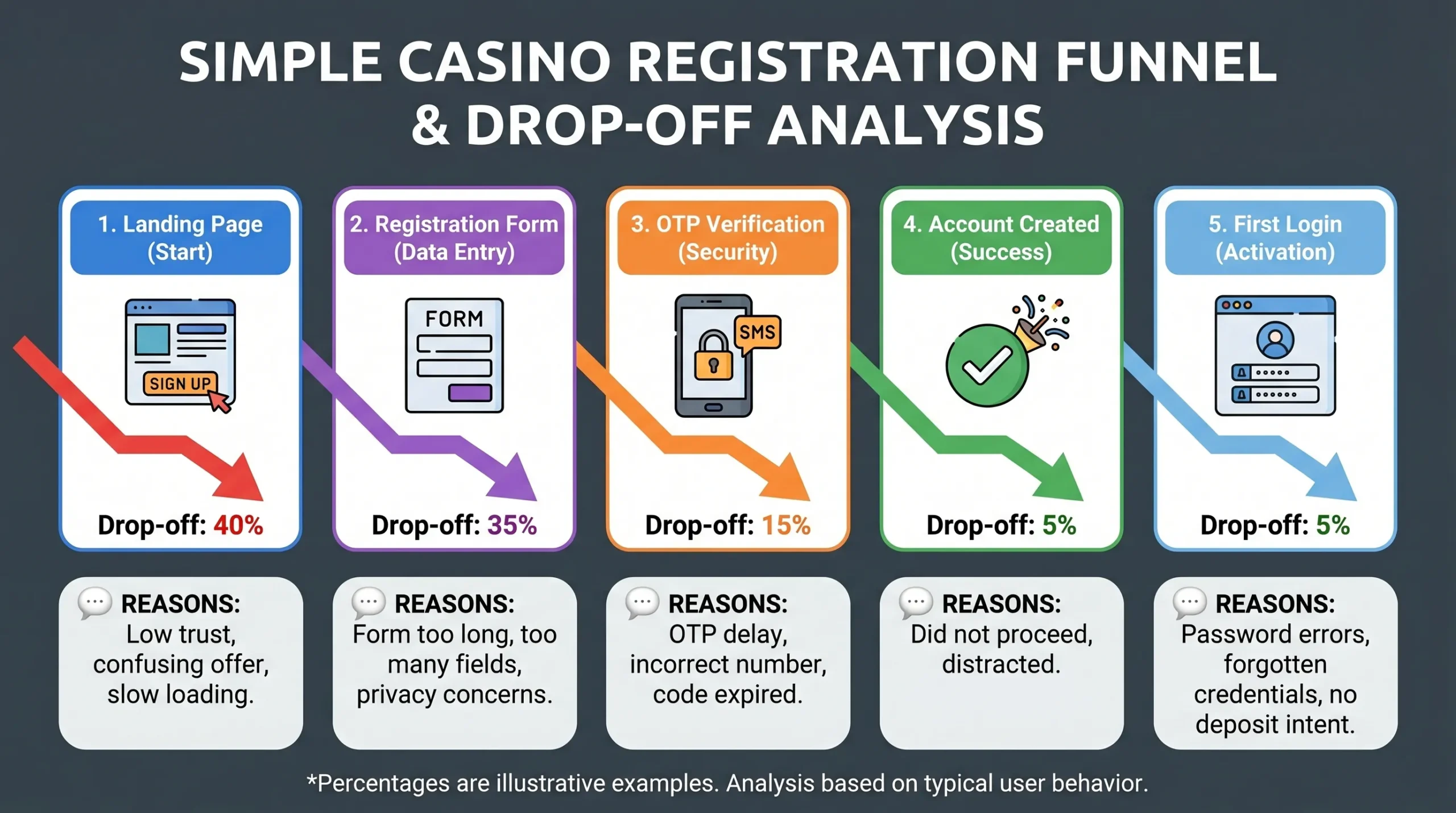
The 8 most common drivers of registration drop-off (and what to do instead)
1) Too many fields, too early
Casino registration forms often ask for everything upfront (full address, DOB, phone, currency, promo preferences). That is understandable for compliance, but it is rarely optimal for conversion.
Fix: Use progressive profiling.
- Keep initial sign-up to what you must have to create an account and enforce basic eligibility.
- Collect secondary details after first value moment (for example: after browsing games, after a first “demo play” session, or after deposit intent).
Even in regulated contexts, many operators can separate:
- Account creation fields (minimum viable)
- Verification fields (triggered by jurisdiction, deposit/withdrawal thresholds, or risk signals)
2) Password rules that feel like punishment
Players abandon when passwords fail silently, requirements are unclear, or mobile keyboards fight them.
Fix: Make password creation “guided,” not “graded.”
- Show requirements inline before submission.
- Provide a visible “show password” toggle.
- Use passkeys where possible (WebAuthn is a W3C standard) to reduce password friction and credential stuffing risk at the same time. Reference: W3C WebAuthn.
3) OTP and verification bottlenecks
Phone or email verification is a top drop-off point because failures feel external and unfair: delayed SMS, carrier filtering, or users switching apps and losing context.
Fix: Engineer for retries and continuity.
- Make resend rules clear, with a visible timer.
- Offer a second channel (SMS + email, or SMS + WhatsApp where permitted).
- Preserve state across app switching so returning from a messaging app does not reset the flow.
- Log OTP outcomes with vendor and carrier metadata when possible so you can identify systemic issues by country.
4) Mobile UX issues that look small but compound fast
On mobile, tiny friction becomes abandonment because the cost of correction is higher.
Fix: Make your inputs mobile-native.
- Use correct keyboard types (
email,tel, numeric). - Auto-format phone numbers by country.
- Support OTP auto-fill (iOS/Android).
- Avoid multi-column layouts and small tap targets.
Also, keep the registration screen lightweight. Google’s mobile research has long shown that slower experiences drive higher abandonment, and this pattern is consistent in high-intent funnels. A commonly cited benchmark is that bounce probability rises sharply as load time increases. Source: Think with Google on mobile speed.
5) Trust gaps: “Is this casino legit?” is a registration killer
Players will not hand over identity data if the page looks thin, confusing, or inconsistent.
Fix: Add trust cues that answer risk questions without distracting from the form.
High-impact cues include:
- Licensing and jurisdiction disclosure (where applicable)
- Responsible gambling and age messaging
- Clear privacy statement link near the submit CTA
- Payment methods preview (especially if you market “crypto-ready” or multi-currency)
- Consistent brand signals (domain, design, support links)
The key is placement: keep trust cues close to the decision point, but do not overwhelm the form.
6) Localization mismatches (language, formats, and expectations)
Registration drop-off spikes when you accept traffic from multiple regions but your form “speaks one country.” Common examples: date formats, name fields, phone formats, address requirements, and currency assumptions.
Fix: Localize inputs and defaults.
- Auto-detect country and language (with a visible override).
- Default currency intelligently where multi-currency is supported.
- Use local examples in placeholders (especially for phone and document types).
- Ensure error messages are translated and culturally clear.
7) Over-aggressive anti-fraud that blocks legitimate new users
If bot protection or fraud scoring is too blunt at registration, you reduce sign-ups and still do not stop sophisticated attackers.
Fix: Use risk-based step-ups, not universal walls.
- Let low-risk users pass with minimal friction.
- Escalate checks for suspicious velocity, device reputation, IP risk, or affiliate anomalies.
- Prefer invisible bot controls where possible, and reserve challenges for high-confidence abuse.
This is especially important for “Shopify-like” onboarding expectations: fast, predictable, and reversible.
8) “Something went wrong” errors with no path forward
Generic errors create a dead end, and players do not open support during registration.
Fix: Turn errors into recovery.
- Use field-level validation with specific messages.
- When failures are server-side, show a retry button that preserves state.
- Provide a fallback option (“Continue with email instead of phone,” “Try a different verification method”).
- Assign every failure a reason code you can analyze later.
A practical optimization table you can hand to product and engineering
| Drop-off point | What it usually means | Fastest fix to test | Metric to watch |
|---|---|---|---|
| Form view → start | Low trust or confusing CTA | Simplify above-the-fold, add trust cues near CTA | Start rate (REG_START / REG_VIEW) |
| Start → submit | Form friction and unclear requirements | Reduce fields, better input masks, inline help | Submit rate |
| Submit → account created | Backend or validation failures | Better error mapping, idempotent submit, retries | Account creation success rate |
| OTP sent → verified | Deliverability and UX continuity | Multi-channel fallback, resend UX, preserve state | OTP completion rate, time-to-verify |
| Mobile-only drop | Layout, speed, keyboard issues | Keyboard types, fewer steps, performance budget | Mobile completion rate |
| Country-specific drop | Vendor coverage or localization gaps | Country routing, localized formats, better copy | Completion by geo |
Instrumentation: the minimum event and logging spec
If you want to reduce registration drop-off reliably, you need more than a dashboard showing “conversion is down.” You need to know why.
At minimum, log:
- Client and server timestamps for each step
- Device, OS, browser, and app version
- Geo and language
- Error codes mapped to human-readable “reason buckets”
Suggested reason buckets:
- Input validation (email format, password rules)
- Duplicate account
- OTP failed (timeout, wrong code, provider error)
- Network or server error
- Fraud or bot block
- Compliance block (age, geo, jurisdiction)
If you are evaluating tooling to speed up funnel diagnosis, vendor comparisons and implementation tutorials can help, a general directory like Online Tool Guides for analytics and optimization tools can be a useful starting point.
UX patterns that consistently reduce sign-up friction (without compromising compliance)
Make the player’s “next step” obvious
Registration fails when users cannot predict what happens next.
Practical patterns:
- A short progress indicator (2 to 4 steps is ideal)
- Confirmation screens that explain what was created
- Clear “why we need this” microcopy next to sensitive fields
Keep the registration page focused
Casino pages often load chat widgets, retargeting scripts, trackers, and multiple tag managers. Registration is not the place for heavy third parties.
Set a performance and stability budget:
- Limit third-party scripts on registration
- Defer non-essential marketing tags until after account creation (where allowed)
- Monitor real-user performance (LCP/INP/CLS) specifically for registration URLs
Offer “save and resume” for high-friction jurisdictions
In some markets, identity requirements are heavier. If you cannot avoid early verification, you can still prevent abandonment by allowing continuity.
- Let users resume from the last completed step via a secure deep link
- Provide a clear pending state (“Verification in progress, we will notify you”)
Recovery: turn abandoned registrations into completed accounts
Registration recovery is underused in iGaming because teams focus on deposit recovery. But many users abandon before they ever become reachable.
Two approaches:
- On-site recovery: if the user returns within a short window, restore the partially completed form state.
- Out-of-session recovery: if the user provided email or phone, trigger a short reminder sequence that links back to the exact step.
Key rule: do not spam. Use frequency caps, and ensure messaging complies with your jurisdiction’s marketing and responsible gambling rules.
How to run tests safely (so conversion gains are real)
Registration is sensitive because changes can affect fraud rates and compliance outcomes. Treat it like a controlled system.
- Run A/B tests with clear primary metrics (completion rate) and guardrails (fraud flags, duplicate rate, chargeback rate downstream).
- Avoid changing multiple friction points at once unless you can attribute impact.
- Monitor by segment, overall lifts can hide mobile regressions or geo-specific issues.
A simple metric set:
| Metric | Why it matters |
|---|---|
| Registration completion rate | Direct measure of drop-off |
| Time to complete registration | Detects hidden friction |
| OTP completion rate | Identifies verification bottlenecks |
| Error rate by reason bucket | Shows what to fix first |
| Fraud blocks per 1,000 attempts | Ensures controls still work |
| First login rate | Catches “account created but unusable” issues |
Frequently Asked Questions
What is a good registration completion rate for an online casino? It varies heavily by channel, geo, and compliance requirements. The actionable approach is benchmarking by segment, then improving step-level conversion and time-to-complete.
Should casinos require KYC during registration? Many operators use progressive verification to reduce drop-off while staying compliant, for example gating withdrawals or higher limits instead of forcing full KYC at first click. The right answer depends on your jurisdiction and risk model.
Why do players drop off at OTP verification? Common causes are SMS deliverability issues, confusing resend UX, app switching that resets the flow, and overly strict timeouts. Multi-channel fallback and state preservation usually deliver quick wins.
How do you reduce registration drop-off without increasing fraud? Use risk-based step-ups: keep low-risk sign-ups fast, escalate verification only when device, velocity, geo, or behavioral signals warrant it, and measure fraud-adjusted conversion.
Build a faster, lower-drop registration flow with Spinlab Studio
If your registration funnel is fighting your growth, it is often because identity, fraud, compliance, payments, and analytics live in separate tools with inconsistent UX and logging. Spinlab Studio provides a modular iGaming platform designed to help operators build and scale online casinos with integrated payments (fiat and crypto), compliance tooling, fraud prevention, game aggregation, and a customizable backoffice.
To see how a unified, crypto-ready platform can simplify onboarding and reduce registration drop-off, explore Spinlab Studio and request a walkthrough of the modules that matter for your market.