

Running an online casino today almost certainly means running Kubernetes. Micro-services for cashier APIs, real-time data pipelines, WebRTC dealers, game engines, and back-office dashboards all benefit from the elasticity and velocity that K8s brings. Unfortunately, that same velocity can introduce a frighteningly large blast radius if clusters are not locked down. In gambling, a single breach is not just an IT headline; it can trigger licence suspension, seven-figure fines, and irrevocable player-trust damage.
This guide shows, step by step, how to apply the Center for Internet Security (CIS) Kubernetes Benchmark to iGaming workloads. We will map each high-impact recommendation to concrete casino risks, add pragmatic implementation tips, and finish with an audit checklist you can copy-paste into Jira. Whether you operate your own Fullhouse cluster or audit a managed service provider, these controls are non-negotiable for 2025-level security and compliance.
Why the CIS Benchmark Matters in Gambling
- Regulated data: Payment card data is covered by PCI DSS and player PII is protected by GDPR/UK GDPR—both frameworks assume hardened infrastructure.
- Real-time money movement: Attackers prize low-latency environments where they can siphon balances fast.
- Always-on promotions: Cheaters automate bonus abuse; if they can move laterally inside your cluster, they will exploit wallet and bonus micro-services.
- Regulator optics: Demonstrating CIS adherence during licence reviews reduces audit friction and shortens incident investigation timelines.
Spinlab’s own SOC2 and ISO 27001 programmes explicitly reference CIS Kubernetes benchmark controls. The rest of this article shows you how to match that bar.
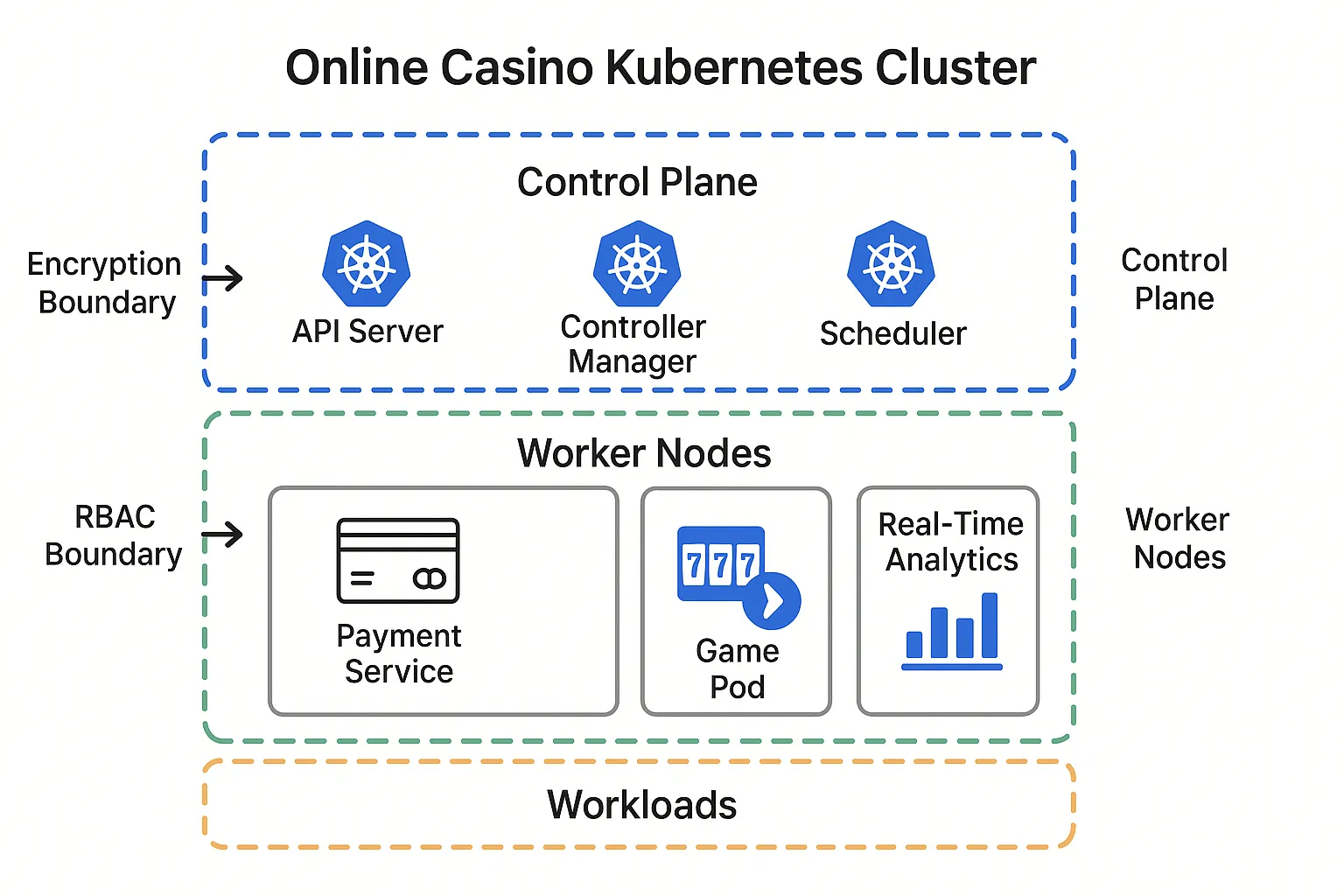
Control-Plane Hardening
| CIS ID | Casino-Specific Risk | Quick Win | Tooling |
|---|---|---|---|
| 1.1.1 | Compromise of etcd may expose player balances, bonus state and AML flags | Encrypt etcd at rest with customer-managed keys | etcd --peer-client-cert-auth + KMS envelope encryption |
| 1.2.6 | Unauthenticated kubelet ports allow attackers to hijack game pods and manipulate RTP | Disable anonymous authentication | --anonymous-auth=false |
| 1.2.9 | Insecure admission control may let devs deploy privileged crash-game images in production | Enable PodSecurity, NodeRestriction |
API server flags or managed-cluster UI |
| 1.3.2 | Node credential leakage can be used to mint chips in cashier service | Rotate kubelet certificates every 30d | --rotate-certificates flag |
Implementation Tips
- Managed offerings such as GKE Autopilot or EKS set many flags for you but never assume parity—audit the control plane with
kube-benchafter every upgrade. - Store encryption keys outside the cluster (AWS KMS, Azure Key Vault, HashiCorp Vault). Regulators increasingly ask for key custody proofs.
Node Hardening
Gambling workloads tend to be performance-sensitive, so operators often skip node patching windows—until ransomware forces a 48-hour outage. Apply these CIS controls to every worker pool:
- 2.1.1 Disable privileged containers except for vetted DaemonSets (CNI, CSI). Bonus-abuse bots often rely on host namespaces to scrape memory.
- 2.1.3 Restrict Linux capabilities to the absolute minimum. A slot-rendering service rarely needs
NET_RAW. - 2.2.1 Use read-only root filesystems for game pods so malicious uploads cannot persist.
- 2.2.4 Use seccomp profiles. Start with
RuntimeDefault; only relaxing rules when benchmarks prove a material FPS gain.
GPU Worker Pools
Live-dealer streaming and AI-dealer inference usually run on GPU nodes. Apply the same CIS settings, plus:
- Isolate GPU workloads with taints and tolerations to prevent co-tenancy with cashier or AML services.
- Enable
nvidia-container-toolkitin user-namespace-remap mode to remove root inside GPU pods.
Workload and Namespace Hardening
Namespaces are your first logical line of defence when an attacker lands via a compromised API key or container escape.
- CIS 5.1.2 – Minimise RBAC cluster-role bindings. Finance and casino-ops SREs should never have access to
kube-system. Map roles to SOC duty segregation requirements. - 5.2.4 – Apply NetworkPolicies. At a minimum, enforce strict egress from game pods; they usually need only RNG endpoints and metrics.
- 5.2.5 – Use PodSecurity Standards (PSS).
restrictedshould be the default, withbaselineexceptions tracked in Git. - 5.7 – Image provenance: mandate signed images using Cosign and verify in admission control. Spinlab sign all Fullhouse base images; you should sign custom skins and promo micro-services too.
Example NetworkPolicy for RNG Isolation
apiVersion: networking.k8s.io/v1
kind: NetworkPolicy
metadata:
  name: allow-only-rng-egress
  namespace: game-engine
spec:
  podSelector:
    matchLabels:
      app: crash-game-engine
  policyTypes:
  - Egress
  egress:
  - to:
    - namespaceSelector:
        matchLabels:
          name: rng-service
    ports:
    - protocol: TCP
      port: 8443
Compliance Mapping Cheat-Sheet
| Regulation / Standard | Relevant CIS Sections | Evidence to Collect |
|---|---|---|
| PCI DSS v4.0 | 1.1, 5.2, 5.7, 5.8 | kube-bench output, NetworkPolicy manifests, encryption-at-rest configs |
| UKGC Remote Tech 2025 | 5.2, 5.3 | RBAC matrix, audit trail exports |
| GDPR Art.32 | 1.1.1, 1.3.2, 2.2.1 | Key management policies, patch cadence reports |
| ISO/IEC 27001 | All controls | Consolidated risk register linked to CIS IDs |
Automating Compliance: From CI to Runtime
-
CI Layer
- Scan Dockerfiles with Trivy and push only signed images.
- Lint Helm charts against PSS using
kubescape.
-
Admission Control
- Deploy Gatekeeper with policies mirroring CIS IDs (privileged pods blocked, rootfs read-only enforced).
-
Runtime
- Use Falco or Cilium Tetragon for syscall-level anomaly detection, tuned for gambling-specific threats (e.g., mass wallet export attempts).
- Stream alerts to Spinlab Real-Time Analytics so fraud and security signals live in one dashboard. See our article on Building a Risk Matrix.
-
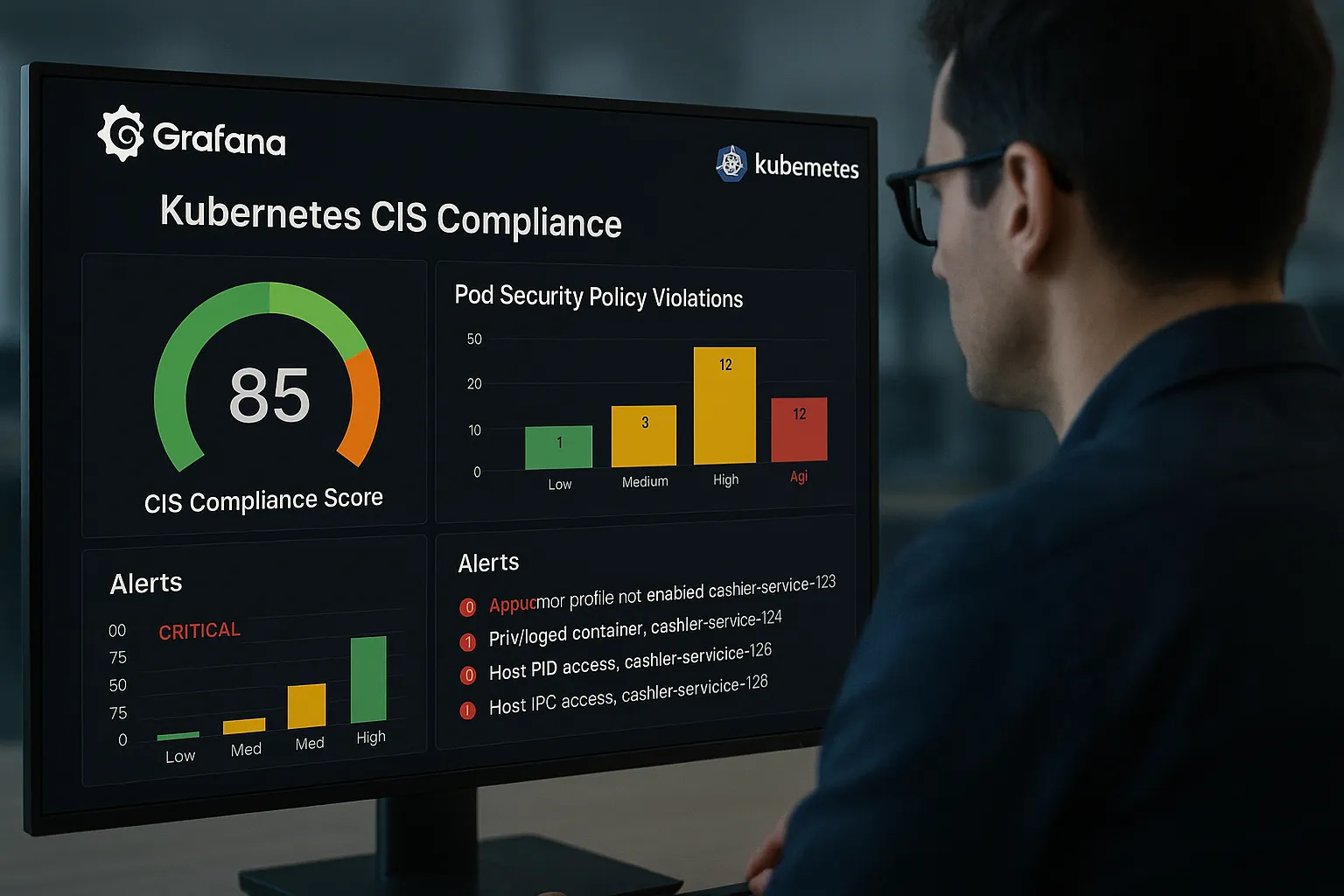
Continuous Audit
- Schedule
kube-benchin CronJobs and dump JSON reports to S3/GCS. Pipe results into Grafana for posture trend lines. - Run quarterly red-team drills focussed on payment and bonus endpoints; validate your NetworkPolicies and PSP exceptions.
- Schedule
Copy-Paste Audit Checklist (Jira-Ready)
- etcd encryption at rest enabled with customer-managed KMS keys.
- Anonymous auth disabled on API server and kubelets.
- PodSecurity admission enabled,
restricteddefault. - All namespaces have default-deny NetworkPolicy.
- Image signing enforced via Gatekeeper.
- Kubelet certificates rotate automatically every 30 days.
- Node pools patched weekly; zero outstanding CVEs >7.0.
- Runtime syscall monitoring deployed on every node.
- Quarterly backup restore drill completes within RTO.
-
kube-benchautomated; trend line reviewed monthly.
Frequently Asked Questions
Do managed Kubernetes services already cover CIS controls? Only partially. Providers secure the control plane, but node, namespace, and workload controls remain your responsibility. Always run your own kube-bench.
Will these settings hurt game performance? Properly tuned seccomp and read-only filesystems show <2 % overhead in Spinlab load tests. The risk reduction vastly outweighs minor CPU hits.
How do I prove compliance to regulators? Export automated audit reports, link CIS IDs to licence obligations (see cheat-sheet above), and maintain immutable logs in object storage with WORM lock.
Can Spinlab run this for me? Yes. Our Fullhouse Cloud tier ships with a pre-hardened cluster, continuous CIS scanning, and audit-ready dashboards. Contact us for a live walkthrough.
Next Steps
Hardening Kubernetes is not a one-off task; it is a living control system. If you are migrating to containers or auditing an inherited cluster, start with the checklist above and measure your baseline. From there, automate every control you can and roll posture metrics into the same dashboards you already use for fraud and player behaviour.
Ready to see a fully hardened, casino-optimized cluster in action? Book a security demo with Spinlab and benchmark your setup against our CIS-aligned baseline today.