

MiCA’s stablecoin rules are no longer a future concern, they are active law across the EU and EEA. If your cashier accepts USDT, USDC, EURC or other stablecoins, you must adapt how you choose tokens, route payments, verify players, and keep audit trails. This guide translates the legal text into a practical plan for casino operators and product teams.
Important note, this article is general information for operators and is not legal advice. Always confirm requirements with counsel in your licensing jurisdiction.
What changed under MiCA and why casinos must care
The Markets in Crypto Assets Regulation, Regulation (EU) 2023/1114, sets a harmonized rulebook for crypto in the EU. Two parts matter immediately for deposits and withdrawals in stablecoins:
- Rules for stablecoins, Titles III and IV, apply from June 30, 2024, covering asset referenced tokens and e money tokens.
- Rules for crypto asset service providers apply from December 30, 2024, with national transition windows for existing firms.
For the legal text, see Regulation (EU) 2023/1114 on EUR Lex. For supervisory standards and technical details that issuers and service providers must follow, see the EBA’s MiCA package of final regulatory technical standards.
MiCA defines two relevant stablecoin categories:
| Token type | What it is | Who can issue in the EEA | Key obligations that affect casinos |
|---|---|---|---|
| ART, asset referenced token | Stablecoin referencing a basket of assets, for example multiple currencies or commodities | Entities authorized under MiCA Title III | Reserve, custody and governance requirements, redemption rights, white paper approval, heightened rules if the token is designated significant |
| EMT, e money token | Stablecoin referencing a single fiat currency, for example EUR or USD | Only credit institutions or e money institutions authorized in the EEA | Redeemable at par at any time with the issuer, strict reserve and safeguarding rules, investment constraints, stress testing and liquidity requirements |
Supervision tightens for stablecoins designated significant, which brings higher own funds, liquidity and reporting. MiCA and the EBA require issuers to monitor how tokens are used as a means of exchange and to apply corrective measures if volumes become too large in payments contexts.
Separately, the EU Transfer of Funds Regulation for crypto, Regulation (EU) 2023/1113, applies the travel rule to crypto transfers from December 30, 2024. CASP to CASP transfers must include full originator and beneficiary information. For transfers involving self hosted wallets, the regulation requires verification measures above defined thresholds. See Regulation (EU) 2023/1113 on EUR Lex for details.
If you accept stablecoins from EU players, process them with an EU based custodian or route payouts to EU wallets, these obligations touch your cashier, wallets, KYC and AML controls, and your audit program.
The operator playbook, 8 concrete actions to take now
1. Build a token whitelist that aligns with the EEA register
Do not rely on brand recognition alone. Only accept stablecoins that are issued by entities authorized in the EEA and are listed on the relevant public registers. This helps you avoid tokens that fall outside MiCA or are in a transition period that EU platforms are restricting.
- Maintain an allow list of specific contract addresses by network, not just symbols.
- Monitor issuer status and significant token designations, then add a kill switch in your cashier to pause new deposits if status changes.
- Prefer EMTs and ARTs with clear redemption and reserve disclosures and with an EEA issuer that has published the MiCA white paper and disclosures.
Useful references, EBA public materials and registers for ART and EMT issuers and tokens.
2. Decide your custody model, you may be a CASP if you hold player coins
Under MiCA, custody and administration of crypto assets on behalf of clients is a regulated CASP service. If your business holds player coins, even temporarily in a pooled wallet, you likely need a CASP authorization or a partnership with a licensed custodian.
- If you operate in the EU and keep customer balances in crypto, speak to counsel about CASP scope and national transitions.
- Many operators mitigate by using a regulated custodian for player assets and keeping only a fiat denominated ledger in the casino wallet.
- If you only accept crypto, immediately convert to fiat or a safeguarded e money float to avoid volatile or non compliant holdings.
Spinlab supports merchant custodial wallets for safekeeping funds and a hybrid cashier pattern that lets you combine crypto with fiat and APMs while keeping operational control. If you choose a third party custodian, Spinlab’s open API approach makes integration straightforward.
3. Align payout and redemption logic with EMT rights
EMTs carry a legal right of redemption at par with the issuer. Your UX and accounting should respect this.
- Show balances and payouts in the reference fiat currency, with a clear exchange and fee breakdown when converting between fiat and the EMT on chain.
- Keep player terms current on how you handle redemption timing, fees and network gas, and how you route payouts if an issuer pauses mints or redemptions.
- Maintain fiat liquidity so you can always credit a player in cash if a token experiences a temporary disruption.
4. Monitor and throttle payment flows if regulators set use caps
MiCA requires issuers to monitor use as a means of exchange and to act if thresholds are hit. Operators should plan for practical consequences.
- Add per token daily counters for casino use that flag increased payment volume and auto switch to alternative rails when a configured threshold is reached.
- Offer a backup path, for example instant A2A via open banking, a euro denominated EMT, or card rails.
- Pre write player facing messages that explain a temporary routing change and prevent deposit abandonment.
5. Implement the crypto travel rule for deposits and withdrawals
From December 30, 2024, the EU travel rule applies to crypto, which means originator and beneficiary information must accompany transfers between CASPs.
- Integrate a travel rule service or the API of your custodian, capture sender and recipient data, and return transfers that arrive without required fields.
- For transfers involving self hosted wallets, verify ownership and apply threshold logic consistent with Regulation (EU) 2023/1113.
- Keep immutable logs and reconciliation workflows that join on chain data, travel rule payloads, and your ledger events for audit.
6. Upgrade AML and sanctions screening for on chain risk
Stablecoins reduce card chargebacks, but they are not risk free. Strengthen your rule set around wallet provenance and behavior.
- Screen inbound and outbound addresses against sanctions and law enforcement lists.
- Use risk scores for mixing services, OFAC flagged clusters, ransomware and darknet proximity.
- Pair deposit velocity rules with play behavior to detect laundering patterns, including rapid in out, multiple wallets per KYC or cross border bursts.
Spinlab ships advanced fraud prevention and KYC and AML compliance features out of the box. If you already use a specialist blockchain analytics vendor, connect it with Spinlab via open APIs to stream risk scores into your real time decision engine.
7. Geofence and market with jurisdiction in mind
MiCA is EU law, but your license may be outside the EU and your player base global. If you target or accept EU players, you still need to respect MiCA in the way you accept and move stablecoins.
- Enforce geo based content and payments whitelists. Restrict tokens and networks that are not permitted for EU players.
- If you run VIP events and cross border promotions, coordinate eligibility checks and travel requirements in advance to avoid last minute compliance issues. Teams that support winners flying to live events often streamline this with tools that, for example, let them automate visa eligibility checks to reduce manual back and forth. If this applies to your operation, consider a partner like SimpleVisa to automate visa eligibility checks.
8. Prepare an audit trail that regulators will accept
- Store white paper and issuer disclosures used for due diligence.
- Keep per transfer travel rule payloads with a hash anchored to your audit log.
- Maintain daily reserve of evidence, wallet risk scoring decisions, and cashier routing decisions with timestamps and IDs.
Cashier and UX changes that reduce friction and risk
Small interface changes have outsized effect on conversion, support cost and compliance.
- Explain network and token choices in plain language and show total cost before wallet confirmation, including gas and any conversion spread.
- Detect the player’s country and default to the most compliant and low cost rail first, for example instant bank pay in SEPA markets, EMT in supported cases, or cards as a fallback.
- When a deposit arrives from a new wallet, present a soft verification step if required by your travel rule policy. Use progressive disclosure so verified players do not see extra prompts on subsequent deposits.
- If a token is temporarily restricted, show a one click alternates panel instead of an error. This alone can preserve first time deposit conversion.
A reference architecture for MiCA compliant stablecoin deposits
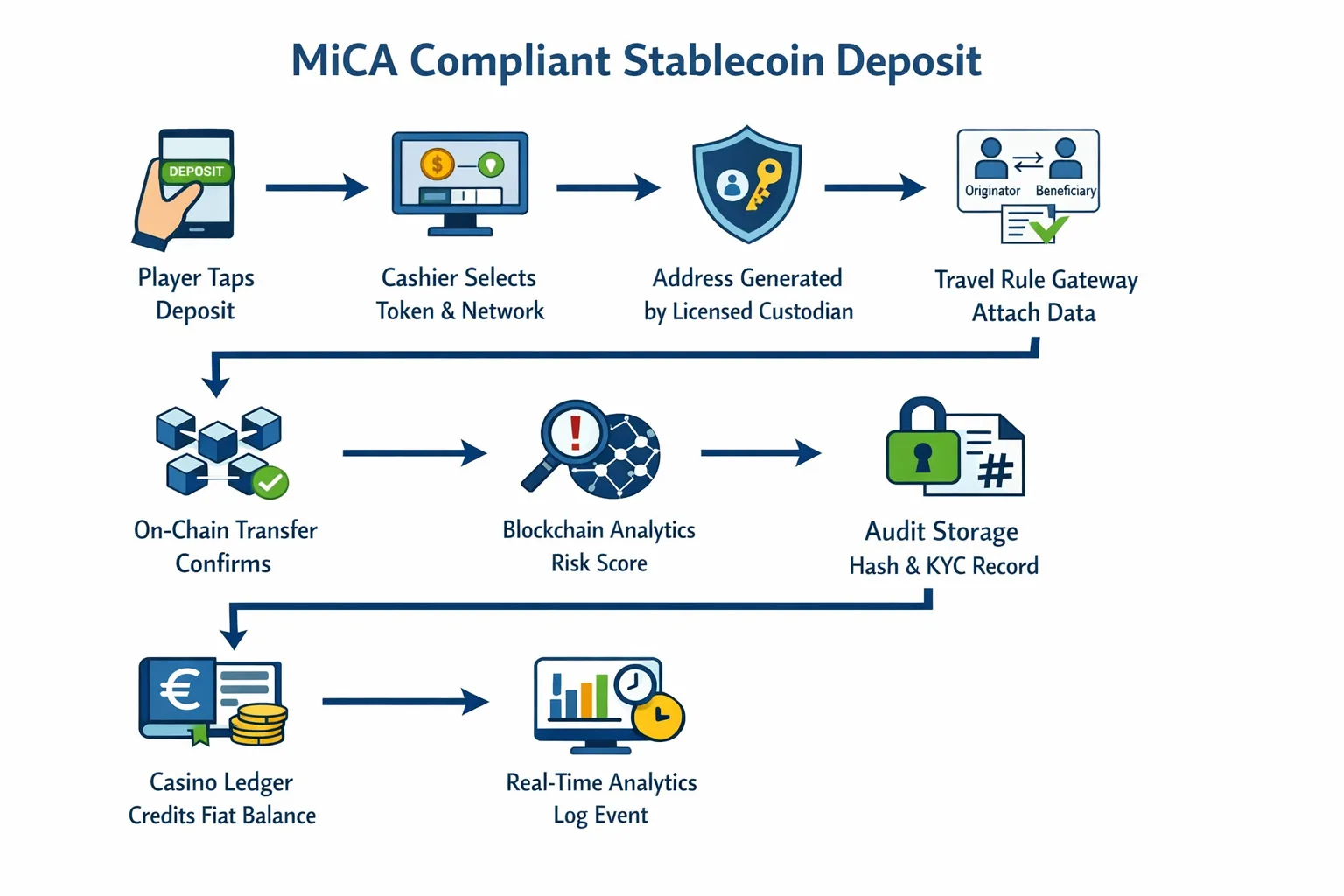
Key design choices that help:
- Custody, rely on a licensed custodian or EMI to generate deposit addresses and hold coins. Keep the casino wallet ledger fiat denominated even when the on chain asset is a stablecoin.
- Travel rule, call the custodian or a travel rule gateway right after address creation and right before payout. Reject or hold transfers without required data.
- Risk pipeline, score every transfer with blockchain analytics, join with KYC and device fingerprint, then decide credit, hold or escalate.
- Observability, stream all events into your real time analytics dashboard so ops can see pending credits, holds and payout queues by rail and jurisdiction.
Spinlab’s real time analytics dashboard, KYC and AML compliance features, multi currency cashier and merchant custodial wallets cover these building blocks. Use our open API integration points to plug in your preferred custodian, travel rule provider and analytics vendor.
30 day implementation plan for product and compliance teams
Week 1, Governance and inventory
- Map current tokens, networks, custody locations, and PSP or custodian partners.
- Decide the target token list per market and publish acceptance criteria tied to the EEA register.
- Define travel rule policy by flow, deposit, internal transfer, payout.
Week 2, Integrations and policy as code
- Connect your custodian API into the cashier, implement per player address and webhooks.
- Implement travel rule payload generation and validation on deposits and withdrawals.
- Wire blockchain analytics and sanctions screening into the deposit pipeline.
Week 3, UX and controls
- Update cashier copy, network selectors, fees disclosure and fallback rails.
- Add throttles and alerts for token volume monitoring and failover rules.
- Configure audit logging with hashes, retention rules and access controls.
Week 4, Dry runs, soft launch, monitoring
- Run end to end tests with testnets and a low limit production segment.
- Prove reconciliation, travel rule round trip, and payout reversals.
- Launch with real time dashboards for Cash Flow at Risk and Travel Rule error rate.
Red flags to eliminate before your next regulator review
| Area | Red flag | Safer practice |
|---|---|---|
| Token acceptance | Accepting any coin with a stable brand name | Accept only tokens with an EEA authorized issuer and an entry on the public register |
| Custody | Pooled hot wallet fully controlled by the casino | Use a licensed custodian with segregated accounts and clear client asset protections |
| Travel rule | No mechanism to attach or consume originator and beneficiary info | Integrate a travel rule gateway and return non compliant transfers |
| Payouts | One size fits all payout rail | Route payouts per player jurisdiction and token status, with instant bank or card fallbacks |
| Audit | Logs only in application DB | Append only audit store with hashed payloads and immutable backups |
How this interacts with your license outside the EU
Many operators licensed in Curaçao, Anjouan or Isle of Man serve EU traffic, either directly or through affiliates. MiCA does not replace gambling law, but it controls how crypto assets can be offered and moved with EU residents and entities.
- If you target EU players, align token acceptance and travel rule handling with EU standards even if your gambling license is offshore.
- If you only use non EU custodians, add screening and routing logic that respects EU data and transfer requirements when a counterparty is in the EEA.
- Coordinate with your PSPs, aggregators and live studios, because their contractual terms may have been updated for MiCA and the travel rule.
Why operators choose Spinlab for the MiCA era
- Crypto and fiat payment support, including hybrid cashiers and crypto onramp choices so you can always offer a compliant, low cost deposit path.
- KYC and AML compliance and advanced fraud prevention, so you can plug risk signals into real time decisions.
- Merchant custodial wallets for safekeeping funds and multi currency support to keep balances stable and payouts fast.
- Real time analytics dashboard, to watch Cash Flow at Risk, travel rule error rate, and payment rail performance live.
- Open API integration, to connect your chosen custodian, travel rule provider and analytics vendor without vendor lock in.
- A Shopify like backoffice and the most cost effective white label casino software on the market, so you ship fast, stay flexible, and protect margin.
Ready to bring your cashier and controls in line with MiCA and the travel rule without slowing growth, Talk to Spinlab’s team about a migration or greenfield launch that gets you compliant and conversion ready.
References, Regulation (EU) 2023/1114, Markets in Crypto Assets, EUR Lex. EBA, MiCA final draft regulatory technical standards and guidelines for ART and EMT issuers. Regulation (EU) 2023/1113, Transfer of Funds Regulation for crypto, EUR Lex.