

Big sign-up bonuses and reloads still move the needle, but they also torch margins when they are spread evenly across players. The fix is not another coupon code, it is value discipline. Real-time LTV modeling turns your promo line into a profit center by steering every bonus dollar to the next most valuable player, offer, and moment.
What “Real-Time LTV” Means for Casinos
Most casinos still treat Lifetime Value as a static 90‑day spreadsheet. That is too slow for in-session decisions and too blunt for modern payment, fraud, and content dynamics. Real-time LTV is a continuously updated estimate of future net revenue per player, refreshed as new events arrive. It answers a simple question every few seconds: given what we know now, what is the expected incremental profit if we spend one more dollar of bonus on this player?
Key differences versus batch LTV:
- Freshness, scores update in seconds or minutes as deposits, spins, RTP deviations, KYC changes, and device or geo shifts happen.
- Net of cost, models subtract bonus cost, expected payment fees, chargeback or fraud risk, cashout propensity, and operational overhead to arrive at expected Net Gaming Revenue.
- Policy-aware, the score respects responsible-gambling flags, licensing constraints, and offer eligibility rules before any action is taken.
A practical LTV decomposition
| Component | What it captures | Typical inputs | Update cadence |
|---|---|---|---|
| Expected GGR | Future gross revenue from play | bet frequency, stake size trend, game mix, RTP variance | every session or every N events |
| Payment cost drag | Fees and approval dynamics by rail | PSP, BIN, APM vs crypto, country, average ticket | per deposit or withdrawal |
| Bonus cost | Direct promo spend, breakage, wagering friction | offer type, wagering rules, historical completion | per offer decision |
| Fraud/chargeback risk | Probability weighted loss | device and identity risk, velocity, affiliate risk | per risk event or hourly |
| Payout cadence impact | Early withdrawals lowering re‑deposits | cashout latency, win streaks, balance level | per withdrawal event |
A simple working formula for a player i at time t:
pLTV_i,t = E[GGR_i,t→T] − E[BonusCost_i,t→T] − E[PaymentFees_i,t→T] − E[FraudLoss_i,t→T] − E[OpsCost_i,t→T]
You will rarely estimate each term with a single model. In practice, you blend survival modeling for churn, regression for spend, and classification for risk, then assemble them into a unified score.
Data you need streaming in
If the score cannot see it in near real time, it cannot optimize it.
- Identity and compliance, KYC/AML status, risk tiers, sanctions hits, device fingerprint, IP intelligence, age and jurisdiction gates.
- Payments, rail used, approval code, fee bucket, time to credit, onramp steps for crypto, card rescues, refund and chargeback events.
- Gameplay, per-session lines like stakes per minute, game mix, volatility class, RTP deviation, time since last event, balance levels.
- Marketing and affiliate, channel, campaign, voucher, source quality score, cohort lifetime metrics.
- Support and RG signals, limits set, warnings, cool‑offs, self‑exclusions, previous intervention outcomes.
Spinlab’s platform ships with the core pieces required for this flow, including crypto and fiat payment support, seamless game aggregation, KYC and AML compliance, an advanced fraud layer, a real-time analytics dashboard, an affiliate and bonus engine, and open APIs to join it all together. That means you can score, decide, and credit in the same second without third‑party round trips.
Modeling options that work in production
There is no single “best” algorithm, you will likely mix methods.
- Survival plus spend, predict the probability a player remains active for the next N days and expected revenue conditional on survival. Multiplying both gives E[GGR].
- Bayesian hierarchical models, useful for small new cohorts. Pool information across similar channels, countries, and payment rails so early scores are not wildly noisy.
- Online or incremental learners, stochastic gradient or Kalman update variants that ingest events and refresh parameters continuously, instead of nightly retrains.
- Uplift models for offers, estimate the incremental change in profit if a specific bonus is shown now, versus if it is not. This is the workhorse for budget allocation.
- Bandits with constraints, contextual multi‑armed bandits choose among eligible offers to maximize expected profit per impression while respecting caps, RG limits, and cohort budgets.
Whatever you choose, log features, predictions, and decisions with timestamps. Without an audit trail you cannot debug, explain to regulators, or improve.
From score to spend, a budget that reallocates itself
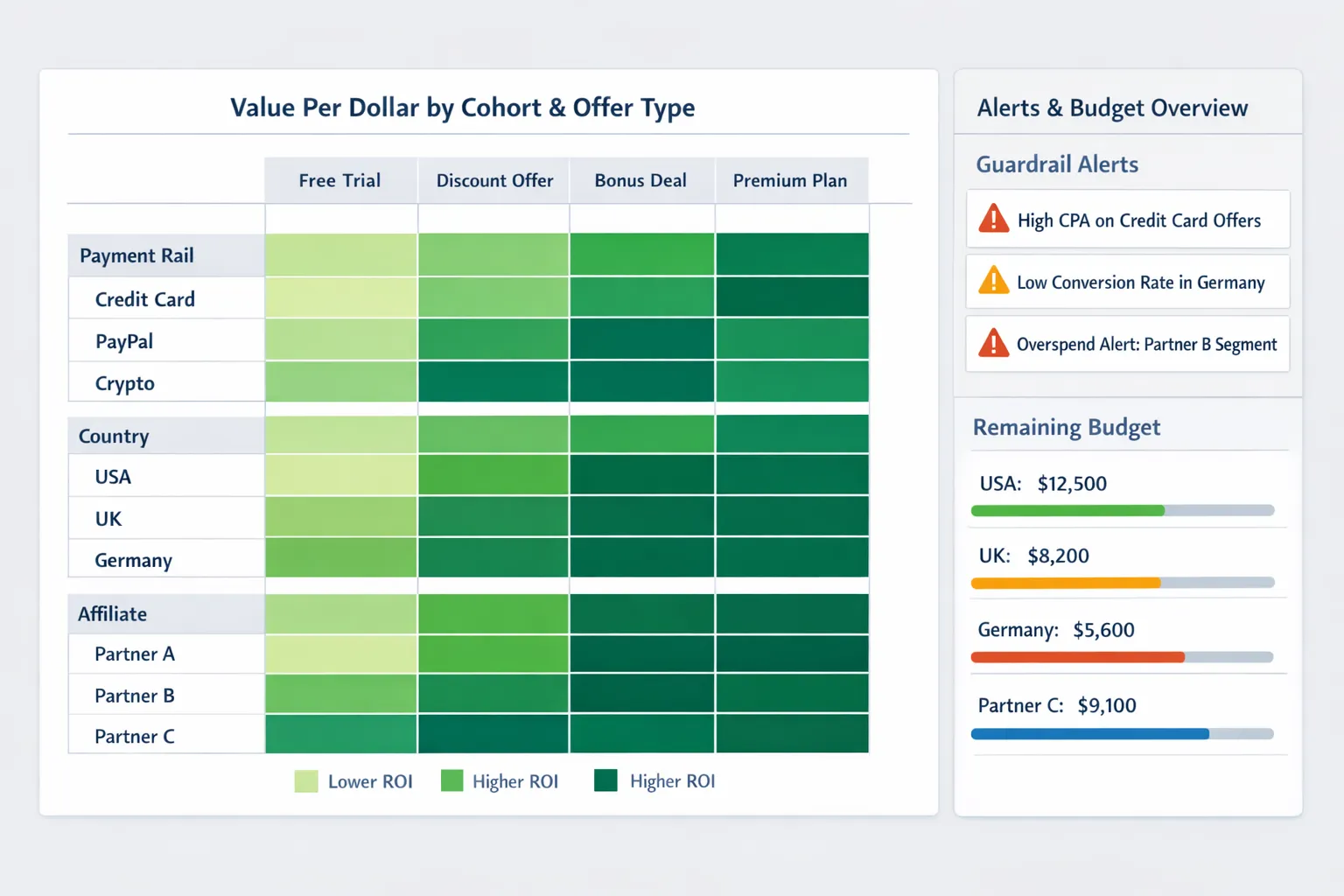
Think of your promo line as a portfolio that reallocates every minute. The engine ranks opportunities by value per dollar and only spends when the marginal dollar is positive after cost and risk.
Offer scoring at decision time:
| Offer | E[Incremental GGR] | Direct cost | Payment fee delta | Fraud delta | Net incremental profit | Value per $ |
|---|---|---|---|---|---|---|
| 50% reload up to $50 | $22.40 | $16.00 | $0.80 | $0.30 | $5.30 | 0.33 |
| 20 free spins on mid‑volatility slot | $9.10 | $4.80 | $0.00 | $0.10 | $4.20 | 0.88 |
| Cashback 10% for losses today | $18.00 | $10.50 | $0.00 | $0.50 | $7.00 | 0.67 |
In this example, the free‑spins offer dominates on value per dollar, so it should be allocated first until segment or daily caps are met. If budget remains, move to the next best. Rankings change continuously as prices, risk, and player state move.
Guardrails to make it safe and compliant
- Never offer if net expected profit is negative after all costs and risks.
- Enforce RG caps and cool‑offs before economic logic, and log the reason when an otherwise profitable offer is skipped.
- Block multi‑account or device clusters from receiving stackable offers; regularly refresh identity graphs.
- Apply per‑segment and per‑affiliate throttles to avoid budget for low-quality traffic soaking up spend.
Architecture, a field‑tested blueprint
You do not need to rebuild your stack to get started. A minimal, durable design looks like this:
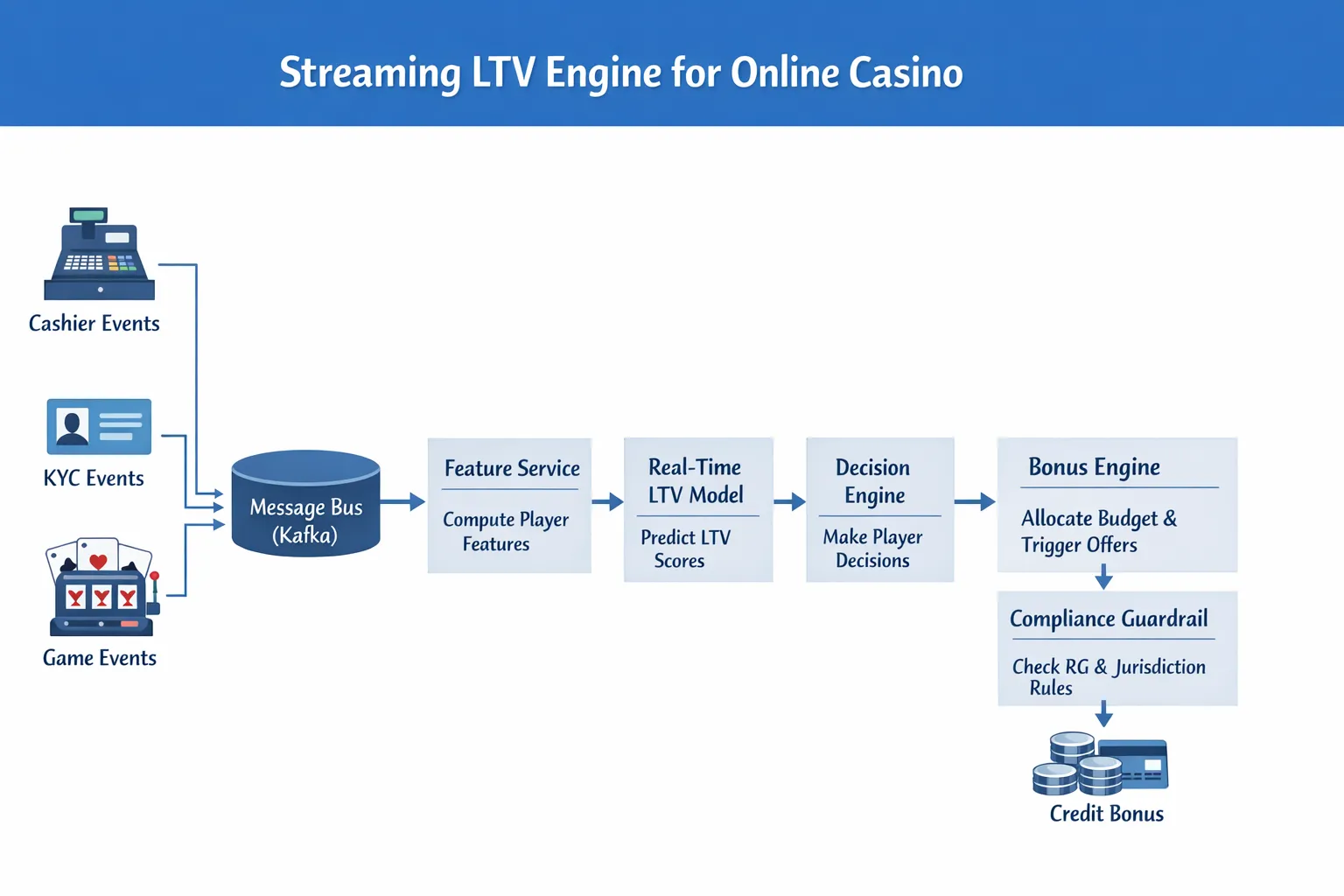
- Event bus, Kafka or Redpanda streams cashier, KYC, gameplay, and CRM events.
- Feature store, materialize rolling features such as 7‑day stakes, deposit cadence, RTP deviation, payment approval streaks; write to a low‑latency store.
- Scoring service, a containerized model endpoint with online features, returning pLTV and per‑offer uplift scores in under 50 ms.
- Decision engine, applies policy constraints, budget caps, and bandit logic to choose the single best action.
- Bonus engine, credits the offer, sets wagering rules, and writes a single, atomic wallet update.
- Observability, ClickHouse or similar for rich, queryable logs of features, scores, decisions, outcomes, and audits.
Spinlab’s whitelabel platform includes the real-time analytics dashboard, bonus and affiliate engine, fraud prevention, KYC and AML compliance, multi‑currency wallets, and open API integration, so these blocks wire together quickly and keep latency under control.
Measuring success with incrementality, not anecdotes
Do not trust raw revenue after a bonus, some of it would have happened anyway.
- Always run randomized control groups or at least rolling suppression cohorts by segment.
- Primary KPI, Net incremental profit per bonus dollar, not redemption rate.
- Secondary KPIs, 30‑ and 90‑day pLTV delta, payback days, deposit approval rate, payment OPEX as a percent of GGR, fraud and chargeback rate, RG interactions, and complaint volume.
- Stability metrics, coefficient of variation for per‑day ROI, and regret for bandit policies to ensure exploration does not harm revenue unduly.
A worked example, how the math pays for itself
Assume a $100,000 monthly promo budget and a baseline where you earn $0.60 in net incremental profit per bonus dollar. Monthly profit from promos is $60,000.
After deploying real-time pLTV with uplift scoring, you observe over a 6‑week pilot:
- 18 percent fewer bonus impressions to low‑value or risky players, because the engine suppresses negative EV offers.
- A shift in mix toward free‑spin and quest rewards that carry lower cost per $ of perceived value.
- A 9 percent lift in payment approval on first‑deposit cohorts due to rail‑aware offer routing.
The combined effect moves ROI to $1.10 per dollar on the impressions that still fire, and reduces spend by 10 percent through suppression. Profit becomes:
Spend = $90,000, Profit = $99,000, Net uplift versus baseline = $39,000 per month.
These numbers are typical of disciplined reallocations when teams switch from blanket bonuses to real-time value controls. Your mileage will vary, so measure incrementally.
Responsible gambling and regulator‑friendly design
Real-time does not mean reckless. Implement the following from day one:
- Priority ordering, RG checks and exclusion lists run before any economic decision.
- Session‑aware cool‑downs, offers do not appear during loss streaks beyond configured thresholds or at night hours in sensitive jurisdictions.
- Transparent terms, simple wagering rules and clear expiries documented in product and sent in decision logs.
- Auditability, per‑player decision reason codes stored for inspection.
Our compliance modules help you encode these as policy‑as‑code so marketing creativity never outruns licensing obligations.
Operating model, people and process
You will get better results if product, data, compliance, and payments sit in the same weekly ritual. A lightweight cadence works well:
- Monday, review lift dashboards, fraud deltas, and budget pacing; approve rule or model changes.
- Wednesday, ship a small test, for example change default rail for a segment or switch the best‑offer threshold from 0.20 to 0.25 value per dollar.
- Friday, audit sampling of decision logs and support tickets to catch unintended behaviors early.
If your team is still building analytics muscle, structured learning accelerates the journey. Spanish‑speaking teams often benefit from formal, mentor‑led programs like the LinkedIn Learning‑powered routes offered by Academia Europea, see their data upskilling programs to level up SQL, analytics, and experimentation skills without pausing operations.
30‑day rollout plan you can actually follow
Week 1, wire events and define features
- Ensure cashier, KYC, gameplay, and CRM events are streaming with stable IDs.
- Stand up a tiny feature store with 10 to 15 features, focus on stake velocity, deposit cadence, RTP deviation, payment rail, risk tier, and balance state.
Week 2, baseline and guardrails
- Compute static pLTV using your current method to establish a benchmark.
- Implement RG and compliance gates as the first step in the decision engine.
Week 3, uplift model and a single policy
- Train a simple uplift model for one offer type, for example 20 free spins on a mid‑volatility slot; deploy as an API.
- Run a 50/50 A/B on a single cohort, for example first‑deposit segment from one affiliate in one country.
Week 4, budget pacing and rail awareness
- Add value‑per‑dollar thresholds and daily caps; switch on payment‑rail aware routing so low‑fee rails get preferential offers.
- Publish a one‑page runbook for support and compliance, including reason codes and overrides.
From here, add more offer types, cohorts, and marketplaces, then consider a constrained bandit to balance exploration and exploitation without manual tuning.
Why do this on Spinlab
- Real-time analytics dashboard and open APIs, score and act in the same flow.
- Bonus and affiliate engine, credit instantly with clear wagering logic and throttles.
- Crypto and fiat payment support and crypto onramp, route offers with rail costs in mind and settle instantly where appropriate.
- Advanced fraud prevention and KYC/AML compliance, suppress negative EV and risky impressions automatically.
- Multi-currency wallets and merchant custodial wallets, keep costs predictable and payout experiences fast.
- Original games and mobile‑optimized platform, align promos with content you can actually differentiate.
Spinlab is also the most cost‑effective whitelabel casino software on the market, designed to feel like a Shopify‑style workflow so your team can launch, learn, and iterate faster.
Ready to put your promo dollars on autopilot, book a demo and see how real-time LTV modeling inside Spinlab’s platform reallocates budget toward higher NGR with fewer headaches.