

Stablecoin payouts are often sold as “instant withdrawals,” but for an operator they are really a treasury and accounting system that happens to settle on-chain. If you do not design the liquidity model, controls, and bookkeeping up front, you will eventually run into one of three failure modes:
- You pay fast, but your hot wallet gets drained during peak hours.
- You stay safe, but withdrawals slow down because everything needs manual approvals.
- Your on-chain totals do not match your player ledger at month end, and finance loses days to reconciliation.
This guide covers the basics you need to get stablecoin payouts right, especially in iGaming where volumes spike, compliance is strict, and player trust is fragile.
What a “stablecoin payout” really is (operationally)
In an online casino, a stablecoin payout is typically a withdrawal (player cashout), but it can also be:
- Affiliate commissions
- Influencer or streamer revenue share
- Game studio settlements (in some crypto-forward arrangements)
- Contractor/vendor payments
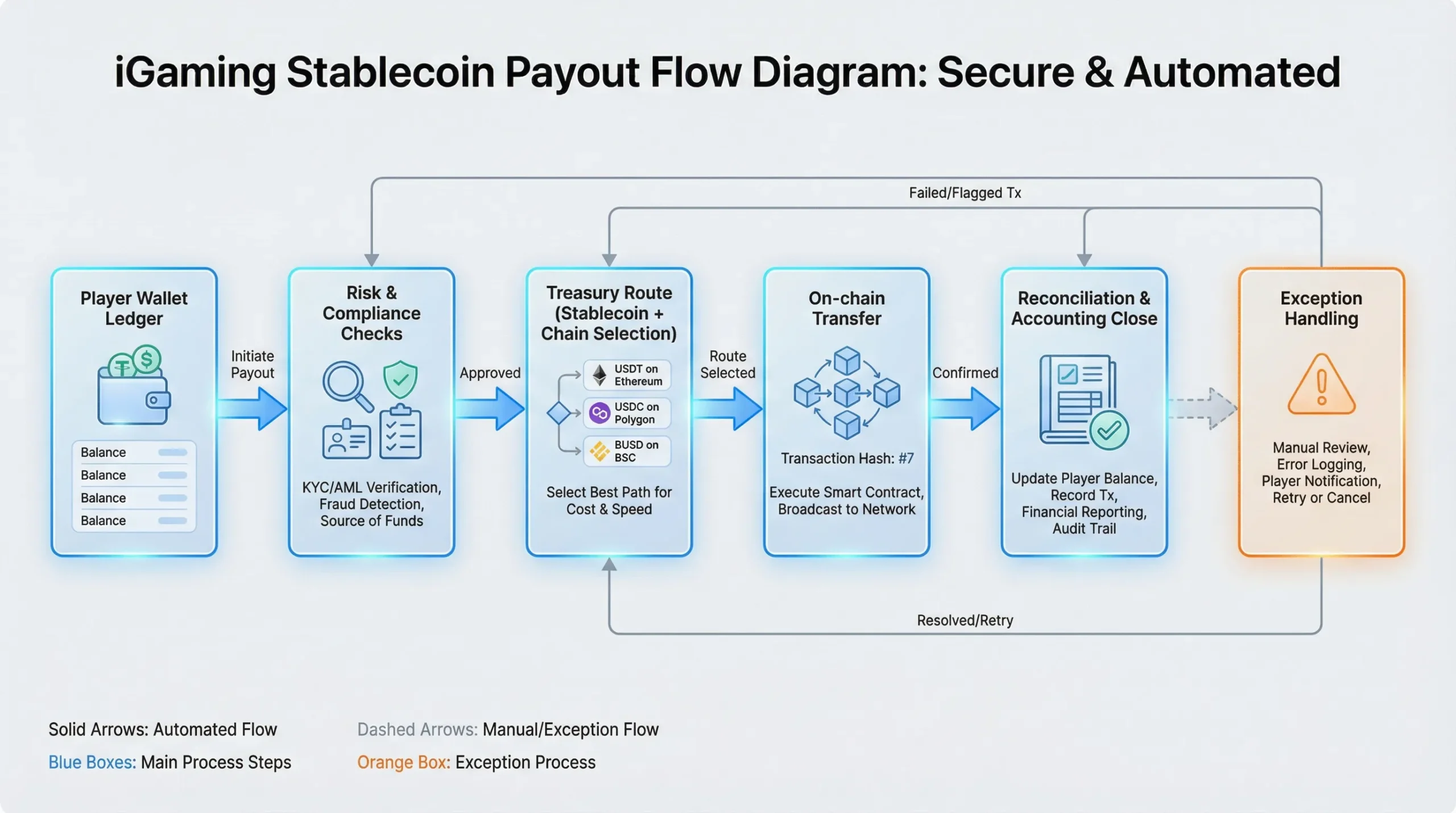
Operationally, each payout is a chain of events:
- Player ledger debits (your internal source of truth for balances)
- Risk and compliance gating (KYC/AML status, sanctions, velocity, responsible gaming rules)
- Treasury selection (which wallet, which chain, which stablecoin)
- On-chain execution (signing, broadcasting, confirmations)
- Accounting + reconciliation (fees, FX, timing differences, exceptions)
Treating stablecoin payouts as “just a wallet integration” is the fastest path to messy books and unpredictable liquidity.
Treasury basics: wallets, limits, and where liquidity lives
The three-wallet model (hot, warm, cold)
Most payout stacks converge on a three-tier design:
- Hot wallet: used for automated, instant payouts. Lowest security, highest availability.
- Warm wallet: replenishes the hot wallet, often with stricter signing rules and slower approvals.
- Cold storage: long-term custody with the strongest controls, not part of day-to-day payout operations.
In iGaming, the hot wallet is effectively your “ATM.” The key is to size it so you can pay quickly without leaving unnecessary exposure online.
Treasury limits you should define on day one
Even lean operators benefit from a simple, explicit limits framework. Define limits by:
- Asset (USDC vs USDT, or other stablecoins)
- Chain (Ethereum mainnet vs L2s and alt L1s)
- Wallet tier (hot vs warm)
- Counterparty type (player vs affiliate vs vendor)
- Withdrawal size band (small, medium, large)
A common control pattern is “low-friction under threshold, step-up above threshold.” That protects you from both fraud bursts and operational mistakes.
Stablecoin selection: it is not just a ticker symbol
From treasury’s perspective, stablecoins differ across:
- Issuer and reserves model (operational and regulatory risk)
- Freeze/blacklist controls (helpful for compliance, but can create payout risk if you receive tainted funds)
- Liquidity depth on your chosen chain(s) (can you rebalance quickly during spikes)
- Redemption and banking relationships (how you convert stablecoin balances back to fiat if needed)
If you operate across jurisdictions, also consider how your compliance team will maintain an allowed list of assets and chains.
Liquidity basics: how to avoid hot-wallet outages and payout backlogs
Think in “payout peak,” not average
Average daily withdrawals rarely matter in iGaming. What matters is:
- Weekend peaks
- Big jackpot events
- VIP cashouts
- Campaign-driven withdrawal clustering (after tournaments, cashback drops, or bonus clearance)
A practical liquidity model uses percentiles (P95/P99) rather than averages.
Build a liquidity buffer policy (and automate refills)
At minimum, define two numbers:
- Target hot-wallet float: what you want available for normal operations
- Minimum hot-wallet floor: when you start replenishing from warm treasury
You then automate replenishment so ops does not wake up to a drained hot wallet.
Here is a simple starting framework you can adapt:
| Component | Purpose | Typical owner | Common pitfall |
|---|---|---|---|
| Hot wallet float | Instant payouts | Payments ops | Sized from averages, drains during peaks |
| Warm wallet reserve | Refill hot wallet | Treasury | Manual refills, delayed by approvals |
| Rebalance rules | Move funds across chains/assets | Treasury + risk | No “who can do what” matrix |
| Emergency throttle | Slow or queue payouts safely | Risk + compliance | No player messaging, trust damage |
Fees and confirmations are part of liquidity
Liquidity is not only how many tokens you hold. It is also whether you can move them quickly.
- On some networks, fee spikes can cause payout transactions to fail or remain pending.
- Bridging between networks adds delay, operational risk, and sometimes compliance complexity.
That is why many operators standardize payouts to a small set of assets and networks, then offer optional alternatives only where there is enough operational maturity.
Netting and batching (when it helps, when it hurts)
You can reduce on-chain fees by batching payouts, but batching changes the product promise.
A workable compromise is:
- Instant payout lane for small and medium withdrawals (hot wallet)
- Scheduled payout lane for large withdrawals (manual review, batching, additional KYT and source-of-funds checks)
This is less about cost optimization and more about operational safety.
Accounting basics: keep your player ledger, on-chain activity, and books consistent
Start with the right mental model: subledger vs general ledger
In iGaming, the player wallet ledger is a subledger, it tracks individual player liabilities. Your general ledger (GL) is what you close monthly and report externally.
Stablecoin payouts add a third record source: the blockchain.
Your goal is not to make the blockchain “the ledger.” Your goal is to ensure:
- Player ledger entries are correct
- On-chain settlements match the intended payout instructions
- GL postings reflect timing, fees, and any FX changes
Stablecoins on the balance sheet: classification is not one-size-fits-all
Accounting treatment depends on facts and jurisdiction, and you should confirm with your accountant or auditor.
Two high-level reference points many finance teams use:
- Under US GAAP, the FASB issued ASU 2023-08 to measure certain crypto assets at fair value for entities within scope (effective for fiscal years beginning after Dec 15, 2024 for many entities, with early adoption permitted). See the FASB overview.
- Under IFRS, crypto assets are often analyzed under IAS 38 (intangible assets) or IAS 2 (inventory) depending on the business model, with careful assessment of rights and obligations.
Stablecoins can look “cash-like” operationally, but the accounting conclusion depends on legal form, redemption rights, and applicable standards.
Journal entry patterns (simplified)
Below are simplified examples to illustrate the mechanics. Your chart of accounts and tax treatment will differ.
Example 1: Player withdrawal paid in stablecoin
- Player withdraws 500 USDC.
- Network fee is 0.50 USDC.
Conceptually you reduce the player liability, and reduce your crypto asset balance. Fees are an expense.
| Line | Account | Debit | Credit |
|---|---|---|---|
| 1 | Player liabilities | 500.00 | |
| 2 | Crypto assets (USDC) | 500.00 | |
| 3 | Network fees expense | 0.50 | |
| 4 | Crypto assets (USDC) | 0.50 |
Example 2: Timing difference (approved vs settled)
If you approve a withdrawal and debit the player ledger immediately, but the on-chain transaction settles later (or fails), you need an intermediate state such as “withdrawals payable” or “pending payouts” to avoid confusing timing in both ops and finance.
Reconciliation: match ledger, chain, and custody reports
At close, you want a clean bridge between:
- Internal ledger (player balances, pending withdrawals, completed withdrawals)
- On-chain transactions (hash, block time, amount, token contract, from/to)
- Custody/wallet reports (hot/warm balances, sweeps, internal transfers)
Minimum data fields that make reconciliation realistic:
- Withdrawal ID (internal)
- On-chain transaction hash
- Token + chain identifiers
- Gross payout amount
- Fee amount (and who paid it)
- Timestamp (requested, approved, broadcast, confirmed)
- Destination address (and ideally an address risk score / attribution snapshot)
A practical approach is to run reconciliation daily and treat month-end close as a review of already-resolved exceptions.
Invoicing and documentation (especially for affiliates and vendors)
Stablecoin payouts to affiliates and partners often need invoice capture and audit trails (what was owed, what was paid, and why). If you manage multiple entities or brands, an invoicing workflow can save real time.
Some teams pair their payout ledger with an online invoicing system such as Kontozz to keep invoices, teams, and supporting documents organized alongside settlement exports.
Risk controls that directly affect treasury and accounting
Stablecoin payouts sit at the intersection of payments risk, AML, and operational security.
AML and Travel Rule considerations
If you are a regulated operator or operate with regulated partners, you may need to support “Travel Rule” style originator and beneficiary information sharing for certain crypto transfers, depending on jurisdiction and thresholds. The FATF’s Travel Rule guidance is a common starting point for compliance teams.
From a finance perspective, the key is that compliance holds create timing differences, and timing differences affect both player comms and accounting cutoffs.
Sanctions, frozen funds, and address risk
Stablecoins can be subject to issuer controls (freezing) and regulatory actions. This is not a reason to avoid stablecoins, but it is a reason to:
- Snapshot address risk at the time of payout approval
- Maintain an exception workflow for “payout approved, settlement blocked”
- Keep clear policies for refunds, reversals, and player dispute handling
Segregation of duties (SoD)
Even small operators should separate who can:
- Approve withdrawals
- Change payout routing rules
- Move treasury between hot/warm/cold
- Export or edit reconciliation data
This is both a fraud control and an audit-readiness requirement.
Implementation blueprint: design choices that make stablecoin payouts boring (in a good way)
1) Define payout tiers and SLAs
Before you write code, define policy:
- What is “instant” (seconds, minutes, under 1 hour)
- What triggers step-up review (amount, player risk score, new address, velocity)
- What is the player-facing messaging for each state
This reduces support tickets and prevents finance from reverse-engineering payout intent later.
2) Use an internal ledger as the source of truth
Do not rely on wallet balances as your primary record. Wallet balances are outcomes, not intent.
Your ledger should support:
- Idempotent withdrawal creation (no double-pays)
- Clear states (requested, pending KYC, pending risk, queued, sent, confirmed, failed)
- Audit logs (who approved what, and when)
3) Make fees explicit in product and accounting
Decide and encode:
- Who pays network fees (operator vs player)
- Whether you quote net or gross to the player
- How you treat fee rebates or promotional “free withdrawals”
Hidden fee handling is a common source of reconciliation drift.
4) Build an exception queue, not a spreadsheet habit
You will have exceptions, for example chain congestion, wrong address formats, token contract mismatches, or failed transactions.
What matters is that exceptions become a controlled workflow with owners, statuses, and resolution notes.
Where Spinlab Studio fits (without overcomplicating the stack)
For operators launching or scaling a crypto-forward online casino, stablecoin payouts are easier when your platform already supports:
- Crypto and fiat payments in one cashier strategy
- Multi-currency wallets and clear ledgering
- KYC/AML compliance and fraud prevention tied to payout decisions
- Custodial wallet options for safeguarding funds
- Open APIs for integrating accounting, BI, and reconciliation workflows
Spinlab Studio positions its modular iGaming platform around these building blocks, with a fast onboarding approach designed to feel more like a Shopify-style admin than a bespoke integration project. If stablecoin withdrawals are part of your growth plan, the best next step is usually an architecture review focused on wallet tiers, liquidity buffers, and reconciliation outputs, before you lock in chains, assets, and payout SLAs.
Quick checklist for finance and ops alignment
Use this as a final pre-launch alignment between treasury, compliance, and accounting:
| Area | Decision to lock | Evidence/output |
|---|---|---|
| Wallet tiers | Hot/warm/cold design, signing rules | Wallet policy + SoD matrix |
| Liquidity | Target float, refill triggers, peak model | Buffer model + refill automation spec |
| Payout policy | Tiers, SLAs, step-up rules | Player-facing statuses + internal runbook |
| Fees | Who pays, how quoted, how booked | Fee policy + journal entry examples |
| Reconciliation | Matching keys and cadence | Daily reconciliation report + exception queue |
| Compliance | Screening points and hold states | Audit log fields + hold-and-release flow |
If you can answer every row with a written policy and a concrete export/report, your stablecoin payouts will be significantly easier to scale.
I have been a regular for over a year and the consistency here is absolutely unmatched. The slot games run flawlessly on every device and the loyalty program rewards stick around when you actually need them. Cash out requests never take more than a day and the game fairness is rock solid. It is refreshing to find a site that values trust above everything else. Join the fun at ys88slot
Finally a spot that really understands what we players need here. The interface is clean and the game catalog features some great localized options. Payments go through without a hitch and the team speaks our language perfectly. It is rare to find this level of attention to detail in the industry. clslotticachile
Getting the vip treatment here has made my hobby so much more enjoyable. Custom drops match my playstyle and the dedicated agent actually replies on weekends. The apk installs in seconds and syncs perfectly with my account. 456betvipappapk
I’ve been messing around with Tojay and I actually like what I am seeing. Check out the offering here tojay
RK88COM. Alright site. No huge wins yet but I haven’t lost all my shirt, so that’s ok. The site works fine. That’s good eh? Give it a peep: rk88com
Lodigame! Been playing it for a while now, and it keeps me entertained. Simple but fun. Anyone else a Lodigame fan? Check it out: lodigame