

For online casino operators, vulnerability management is not just a technical hygiene task. It is a revenue protection, player trust, and licensing discipline. A single exposed admin panel, outdated payment plugin, vulnerable API endpoint, or misconfigured cloud bucket can lead to account takeover, wallet manipulation, personal data exposure, payment abuse, and regulatory scrutiny.
The challenge is that casino environments change constantly. New slot games are added, live casino integrations evolve, payment gateway settings change, bonus rules are updated, affiliate campaigns launch, and fraud teams tune controls in real time. In that environment, a quarterly scan is not enough. Operators need a repeatable program that finds weaknesses, ranks them by casino-specific impact, fixes them safely, and leaves evidence behind.
This guide explains how to build vulnerability management for online casino operators in a way that supports fast launches, uptime, compliance, and secure growth.
Why vulnerability management is different in online casinos
Most software companies worry about data loss and service disruption. Online casinos must also protect real-money balances, bonus economics, game integrity, payment acceptance, KYC data, and responsible gaming workflows. That changes how vulnerabilities should be prioritized.
For example, a medium-severity bug in a marketing page may be less urgent than a lower-scored authorization flaw in a withdrawal endpoint. A vulnerability that allows duplicate webhook processing could affect wallet balances even if it does not look critical in a generic scanner report. A dependency issue inside an internal bonus engine may matter more during a major promotion than during a quiet period.
Casino operators also rely heavily on external components, including game aggregators, KYC and AML vendors, payment processors, crypto onramps, analytics scripts, affiliate platforms, cloud infrastructure, and support tools. Each integration expands the attack surface. Vulnerability management has to cover the full online gambling platform, not only the public website.
If you are still defining the security foundations of your launch, start with core platform controls first, then mature into a formal vulnerability program. Vulnerability management works best when access control, logging, secrets handling, fraud prevention, and data protection already have owners.
Start with an asset inventory that reflects casino reality
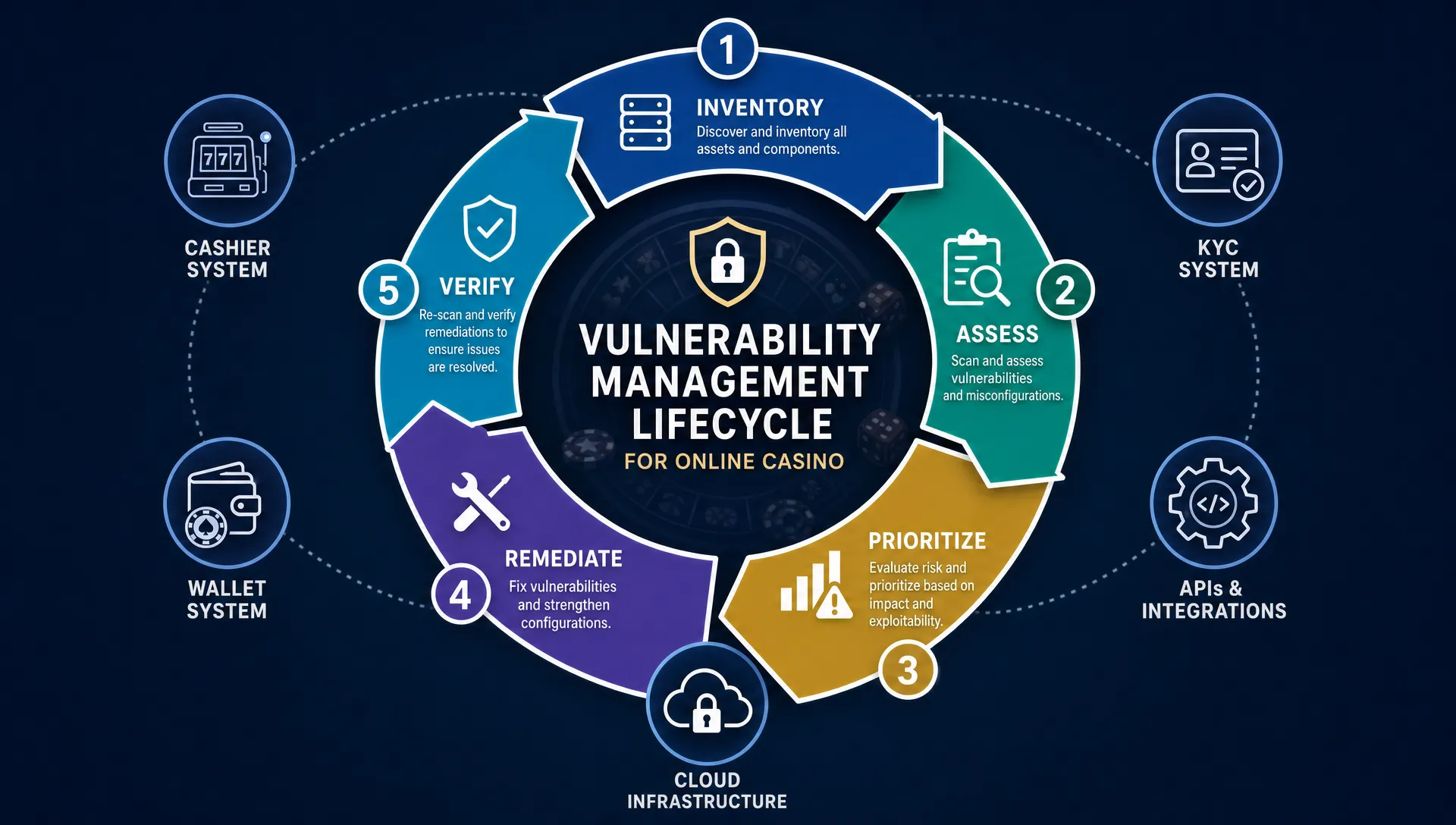
You cannot patch what you do not know exists. The first step is an asset inventory that maps the casino as players, administrators, vendors, and attackers see it. This inventory should be more specific than a spreadsheet of servers. It should connect each asset to business function, data sensitivity, owner, environment, exposure, and operational dependency.
At a minimum, include these asset categories:
- Player-facing web and mobile experiences, including registration, login, profile, responsible gaming, promotions, and account pages.
- Cashier, wallet, payment gateway, crypto onramp, deposit, withdrawal, refund, and chargeback flows.
- Game aggregation integrations, slot games, live casino games, casino original games, RNG-related services, and game session APIs.
- Backoffice tools, admin panels, customer support systems, risk review queues, affiliate dashboards, and bonus management tools.
- KYC, AML, fraud prevention, device intelligence, geolocation, email, SMS, and notification providers.
- Cloud infrastructure, containers, CI/CD pipelines, secrets stores, databases, object storage, CDN, WAF, DNS, and monitoring tools.
For each item, record who owns it, whether it is internet-facing, what player or payment data it touches, what jurisdiction or compliance obligations apply, and how quickly it can be safely changed. This gives security and engineering teams a shared map for triage.
A strong inventory should also include shadow systems. Test environments, staging domains, abandoned promotional microsites, forgotten admin subdomains, and old API versions are common sources of exploitable weaknesses. In casino operations, these forgotten assets can be especially dangerous because they may still connect to production-like player data or payment test credentials.
Prioritize vulnerabilities by exploitability and casino impact
Generic severity scores are useful, but they are not enough. FIRST CVSS provides a standardized way to describe technical severity, and FIRST EPSS can help estimate the likelihood that a vulnerability will be exploited in the wild. The CISA Known Exploited Vulnerabilities catalog is also valuable because it highlights issues with confirmed exploitation.
Casino operators should combine those signals with business impact. Ask what the vulnerability could do in your environment. Could it modify balances, bypass withdrawal checks, expose KYC documents, compromise an admin account, alter bonus eligibility, disrupt deposits, or affect game session integrity? If so, it deserves a higher priority than the scanner score alone may suggest.
A practical priority model can look like this:
| Priority | Casino-specific trigger | Target response |
|---|---|---|
| P0 | Active exploitation, public exploit against an internet-facing asset, wallet or payment integrity risk, admin takeover risk, exposed secrets | Mitigate immediately, patch or isolate within 24 to 48 hours where feasible |
| P1 | High-impact vulnerability in cashier, KYC, game session, backoffice, or exposed API with credible exploitability | Fix in the next urgent release cycle, often within 7 days |
| P2 | Authenticated vulnerability, internal system issue, exploitable misconfiguration, outdated dependency with no active exploitation | Fix in a planned sprint, commonly within 30 days |
| P3 | Low-impact hardening item, informational finding, non-production issue with controls in place | Track in backlog and resolve through normal maintenance |
These response targets are examples, not universal rules. A licensed operator, a crypto-heavy casino, or a brand running high-volume promotions may need tighter timelines. The important point is that priority must reflect both exploitability and the specific harm to the casino.
A formal risk matrix can help keep those decisions consistent. Spinlab's guide to building a risk matrix for online casinos is a useful companion when security, compliance, fraud, and engineering teams need a common scoring language.
Patch without disrupting casino operations
Casino platforms are live, transactional systems. Patching should be fast, but it cannot be reckless. A rushed fix that breaks deposits, locks players out, delays withdrawals, or corrupts bonus calculations can create a different kind of incident.
NIST guidance on enterprise patch management emphasizes planning, prioritization, testing, and preventive maintenance. For casinos, that means every remediation workflow should include regression testing around money movement, identity checks, game launches, session continuity, and admin permissions.
A reliable remediation workflow usually includes:
- Confirm the finding, remove false positives, and identify every affected environment.
- Choose the safest fix, such as patching, configuration hardening, compensating controls, isolation, or feature disablement.
- Test cashier, wallet, login, KYC, bonus, and game session flows before production deployment.
- Deploy in controlled waves where possible, with rollback plans and monitoring ready.
- Retest the vulnerability and attach evidence to the ticket before closure.
For critical issues, mitigation may come before full patching. You might block an endpoint at the WAF, rotate exposed keys, disable a risky integration, restrict an admin route by IP allowlist, or move a vulnerable service behind stronger authentication. The goal is to reduce exploitability quickly while engineering completes a durable fix.
Pay special attention to APIs, webhooks, and payment flows
Modern iGaming platforms are API-driven. Player apps, backoffice tools, payment processors, game aggregators, crypto custodial wallets, affiliate systems, and KYC providers exchange events constantly. This makes API security central to vulnerability management.
The OWASP API Security Top 10 highlights issues such as broken object level authorization, broken authentication, unrestricted resource consumption, and server-side request forgery. In a casino, those flaws can show up as unauthorized access to player profiles, wallet abuse, duplicate withdrawals, or automated account attacks.
Webhooks deserve separate attention because they often trigger balance updates, payment status changes, KYC decisions, or bonus actions. Weak signature validation, missing timestamp checks, lack of idempotency, and poor event-state validation can turn a normal integration into a fraud path. If your platform depends on callbacks from payment or game providers, review the practical controls in Spinlab's guide on securing casino webhooks from fraud and replay attacks.
Manage third-party and supply-chain risk
A casino operator can do everything right internally and still inherit risk from vendors. Game providers, game aggregators, payment processors, KYC tools, AML screening platforms, customer support widgets, affiliate trackers, and analytics scripts all need oversight.
Vendor risk management should be tied to vulnerability management, not handled as a once-a-year procurement exercise. For each critical provider, operators should know how vulnerabilities are disclosed, how quickly emergency fixes are issued, what security evidence is available, and which integration points could affect player funds or personal data.
Ask vendors and platform partners practical questions before launch and during renewals:
- Which components are managed by the vendor, and which are the operator's responsibility?
- How are critical vulnerabilities disclosed, and what response timelines are contractually supported?
- Can the vendor provide recent penetration test summaries, security certifications, or secure development evidence where appropriate?
- Are payment, wallet, crypto onramp, KYC, and backoffice integrations isolated from less trusted systems?
- How are custom casino original games reviewed before release?
For front-end supply chain risk, reduce unnecessary scripts, apply a strong content security policy, restrict where third-party code can load, and monitor changes to critical pages such as registration, login, deposit, and withdrawal. Marketing teams often move fast, but scripts on payment or account pages should never bypass security review.
Combine automated scanning with human testing
Automated scanners are essential, but they will not understand every casino business rule. A scanner may find an outdated library, open port, missing security header, or exposed bucket. It may miss a bonus abuse path, an authorization flaw in a withdrawal approval flow, or an admin permission issue that only appears after a specific sequence of actions.
Use multiple testing layers:
| Testing layer | What it helps catch | Suggested use |
|---|---|---|
| External attack surface scanning | Exposed services, forgotten subdomains, outdated edge systems | Continuous or frequent monitoring |
| Web and API scanning | Common application flaws, misconfigurations, injection risks | On release and on a recurring schedule |
| Software composition analysis | Vulnerable open-source dependencies and license risk | In CI/CD and scheduled rescans |
| Container and cloud posture scanning | Misconfigured storage, excessive permissions, vulnerable images | Before deployment and continuously |
| Manual penetration testing | Business logic flaws, chained attacks, privilege abuse, wallet and cashier issues | Before launch, after major changes, and periodically |
Manual testing is especially important around real-money workflows. A good casino penetration test should cover player-facing apps, APIs, cashier and wallet flows, backoffice permissions, fraud controls, and provider integrations. Spinlab's article on casino penetration testing scope, frequency, and evidence explains how to make that work useful for both engineering and compliance.
Keep evidence for compliance, audits, and leadership
Vulnerability management should produce evidence, not just fixes. Licensed operators, payment partners, banks, auditors, and internal leadership may all ask whether issues were identified, prioritized, remediated, and retested.
If you process card payments, PCI DSS requirements make vulnerability management and security testing especially important. Operators should consult the current PCI Security Standards Council documentation and work with qualified advisors for their exact scope. Crypto casinos and multi-currency platforms may also face additional expectations from banking partners, custodians, payment providers, and regulators.
Good evidence includes asset inventory records, scan results, ticket history, severity decisions, compensating controls, risk acceptances, deployment notes, retest results, and screenshots or logs where appropriate. Risk acceptance should be time-bound, approved by the right owner, and revisited. It should never become a permanent hiding place for unfixed critical issues.
This evidence also helps leadership understand whether risk is going down. Security teams should avoid reporting only the total number of vulnerabilities. A growing count may simply mean better scanning coverage. Instead, report metrics that connect risk to business exposure.
Track metrics that drive action
The right metrics make vulnerability management easier to fund and easier to improve. They also prevent teams from arguing about isolated findings instead of systemic trends.
| Metric | Why it matters for casino operators |
|---|---|
| Mean time to remediate by priority | Shows whether critical risks are being fixed fast enough |
| Internet-facing critical vulnerabilities | Highlights the issues most likely to become urgent incidents |
| Asset coverage | Shows whether scanners and inventories include all major systems |
| Exception age | Prevents accepted risks from becoming forgotten risks |
| Reopened vulnerability rate | Reveals fixes that were incomplete or not durable |
| Vulnerabilities by domain | Shows whether cashier, wallet, backoffice, game, or marketing systems need deeper investment |
| Change failure rate after security fixes | Balances speed with operational stability |
Review these metrics in a regular security operations meeting. A weekly triage meeting can focus on new critical and high findings. A monthly leadership review can focus on trends, overdue items, exceptions, and investment decisions. After any major incident or near miss, update the priority model and playbooks.
Build clear ownership across the casino team
Vulnerability management fails when every finding belongs to security and no one else. Security can coordinate, validate, and advise, but the owners of systems must own remediation. Casino operators should assign ownership by domain, such as cashier, payments, wallet, games, backoffice, player account, infrastructure, and data.
Compliance and fraud teams should also be involved. A vulnerability that affects KYC, AML monitoring, withdrawals, bonus abuse, or affiliate fraud may require operational controls while the technical fix is being developed. Customer support may need prepared messaging if players are affected by a security-related change. Finance may need to watch for abnormal refunds, chargebacks, or wallet adjustments.
For severe vulnerabilities, the process should connect directly to incident response. If there is evidence of exploitation, the question is no longer only how fast can we patch. It becomes whether player data, funds, accounts, or platform integrity were affected. Logs, fraud signals, payment records, and admin activity should be reviewed quickly.
What to expect from a whitelabel casino platform provider
A whitelabel casino platform or turnkey casino solution can reduce build complexity, but it does not remove the operator's need to understand vulnerability management. The key is clarity. The provider and operator should agree on which systems are managed by whom, how vulnerabilities are reported, how urgent fixes are deployed, and what evidence is available.
When evaluating whitelabel iGaming software, ask how the platform supports secure operations across payments, game aggregation, fraud prevention, KYC and AML workflows, backoffice access, APIs, and analytics. A modular platform can make ownership clearer because each operational domain can be reviewed, monitored, and improved without treating the casino as one opaque system.
Spinlab provides a modular iGaming platform for building, launching, and scaling online casinos, with crypto and fiat payment support, game aggregation, real-time analytics, fraud prevention, KYC and AML features, a customizable backoffice, open API integration, multi-currency support, crypto onramp solutions, merchant custodial wallets, and custom original games. For operators, those capabilities should be paired with disciplined vulnerability management so speed does not come at the expense of security.
Frequently Asked Questions
What is vulnerability management in an online casino? Vulnerability management is the continuous process of identifying, prioritizing, fixing, and verifying security weaknesses across the casino platform. It covers player apps, APIs, cashier and wallet flows, payment gateway integrations, backoffice tools, cloud systems, vendors, and game integrations.
How often should an online casino scan for vulnerabilities? Internet-facing assets should be monitored frequently, and critical systems should be scanned on a recurring schedule and after major changes. CI/CD pipelines should also check dependencies, containers, secrets, and infrastructure configuration before deployment. Manual penetration testing should be performed before launch, after major releases, and periodically.
Should whitelabel casino operators still manage vulnerabilities? Yes. A whitelabel casino provider may manage parts of the platform, but the operator still needs visibility into responsibilities, risk acceptance, third-party integrations, admin access, payment configuration, marketing scripts, and compliance evidence. Shared responsibility must be documented.
Which casino vulnerabilities should be fixed first? Prioritize vulnerabilities that are actively exploited, internet-facing, or able to affect funds, withdrawals, deposits, player identity, KYC documents, admin access, game session integrity, or sensitive operational data. Business impact should be considered alongside CVSS, EPSS, and vendor advisories.
How is vulnerability management different from penetration testing? Vulnerability management is an ongoing operational program. Penetration testing is a deeper point-in-time assessment that uses human expertise to find exploitable paths, business logic flaws, and chained attacks. Both are needed, and penetration test findings should feed into the same remediation workflow.
Launch fast, but keep the attack surface under control
The best casino security programs do not slow the business down. They make risk visible, assign ownership, and give operators a safe way to move quickly. With a strong inventory, casino-specific prioritization, reliable patching, third-party oversight, and clear evidence, vulnerability management becomes part of how the platform scales.
If you are building or modernizing an online casino, explore Spinlab's modular iGaming platform to see how a flexible, crypto-ready solution can support secure growth across payments, games, compliance workflows, and operations.