

Online casino operators have spent the past decade tightening Know-Your-Customer (KYC) checks to satisfy regulators. Unfortunately, every passport scan and proof-of-address you collect is another liability sitting in a database—a prime target for hackers and a point of friction that pushes would-be players to competitors.
According to IBM’s 2024 Cost of a Data Breach study, the average breach in financial services now costs US $5.9 million, with personally identifiable information (PII) being the most expensive data class to lose. No wonder privacy-minded players ask, “Why does a slot site need my utility bill?”
Zero-knowledge proofs (ZKPs) promise a new path: prove that a player meets age, jurisdiction, and sanction checks without revealing or storing the underlying documents. In this article we unpack how ZK-KYC works, why it matters for iGaming, and what an implementation roadmap could look like on a modular platform such as Spinlab’s.
The KYC Paradox in iGaming
Regulators from Malta to Ontario require operators to verify identity, age, and source of funds. Yet every added form field drives up abandonment rates. In our own analysis of 40+ funnels (see “11 UX Tweaks That Cut KYC Drop-Off by 30%”), document upload was the single biggest choke point.
Traditional KYC pain points:
- High churn during onboarding—up to 42 % in some emerging markets.
- Expensive manual reviews and third-party look-ups.
- Long-term liability from holding PII under GDPR, AMLD6, and CCPA.
- Re-verification hurdles when a user changes address or reaches higher VIP tiers.
Operators need a solution that locks in compliance but unlocks conversions. Enter zero-knowledge proofs.
Zero-Knowledge Proofs 101
A zero-knowledge proof is a cryptographic method that lets one party (the prover) demonstrate to another party (the verifier) that a statement is true without revealing any underlying data. Originating in academic papers from the 1980s, ZKPs have found commercial use in privacy-focused blockchains like Zcash and scaling projects such as zkSync.
Key properties relevant to gambling compliance:
- Completeness – If the statement is true (e.g., “I am over 18”), an honest prover can always convince the verifier.
- Soundness – A dishonest prover cannot convince the verifier of a false statement (e.g., a minor cannot pretend to be 18+).
- Zero-knowledge – The verifier learns nothing beyond the validity of the statement.
Applied to KYC, this means a player could prove they are over 18 and not on a sanctions list without ever sharing their full birth date or passport number with the casino.
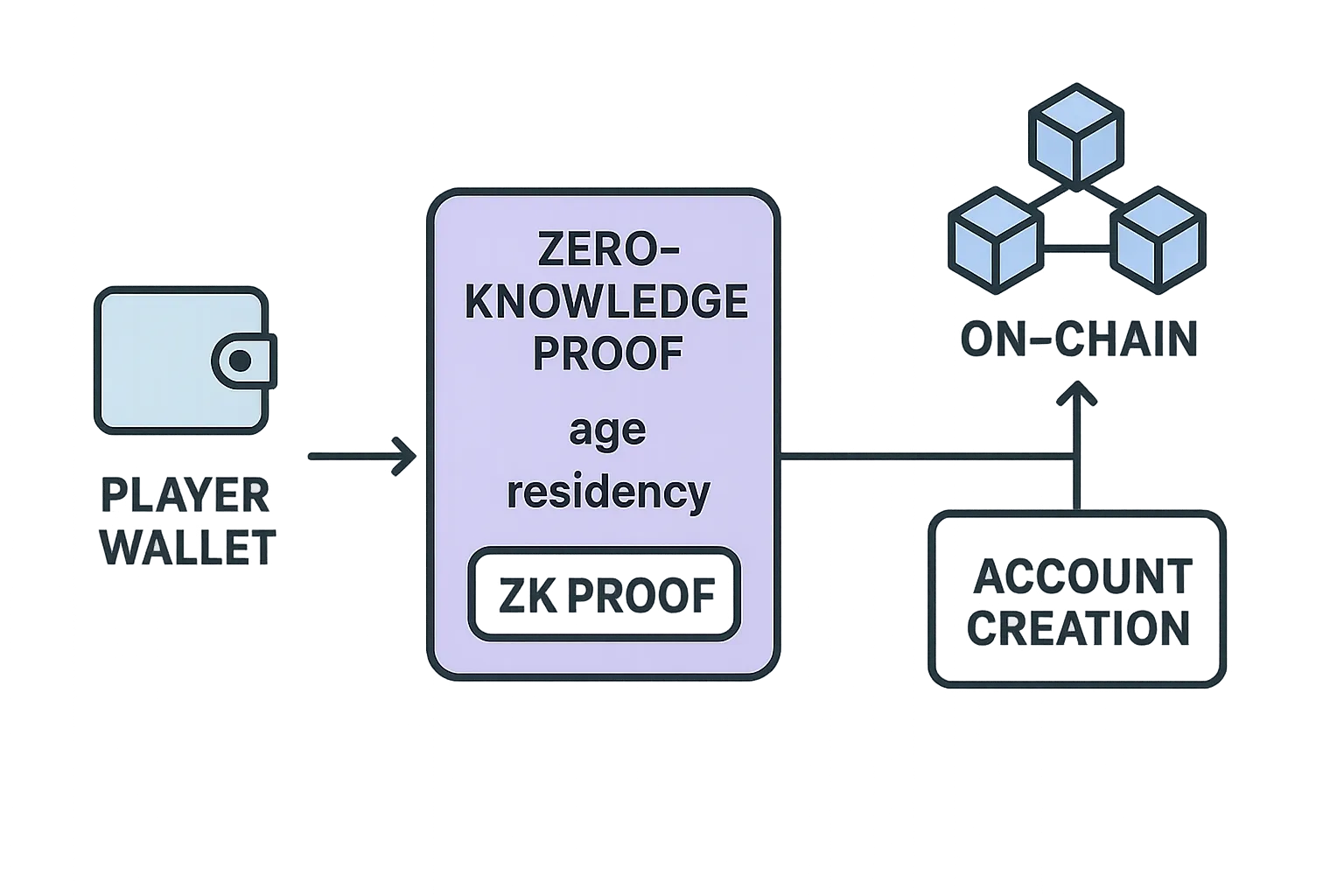
How ZK-KYC Works in Practice
-
Trusted Issuer Performs Full KYC
A regulated entity—bank, licensed KYC provider, or even a government portal—verifies the customer once and issues a cryptographic credential to the player’s wallet. -
Player Generates a Proof
When registering at your casino, the wallet creates a zero-knowledge proof that the credential satisfies specific rules (age ≥ 18, country ≠ restricted list, etc.). -
Casino Verifies the Proof
Using an on-chain or off-chain verifier, the casino checks the validity of the proof in milliseconds and stores only a hash as an audit trail. No PII touches the gaming database. -
Ongoing Compliance Checks
If regulations change—or the player reaches a new spend threshold—the casino can request a fresh proof without another document upload.
Traditional KYC vs. ZK-KYC
| Criterion | Traditional KYC | ZK-KYC |
|---|---|---|
| Onboarding time | 2–10 minutes (doc upload + review) | <30 seconds (wallet proof) |
| PII stored by casino | Passport, selfie, address docs | Zero (hash only) |
| Data breach exposure | High | Near-zero |
| Re-verification cost | Manual, repetitive | Automated, credential re-use |
| Regulator audit trail | Document archive | Cryptographic proof + hash |
Five Business Benefits for Online Casinos
-
Higher Conversion Rates
Shorter sign-up flows mean fewer rage-quits. Early pilots in fintech show up to 25 % lift in completed registrations when zero-knowledge age proofs replace document uploads. -
Lower Compliance OPEX
No document management, redaction, or secure storage. Automated proofs slash manual review hours. -
Reduced Breach Liability
Storing less PII limits breach notification costs and regulatory fines. Under EU GDPR Article 83, fines can reach €20 million or 4 % of global turnover. -
Frictionless Global Expansion
Players reuse the same credential across multiple brands and jurisdictions, streamlining localisation. -
Synergy with Crypto Payments
Wallet-based identity dovetails with Web3 cashiers and Layer-2 instant payouts (see “Why Layer-2 Blockchains Matter for Instant Payouts”).
Technical Blueprint on Spinlab’s Modular Stack
Spinlab already exposes open REST and WebSocket APIs for identity checks, wallet deposits, and risk rules. Integrating a ZK-KYC provider follows the same pattern:
- Identity Provider Plug-in – Connect a provider such as Polygon ID or AnonCreds via OAuth2 or DIDComm.
- Wallet SDK in Front End – Extend the React component library to trigger a
requestProof()call during registration. - Verifier Microservice – Spinlab’s policy engine receives the proof, passes it to a verifier module (containerised), and writes a signed result to the real-time risk ledger.
- Audit Dashboard – The existing compliance dashboard shows pass/fail status and proof hashes; no personal data is visible to agents.
Because Spinlab’s cashier already supports crypto deeplinks and custodial wallets, the same wallet session can cover payments and identity, giving operators a Shopify-like UX with enterprise-grade compliance.
Note: Spinlab does not currently ship a first-party ZK-KYC module out of the box. The platform’s open API lets you integrate third-party ZK providers while maintaining full access to real-time analytics and fraud rules.
Regulatory Outlook (2025-2027)
- EU AML Regulation (AMLR) – The upcoming AMLR allows “privacy-preserving technologies” provided regulators can still trace transactions if required. Early guidance from the European Banking Authority mentions ZKPs as a viable method.
- MGA Sandbox – The Malta Gaming Authority opened a two-year sandbox for blockchain applications in gambling, explicitly naming zero-knowledge identity as a focus area.
- US FinCEN & FATF – While FinCEN has not yet approved ZK-KYC, FATF Recommendation 10 already permits “digital identity systems” that offer equivalent assurance.
Takeaway: ZK-KYC is not yet a regulatory default, but momentum is building. Operators that start testing now will be ready when guidance crystallises.
Implementation Roadmap
- Run a Proof-of-Concept (4 weeks)
Integrate a ZK-KYC sandbox into your staging casino with 500 invited testers. - Map Compliance Requirements (2 weeks)
Define which attributes (age, country, source-of-funds) must be covered by proofs in each licence. - UX Optimisation (3 weeks)
A/B test wallet connect positions, progress bars, and fallback flows. Use insights from our article on KYC UX tweaks. - Risk Rule Calibration (1 week)
Feed proof status into Spinlab’s rule engine—e.g., block play if proof expires or credential issuer is downgraded. - Stakeholder Sign-off (ongoing)
Engage regulators early; share sandbox logs and cryptographic audit trails.
Challenges & Mitigations
- Regulator Education – Provide clear, non-technical briefs and independent audits of the ZK protocol.
- Issuer Trust Anchors – Only accept credentials from vetted, licensed entities to avoid “self-issued” loopholes.
- Revocation Handling – Use revocation registries so proofs become invalid if documents expire or fraud is detected.
- Device Compatibility – Ensure wallet SDKs support both Android/iOS and desktop browsers to avoid segment drop-off.
Frequently Asked Questions
Is ZK-KYC legal today? Regulators have not prohibited zero-knowledge proofs; they simply require that identity verification meets the same assurance level as traditional methods. Early pilots are already running under regulatory sandboxes.
Do players still need to upload documents somewhere? Yes—once, to a trusted issuer. After that, they reuse the credential without resubmitting paperwork to each casino.
How big is the performance overhead? Modern zk-SNARKs can generate proofs in <400 ms on a mid-range smartphone, and verification on the casino side is normally <10 ms.
What if a player loses their wallet? Credentials can be re-issued by the original KYC provider after standard recovery checks, or backed up via social/key recovery schemes.
Can ZK-KYC work with fiat payments? Absolutely. The proof covers identity; payment rails—cards, APMs, open banking—remain unchanged.
Ready to explore privacy-first compliance and faster onboarding? Schedule a 30-minute strategy call with Spinlab’s solutions team to see how our open iGaming platform can integrate ZK-KYC and future-proof your casino launch.