

The latest batch of Hacksaw Gaming releases—think RIP City Dream Drop, Immortal Desire, and Beast Mode XXL—are climbing lobby charts and social feeds at record speed. Their trademark high-volatility math and meme-ready artwork are irresistible to streamers and VIP grinders alike. But adding the newest Hacksaw slots to your casino is not just a one-click API toggle. The partner you choose to deliver that content will affect game uptime, compliance, margins, and even your brand reputation.
Below are six hard-hitting questions every operator should ask before signing any deal to bring new Hacksaw titles on board. Use them as a structured vetting framework, whether you are evaluating a stand-alone game aggregator, a direct studio contract, or a full-stack iGaming platform like Spinlab.
1. Is the content fully certified for my target jurisdictions—and can you prove it?
Regulators in 2025 have zero tolerance for uncertified RNG titles. Ask for:
- A copy of the most recent certificates from GLI, eCOGRA, iTech Labs, or the relevant local test house.
- The XML signature or SHA-256 checksum used to verify game packages at runtime.
- A mapping of Hacksaw release IDs to licence numbers in each market (e.g., MGA/B2B/111, UKGC 058290-R-333, ON-AGCO).
If the partner cannot provide verifiable artefacts within 24 hours, treat it as a red flag. Spinlab stores certificates in an encrypted vault and surfaces them in-dash for instant regulator audits.
2. What is the total cost of ownership over 24 months—beyond headline rev-share?
Aggregator invoices often hide setup fees, premium game uplifts, and data overage charges. Build a spreadsheet that covers:
| Cost Item | Typical Market Range | Question to Ask |
|---|---|---|
| Studio royalty (Hacksaw) | 10–16% of GGR | Is this bundled or pass-through? |
| Aggregator margin | 3–7% of GGR | Flat, tiered, or escalating? |
| Monthly minimums | €1k–€5k | Do slow seasons trigger clawbacks? |
| Certification fees | €500–€2k per title | Who pays on re-tests? |
| API call overages | €0.002–€0.01 per call | What constitutes a call? |
Run three volume scenarios (bear, base, bull) to see how effective cost per €100 of GGR shifts. Operators using Spinlab’s flat-fee, platform-native aggregation often cut effective costs by 18–25% compared with stacked contracts.
3. How will the integration impact latency and uptime KPIs?
High-volatility slots like Hacksaw’s can punish single-millisecond delays because bonus rounds involve rapid state changes. Request:
- Recent glass-to-glass latency benchmarks under 100 ms for 5k+ concurrent users.
- Details on WebSocket vs REST mechanics and regional edge nodes.
- SLA documentation covering p95 response times and 24/7 escalation paths.
Spinlab’s multi-region CDN and WebSocket game adapter shaved 42 ms off average round-trip time for a LATAM client in Q2 2025, boosting session length by 11%.
4. Do I have rights to customise RTP, volatility, and feature flags per market?
Hacksaw generally offers multiple math profiles (e.g., 92, 94, 96, 98 % RTP). Some aggregators lock you into a single default. Make sure you can:
- Toggle RTP versions without a new certification cycle when rules allow.
- Enable or disable bonus-buy, gamble, or jackpot features by jurisdiction.
- Pull real-time performance splits in the backoffice to validate the change.
Custom math control lets you comply with UKGC stake limits while still running high-RTP versions in crypto-friendly markets—a key revenue lever.
5. What marketing hooks and real-time data will be available at launch?
Hacksaw’s Drop-to-Zero jackpots and Mystery Box side bets convert exceptionally well when paired with targeted promos. Confirm that your partner offers:
- Raw game events (round start, finish, max-win, jackpot drop) streamed to your CDP or CRM in <10 s.
- Pre-built free-spin or cash-drop promos with wallet-level limits.
- Opt-in cross-sell triggers (e.g., if player hits >10x win then send mission).
Operators using Spinlab’s event stream pipe these signals into real-time journeys, generating +27% session-to-deposit on max-win retargeting campaigns.
6. How future-proof is the roadmap and support model?
Signing a two-year deal with a partner that cannot keep up with Hacksaw’s rapid release cadence (often 20+ new titles per year) creates lagging lobbies. Ask for:
- A published 6-month integration calendar and average time-to-market metric (days from Hacksaw GA to lobby availability).
- Evidence of Same-Day Patch flows for urgent bug or compliance updates.
- Dedicated Slack or Teams channel with response SLAs <30 min for critical issues.
Spinlab’s Shopify-like plugin store automatically surfaces new releases, letting operators one-click publish within hours of studio launch.
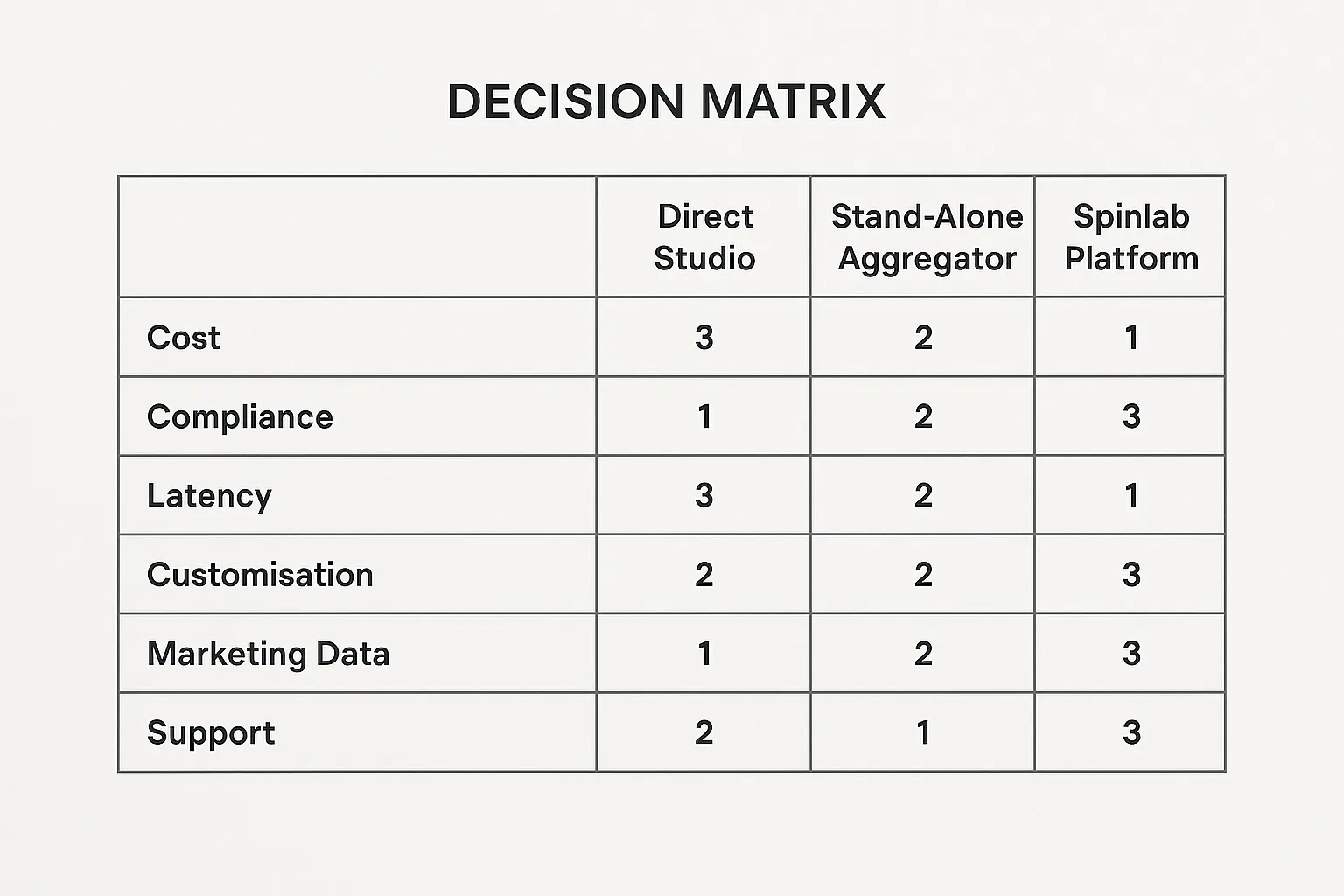
Putting it all together: a quick scoring template
Assign each question a 1-to-5 score per vendor, multiply by weighted importance, and total. A sample weighting:
| Vetting Question | Weight | Vendor A | Vendor B | Spinlab |
|---|---|---|---|---|
| Certification & Compliance | 25% | 3 | 4 | 5 |
| Total Cost of Ownership | 20% | 2 | 3 | 5 |
| Latency & Uptime | 15% | 3 | 3 | 5 |
| RTP & Feature Control | 15% | 2 | 4 | 5 |
| Marketing & Data Hooks | 15% | 2 | 3 | 5 |
| Roadmap & Support | 10% | 3 | 3 | 5 |
| Weighted Score | 100% | 2.55 | 3.35 | 5.00 |
Use this quantitative approach to move internal discussions beyond gut feel.
Frequently Asked Questions
Are Hacksaw Gaming slots legal in the United States? Jurisdictions such as New Jersey and Michigan currently do not license Hacksaw content. Always cross-check your state approvals or rely on a platform that blocks unsupported markets automatically.
Can I run Hacksaw jackpot titles in crypto-only casinos without local licences? You still need a master licence (e.g., Curaçao, Anjouan) and must ensure jackpot liquidity is segregated. Spinlab supports crypto-ready liquidity pools with real-time audit trails.
What happens if Hacksaw changes its RTP tables mid-year? Your platform should propagate the update seamlessly. Spinlab auto-updates RTP metadata and flags jurisdictions that require re-certification, preventing silent compliance breaches.
Do Drop-to-Zero jackpots create extra hosting costs? Yes, progressive pots increase write traffic. Negotiate whether those costs sit with the aggregator or are pass-through. Spinlab’s unified ledger absorbs the cost without surcharge.
Ready to launch Hacksaw’s latest hits without hidden risks?
Spinlab’s all-in-one iGaming platform delivers new Hacksaw slots with flat pricing, instant certificate access, lightning-fast WebSocket play, and one-click promotion hooks. Book a 15-minute demo to see how you can publish the next viral release in hours, not weeks.
UC888, huh? New kid on the block? Always down to explore new options for a bit of online fun. Hoping for a smooth experience and some solid winnings. Fingers crossed! This is the spot uc888
911betapp, now there one to remember. Easy to navigate and decent odds, not much to complain. May be your next favorite spot to test your knowledge. 911betapp
Winvn? Heard about it from my cousin, he says it’s the real deal for Vietnamese players. Gotta check it out myself, see what all the fuss is about. Feels legit, ya know? You can find it here: winvn