

New players do not churn because your games are bad. Most churn happens before they ever reach them.
In practice, “casino onboarding” is a conversion funnel with a very specific moment of truth: time to first spin (TTFS). If a new user cannot register, trust you, fund, and launch a game quickly on mobile, you lose them to a competitor that can.
This guide breaks down casino UX for new players into the few onboarding decisions that reliably move players from first click to first spin, while still respecting KYC/AML, fraud controls, and responsible gambling.
Define the onboarding job: get to first spin (safely)
For a new player, the job is simple: “Let me try the product, understand what’s happening, and feel safe.”
For an operator, the job is more nuanced:
- Convert a qualified visitor into a verified player
- Accept a deposit with minimal friction (fiat, crypto, or local rails)
- Prevent obvious abuse (bonus hunters, bots, card testing)
- Stay audit-ready (KYC/AML, RG limits, consent)
The most useful way to align these goals is to treat onboarding as an instrumented system, not just a set of screens.
The three onboarding metrics that matter
You can track dozens of metrics, but onboarding decisions usually come down to these:
- Registration completion rate: % of visitors who finish account creation
- FTD conversion rate (first-time depositor): % of registrants who successfully deposit
- Time to first spin (TTFS): elapsed time from landing to first wagered spin (or first real-money bet)
TTFS is the bridge metric. It forces the org to coordinate UX, payments, compliance, fraud, and game launch performance.
Map the friction: where new players actually drop off
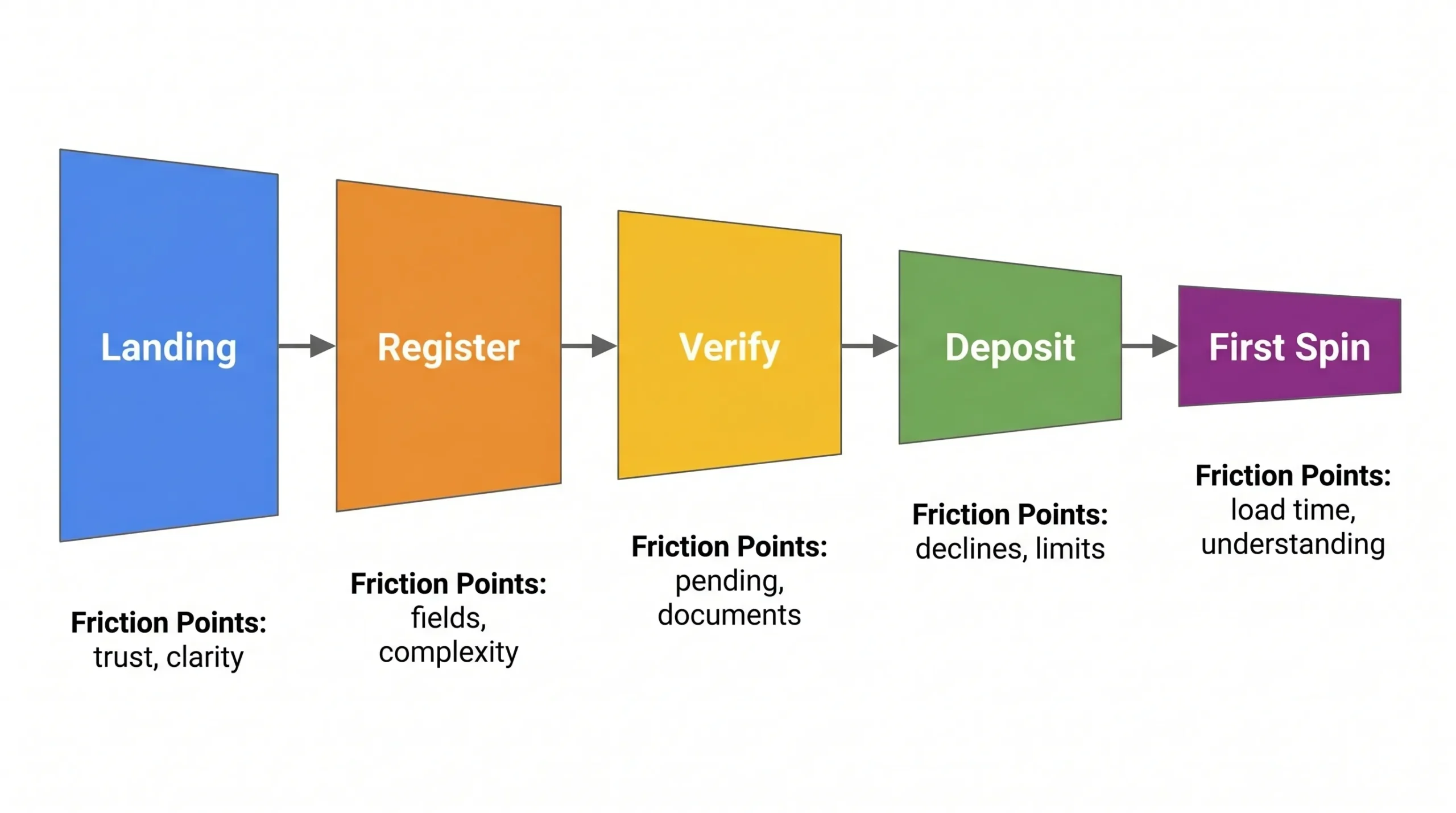
Most onboarding drop-offs cluster in predictable spots. Here is a practical breakdown you can use in product reviews.
| Onboarding stage | Why players drop | UX patterns that help | What to measure |
|---|---|---|---|
| Landing to intent | Unclear value, trust doubts, wrong geo | Clear proposition, licensing and RG cues, geo-aware messaging | Landing CTR, bounce rate, geo blocks |
| Registration | Too many fields, slow OTP, password frustration | Progressive profiling, passkey-friendly login, fewer steps | Start rate, completion rate, retries |
| Verification (KYC) | Surprise KYC, poor mobile capture, “pending” limbo | Risk-based step-up, designed pending states, clear time estimates | KYC start/completion, time-to-verify, resubmits |
| Cashier (deposit) | Method mismatch, declines, confusing fees | Local-first rails, smart defaults, transparent totals | Deposit initiation, approval rate, time-to-credit |
| Lobby to launch | Too many choices, slow loads, compliance gating | Curated first lobby, instant demo preview, fast game launch | Lobby CTR, game launch success, TTFS |
If you already have analytics, you can often identify the biggest lever in a day. The hard part is choosing a fix that does not create new risk.
The onboarding principles that get players to first spin
1) Remove decisions early, add choices later
New players do not want a giant lobby and a dozen deposit options on day one. They want a guided start.
High-performing onboarding flows typically do this:
- Ask for the minimum to create an account (email or phone, plus a secure login method)
- Offer a small set of “default good” games (popular, fast-loading, low cognitive load)
- Put the full catalog behind one click (“Browse all games”)
A simple win: build a New Player Lobby that is curated around fast activation, not long-term personalization.
2) Make trust visible before you ask for money
New users are making a risk assessment, especially in online gambling:
- “Will I get paid?”
- “Is this legit in my region?”
- “Will my card or crypto be safe?”
Trust is a UX feature. You can strengthen it without adding friction:
- Display concise payout and verification expectations (not a wall of terms)
- Show security and compliance signals where decisions happen (registration, cashier)
- Use plain-language explanations of why data is needed
Regulated industries outside iGaming face the same challenge: balancing complexity with confidence. Even in energy procurement, businesses often rely on trusted industry bodies for clarity and standards, for example BVGE’s work supporting commercial energy users. The lesson transfers: reduce uncertainty with credible, human-readable cues.
3) Use progressive profiling instead of front-loading forms
Front-loading every field is the classic “conversion killer.” Instead:
- Create the account with minimal details
- Ask for additional information when it unlocks value (deposit limits, withdrawals, higher limits)
- Keep the player informed about what is required now vs later
Progressive profiling is not “avoid KYC.” It is sequencing.
Designing KYC that protects conversion
KYC is a major reason new players never reach first spin, but it is also non-negotiable in regulated operations.
The UX goal is to avoid two failures:
- KYC surprise: users deposit, win, then discover verification blocks withdrawal
- KYC overload: users are forced into complex verification before they understand the product
A common pattern in iGaming is risk-based step-up:
- Allow low-risk users to start playing with limited functionality (jurisdiction-dependent)
- Trigger additional verification at sensible thresholds (deposit size, withdrawal, risk score)
- Provide a well-designed “pending” state with clear next actions
If you want a deeper set of KYC UX improvements, Spinlab has a dedicated guide on UX tweaks that cut KYC drop-off.
“Pending” is a screen, not a status
Many casinos lose trust because verification becomes a black box.
A good pending state includes:
- What is being checked (document, address, source of funds, age)
- Expected time range (even if broad)
- What the player can do now (play demo, browse, set limits)
- A clear path to fix common failures (retake photo, update address)
Cashier UX: the shortest path to playable balance
Once a player is ready to deposit, your goal is not “collect payment details.” It is get a playable balance fast, with minimal declines and minimal confusion.
Key cashier patterns that help onboarding
- Show the best rail first: local methods for local players, crypto options for crypto-native players
- Reduce cognitive load: fewer method tiles, better defaults, remember preferences after first success
- Make costs explicit: display totals and fees (including network fees when relevant)
- Handle failures like a product: decline recovery, safe retries, alternative rails
If you are optimizing speed and conversion specifically, this pairs well with Spinlab’s article on deposit form optimization for 3-second checkout.
TTFS depends on “time to credit,” not just deposit completion
A frequent instrumentation mistake is tracking deposit completion but not tracking when funds are actually credited to the casino wallet.
Operationally, players care about one moment: when they can play.
Measure:
- Time-to-credit (P50/P95): from deposit submit to playable balance
- Deposit abandonment reason: method not available, decline, KYC triggered, timeout
- Approval rate by rail: cards vs APMs vs crypto, by country and device
Lobby-to-first-spin UX: activation beats personalization (at first)
For a brand-new user, lobby personalization can wait. Activation cannot.
What a “first session lobby” should do
- Present 6 to 12 games max (fast to understand, representative of your offering)
- Highlight “Play now” rather than complex sorting/filtering
- Provide one obvious path to explore the full catalog
- Explain key mechanics lightly (volatility labels, demo vs real, betting limits)
Reduce “choice paralysis” with starter rails
A practical design is to offer three clear starting intents:
- “Try a slot”
- “Try live casino”
- “Explore all games”
Each route should land on a curated list, not a giant catalog.
Instrumentation: the minimum event map for onboarding
If you cannot measure onboarding precisely, you end up arguing opinions.
Here is a minimal event taxonomy that supports TTFS optimization:
| Category | Event | Example property to capture |
|---|---|---|
| Acquisition | LANDING_VIEW | geo, device, campaign |
| Registration | SIGNUP_STARTED / SIGNUP_COMPLETED | method (email, phone), duration |
| KYC | KYC_STARTED / KYC_COMPLETED / KYC_FAILED | failure_code, retry_count |
| Payments | DEPOSIT_STARTED / DEPOSIT_APPROVED / DEPOSIT_FAILED | rail, amount, decline_code |
| Gameplay | GAME_LAUNCH_STARTED / GAME_LAUNCH_SUCCESS | provider, launch_time_ms |
| Activation | FIRST_SPIN | elapsed_seconds_from_landing |
Once you have this, onboarding becomes easier to improve because each team sees the same funnel.
Where a modular platform helps (without locking you in)
Many onboarding problems are not “UI issues.” They come from fragmented systems:
- A separate KYC tool with slow callbacks
- A payment gateway that cannot route intelligently
- A game aggregator that launches slowly in certain regions
- No real-time analytics to see where new players are stuck
Spinlab Studio positions itself as an all-in-one, modular iGaming platform for building and scaling online casinos, with integrated payments (crypto and fiat), game aggregation, compliance tooling (KYC/AML), fraud prevention, multi-currency support, and an operator-focused backoffice. It is also designed to be cost-efficient, with a Shopify-like admin experience for fast onboarding and iteration.
The practical operator benefit: you can iterate onboarding faster when the platform surfaces the right controls (payments, compliance, analytics, and games) in one place.
Frequently Asked Questions
What is “time to first spin” in casino onboarding? Time to first spin (TTFS) is the elapsed time from a user’s first landing session to their first real-money spin or wager. It captures the combined friction of registration, KYC, deposit, and game launch.
Should casinos require KYC before the first deposit? It depends on your jurisdiction, risk appetite, and payment rails. Many operators use risk-based step-up verification, but you should avoid “KYC surprise” by clearly communicating what will be required before withdrawals.
What is the biggest UX mistake in onboarding new casino players? Overloading new users with too many fields, too many payment choices, and a massive lobby. Early UX should guide players to a successful first session, then expand options.
How do you improve first-time deposit conversion without increasing fraud? Use clearer deposit UX, add rail diversity (local methods and crypto where relevant), implement risk-based step-ups (3DS/KYC), and measure fraud-adjusted approval rates rather than raw approvals.
What should a new player lobby include? A curated set of fast-loading, easy-to-understand games, clear CTAs, lightweight education (demo vs real, volatility/limits), and a path to browse the full catalog.
Build onboarding that reaches first spin, then scale it
If you want to grow efficiently, optimize onboarding like a product system: one funnel, one set of metrics, fast iteration.
Spinlab Studio helps operators launch and scale on a modular, crypto-ready platform with integrated payments, game aggregation, compliance (KYC/AML), fraud prevention, real-time analytics, and a customizable backoffice.
Explore the platform at spinlab.studio and request a walkthrough to see how your onboarding can get more new players to first spin, faster.
Been playing here for a week now and the game variety is impressive. Always something new to try out. Cheers! ph879ph
Five stars for the customer support. They answered my query in minutes and helped me set up my account easily. ph80jl
Such a chill vibe on this platform. It is easy to navigate and the rewards system is actually rewarding. ph772pub