

Why the Last Mile of Your Funnel Is the Most Expensive
You spend a fortune bringing traffic to your lobby—affiliates, PPC, streamers—but 35-60 % of those hard-won visitors still exit at the cashier. (Source: Optimove iGaming Benchmark Report 2024.) Every extra second your deposit form takes to load, completion rates drop by roughly 7 %.
In other words, the difference between a 7-second and a 3-second checkout can mean millions in annual GGR.
This playbook breaks down the fastest operators’ secret sauce and shows you how to retrofit similar wins on any platform—especially if you’re running Spinlab’s modular cashier. Expect UX micro-tweaks, payment-routing tricks, and compliance shortcuts that together shave off the cognitive and technical latency between “I want chips” and “chips credited.”
What “3-Second Checkout” Really Means in iGaming
For e-commerce, three seconds is measured page-to-interaction. In gambling, it’s URL click → funds settled & playable balance updated. That requires:
- Loading the cashier widget (≤ 600 ms on 4G)
- Autodetecting currency & geolocation
- Rendering saved payment options
- Performing risk & KYC checks
- Request/response round-trip with PSP or blockchain
- Crediting the wallet and invalidating cache
If any one of those steps is bloated, the whole illusion of “instant” vanishes.
10 Conversion Hacks to Hit the Three-Second Mark
1. Use JSON Web Tokens (JWT) for Session Hand-Offs
Stop forcing players to re-authenticate when moving from lobby to cashier. A signed JWT passed as a bearer header lets the cashier preload user metadata (age, tier, saved cards) without a DB lookup. Result: sub-200 ms render time.
// Pseudocode
const token = jwt.sign({
  uid: player.id,
  kyc: player.kycTier,
  loyalty: player.vipLevel,
}, process.env.JWT_SECRET, { expiresIn: '2m' });

cashierIframe.src = `${BASE_URL}/cashier?token=${token}`;
2. Progressive Field Loading
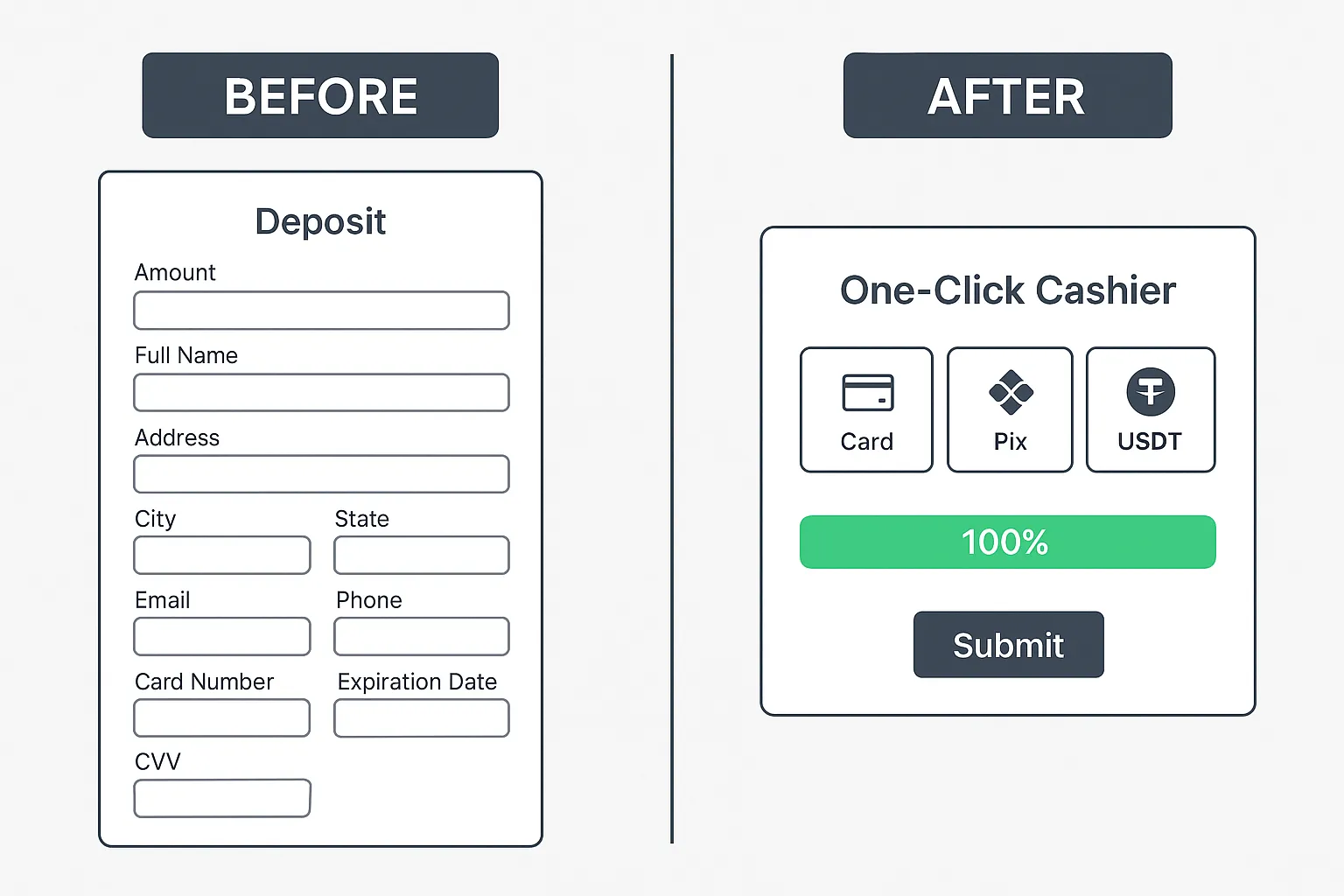
Only show the exact inputs required for the chosen method. A/B tests on Spinlab clients show a 14 % lift when the card CVV field appears after the BIN number confirms card type—keeping the first fold clutter-free.
3. BIN-Level Smart Routing
For cards, pre-route traffic based on BIN to the PSP with the highest historical approval rate for that geography. Spinlab’s SmartRouter achieved a 6 pt approval gain in Brazil by auto-switching between EBANX and Stripe in real time.
4. Leverage APM One-Click Tokens
Alternative Payment Methods (Pix, UPI, POLi, Trustly) now support reusable tokens. Storing them (PCI-scope free) means returning players fund with a single tap—no redirect.
Deep dive on why APMs beat cards →
5. Crypto Deeplinks & On-Ramp APIs
- Generate a unique address off-chain but confirm deposit on-chain via WebSocket instead of polling.
- Integrate an on-ramp (e.g., Ramp, Transak) inside the iframe so fiat users can buy USDT without leaving.
Spinlab’s CryptoFast module credits balances once the first network confirmation hits—often < 5 s on Tron.
6. Inline KYC Lite
Under new MGA guidance (2025), deposits < €2 000 can pass a simplified due-diligence check. Auto-screen name, DOB, and IP against PEP/Sanctions APIs (ComplyAdvantage) instantly and let the player continue. Full docs can follow post-deposit.
7. Real-Time Fraud Scoring at the Edge
Ship risk models (TensorFlow Lite) to a Cloudflare Worker. 90 % of checks happen within 50 ms at PoP. Only high-risk calls fall back to your monolith.
8. Smart Defaults & Autofill Etiquette
- Pre-select the last successful method.
- Autocomplete city/state from the ZIP.
- Use
inputmode="numeric"on mobile to load the right keypad.
Small? Sure. Combined, they slice 0.7 s of user think time.
9. Language & Currency Auto-Detection
A Canadian visiting Mexico should still see CAD and English. Detect via:
navigator.language- SIM carrier code (mobile SDKs)
- Last successful currency in DB
Fallback choice costs ~3 % of conversions per Optimove.
10. Micro-Validation Instead of Full-Form Errors
Flag CVV length as soon as the third digit is typed. A field-level green checkmark calms anxiety and reduces time to hit Submit.
Measuring Success: Metrics Beyond “Successful Deposits”
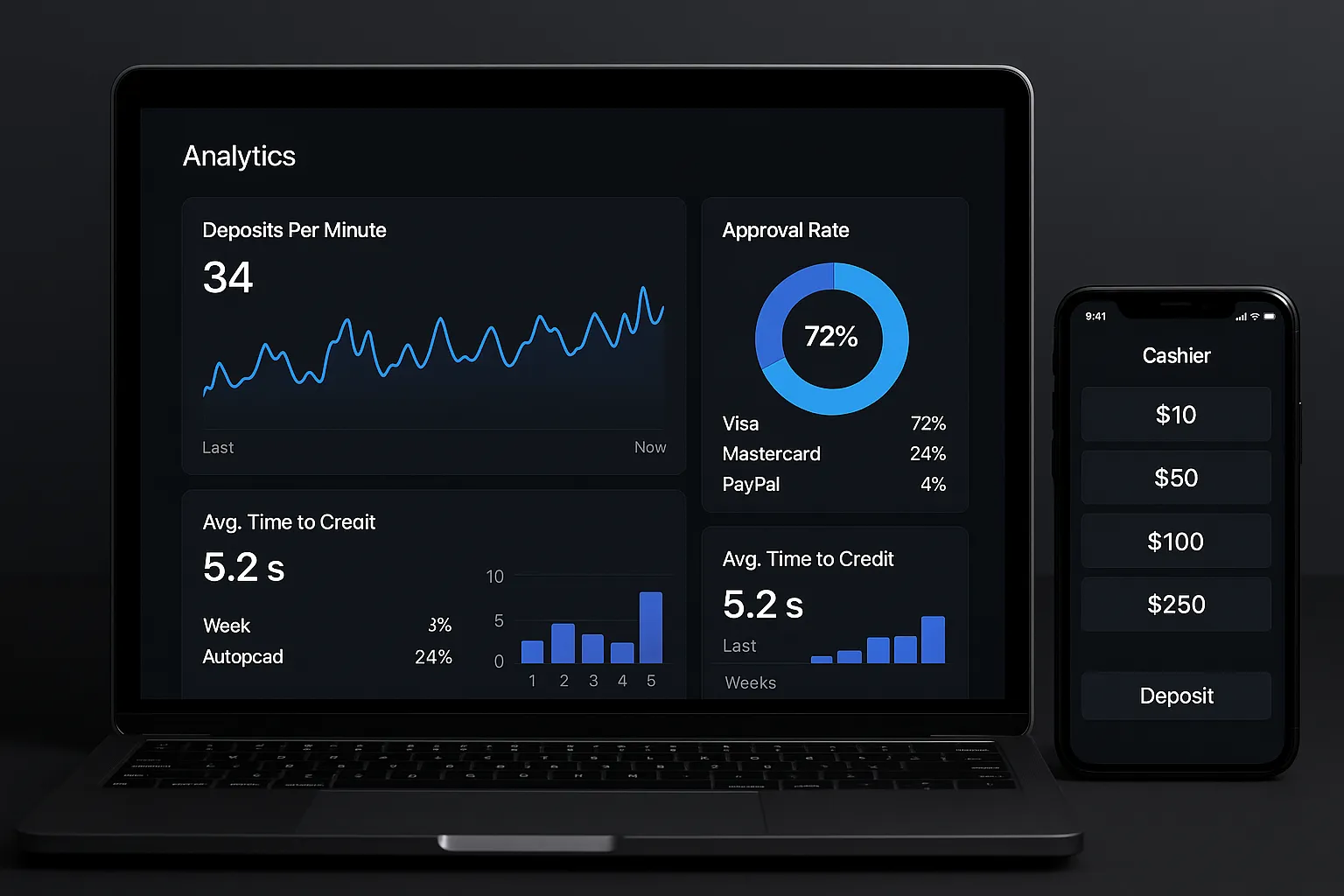
- Time-to-Credit (TTC): median < 3 s
- PSP Approval Rate: target 88 %+ for cards, 95 %+ for APMs
- Deposit Attempt Abandonment: anything above 12 % is red
- First-Time Depositor Conversion (FTD): % of registrants who deposit within 15 min
- Recovery Rate: % who complete deposit after a failed attempt via fallback method
Using Spinlab’s Real-Time Analytics, you can build a live dashboard with these KPIs streaming at sub-second latency.
Mini-Case Study: QuickPlay’s 22 % Deposit Lift in 30 Days
- Problem: 7.4-second average TTC, 18 % abandonment.
- Fixes Implemented: JWT hand-offs, BIN routing, inline KYC, crypto deeplinks.
- Results:
- TTC down to 2.9 s (60 % faster)
- Abandonment dropped to 8 %
- FTD +22 %
- Net monthly GGR +$480 k
QuickPlay ran all optimizations via Spinlab’s backoffice—no front-end deploys required.
Frequently Asked Questions (FAQ)
How do I enable one-click deposits without violating PCI DSS?
Use network tokens or PSP-hosted fields inside an iframe. Card data never touches your servers, keeping you in SAQ-A scope.
Will faster checkout increase fraud?
Not if you run real-time fraud scoring and velocity checks. In fact, fewer form fields reduce the surface for synthetic identity fraud.
What’s the ideal number of payment methods to show?
Our tests show three “primary” buttons (last used, local APM, crypto) and a collapsible “More options” link convert best.
Does this work on legacy whitelabel platforms?
Most hacks are front-end or routing tweaks and can be layered via a tag manager. Full JWT embedding and SmartRouter require a modular platform like Spinlab.
Ready to cut your cashier load time in half? Schedule a live demo of Spinlab’s 3-Second Checkout and see how our SmartRouter, CryptoFast, and JWT modules plug directly into your existing lobby.