

Online casinos are high-value, always-on targets. You are processing real money, running latency-sensitive gameplay, and serving traffic that can spike from affiliates, streamers, and jackpot moments. That mix makes DDoS attacks uniquely damaging: even short disruptions can break deposit flows, trigger “site is down” churn, and create compliance headaches when logs and evidence are incomplete.
This guide gives a layered DDoS protection setup you can apply whether you run a single brand or a multi-brand iGaming operation. The goal is not only “stay up”, it is “stay up while preserving payments correctness, player trust, and audit-grade evidence.”
What “good” DDoS protection looks like for an online casino
DDoS protection is not a single appliance or a toggle in a CDN. For iGaming, it is a set of controls across:
- Edge availability (absorb volumetric floods and keep the site reachable)
- Application survivability (stop Layer 7 request floods that exhaust CPU, DB, and third parties)
- Gameplay and cashier integrity (avoid double credits, broken sessions, and inconsistent states)
- Operational readiness (detect fast, respond predictably, and preserve evidence)
A practical north star is to define two SLOs:
- Public site SLO (landing, registration, login): for example, 99.95% monthly.
- Money path SLO (cashier, wallet, withdrawals): for example, 99.99% monthly, with stricter error budgets.
Then design your layers so that an edge incident does not become a payments incident.
Threat model: the DDoS patterns casinos actually see
Most casino teams plan for volumetric attacks, but many outages come from cheaper Layer 7 pressure that looks like “normal traffic” to naive setups.
Layer 3 and 4 floods (volumetric)
These are SYN floods, UDP floods, and amplification attacks aimed at saturating bandwidth or load balancers. Mitigation typically requires Anycast networks and upstream scrubbing.
Layer 7 HTTP floods (app exhaustion)
Attackers hit expensive endpoints repeatedly: registration, login, password reset, bonus claim, game launch, cashier quote, and wallet balance refresh. Even if each request is “valid,” the aggregate can take you down.
“Gray” attacks that blend bots, scraping, and fraud
Some campaigns combine DDoS with credential stuffing, bonus abuse, or card testing to create noise that overwhelms ops.
If you want to harden bot surfaces without trashing UX, see Spinlab’s write-up on Cloudflare Turnstile for casinos.
The layered model (edge to origin)
A resilient setup assumes any one control can fail. The stack below is intentionally redundant.
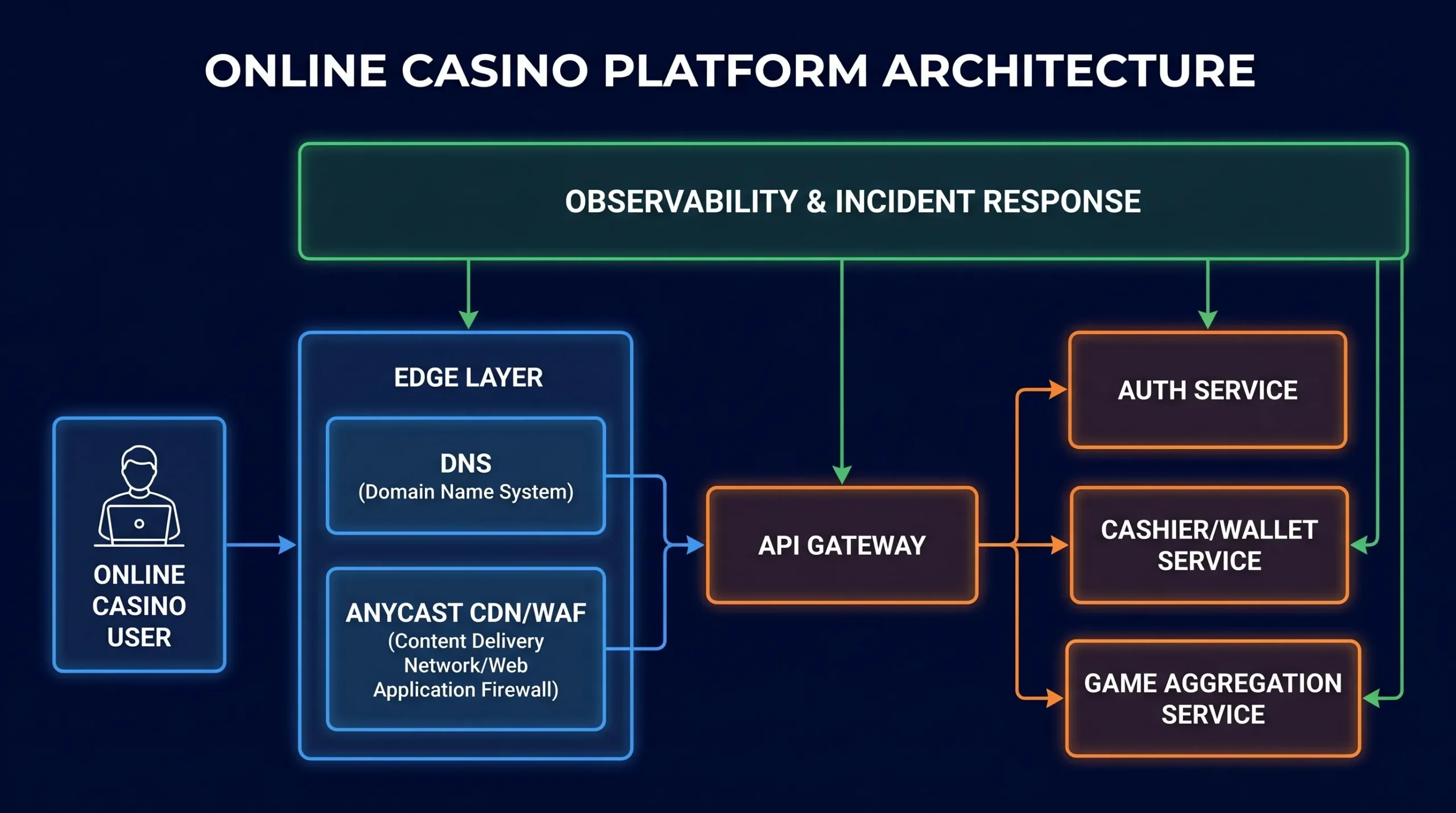
Layer 1: DNS and traffic steering
Objective: stay reachable and route around failures.
Key practices:
- Use a mature DNS provider with Anycast and strong DDoS posture.
- Keep TTLs low enough to fail over quickly (but not so low you create unnecessary query load).
- Plan for regional failover if your compliance model supports it.
Layer 2: CDN and caching for casino frontends
Objective: prevent origins from seeing traffic they do not need.
For casino sites, caching is often underused because teams assume “everything is dynamic.” In practice, you can cache a lot safely:
- Static assets (JS, CSS, images, fonts)
- Game thumbnails and lobby media
- Public content pages (terms, help, promotions content with short TTL)
The edge should also support origin shielding (a shield PoP) so your origin does not get hit from every edge location during spikes.
Layer 3: WAF and bot management (the real Layer 7 shield)
Objective: stop expensive requests before they execute application logic.
Protect endpoints that are both high value and computationally expensive:
/register,/login,/password-reset/kyc/*upload and status endpoints/cashier/quote,/deposit/intents,/withdrawals/*/bonus/claim,/promotions/apply/game/launchand session creation
Use a combination of:
- Rate limiting with identity-aware keys (IP alone is not enough)
- Challenge flows for suspicious traffic
- Known-bad ASN and geo rules (only where lawful and aligned with licensing)
- Header and method validation (block weird verbs and malformed payloads)
Reference baselines for web application controls are well covered by the OWASP Application Security Verification Standard (ASVS).
Layer 4: API gateway and service-level limits
Objective: make sure one endpoint cannot starve the entire platform.
At minimum, implement:
- Global concurrency limits per route group (auth, cashier, games)
- Per-player and per-session limits once identity is established
- Per-IP limits for pre-auth endpoints
- Request body limits for uploads
- Timeouts that fail fast, plus circuit breakers for third-party dependencies
Casino-specific note: your “money path” should be isolated from marketing and content endpoints so that a promo spike cannot degrade wallet operations.
Layer 5: Application hardening (make requests cheaper)
Objective: reduce compute cost per request so you can absorb more.
High-impact changes that double as DDoS mitigations:
- Precompute and cache lobby payloads and game catalogs.
- Avoid synchronous calls to third parties in hot paths (KYC, PSP lookups, bonus engines).
- Make balance reads cheap, and move heavy calculations off the request thread.
- Apply strict input validation and short-circuit early.
If you are running Kubernetes, align this layer with hardening and isolation controls. Spinlab’s Kubernetes hardening guide for gambling workloads is a useful checklist for RBAC, NetworkPolicies, and admission controls.
Layer 6: Data tier protection (DB, cache, queues)
Objective: prevent cascades, preserve correctness, and keep recovery fast.
Common failure mode: the edge holds, but your DB melts under read amplification.
Protect your data tier with:
- Read-through caches for hot reads (lobby, profile summary, balances where safe)
- DB connection pool limits and sane max connections per service
- Backpressure (reject early instead of timeouts that pile up)
- Queue-based ingestion for non-critical telemetry
For money movement, correctness is more important than availability. Pair protection with engineering discipline like idempotency. If you have not implemented it end-to-end, see Idempotency for casino payments.
Layer 7: Observability and DDoS detection
Objective: detect in seconds, not minutes.
Track four buckets of signals:
- Edge: requests per second, blocked/challenged ratio, geo/ASN distribution
- App: P50/P95 latency per endpoint, error rates, saturation (CPU, concurrency)
- Data: DB QPS, slow query rate, cache hit ratio, queue lag
- Business: deposit initiation rate, deposit completion rate, game launch success, login success
The business signals matter because some DDoS campaigns aim to selectively break deposits and withdrawals rather than take the whole site down.
Layer 8: Incident response and safe-mode operations
Objective: keep the casino usable while you mitigate.
A casino-safe “degrade mode” typically means:
- Freeze or slow non-essential endpoints (search, recommendations, some promos)
- Add friction on pre-auth (Turnstile, stronger rate limits)
- Temporarily disable high-abuse promos if bots are exploiting them
- Preserve cashier and withdrawals integrity, even if you slow them with clear UX
The key is to rehearse this before an incident. If your biggest traffic spikes happen during events, align the runbook with capacity planning like forecasting server capacity for mega-jackpot weekends.
A practical layered setup guide (what to configure first)
This section is ordered by fastest risk reduction per hour invested.
1) Inventory and classify your endpoints
Create a simple endpoint map and mark:
- Public and cacheable
- Public and expensive
- Authenticated and expensive
- Money movement (deposit, withdrawal, ledger posting)
This classification drives your WAF, rate limits, and safe-mode switches.
2) Put your casino behind a real edge (CDN + WAF)
Whether you choose Cloudflare, Fastly, Akamai, or a cloud-native option, validate these capabilities:
- Global Anycast network and L3/L4 mitigation
- Managed WAF with custom rules
- Bot signals and challenge flows
- Origin shielding
- Detailed logs export (critical for audits and investigations)
Cloud providers also offer integrated services, for example AWS Shield and Google Cloud Armor. The right choice depends on your hosting footprint and where you want operational ownership.
3) Add rate limiting that matches casino identity
Avoid the trap of “100 requests per minute per IP.” Casino traffic is full of NATs, mobile carriers, and shared networks.
Prefer rate limit keys like:
- IP + user agent + TLS fingerprint (pre-auth)
- Account ID (post-auth)
- Session ID or device fingerprint (where lawful and disclosed)
- Payment intent ID on cashier flows
Keep limits endpoint-specific. Login needs different limits than lobby browse.
4) Protect game launch and WebSocket surfaces
Game launch endpoints are frequently targeted because they can trigger multiple downstream calls (aggregation, wallet, bonus eligibility).
Controls that help:
- Strict request validation and allowlisted parameters
- Per-account launch rate limits
- Timeouts and circuit breakers when upstream game providers slow down
If you use WebSockets for gameplay events, cap:
- Concurrent sockets per account
- Message rate per socket
- Max payload size
5) Separate “money path” from “marketing path” at the infrastructure level
If deposits, withdrawals, and wallet reads share the same bottlenecks as promo pages and content, attackers can take down the cashier indirectly.
Practical separation options:
- Distinct route groups with dedicated concurrency pools
- Separate autoscaling policies
- Separate caches
- Different WAF policies
6) Build a safe-mode switch you can activate in minutes
Safe-mode should be operationally simple. The best version is a configuration toggle that:
- Tightens edge rules
- Enables additional bot challenges
- Disables non-essential endpoints
- Lowers timeouts for slow upstream calls
Treat it like a product feature, test it in staging, and document what it does to player UX.
Layer-by-layer checklist (with owners and metrics)
Use the table below as an internal implementation tracker.
| Layer | Control | Owner | “Done” evidence | Metric to watch |
|---|---|---|---|---|
| DNS | Anycast DNS, low TTL failover plan | Infra | Failover test completed | DNS error rate, time to failover |
| Edge | CDN caching + origin shield | Infra | Cache rules and shield enabled | Origin RPS, cache hit ratio |
| Edge security | WAF rules for high-cost endpoints | Security | Rule set + exception process | Block/challenge rate, false positives |
| Bot | Invisible challenges on pre-auth | Security/Product | A/B test and UX review | Login success, registration drop-off |
| API | Route-based rate limits and concurrency caps | Backend | Config in IaC, tested | 429 rate, P95 latency |
| App | Timeouts, circuit breakers, input validation | Backend | Load test report | Error rate by dependency |
| Data | Connection pool limits + cache strategy | Backend/DBA | SLO-aligned settings | DB CPU, slow queries |
| Ops | DDoS runbook + safe-mode toggle | SRE/Ops | Game day drill results | Time to detect, time to mitigate |
Common mistakes that make casino DDoS incidents worse
Assuming autoscaling alone solves DDoS
Autoscaling is helpful for legitimate spikes, but it can also scale you into a larger cloud bill while the attacker keeps you pinned. You still need edge filtering and request cost reduction.
Letting third parties sit in hot paths
If every login or cashier call synchronously waits for third-party services, attackers can magnify impact. Use timeouts, fallbacks, and asynchronous flows where possible.
Not having “payments correctness” invariants during attack mode
Under stress, retries explode. Without idempotency, monotonic state transitions, and audit-grade ledgers, DDoS turns into reconciliation incidents.
Fighting the last war
Teams often optimize for one attack they remember. Instead, keep a living risk model and revisit it quarterly. A simple starting point is a threat-prioritization approach like Spinlab’s risk matrix guide for online casinos.
Where your iGaming platform choice matters
Even with best-in-class edge tooling, your platform architecture affects how well you withstand Layer 7 pressure:
- Can you isolate cashier and wallet workloads from content and promos?
- Do you have real-time analytics to spot conversion drops that signal targeted attacks?
- Can you quickly change limits, rules, and flows without a risky deploy?
- Do you have integrated fraud controls so bot noise does not overwhelm ops?
Spinlab is built as a modular iGaming platform with integrated payments, compliance, fraud prevention, and real-time analytics. If you are evaluating platforms for operational resilience, it is worth asking vendors to demonstrate how their stack behaves under L7 floods and how fast you can activate safe-mode.
Frequently Asked Questions
What is the best DDoS protection for online casinos? The best approach is layered: Anycast edge mitigation plus WAF and bot controls for Layer 7, backed by API limits, app hardening, and an incident runbook with safe-mode.
How do I protect casino deposits and withdrawals during a DDoS attack? Separate the money path from marketing traffic, enforce strict rate limits on cashier endpoints, and rely on idempotent payment intents so retries do not cause double credits.
Is a CDN enough to stop Layer 7 DDoS? Not by itself. You need WAF rules, bot detection, endpoint-specific rate limits, and application changes that reduce request cost.
What endpoints should I protect first on a casino site? Registration, login, password reset, game launch/session creation, cashier quote and deposit intent endpoints, bonus claim, and any KYC upload/status endpoints.
How can I reduce false positives from WAF and bot rules? Start with monitor mode, tune by endpoint, use identity-aware keys beyond IP, and measure business KPIs (login success, deposit completion) alongside security blocks.
Want a platform that stays resilient under real casino traffic?
If you are building or migrating an online casino and want fewer single points of failure across payments, compliance, and gameplay operations, Spinlab’s modular platform is designed for fast onboarding and global scaling.
Explore Spinlab or book a technical walkthrough to discuss your DDoS threat model, safe-mode design, and how to isolate your cashier and wallet flows under attack pressure.