

Affiliate growth is one of the few acquisition channels where an online casino can turn marketing spend into a performance-managed asset. Instead of buying impressions and hoping they convert, operators can work with publishers, streamers, comparison sites, communities, and media buyers who are rewarded for the value they bring.
But the keyword is system. A casino affiliate program that runs on spreadsheets, promo codes, and manual payout checks will eventually leak margin, misattribute players, and attract abuse. A modern affiliate system connects tracking, offers, player quality, compliance, fraud prevention, and payouts into one operational loop.
For operators building or scaling an online casino, this is where affiliate systems become a serious growth lever.
What is an affiliate system for an online casino?
An affiliate system is the infrastructure that lets an online casino recruit partners, track referred players, calculate commissions, monitor quality, prevent fraud, and pay partners according to agreed rules.
In iGaming, affiliate systems need to be more robust than generic referral tools because the acquisition event is not simply a click or signup. A valuable referred player may need to register, pass eligibility checks, make a first deposit, play within allowed markets, avoid chargebacks, and remain active over time.
A basic affiliate setup might track links and registrations. A growth-ready affiliate system should connect the full journey from traffic source to player lifetime value.
| Affiliate system layer | What it does | Why it matters for growth |
|---|---|---|
| Tracking and attribution | Connects clicks, codes, registrations, deposits, and player activity to the right partner | Prevents underpaying good partners or overpaying low-quality traffic |
| Commission engine | Supports CPA, revenue share, hybrid, tiered, or custom payout models | Aligns partner incentives with casino economics |
| Offer and bonus controls | Assigns landing pages, promo codes, welcome offers, and campaign rules | Improves conversion without losing control of bonus cost |
| Compliance controls | Enforces geo, age, licensing, and marketing rules | Reduces regulatory and reputational risk |
| Fraud monitoring | Detects self-referrals, multi-accounting, bot traffic, chargeback patterns, and suspicious partner behavior | Protects margin before payout approval |
| Reporting and analytics | Shows FTDs, NGR, retention, payback, and partner quality | Helps operators scale winners and cut waste |
A strong affiliate system is not just a marketing tool. It is part of the casino’s commercial control layer.
Why affiliate systems help online casinos grow
Affiliate systems help online casinos grow because they create a scalable way to acquire players through trusted third-party audiences while keeping acquisition spend tied to measurable outcomes.
Paid ads can be expensive, restricted, or unstable in gambling markets. Affiliates often already own the audiences operators want to reach, including slot review readers, sportsbook communities, casino bonus searchers, crypto bettors, VIP comparison traffic, and local-language casino players.
The growth advantage comes from four forces working together: distribution, trust, performance pricing, and feedback.
1. Affiliates extend your distribution beyond paid media
Most new casinos do not start with a large brand, organic search footprint, or community. Affiliates can fill that gap.
A single operator may struggle to rank for competitive search terms, build a YouTube presence, run compliant social campaigns, and maintain localized communities at the same time. Affiliates specialize in these channels. Some are SEO publishers, some are streamers, some run comparison portals, some manage private communities, and some focus on paid media arbitrage.
An affiliate system gives each partner a controlled path to promote your casino through approved links, landing pages, campaigns, and tracking parameters. The operator gains distribution without having to build every audience from scratch.
This matters especially for new online casino brands that need early traffic, first-time depositors, and market feedback before scaling larger campaigns.
2. Performance-based payouts make acquisition more controllable
Affiliate systems help operators move away from paying only for exposure. Instead, payouts can be tied to the outcomes that matter.
Common iGaming affiliate payout structures include CPA, revenue share, hybrid, and tiered deals. CPA gives predictable acquisition cost, while revenue share can align long-term incentives. Hybrid deals combine both, often with a smaller upfront payment and ongoing share of player value.
The best model depends on your market, player value, margin, and risk tolerance. For a deeper comparison, Spinlab’s guide to CPA vs rev share affiliate payouts breaks down the trade-offs.
The important point is that a real affiliate system can enforce those models automatically. It can calculate commissions based on deposits, net gaming revenue, chargebacks, bonus costs, and exclusions instead of relying on manual reconciliation.
That makes affiliate growth more predictable. Operators can raise payouts for high-quality partners, cap exposure on experimental traffic, and avoid scaling campaigns that look good on registrations but fail on retention or NGR.
3. Affiliates bring trust into the player acquisition journey
Online casino players often compare brands before depositing. They want to know whether the platform is legitimate, what games are available, how withdrawals work, which payment methods are supported, and whether bonuses are worth claiming.
Affiliate content can answer those questions in places where players are already researching. Review pages, comparison tables, streamer demos, Discord communities, newsletters, and tutorial content all shape trust before a player lands on your site.
This is why affiliate systems and landing pages should work together. A player coming from a crypto casino community may need different proof points than a player coming from a slot review article. The offer, payment messaging, game lobby, and onboarding experience should match the traffic source.
Affiliate systems make this easier by connecting partners to specific campaigns, links, offers, and player segments. That gives operators a cleaner way to test which messages drive funded accounts, not just clicks.
4. Local affiliates speed up market entry
When entering a new geography, local knowledge often beats generic media buying. Affiliates understand local language, payment preferences, player expectations, device habits, bonus norms, and trust signals.
For example, an operator expanding into a mobile-first market may need affiliates who know which landing page formats convert, which payment methods players expect, and which casino content categories generate intent. In crypto-forward markets, affiliates may also educate players on wallet deposits, stablecoins, and onramp flows.
An affiliate system helps operators structure those local partnerships with market-specific tracking, currencies, campaign rules, and compliance controls. This is especially important when operating across multiple jurisdictions or brands.
The growth benefit is speed. Instead of guessing what will resonate, operators can launch controlled campaigns with local partners, monitor quality, and scale the partners who bring profitable traffic.
5. Better attribution improves every growth decision
Affiliate traffic becomes far more valuable when it feeds the wider analytics stack. If affiliate reporting stops at clicks, registrations, and first deposits, operators miss the most important question: which partners bring players who remain profitable?
A growth-ready system should connect affiliate source data to player lifecycle metrics such as deposits, withdrawals, bonus cost, game preferences, retention, fraud reviews, and support load.
That data helps answer practical questions:
- Which affiliates bring players who deposit again after the first session?
- Which campaigns drive high registration volume but weak KYC completion?
- Which partners produce bonus-heavy players with low net value?
- Which geographies or creatives lead to higher chargeback risk?
- Which traffic sources produce players suited for slots, live casino, or original games?
This turns the affiliate program from a cost center into a learning engine. The operator can use partner-level insights to improve landing pages, bonus rules, cashier flows, game lobby curation, and CRM segmentation.
For broader lifecycle activation, it also helps to connect affiliate data with a scalable casino CRM stack, so referred players can be nurtured based on behavior rather than treated as one generic cohort.
The metrics that show whether affiliates are really growing the casino
Affiliate growth should not be judged by traffic volume alone. A partner can send thousands of clicks and still damage profitability if the players fail KYC, claim bonuses without depositing again, or create fraud risk.
The most useful affiliate metrics connect acquisition, player quality, and margin.
| Metric | What it tells you | How operators use it |
|---|---|---|
| Click-to-registration rate | Whether traffic and landing pages match player intent | Improve partner targeting and landing page relevance |
| Registration-to-FTD rate | Whether onboarding, KYC timing, and cashier UX convert interest into deposits | Diagnose funnel friction by partner or campaign |
| Cost per FTD | How much each funded player costs | Compare acquisition efficiency across partners |
| NGR per referred player | Net value after bonuses, winnings, fees, and adjustments | Identify partners that bring profitable players |
| Payback period | How long it takes to recover acquisition cost | Set CPA caps and tier thresholds |
| Retention by cohort | Whether referred players return after the first session | Separate sustainable partners from one-time traffic |
| Chargeback and refund rate | Whether partner traffic creates payment risk | Hold or adjust payouts before losses scale |
| Bonus cost to NGR | Whether offers are too generous for a traffic source | Tune campaign-specific bonus rules |
The key is to evaluate affiliates on quality-adjusted growth. This prevents teams from celebrating vanity metrics while the underlying economics deteriorate.
How affiliate systems protect margins as volume scales
Affiliate marketing can grow quickly, which is both the opportunity and the risk. Once a campaign works, partners can increase traffic fast. Without controls, that same speed can amplify fraud, compliance gaps, bonus abuse, and payout disputes.
A mature affiliate system protects margins in several ways.
First, it centralizes tracking. When player source data, promo codes, campaign IDs, and postbacks are stored consistently, disputes become easier to resolve. Operators can see which partner referred a player, which terms applied, and whether the commission conditions were met.
Second, it connects affiliate data to fraud and payments. Fraudulent affiliate traffic often shows patterns across devices, IPs, payment methods, KYC outcomes, gameplay, and withdrawal behavior. If affiliate reporting is isolated from the casino’s risk systems, those patterns may only appear after the payout is processed.
Third, it supports payout holds and review rules. Operators can delay or adjust commissions when players trigger high-risk signals, create chargebacks, abuse bonuses, or fail verification. This does not mean treating every partner with suspicion. It means building fair, transparent rules that protect both the casino and legitimate affiliates.
Spinlab has a separate guide on detecting affiliate fraud before your first payout for operators that want a deeper operational checklist.
Compliance: the growth lever operators cannot ignore
Affiliate systems also help online casinos grow by making partner marketing more governable. In regulated or licensing-sensitive markets, affiliates can create real exposure if they use misleading claims, target restricted geographies, omit required disclosures, or promote offers to prohibited audiences.
Regulators and consumer protection authorities increasingly expect advertisers to maintain control over third-party marketing. The FTC’s disclosure guidance for influencers is one example of the broader expectation that paid relationships should be clear to consumers. In gambling, local advertising rules can be even stricter.
A casino affiliate system should help enforce this through approved creatives, jurisdiction restrictions, campaign terms, audit logs, and partner-level monitoring. It should also make it easy to pause campaigns quickly when rules change or when a partner violates requirements.
Compliance is not only defensive. It enables growth because serious affiliates prefer operators with clear rules, reliable tracking, and predictable settlement. The easier you make it for quality partners to promote you safely, the more likely they are to invest effort into your brand.
What to look for in an affiliate system for casino growth
Operators evaluating a white label casino platform or standalone affiliate tool should look beyond basic referral links. The system needs to support the full commercial lifecycle.
At minimum, a casino affiliate system should include:
- Server-side tracking with campaign, partner, sub-affiliate, and source identifiers
- Flexible commission models such as CPA, revenue share, hybrid, tiered, and custom rules
- Partner dashboards showing traffic, conversions, earnings, and payment status
- Bonus and promo code controls tied to specific campaigns or traffic sources
- Fraud and quality checks before commission approval
- Compliance workflows for creative approval, geo restrictions, and audit evidence
- Multi-currency settlement support for international partners
- API or webhook access so affiliate data can connect to analytics, CRM, payments, and backoffice workflows
The more fragmented these capabilities are, the harder the program becomes to operate. A spreadsheet can work for the first few partners. It will not work once you have dozens of affiliates, multiple markets, custom payout rules, and fraud reviews happening at the same time.
Where affiliate systems fit inside a modern iGaming platform
Affiliate systems perform best when they are not bolted on as an afterthought. They should connect to the casino platform’s core systems, including registration, KYC, payments, wallet, bonus engine, fraud prevention, analytics, and backoffice.
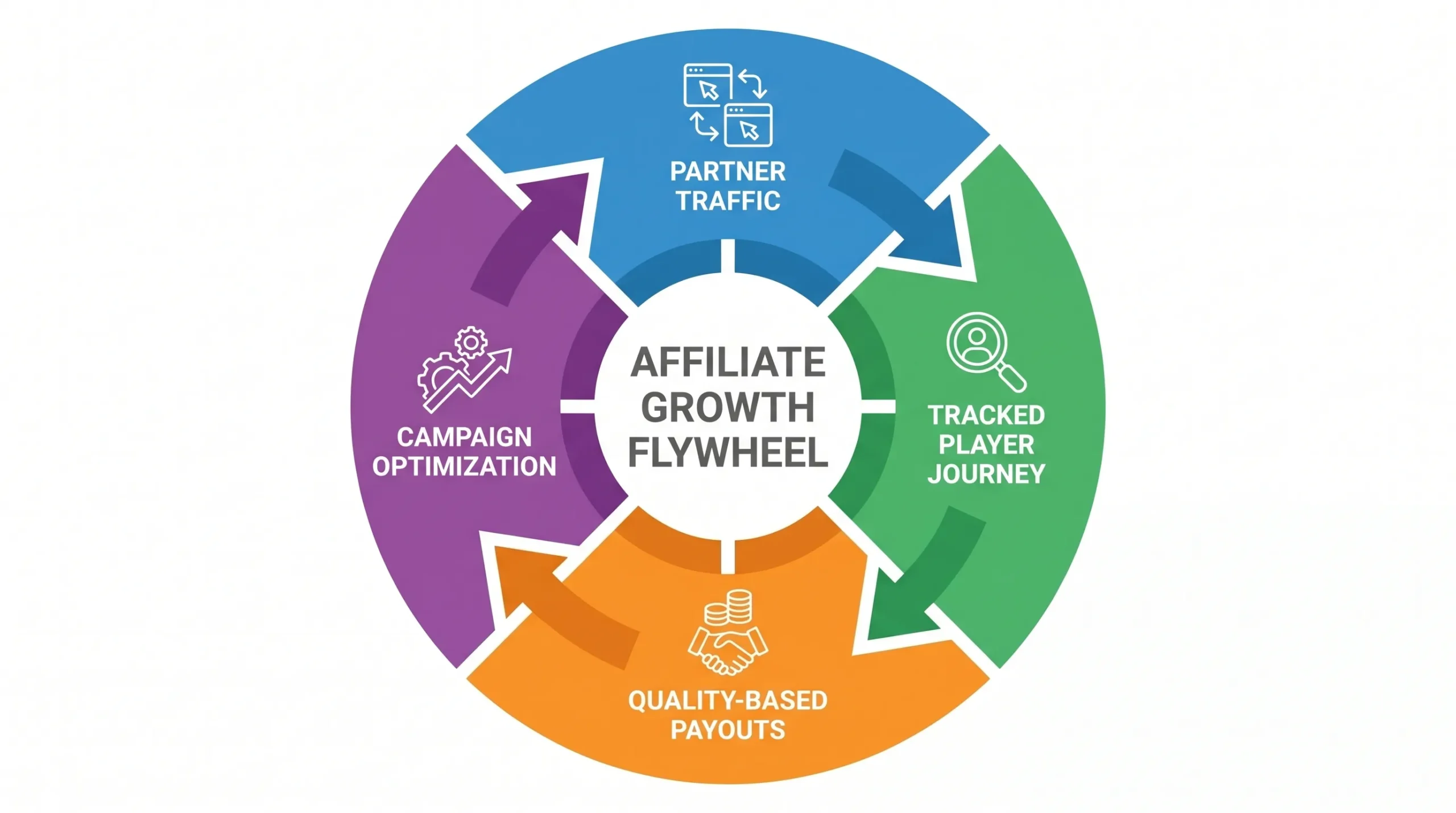
This integrated model creates a cleaner growth loop:
- A partner sends traffic through a tracked link or campaign.
- The player lands on a relevant page with the correct offer and market settings.
- Registration, KYC, deposit, gameplay, and bonus events are attributed to the right source.
- The analytics layer measures player quality over time.
- The commission engine calculates payouts based on agreed rules and risk outcomes.
- The operator scales, pauses, or adjusts campaigns using real performance data.
This is the difference between “having affiliates” and running affiliate-led growth.
Spinlab’s modular iGaming platform is designed to support this kind of connected operation. Its feature set includes an affiliate and bonus engine, real-time analytics dashboard, advanced fraud prevention, KYC and AML compliance, crypto and fiat payment support, multi-currency capabilities, a customizable backoffice admin panel, and open API integration.
For operators who want a simpler operating model, Spinlab also focuses on a Shopify-like user experience for launching and managing casino brands without unnecessary technical overhead. That matters because affiliate growth requires constant iteration: new campaigns, offers, landing pages, partner rules, payout models, and fraud controls.
Common mistakes that limit affiliate growth
Many online casinos launch affiliate programs but fail to turn them into a reliable growth channel. The most common issue is not lack of partners. It is lack of control.
One mistake is paying for the wrong event. If a casino pays aggressively for registrations or first deposits without measuring retention, NGR, chargebacks, and bonus cost, it may reward partners who bring low-quality traffic.
Another mistake is treating all affiliates the same. A streamer, SEO review site, paid media buyer, and local community owner have different traffic patterns and risk profiles. Their offers, payout terms, compliance checks, and performance benchmarks should reflect that.
Operators also run into problems when affiliate systems are disconnected from the rest of the platform. If payments, KYC, fraud, bonuses, and analytics all sit in separate tools, the team will struggle to understand whether partner growth is profitable or risky.
A final mistake is reviewing fraud too late. Affiliate abuse should be checked before payouts, not after losses accumulate. This is why partner vetting, player-level risk signals, and payout approval workflows need to be part of the system from day one.
For a complete program-building framework, see Spinlab’s guide to building a high-ROI affiliate program for casinos.
The bottom line: affiliate systems turn partnerships into scalable growth
Affiliate systems help online casinos grow by turning partner traffic into a measurable, controllable, and optimizable acquisition engine. They expand distribution, reduce upfront media risk, improve trust through third-party audiences, support localization, and connect marketing spend to player value.
The operators that win with affiliates are not simply the ones offering the highest CPA. They are the ones with better tracking, faster campaign testing, clearer partner terms, stronger fraud controls, and analytics that measure profitability beyond the first deposit.
In a competitive iGaming market, that operational discipline is what turns affiliate marketing from a cost line into a growth system.
Frequently Asked Questions
What is an affiliate system in online casinos? An affiliate system is the software and workflow an online casino uses to track partner traffic, attribute referred players, manage offers, calculate commissions, detect fraud, and pay affiliates based on agreed rules.
How do affiliates help online casinos grow? Affiliates help casinos reach audiences they do not already own, such as search traffic, streamer communities, review sites, and local-market players. A strong affiliate system converts that traffic into measurable growth by tracking player quality and profitability.
Is CPA or revenue share better for casino affiliates? CPA is useful when operators want predictable acquisition costs, while revenue share can align partners with long-term player value. Many casinos use hybrid or tiered models to balance cash flow, risk, and partner incentives.
How can casinos prevent affiliate fraud? Casinos can reduce affiliate fraud by using server-side tracking, partner KYB, device and payment risk signals, KYC outcomes, chargeback monitoring, bonus-abuse detection, and payout review rules before commissions are approved.
Do crypto casinos need affiliate systems? Yes. Crypto casinos still need reliable attribution, partner reporting, commission logic, compliance controls, and fraud monitoring. They may also need multi-currency settlement, crypto payout workflows, and additional AML or wallet-risk checks.
What should operators measure before scaling an affiliate campaign? Operators should measure FTDs, cost per FTD, NGR per player, retention, bonus cost, chargebacks, KYC completion, payback period, and fraud review rates. Scaling should be based on quality-adjusted profitability, not traffic volume alone.
Build affiliate growth into your casino platform
If affiliate marketing is going to be a serious growth channel, it needs to be connected to your casino’s payments, bonuses, analytics, fraud prevention, KYC, and backoffice from the start.
Spinlab brings these core systems together in a modular, crypto-ready iGaming platform built for fast launches and scalable operations. If you want affiliate growth without stitching together disconnected tools, explore Spinlab Studio and see how an integrated platform can help you launch, track, and optimize your next casino brand.